
November 8, 2025
Why Your Next Big Insight Will Come From AI Tools for Market
Why Your Next Big Insight Will Come From AI Tools for Market Research
In today's hyper-competitive landscape, understanding your customer is no longer a goal—it's the only way to survive. The challenge is that customer conversations are happening everywhere, all at once, creating a deluge of data. Traditional methods are struggling to keep up. This is where AI-powered market research transforms the game, moving from educated guesses to data-driven certainty.
So, what exactly is it? AI-powered market research uses machine learning (ML), natural language processing (NLP), and other advanced technologies to collect, process, and analyze vast amounts of data from diverse sources. It’s about going beyond the numbers on a spreadsheet to understand the context, emotion, and underlying motivations driving consumer behavior. The right ai tools for market research don't just give you data; they give you a story.
Moving Beyond Traditional Surveys: The AI Advantage
For decades, market research has relied on surveys, focus groups, and interviews. While valuable, these methods have inherent limitations. They are often slow to deploy, expensive to conduct, and capture only a small, curated snapshot of a much larger audience. They are also prone to biases—from how questions are worded to the simple fact that people may not always say what they truly feel.
AI offers a profound advantage by shifting the focus from asking to listening. Instead of polling a few hundred people, AI can analyze millions of authentic, unsolicited conversations happening in real-time across:
- Social Media: Track brand mentions, sentiment, and emerging trends.
- Product Reviews: Identify specific feature praise or pain points from e-commerce sites and app stores.
- Forums and Blogs: Understand niche community discussions and unresolved customer problems.
- Customer Support Tickets: Pinpoint recurring issues and areas for product improvement.
This approach delivers a richer, more authentic understanding of the market because it’s based on what people actually say and do, not just how they respond to a questionnaire.
How AI Automates Analysis and Uncovers Hidden Patterns
The true power of ai tools for market research lies in their ability to make sense of massive, unstructured datasets that would be impossible for a human team to analyze. AI automates the heavy lifting and, more importantly, connects the dots in ways we often can’t.
Here’s how it works:
- Automated Sentiment Analysis: AI algorithms can instantly read thousands of comments or reviews and classify the underlying emotion as positive, negative, or neutral. It can even detect nuances like sarcasm or urgency.
- Topic and Theme Recognition: AI doesn’t just see keywords; it identifies the core themes and topics of conversation. It can tell you that while customers are talking about your brand, the specific sub-topics they are most passionate about are "packaging waste" and "delivery speed."
- Predictive Analytics: By analyzing historical data and current trends, AI can forecast future market shifts, identify emerging consumer needs, and predict the potential impact of a new product launch.
This automation uncovers hidden patterns that lead to breakthrough insights. For instance, an AI might correlate a slight dip in positive sentiment on Twitter with a specific software update mentioned in tech forums, flagging a potential usability issue long before it impacts sales figures. It frees your team from manual data wrangling, allowing them to focus on what matters most: interpreting these deep insights and turning them into winning strategies.
Top Categories of AI Tools for Market Research Available Today
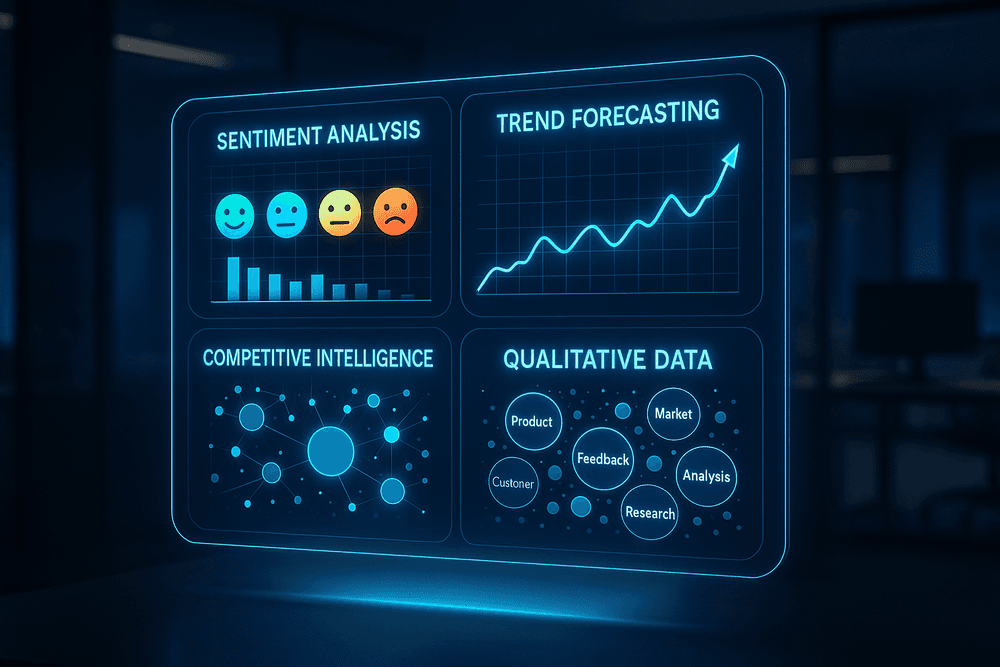
The landscape of AI-powered market research isn't a single, monolithic solution. Instead, it’s a vibrant ecosystem of specialized tools designed to tackle specific challenges. Understanding these core categories is the first step toward building a powerful research stack that delivers actionable intelligence. By identifying your primary needs, you can select the right AI tools for market research to gain a decisive competitive edge.
AI-Driven Consumer Sentiment Analysis
Gone are the days of relying solely on star ratings and survey scores. Sentiment analysis tools use Natural Language Processing (NLP) to dig into the why behind consumer opinions. These platforms scan millions of data points from social media posts, online reviews, support tickets, and news articles to gauge public perception of your brand, products, or campaigns.
Instead of just telling you that 75% of reviews are positive, these AI tools can identify the specific features customers love, the pain points that lead to negative feedback, and the nuanced emotions (like frustration, delight, or confusion) associated with their experience. This provides a real-time pulse on brand health, allowing you to quickly address emerging issues or double down on what’s working.
Platforms for Predictive Market Trend Forecasting
While traditional research tells you what happened in the past, predictive AI tools focus on what’s likely to happen next. By analyzing vast datasets—including historical sales figures, search query volumes, social media conversations, and macroeconomic indicators—machine learning algorithms can identify emerging patterns and forecast future market trends with remarkable accuracy.
These AI tools for market research empower businesses to move from a reactive to a proactive stance. You can anticipate shifts in consumer demand, identify nascent product categories before they hit the mainstream, and optimize marketing spend by aligning campaigns with upcoming trends. This foresight is invaluable for strategic planning, product development, and inventory management.
Solutions for Automated Competitive Intelligence
Manually tracking every move your competitors make is an impossible task. AI-powered competitive intelligence solutions automate this process, acting as your 24/7 market watchtower. These tools continuously monitor competitors’ digital footprints, tracking everything from pricing changes and new product launches to shifts in their digital advertising strategy and social media messaging.
This automated surveillance provides a dynamic view of the competitive landscape. You can receive alerts on a rival's new marketing campaign, analyze their share of voice on key topics, and benchmark your own performance against theirs. For businesses operating in fast-moving industries, these AI tools for market research are essential for spotting threats and seizing opportunities.
AI That Streamlines Qualitative and Survey Analysis
Qualitative data from open-ended survey questions, interviews, and focus groups contains a goldmine of insights, but analyzing it has traditionally been a slow, manual, and subjective process. AI is changing the game by automating the thematic analysis of this unstructured text.
These platforms can rapidly process thousands of responses, automatically identifying and categorizing key themes, common pain points, and emerging customer needs. This allows researchers to move beyond simple word clouds and uncover deep, actionable insights in a fraction of the time. This capability transforms qualitative feedback from a research bottleneck into a source of immediate, data-driven strategic direction.
Core Features to Demand from Your AI Tools for Market Research
The market is now saturated with platforms claiming to leverage artificial intelligence. However, to truly revolutionize your strategy, you must look beyond the buzzwords. The most effective AI tools for market research are not just about processing data faster; they're about uncovering deeper, more actionable insights. When evaluating your options, demand a robust feature set that turns raw information into a competitive advantage. Here are the non-negotiable capabilities to look for.
Natural Language Processing (NLP) for Understanding Customer Voice
At its heart, market research is about understanding people. Natural Language Processing is the technology that allows AI to comprehend, interpret, and derive meaning from human language. This is your key to unlocking the authentic voice of the customer from vast, unstructured sources. An elite AI tool uses NLP to scan thousands of online reviews, social media comments, forum discussions, and customer support tickets in minutes. It goes beyond simple keyword tracking to identify nuanced sentiment, emerging topics, and the emotional drivers behind customer opinions. This allows you to stop guessing what customers want and start listening to what they’re already telling you, at an unprecedented scale.
Predictive Analytics to Forecast Market Shifts
While traditional market research is excellent at explaining what has happened, superior AI tools focus on what will happen. Predictive analytics leverages machine learning algorithms to analyze historical data, identify subtle patterns, and forecast future trends with a remarkable degree of accuracy. This feature transforms your research from a reactive report into a proactive strategic guide. Imagine being able to anticipate shifts in consumer behavior before your competitors do, forecast demand for a new product category, or identify which market segments are poised for growth. This is the power of predictive analytics—it gives you the foresight to make confident, forward-looking decisions instead of just reacting to the past.
Automated Data Visualization and Reporting Dashboards
Complex data is only valuable if it’s understandable. The best AI tools for market research don’t just hand you a spreadsheet; they translate complex findings into intuitive, interactive dashboards. Look for tools that offer automated data visualization, generating clear charts, heatmaps, and graphs that tell a compelling story at a glance. These dashboards should be customizable and update in real-time, providing a live pulse on your market. This capability democratizes data within your organization, empowering team members from marketing to product development to access and act on critical insights without needing a data science degree.
Seamless Integration with CRM and Social Media Platforms
Your market research tool should not exist in a silo. To achieve a 360-degree view of your market and customers, it must integrate seamlessly with the platforms you already use. Essential integrations include CRM systems (like Salesforce or HubSpot) and major social media platforms. By connecting your AI research tool to your CRM, you can enrich customer profiles with real-world sentiment and behavioral data. Integrating with social media allows for direct, real-time analysis of brand conversations and competitor activity. This creates a powerful, interconnected ecosystem where insights flow freely, breaking down data barriers and enabling you to move from analysis to action instantly.
Putting AI to Work: Real-World Use Cases for Market Research
Theory is one thing, but the true power of AI-powered market research is revealed in its real-world application. Moving beyond abstract data points, these tools provide actionable intelligence that drives tangible business growth. Let's explore how leading brands are leveraging AI tools for market research to innovate, optimize, and dominate their respective industries.
Case Study: How a CPG Brand Uncovered a New Market Segment
A well-established snack food company wanted to expand its market share but felt its traditional research methods, like focus groups and surveys, were yielding stale insights. They were stuck targeting the same broad "family-friendly" demographic.
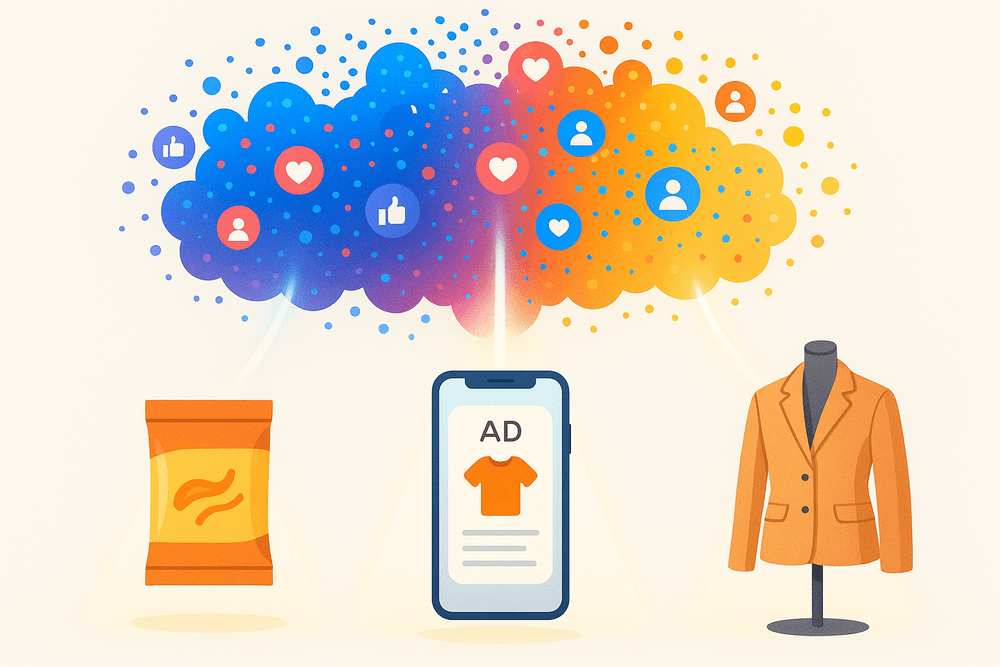
By implementing an AI platform to analyze thousands of unstructured data points from social media, forums, and product reviews, they uncovered a surprising and highly engaged user group: late-night gamers. The AI’s sentiment analysis revealed that this group wasn’t just eating the snacks; they were praising them for specific attributes that the company had never marketed, such as being “low-mess” and providing a “quiet crunch” that wouldn’t be picked up by their gaming headsets.
Armed with this insight, the brand launched a targeted digital campaign featuring gaming influencers and developed a new packaging format for easy, one-handed access. The result was a 15% uplift in sales within six months, all thanks to an AI-driven discovery that traditional methods had completely missed.
Using AI to Optimize Product Launch Messaging
Launching a new product is a high-stakes gamble, and the right messaging can make all the difference. A SaaS company preparing to launch a new project management tool used predictive AI tools for market research to ensure their message would land with maximum impact.
Instead of relying on gut feelings or limited A/B testing, they fed the AI platform data on their target audience, competitor messaging, and industry reports. The AI analyzed this information and generated dozens of value propositions and headline variations. It then simulated audience reception, predicting which concepts would resonate most strongly.
The platform revealed that while the engineering team was proud of the software's "complex algorithmic scheduling," the target audience responded far more positively to messaging around "effortless team alignment" and "automating the tedious tasks you hate." By launching with this AI-optimized messaging, the company achieved a 40% higher click-through rate on its launch ads and exceeded its first-quarter user acquisition goals.
Gaining a Competitive Edge with Real-Time Trend Monitoring
In the fast-paced world of fashion, trends can emerge and fade in a matter of weeks. A mid-sized apparel retailer was struggling to keep up with larger competitors who had massive trend-spotting teams.
They turned to an AI-powered market intelligence tool that monitored social media platforms, blogs, and online publications in real-time. The system was configured to flag emerging keywords, styles, and color palettes that were gaining traction with their target demographic. In early spring, the tool detected a sudden spike in conversations around "utility-style jumpsuits" in a specific shade of olive green.
While competitors were still waiting for quarterly trend reports, this retailer was already in contact with its suppliers. They fast-tracked a small batch production and launched the product online. It sold out in 72 hours. This ability to act on data-driven insights instantly provides a significant competitive advantage, turning market research from a reactive report into a proactive, revenue-generating engine.
Best Practices for Integrating AI Tools Into Your Research Strategy
Adopting powerful ai tools for market research is a significant first step, but it’s not a magic bullet. To truly unlock their potential and drive transformative business results, you need a strategic integration plan. Without a clear framework, even the most advanced technology can lead to confusing data and wasted resources. By following a few key best practices, you can ensure your investment translates into a clear competitive advantage, turning raw data into your most valuable strategic asset.
Define Your 'Why': Start with a Clear Business Question
Before you even explore different platforms, ground your search in a specific business objective. What question are you trying to answer? Are you looking to understand the root cause of customer churn, identify untapped market segments, predict the next big consumer trend, or optimize your pricing strategy? Starting with a well-defined goal focuses your efforts and helps you select the right tool for the job. Vague objectives like "we need more data" are a recipe for failure. A clear mission, such as "Identify the top three drivers of negative sentiment in our online reviews for Product X," gives your AI-powered research a clear direction and a measurable outcome.
Garbage In, Garbage Out: Prioritize High-Quality Data
The insights generated by ai tools for market research are only as good as the data they are fed. The principle of "garbage in, garbage out" is more critical than ever in the age of machine learning. Ensure your data is clean, relevant, and comprehensive. This means breaking down data silos and integrating diverse sources, from your CRM and sales figures to social media conversations, customer support tickets, and survey responses. Invest time in data hygiene—removing duplicates, correcting errors, and standardizing formats. A robust, high-quality dataset is the foundation upon which accurate, reliable, and game-changing AI insights are built.
Empower Your People: Train for Insight, Not Just Data
Technology doesn't replace human expertise; it augments it. Your team is the crucial link between AI-generated reports and actionable strategy. Invest in training that goes beyond just learning the software's interface. Empower your market researchers, analysts, and marketers to critically interpret AI outputs. Teach them to ask the right questions, spot potential biases in the data, and connect the dots between a statistical finding and a real-world business opportunity. A culture of data literacy and critical thinking will ensure that your team can confidently translate complex AI analysis into clear, compelling, and effective business actions.
Track Your Impact: Measure the ROI of Your AI Investment
To justify the ongoing investment in ai tools for market research, you must demonstrate their value. Define your key performance indicators (KPIs) before full-scale implementation. Are you aiming to reduce the time it takes to complete a research project, increase the conversion rate of marketing campaigns, improve customer satisfaction scores, or accelerate product innovation? Track these metrics rigorously. The ROI isn't just about cost savings; it’s about the quality and speed of your decision-making. By measuring the impact on both efficiency (doing things faster) and effectiveness (making smarter choices), you can build a powerful business case for a continued and expanded role for AI in your research strategy.

Conclusion: The Future of Insight-Driven Decisions
The era of manual data sifting and gut-feel decision-making is officially over. As we've explored, the landscape of market research has been irrevocably transformed by artificial intelligence. The ability to process vast datasets, identify hidden patterns, and understand consumer sentiment in real-time is no longer a futuristic concept—it's a competitive necessity. Businesses that embrace these powerful platforms are not just keeping up; they are setting the pace, turning raw data into a strategic asset that fuels growth, innovation, and customer loyalty. The question is no longer if you should adopt AI, but how you can integrate it to build a more agile, informed, and forward-thinking organization.
Choosing the Right AI Tool for Your Business
Navigating the crowded market of AI tools for market research can feel daunting, but the perfect fit is out there. The key is to align the technology with your unique operational scale and strategic objectives.
- For Startups and SMBs: Agility is paramount. Look for tools that offer flexible pricing, intuitive user interfaces, and quick setup. Your focus should be on platforms that deliver high-impact insights—like social media sentiment analysis or competitor tracking—without requiring a dedicated data science team.
- For Mid-Sized Companies: As you scale, your needs become more complex. The ideal tool should offer a balance of power and usability, with capabilities for analyzing diverse data sources (e.g., customer reviews, surveys, sales data) and features that support cross-departmental collaboration.
- For Large Enterprises: Your requirements center on scalability, security, and integration. Seek out robust, enterprise-grade platforms that can handle massive data volumes, offer advanced customization, and seamlessly integrate with your existing CRM, BI, and data warehouse systems.
Ultimately, the best choice is a tool that not only solves today's problems but also has the capacity to grow with you as your business evolves.
What's Next: The Evolution of AI in Market Analysis
The revolution is just beginning. The future of AI tools for market research promises even more sophisticated and integrated capabilities. We are moving beyond descriptive and diagnostic analysis into a new frontier of predictive and prescriptive insights. Imagine AI that doesn't just tell you what your customers think now, but accurately forecasts emerging trends and recommends specific marketing campaigns to capitalize on them.
Expect to see generative AI play a larger role, creating detailed consumer personas, simulating market scenarios, and even drafting initial creative briefs based on its findings. This evolution will make market intelligence a proactive, continuous, and deeply embedded part of business strategy, closing the gap between insight and action entirely.
Get Started on Your AI-Powered Journey
Are you ready to stop guessing and start knowing? The power to understand your market with unparalleled clarity and speed is within reach. Take the next step to transform your decision-making process from reactive to revolutionary.
Book a personalized demo to see our platform in action and discover how AI-driven insights can unlock your business's full potential.
Download our free guide, "The Essential Checklist for Choosing Your AI Market Research Tool," to equip yourself with the framework for making a confident, informed decision.