
November 6, 2025
Why the Old Way of Reading Medical Literature is Broken (And
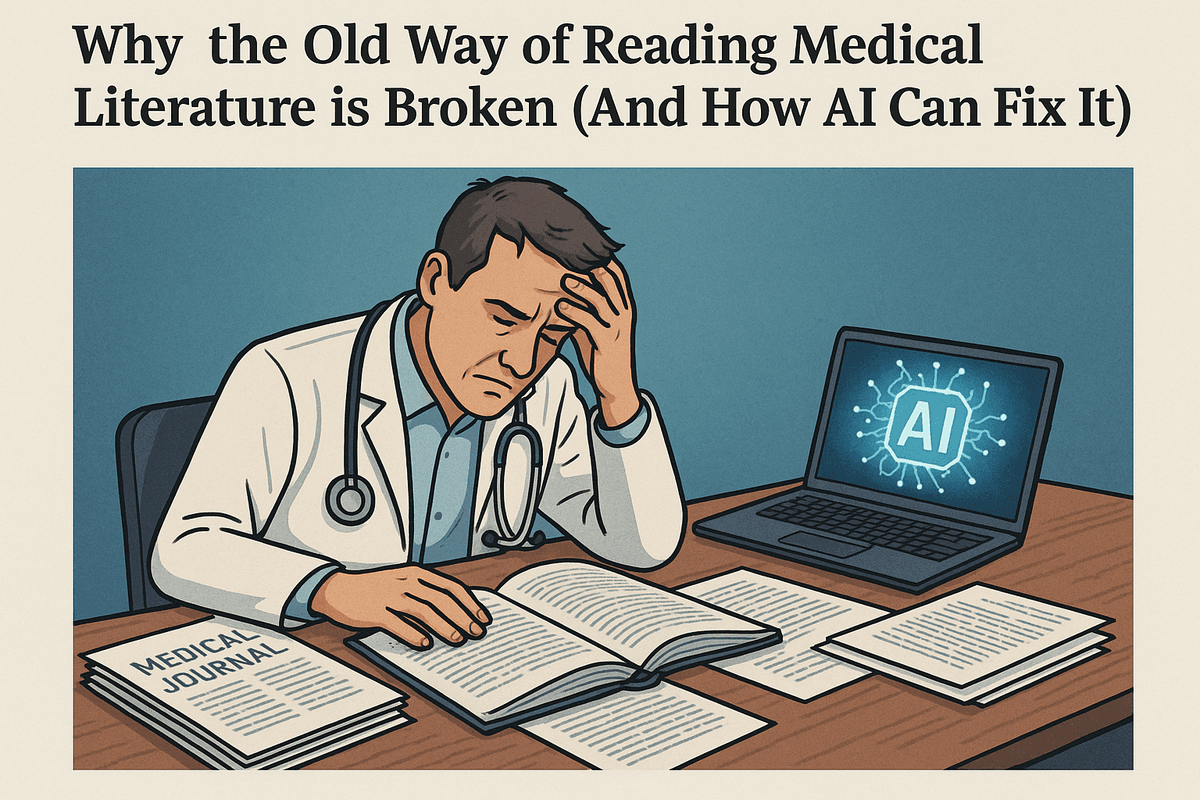
Why the Old Way of Reading Medical Literature is Broken (And How AI Can Fix It)
For centuries, the foundation of medical progress has been the scholarly article. But the sheer volume of research published today is threatening to crack that foundation. Every year, millions of new biomedical papers are published on platforms like PubMed, creating a relentless tsunami of data. For the dedicated clinician trying to stay current or the researcher working on a breakthrough, keeping up has moved from being a challenge to a practical impossibility. This is the information overload problem, and it’s a critical bottleneck in modern medicine.
The Information Overload Problem in Medicine
The traditional literature review process—manually searching databases, screening titles and abstracts, and painstakingly reading full-text articles—was designed for a different era. Today, this manual approach is too slow and too narrow. Clinicians risk practicing with outdated information simply because the latest evidence is buried in a mountain of unread papers. Researchers can spend months, not weeks, on literature reviews, delaying critical projects and potentially duplicating work that has already been done.
The consequences are significant:
- Delayed Adoption of Best Practices: Promising new treatments or diagnostic methods can take years to become standard care because the supporting evidence is dispersed and difficult to synthesize.
- Research Inefficiency: Valuable time and funding are wasted on redundant studies and slow, laborious background research.
- Clinician Burnout: The pressure to stay informed adds another layer of stress to an already demanding profession.
What is Medical Literature AI? A Plain-English Explanation
This is where medical literature AI steps in, not as a replacement for human intellect, but as a powerful amplifier. In simple terms, medical literature AI refers to specialized artificial intelligence tools designed to read, understand, categorize, and synthesize vast quantities of biomedical text at superhuman speed. Think of it as a team of tireless, expert research assistants who can process an entire library of studies in the time it takes you to drink your morning coffee.
These systems leverage advanced technologies like Natural Language Processing (NLP), which allows them to comprehend the complex language, jargon, and structure of scientific papers. They can differentiate between a study’s methodology, its patient population, the interventions used, and the outcomes reported. By transforming unstructured text from thousands of articles into structured, analyzable data, this technology fundamentally changes how we interact with medical knowledge.
Beyond Speed: The Promise of Deeper Insights
The most exciting aspect of medical literature AI isn't just its speed—it's the depth of understanding it unlocks. While a human can compare a handful of studies, an AI can analyze tens of thousands simultaneously, revealing patterns and connections that are invisible to the naked eye.
This capability moves us beyond simple summarization to genuine discovery. A medical literature AI platform can:
- Identify Hidden Trends: Pinpoint emerging correlations between a specific gene and a drug’s side effects across hundreds of disparate clinical trials.
- Uncover Research Gaps: Systematically map out what is known about a topic and, more importantly, what isn't, guiding future research efforts more effectively.
- Synthesize Contradictory Evidence: Analyze conflicting study results to hypothesize why they differ, perhaps due to subtle variations in patient cohorts or methodologies.
By turning an overwhelming flood of information into a strategic asset, medical literature AI promises to accelerate discovery, sharpen clinical decision-making, and build a more robust foundation for the future of evidence-based medicine.

Core Use Cases: Putting Medical Literature AI to Work
The theoretical power of artificial intelligence becomes truly transformative when applied to real-world challenges. For researchers and clinicians drowning in a sea of publications, medical literature AI is not just a concept—it's a practical toolkit for navigating, understanding, and utilizing scientific knowledge more effectively. These tools are fundamentally changing workflows, accelerating discovery, and bringing evidence-based medicine closer to the point of care. Here are the core use cases making an immediate impact.
Accelerating Systematic Reviews and Meta-Analyses
Systematic reviews are the cornerstone of evidence-based medicine, but their manual execution is notoriously slow and labor-intensive, often taking months or even years. Researchers must manually screen thousands of abstracts and full-text articles against strict inclusion and exclusion criteria.
A medical literature AI platform automates the most grueling stages of this process. Using advanced Natural Language Processing (NLP), these tools can:
- Screen thousands of titles and abstracts in minutes, flagging relevant studies with high accuracy.
- Apply inclusion/exclusion criteria consistently, reducing human error and bias.
- Extract key data points automatically, such as patient demographics, interventions, controls, and outcomes (PICO), populating data extraction forms instantly.
By handling the heavy lifting of screening and data extraction, AI frees up researchers to focus on higher-level tasks like quality appraisal and evidence synthesis, dramatically shortening the timeline from research question to publication.
Summarizing Complex Clinical Studies in Seconds
Busy clinicians rarely have time to read a 20-page clinical trial report between patient appointments. Yet, staying current with the latest evidence is critical. AI-powered summarization tools bridge this gap by distilling dense, jargon-filled articles into digestible insights. Instead of just pulling out key sentences (extractive summarization), modern platforms use generative AI to create novel, human-like summaries (abstractive summarization) that highlight a study's core findings, methodology, and clinical implications. This allows a healthcare professional to grasp the essence of a new study in under a minute, making it feasible to stay informed on the go.
Identifying Research Gaps and Emerging Trends
How can a research team know where to focus its efforts next? Manually analyzing the entire body of literature in a field to find unexplored niches is nearly impossible. Medical literature AI excels at this "big picture" analysis. By processing tens of thousands of papers simultaneously, these systems can perform topic modeling and citation analysis to:
- Visualize research hotspots where funding and publications are concentrated.
- Identify "cold spots" or research gaps where crucial questions remain unanswered.
- Track emerging trends, such as novel biomarkers, new therapeutic targets, or rising interest in a specific intervention.
This provides an invaluable strategic advantage, helping researchers formulate novel hypotheses and direct funding toward areas with the greatest potential for impact.
Enhancing Evidence-Based Clinical Decision-Making
Ultimately, the goal of medical research is to improve patient outcomes. AI acts as a powerful catalyst in translating research into practice. When faced with a complex clinical question at the bedside, a physician can use a medical literature AI tool as a "clinical research assistant." By posing a specific query—for example, "What is the latest evidence on using SGLT2 inhibitors for heart failure in non-diabetic patients?"—the AI can rapidly scan, synthesize, and present the most relevant and high-quality evidence. This provides immediate, data-driven support for clinical decisions, ensuring that patient care is aligned with the most current scientific understanding.
Choosing Your Toolkit: What to Look for in a Medical Literature AI
Selecting the right medical literature AI is like choosing a new stethoscope—it needs to be reliable, accurate, and a natural fit for your workflow. With a growing number of platforms available, it’s crucial to look beyond the flashy marketing and evaluate the core functionalities that will truly accelerate your research and clinical practice. Here’s what to prioritize.
Core Capabilities: Summarization vs. Synthesis vs. Search
Not all AI tools are created equal. Their primary functions can be categorized into three distinct, though often overlapping, capabilities. Understanding these differences is the first step in finding the tool that matches your needs.
- AI-Powered Search: This is the foundational layer. Think of it as a supercharged PubMed or Google Scholar. Instead of just matching keywords, a sophisticated medical literature AI uses natural language processing to understand the intent behind your query. You can ask complex clinical questions like, "What are the latest non-hormonal treatments for vasomotor symptoms in perimenopausal women?" and get a list of highly relevant papers, not just documents containing those exact words.
- Summarization: This feature focuses on condensing a single document. A good summarization tool can instantly extract the PICO (Patient, Intervention, Comparison, Outcome) elements, methodology, key findings, and limitations from a dense 20-page study. This is invaluable for quickly triaging papers to decide which ones warrant a full read.
- Synthesis: This is the most advanced and powerful capability. Synthesis involves drawing insights from multiple sources simultaneously. A top-tier medical literature AI can analyze dozens of papers to answer your clinical question, highlight consensus, point out conflicting evidence, and identify trends or gaps in the research. This is the function that transforms the tool from a simple time-saver into a true partner in evidence synthesis and literature reviews.
Evaluating Accuracy: The Guardrails of Trust
In medicine, accuracy is non-negotiable. An AI that provides incorrect or fabricated information is worse than no AI at all. When evaluating a platform, scrutinize its commitment to accuracy.
- Verifiable Citations: The single most important feature for ensuring trust is transparent and accurate source attribution. The AI must provide direct, in-line citations for every claim it makes, with links that take you straight to the corresponding section of the source paper. Without this, you cannot verify the information.
- Managing "Hallucinations": AI models can sometimes "hallucinate"— confidently state fabricated facts or invent citations. Test the platform rigorously. Ask it questions where you already know the answer. Check if its cited sources actually contain the information it claims they do. A reliable medical literature AI will have been specifically trained on medical data to minimize these errors and should be transparent about its limitations.
Seamless Integration with Your Research Workflow
The best tool is one you’ll actually use. A powerful AI that disrupts your established process will quickly be abandoned. Look for platforms that integrate smoothly with the tools you already rely on. Key integrations to look for include support for reference managers like Zotero, Mendeley, and EndNote. The ability to directly export summaries, synthesized answers, and source lists to your reference library can save hours of manual data entry and streamline the entire literature review process.

Best Practices: Getting Accurate & Actionable Results
Harnessing the power of AI for medical literature analysis is transformative, but the quality of the output is directly tied to the quality of your input and oversight. Like any sophisticated instrument, a medical literature AI requires skilled handling to produce reliable results. Adhering to best practices ensures that you move beyond simple summaries to generate insights that are accurate, actionable, and ethically sound.
Crafting Precise Prompts for Targeted Analysis
The principle of "garbage in, garbage out" is especially true for AI. Vague prompts yield vague answers. To get targeted results, you must treat the AI as a highly capable but literal-minded research assistant. Precision is paramount.
Instead of a broad query like, "What's new in cardiology?" craft a detailed, specific prompt:
- Weak Prompt: "Summarize studies about heart failure."
- Strong Prompt: "Generate a summary of randomized controlled trials published between 2020 and today on the efficacy of SGLT2 inhibitors for treating heart failure with preserved ejection fraction (HFpEF), focusing on outcomes related to hospitalization rates and patient-reported quality of life."
This level of detail—specifying study type (RCTs), date range, drug class (SGLT2 inhibitors), specific condition (HFpEF), and desired outcomes—guides the AI to filter out irrelevant information and deliver a concise, relevant analysis. Effective prompting is the cornerstone of successful medical literature ai analysis, saving you hours of manual filtering.
The Human-in-the-Loop: Why Expert Verification is Crucial
Think of AI as a brilliant co-pilot, not the pilot. It can navigate vast databases of information at incredible speeds, but the final clinical judgment must remain with the human expert. AI models can sometimes "hallucinate"—generating plausible but factually incorrect statements or even fabricating citations.
Your role as the human-in-the-loop is non-negotiable for several reasons:
- Accuracy Check: Always cross-reference the AI's summaries and key findings with the original source articles. Did the AI miss a critical limitation mentioned in the study's discussion section? Did it misinterpret a statistical nuance?
- Contextual Interpretation: AI lacks real-world clinical experience. It can identify a trend, but you are the one who understands its relevance to a specific patient population or its place within the broader landscape of clinical care.
- Nuance and Subtlety: Medical literature is filled with subtlety. An AI might not grasp the cautious tone of an author or the exploratory nature of a sub-group analysis.
This expert validation step transforms AI-generated data into trustworthy clinical intelligence, which is essential when using medical literature ai for patient care decisions or high-stakes research.
Staying Compliant: Navigating Copyright and Data Privacy
Integrating AI into your workflow requires careful attention to legal and ethical boundaries. The two primary areas of concern are copyright and data privacy.
- Copyright and Fair Use: Be mindful of how you use AI-generated content. Many academic journals are protected by strict copyright. Use AI tools that are designed to operate ethically, either by drawing from open-access sources or by analyzing literature you already have legal access to via institutional subscriptions. Avoid copying and pasting AI summaries directly into publications; always synthesize the information and cite the original sources.
- Data Privacy (HIPAA): This is a critical red line. Never input any Protected Health Information (PHI) into a public, non-secure AI platform. If your analysis involves cross-referencing literature with internal case notes or patient data, you must use an enterprise-grade, HIPAA-compliant medical literature ai platform designed for healthcare environments.
By staying vigilant about these compliance issues, you can leverage the power of AI responsibly, maintaining professional integrity and protecting patient privacy.
Real-World Impact: Medical Literature AI Success Stories
The theoretical promise of artificial intelligence is compelling, but its true value is measured in tangible outcomes. Across the healthcare spectrum, from research labs to hospital bedsides, medical literature AI is no longer a futuristic concept but a practical tool delivering transformative results. These success stories highlight how AI is accelerating discovery, streamlining development, and ultimately, improving human health.
Case Study: How AI Helped Accelerate Rare Disease Research
For the millions affected by rare diseases, time is a critical factor. The research process is often hampered by information that is sparse and scattered across decades of scientific publications. A consortium focused on a rare neurodegenerative disorder faced this exact challenge. They deployed a medical literature AI platform to analyze over 2 million research papers, patient forums, and genomic databases.
Where human teams would spend years manually sifting through data, the AI identified a previously overlooked correlation between a specific genetic mutation and a cellular pathway detailed in cancer research. This non-obvious connection, unearthed in minutes, provided a novel therapeutic target. The AI-driven insight allowed researchers to bypass months of preliminary work and move directly to targeted experiments, dramatically accelerating the search for a viable treatment and offering new hope to patients.
Use Case: A Pharmaceutical Company's Approach to Drug Discovery
The pharmaceutical industry faces immense pressure to innovate while controlling staggering R&D costs. One leading pharma company integrated a sophisticated medical literature AI tool into its early-stage drug discovery pipeline. The platform continuously scans, ingests, and understands millions of documents, including preclinical studies, clinical trial data, and patent filings.
Instead of relying solely on periodic manual reviews, their research teams now receive real-time intelligence. The AI automatically maps competitive landscapes, identifies "white spaces" for innovation, and flags promising biomarkers mentioned in emerging literature. In one instance, the system alerted them to a compound being studied for an inflammatory condition that showed strong potential for an entirely different autoimmune disease based on newly published mechanistic data. This enabled them to pivot their strategy and pursue a high-potential drug repurposing opportunity, saving an estimated two years and millions in research costs.
In the Clinic: Improving Patient Outcomes with Faster Evidence Retrieval
For clinicians on the front lines, evidence-based medicine is the gold standard, but keeping up with the torrent of new studies is nearly impossible. A large hospital system implemented an AI-powered clinical decision support tool directly into its electronic health record (EHR) system. This tool is a prime example of medical literature AI in action.
When a physician treats a patient with a complex, multi-symptom presentation, they can pose a clinical question in plain language, such as, "What are the latest treatment guidelines for a diabetic patient with recurring kidney infections and penicillin allergy?" Within seconds, the AI synthesizes the most relevant, high-quality evidence from journals and clinical guidelines, presenting a concise, actionable summary with links to the source articles. This immediate access to vetted information empowers doctors to make faster, more accurate decisions at the point of care, leading to improved patient safety and better treatment outcomes.

The Future of Research: What's Next for Medical Literature AI?
The current capabilities of medical literature AI are already transformative, but we are only at the beginning of this technological revolution. The journey from simply managing information to actively shaping the future of medicine is well underway. As these tools become more sophisticated, their role will expand from assistant to an indispensable partner in discovery and care.
From Analysis to Prediction: The Next Frontier
The next evolution of medical literature AI is the leap from analysis to prediction. While current tools excel at summarizing and synthesizing existing knowledge, future platforms will focus on forecasting trends, identifying hidden connections, and generating novel hypotheses. Imagine an AI that doesn't just review clinical trial data but predicts the likelihood of a new drug's success based on preclinical literature and molecular data.
We are moving toward systems that can:
- Forecast Disease Outbreaks: By analyzing global research, news, and clinical reports in real-time, AI can identify patterns that signal a potential epidemic long before it becomes a crisis.
- Identify Novel Drug Targets: AI can scan millions of articles to find undiscovered links between genes, proteins, and diseases, suggesting new avenues for therapeutic development that humans might miss.
- Personalize Treatment Pathways: By continuously monitoring emerging literature, a medical literature AI could recommend adjustments to a patient's treatment plan based on the very latest evidence relevant to their specific condition and genetic profile. This predictive power will accelerate the pace of innovation and bring personalized medicine to a new level of precision.
Final Checklist: Are You Ready to Adopt Medical Literature AI?
Integrating a new technology can seem daunting. Before you dive in, use this checklist to assess your readiness and set yourself up for success.
- ☐ You have a clear objective. Do you want to speed up your literature reviews, stay current in your field, or find gaps in existing research? Knowing your goal helps you choose the right tool.
- ☐ You understand AI is an augmenter, not a replacement. Are you prepared to use AI as a powerful assistant while applying your own critical thinking and expertise to validate its outputs?
- ☐ You are open to adjusting your workflow. Adopting medical literature AI requires a willingness to experiment and integrate a new step into your research or clinical practice process.
- ☐ You value speed and efficiency. Are you looking for a way to cut down the hours spent on manual searches and reading, freeing up time for higher-level analysis and patient care?
- ☐ You are committed to ethical use. Do you recognize the importance of verifying AI-generated summaries and ensuring that patient data privacy is respected at all times?
If you answered "yes" to most of these points, you are in a prime position to benefit from this technology.
Getting Started: Your First Step into AI-Powered Research
Embracing medical literature AI doesn't require a complete overhaul of your methods. The key is to start small and build confidence.
- Choose a User-Friendly Tool: Begin with a tool that has a low barrier to entry, such as an AI-enhanced search engine or a dedicated summarization platform. Many offer free trials.
- Test it on a Familiar Topic: Run a query on a subject you know inside and out. This allows you to critically evaluate the quality of the AI's results and understand its strengths and weaknesses.
- Focus on a Single Task: Assign the AI one specific job. For example, ask it to summarize the three most recent review articles on a particular topic or to identify the key methodologies used in a landmark study.
- Compare and Contrast: Run a traditional literature search alongside an AI-powered one. Compare the time taken, the relevance of the results, and the insights gained. This simple exercise will quickly demonstrate the value AI brings to the table.