
June 29, 2025
Why Every Business Needs an AI Ethics Framework Today
Why Every Business Needs an AI Ethics Framework Today
As artificial intelligence transitions from a futuristic concept to a fundamental business tool, its power to create value is matched only by its potential to cause harm. Companies are rushing to deploy AI for everything from customer service to product development, but many are doing so without a crucial safety net. This is where a formal AI ethics framework becomes not just a "nice-to-have," but an absolute necessity for survival and success in the modern digital landscape.
What is an AI Ethics Framework (and What It's Not)?
At its core, an AI ethics framework is a structured system of guidelines, principles, and governance processes that steer the responsible design, development, and deployment of artificial intelligence. Think of it as a constitution for your company's AI initiatives, ensuring they align with your core values and societal expectations. It provides a common language and a clear set of standards for everyone involved—from data scientists and engineers to marketing and legal teams.
However, it’s critical to understand what it is not:
- It’s not a one-time checklist. A robust framework is a living document, designed to evolve alongside technology and regulations.
- It’s not just a vague values statement. It must be operational, with clear procedures for review, risk assessment, and accountability.
- It’s not a substitute for legal compliance. Instead, it complements legal requirements, helping you go beyond the letter of the law to build truly trustworthy systems.
The Rising Stakes: Navigating AI's Ethical Minefield
We are no longer in the realm of hypotheticals. Every day brings new stories of AI systems perpetuating bias in hiring, creating privacy nightmares, or making opaque decisions that profoundly impact people's lives. Operating without a clear ethical compass is like navigating a minefield blindfolded.
The risks of getting it wrong are immense and multifaceted. They include:
- Reputational Damage: A single ethical lapse can erode decades of customer trust, leading to public backlash and brand erosion.
- Legal and Regulatory Penalties: Governments worldwide are enacting stringent regulations like the EU's AI Act, with steep fines for non-compliance.
- Operational Failures: Biased or unreliable AI models don't just create ethical problems—they deliver poor business outcomes, from flawed market predictions to discriminatory loan approvals.
Without an AI ethics framework, your organization is left reacting to crises rather than preventing them, a position no business can afford to be in.
Beyond Compliance: The Tangible Business Benefits of Proactive AI Governance
While risk mitigation is a powerful motivator, the true value of an AI ethics framework lies in the competitive advantages it unlocks. Proactive AI governance is a strategic enabler that drives significant business benefits.
- Enhanced Customer Trust and Loyalty: In a crowded market, demonstrating a verifiable commitment to ethical AI is a powerful differentiator. Customers are more likely to engage with and remain loyal to brands they perceive as responsible.
- Attraction and Retention of Top Talent: The best and brightest minds in AI want to work on projects that have a positive impact. A public commitment to ethics makes your company a magnet for top-tier talent who are increasingly mission-driven.
- Superior Innovation and Product Quality: Embedding ethical considerations into the design process forces teams to think more critically about their creations. This leads to more robust, resilient, and human-centric products that better serve a wider range of users.
- Increased Investor Confidence: As environmental, social, and governance (ESG) criteria become central to investment decisions, a strong AI ethics framework signals stability, foresight, and long-term viability to stakeholders.
The Core Components of a Robust AI Ethics Framework
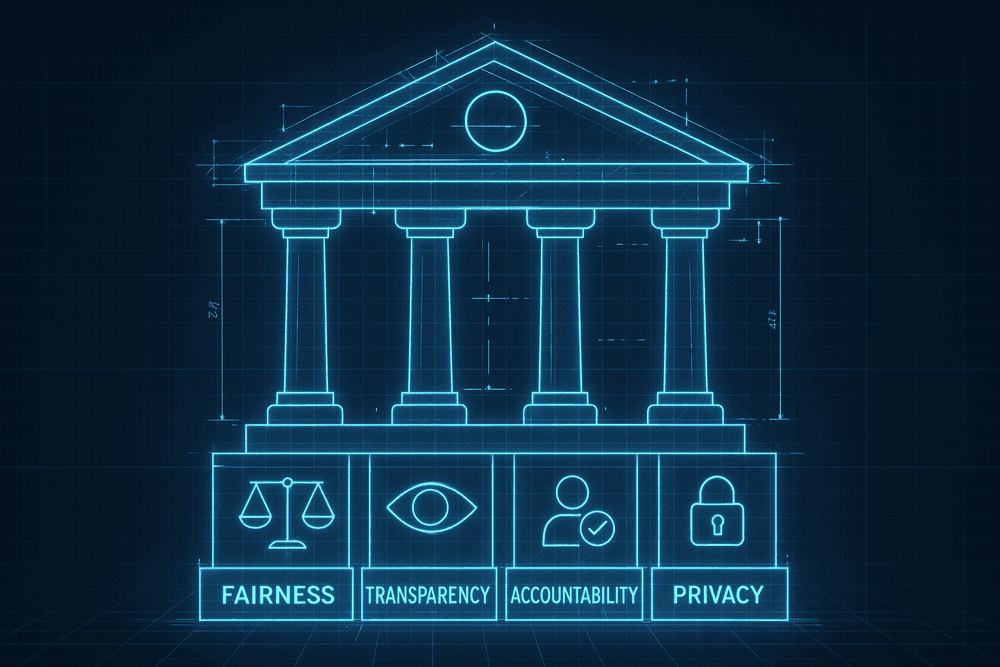
An effective AI ethics framework isn’t a vague mission statement; it’s a structured, actionable guide built on four foundational pillars. These components work in tandem to create a comprehensive system of governance that moves your organization from simply using AI to deploying it responsibly. Neglecting any one of these pillars leaves your framework vulnerable and undermines the trust you aim to build with users, stakeholders, and regulators. Let's break down the essential architecture of a successful framework.
Pillar 1: Fairness and Bias Mitigation in AI Algorithms
At its core, AI learns from data. If that data reflects historical or societal biases, the AI will not only learn but also amplify those prejudices at an unprecedented scale. Fairness is the commitment to proactively identifying and correcting these biases to ensure AI systems produce equitable outcomes for all user groups, regardless of race, gender, age, or other protected characteristics.
Implementing this pillar involves:
- Auditing Datasets: Scrutinizing training data for skewed representation or historical inequalities.
- Using Bias Detection Tools: Employing specialized software during the model development lifecycle to flag potential biases.
- Algorithmic Adjustments: Implementing techniques like re-weighing data points or applying fairness constraints directly to the algorithm. A robust AI ethics framework mandates these practices to prevent discriminatory outcomes that can damage brand reputation and lead to serious legal consequences.
Pillar 2: Transparency and Explainability (XAI)
Trust is impossible without understanding. The "black box" problem—where even developers don't fully understand an AI's decision-making process—is a major obstacle to ethical deployment. This pillar addresses that challenge head-on.
- Transparency means being clear about when and how an AI system is being used. Users have a right to know if they are interacting with a chatbot or if an AI is making a decision that affects them.
- Explainability (XAI) goes deeper, focusing on the ability to articulate why an AI model made a specific decision. Techniques like LIME (Local Interpretable Model-agnostic Explanations) and SHAP (SHapley Additive exPlanations) help translate complex calculations into human-understandable terms. This is critical for debugging, appealing decisions, and satisfying regulatory requirements like GDPR's "right to explanation."
Pillar 3: Accountability and Clear Human Oversight
An algorithm cannot be held accountable for its actions, but the organization that deploys it can. This pillar establishes clear lines of responsibility for the entire AI lifecycle. Your AI ethics framework must define who is answerable for an AI's performance, who is responsible for monitoring its outputs, and who has the authority to intervene or shut the system down.
This is often implemented through a "human-in-the-loop" (HITL) model, where a person is directly involved in the decision-making process, especially for high-stakes applications like medical diagnoses or loan approvals. At a minimum, "human-on-the-loop" oversight is necessary, where individuals actively monitor the system's performance and can step in when needed. This ensures that final authority and moral responsibility remain firmly in human hands.
Pillar 4: Data Privacy, Security, and User Consent
AI models are fueled by data, making data governance a cornerstone of any AI ethics framework. This pillar is about respecting user autonomy and safeguarding their information. It encompasses several key practices:
- Data Minimization: Collecting only the data that is strictly necessary for the AI's intended function.
- Anonymization and Pseudonymization: Stripping personally identifiable information (PII) from datasets to protect user privacy.
- Robust Security: Implementing state-of-the-art cybersecurity measures to protect data from breaches.
- Informed Consent: Obtaining clear, explicit, and ongoing permission from users to collect and use their data, and providing simple ways for them to revoke that consent.
How to Build and Implement Your AI Ethics Framework: A Step-by-Step Guide
Moving from abstract ideals to a concrete, operational AI ethics framework requires a deliberate and structured approach. It’s a strategic initiative that embeds responsibility directly into your organization's DNA. By following these four essential steps, you can create a robust framework that not only mitigates risk but also builds trust with your customers and stakeholders.
Step 1: Assemble a Cross-Functional AI Ethics Committee
Your journey to responsible AI begins with people, not code. An effective AI ethics framework cannot be developed in an executive or technical silo; it demands a diversity of perspectives. The first step is to establish a dedicated, cross-functional committee or board responsible for steering this initiative. This group will champion the framework, ensure its practicality, and oversee its implementation.
Your committee should include representatives from:
- Technology & Data Science: The architects of your AI systems who understand their capabilities and limitations.
- Legal & Compliance: The experts who navigate the complex and evolving landscape of data privacy and AI regulations.
- Business & Product Leadership: The strategists who align AI initiatives with company goals and customer needs.
- Ethics & HR: The guardians of your company culture, values, and employee conduct.
- Customer-Facing Roles (e.g., Support, UX): The front-line voices who understand how your AI impacts real people every day.
This diverse team ensures that your framework is not only technically sound and legally compliant but also ethically robust and aligned with your core business values.
Step 2: Conduct an AI Risk and Impact Assessment
With your committee in place, you must identify what you need to protect against. You cannot build an effective AI ethics framework without first understanding your specific vulnerabilities. An AI Risk and Impact Assessment is a systematic process to proactively identify, analyze, and evaluate potential ethical pitfalls and societal consequences related to your AI systems.
Focus your assessment on critical areas such as:
- Bias and Fairness: Where might your data or algorithms perpetuate or amplify existing societal biases related to race, gender, age, or other characteristics?
- Privacy: How do your models collect, use, and protect personal data? Are you providing individuals with sufficient control and transparency?
- Explainability: Can you explain why your AI model made a particular decision? A lack of transparency can erode trust and prevent recourse.
- Accountability: If an AI system causes harm, who is responsible? Clear lines of accountability are crucial.
This assessment provides the essential context needed to tailor your principles and procedures to your unique operational environment.
Step 3: Define and Document Your Organization's Guiding Principles
This is where your abstract goals become concrete commitments. Using the insights from your risk assessment and your core company values, the committee will define and articulate the guiding principles of your AI ethics framework. These principles are the foundation upon which all your AI development and deployment will be built.
Aim for principles that are clear, memorable, and actionable. Common pillars include:
- Fairness: A commitment to proactively identifying and mitigating harmful bias.
- Accountability: Taking ownership of AI system outcomes and establishing clear oversight.
- Transparency: Being open about where and how AI is used and making decisions understandable.
- Human-Centricity: Designing AI to augment human potential with meaningful human control.
- Privacy & Security: Embedding robust data protection and security measures into the entire AI lifecycle.
Crucially, these principles must be formally documented and socialized throughout the organization. This document serves as a North Star, empowering every employee to make ethically sound decisions.
Step 4: Create Actionable Procedures for Auditing and Enforcement
Principles without procedures are merely suggestions. The final step is to operationalize your framework by establishing clear processes for implementation, auditing, and enforcement. This is what gives your AI ethics framework teeth and transforms it from a static document into a living, breathing part of your governance.
Your procedures should include:
- Integrated Ethical Review: Build ethics checkpoints directly into your AI development lifecycle.
- Regular Auditing: Schedule periodic reviews of AI systems to ensure ongoing compliance with your principles.
- Reporting & Remediation: Create a safe, clear channel for employees and customers to raise concerns, and define a formal process for investigating and resolving them.
- Ongoing Training: Implement education programs to ensure all relevant employees understand the framework and their role in upholding it.
By translating principles into practice, you foster a culture of accountability where responsible innovation is not just an ideal, but a daily operational reality.

Putting Theory into Practice: Real-World AI Ethics Framework Examples
Developing an AI ethics framework on paper is a critical first step, but its true value is realized only through consistent, real-world implementation. Moving from abstract principles to concrete actions separates leading organizations from those who merely pay lip service to responsible AI. Let's examine how successful organizations have deployed their frameworks and the common pitfalls others have faced.
Case Study: How Salesforce Implemented Its Trusted AI Framework
Salesforce, a pioneer in CRM technology, recognized early that customer trust in AI was paramount. To operationalize this, they didn't just publish a list of values; they built an entire ecosystem around their AI ethics framework.
Their approach is anchored in five "Trusted AI Principles": Responsibility, Accountability, Transparency, Empowerment, and Inclusivity. Here’s how they translate these into practice:
- Dedicated Governance: Salesforce established an Office of Ethical and Humane Use, a dedicated team that provides guidance and oversight across the entire product lifecycle. This ensures that ethical considerations aren't an afterthought but a core part of development.
- Integrated Tools: Rather than leaving ethics to individual interpretation, they embed tools directly into their platform. For instance, their Einstein AI includes "Model Cards," which are like nutrition labels for AI models, transparently explaining a model’s performance, intended use, and potential biases.
- Proactive Review Process: Before any AI-powered feature goes live, it undergoes a rigorous ethical review process. This involves asking tough questions: Could this technology be used to harm? Does it disproportionately affect a certain demographic? This proactive stance helps catch potential issues before they impact customers.
Salesforce’s success demonstrates that an effective AI ethics framework must be a living, breathing part of the organization, supported by dedicated resources, integrated tools, and a culture of accountability.
Case Study: A Healthcare Provider's Approach to Ethical AI in Diagnostics
Consider a large hospital network deploying AI to help radiologists detect early signs of cancer in medical imaging. The stakes are incredibly high, making a robust AI ethics framework non-negotiable.
Their framework is built on a "Patient-First" foundation with four key pillars:
- Clinical Validation and Safety: The AI model undergoes rigorous testing against historical data and in controlled clinical trials, ensuring its accuracy and reliability meet or exceed human benchmarks before deployment.
- Bias Mitigation: The network actively audits its training data to ensure it represents the diverse patient population it serves. They use fairness metrics to check if the model performs equally well across different ages, genders, and ethnicities, preventing diagnostic disparities.
- Explainability and Trust: The system is designed not to give a simple "yes/no" answer but to highlight areas of concern on an image and provide a confidence score. This "clinician-in-the-loop" design empowers radiologists, making the AI a trusted co-pilot rather than an opaque black box.
- Data Privacy: All patient data is anonymized and secured, adhering strictly to HIPAA. The provider may even use federated learning, where the model is trained on-site at different hospitals without sensitive data ever leaving the premises.
Learning from Missteps: Common Pitfalls in Framework Deployment
Even with the best intentions, organizations can stumble when implementing an AI ethics framework. Learning from these common mistakes is crucial for your own success:
- The "Set and Forget" Framework: The biggest error is treating your framework as a static document. AI technology and societal norms evolve rapidly. An ethical framework must be a living document, reviewed and updated annually or whenever a significant new use case emerges.
- Ethics as an Ivory Tower: When an ethics board operates in isolation from engineering and product teams, its recommendations are often seen as impractical or obstructive. Effective frameworks require deep integration, with "ethics champions" embedded within development teams.
- Ignoring Full-Spectrum Diversity: It's not enough to have a diverse ethics committee. You must actively seek input from the communities your AI will impact. Without this, you risk creating solutions that solve a problem for one group while creating a new one for another.
- Treating Ethics as a Checkbox: If the framework is seen merely as a compliance hurdle to clear, its spirit is lost. Leadership must champion ethical AI as a competitive advantage and a cornerstone of brand trust, fostering a culture where every employee feels responsible for its success.
Best Practices for Maintaining and Evolving Your Framework
An AI ethics framework is not a static artifact to be created once and filed away. It is a living, breathing component of your organizational strategy that must adapt to new technologies, business goals, and societal expectations. In the dynamic field of artificial intelligence, a commitment to continuous improvement isn't just good practice—it's essential for long-term success and trustworthiness. This means actively maintaining and evolving your framework to ensure it remains relevant, effective, and resilient.
Fostering a Culture of Responsible AI Through Continuous Training
Your framework’s principles are only as powerful as the people who implement them. A one-time training session is insufficient to build a lasting culture of ethical responsibility. Instead, embed AI ethics into your ongoing professional development programs.
- Role-Specific Education: Move beyond generic presentations. Create tailored training modules for different teams. Data scientists need deep dives into bias mitigation techniques and model explainability, while product managers need to master impact assessments and user-centric ethical design.
- Practical Workshops: Host regular workshops that use real-world case studies and hypothetical dilemmas. This allows teams to practice applying the ai ethics framework in a safe environment, strengthening their critical thinking and decision-making skills.
- Demystify for All: Ensure everyone in the organization, including leadership and non-technical staff, understands the core tenets of your framework. This company-wide literacy fosters a shared vocabulary and collective ownership of responsible AI.
Establishing a Feedback Loop for Ongoing Refinement
Your AI systems will inevitably encounter unforeseen challenges and edge cases once deployed. An effective feedback loop is the critical mechanism for capturing these real-world lessons and using them to strengthen your governance.
- Create Accessible Channels: Establish clear, simple, and safe channels for anyone—from internal engineers to external end-users—to report issues, biases, or ethical concerns. This could include a dedicated email, an anonymous reporting tool, or integrated feedback buttons within AI-powered applications.
- Institute Formal Review Cycles: Schedule regular, cross-functional reviews of your ai ethics framework. This meeting should bring together representatives from legal, technical, product, and ethics teams to discuss recent incidents, feedback, and model performance data.
- Close the Loop: Acting on feedback is paramount. When an issue is raised and a change is made to a model or the framework, communicate that resolution back to the relevant stakeholders. This transparency builds trust and encourages continued engagement, demonstrating that feedback leads to meaningful improvement.
Staying Ahead: Adapting to New AI Regulations and Standards
The legal landscape for AI is rapidly solidifying. Proactively adapting your ai ethics framework to new regulations and standards is crucial for mitigating risk and maintaining a competitive edge.
- Monitor the Regulatory Horizon: Assign a dedicated individual or team to track emerging AI legislation (like the EU AI Act), regulatory guidance, and evolving industry benchmarks. Subscribing to legal tech newsletters and joining industry consortiums are effective ways to stay informed.
- Build a Modular Framework: Design your framework to be flexible. By structuring it in modular components (e.g., data governance, transparency, fairness), you can update specific sections in response to new legal requirements without having to redraft the entire document. This agility ensures you can remain compliant as the regulatory environment changes.
- Turn Compliance into a Differentiator: Don't view regulation as merely a hurdle. Use it as an opportunity to reinforce your commitment to ethics. A framework that already aligns with or exceeds emerging standards signals to customers, partners, and regulators that your organization is a trustworthy leader in the responsible development of AI.

Conclusion: The Future is Ethical—Your Next Steps
The journey toward responsible innovation doesn’t end with a single decision; it begins with a commitment. Throughout this guide, we've navigated the complex but critical landscape of artificial intelligence, establishing that an AI ethics framework is no longer a "nice-to-have" but a foundational pillar for sustainable success and public trust. The future isn't just automated; it's accountable, transparent, and fair. By embedding ethics into your AI strategy from the ground up, you're not just mitigating risk—you're building a competitive advantage and a better future.
A Quick Recap of Your AI Ethics Framework Journey
We started by defining the core principles that anchor any robust AI ethics framework: accountability, fairness, transparency, privacy, and security. We then deconstructed the essential components, moving from abstract ideas to concrete structures like governance bodies, impact assessments, and continuous monitoring protocols.
You've learned that building an effective AI ethics framework is not a one-off task for the legal department. It's a dynamic, cross-functional discipline that involves a deep understanding of your data, collaboration with diverse stakeholders, and a proactive approach to identifying and addressing potential harms before they materialize. This framework is your organization’s compass, guiding every stage of the AI lifecycle—from initial concept to final deployment and beyond.
Your Blueprint for Action: A Downloadable Checklist
Theory is powerful, but action is transformative. To help you translate these principles into practice, we've created a comprehensive checklist designed to kickstart your development process. This step-by-step resource will guide you through the essential questions to ask, stakeholders to involve, and policies to consider. It’s your hands-on tool for building a tailored AI ethics framework that aligns with your organization's unique values and goals.
Don’t wait for regulation to dictate your future. Take the first concrete step today.
[Download Your Free AI Ethics Framework Checklist Now]
How to Champion Responsible AI in Your Organization
Implementing a framework is one thing; fostering a culture of ethical AI is another. Becoming a true champion for responsible AI requires strategy, persistence, and leadership. Here’s how you can lead the charge:
- Educate and Evangelize: Start by sharing what you've learned. Host "lunch and learn" sessions, circulate this article, and translate ethical principles into the language of different departments. Show the product team how fairness improves user experience and the sales team how trust drives customer loyalty.
- Build a Coalition of Allies: You cannot do this alone. Identify and connect with like-minded colleagues in legal, compliance, HR, data science, and engineering. A multi-disciplinary council is essential for creating a holistic and practical AI ethics framework.
- Start with a Pilot Project: Demonstrate value on a smaller scale. Select a low-risk, high-visibility AI project to apply your nascent framework. Document the process, measure the outcomes (like reduced bias or improved model explainability), and use this success story to gain buy-in for broader implementation.
- Integrate, Don't Isolate: Weave ethical checkpoints directly into your existing development workflows, such as Agile or DevOps. Ethics should not be a final gate to pass but a continuous thread woven throughout the entire project lifecycle.
By taking these steps, you move from being a passive observer to an active architect of a more responsible and trustworthy technological future.