
September 15, 2025
Why Effective AI Bias Mitigation Strategies are Crucial for
Why Effective AI Bias Mitigation Strategies are Crucial for Modern Business
Artificial intelligence is no longer a futuristic concept; it’s a core driver of decision-making in the modern enterprise. From automating hiring processes to approving financial loans, AI promises unprecedented efficiency and insight. But this power comes with a critical risk: algorithmic bias. When left unchecked, AI bias can poison your operations, alienate your customers, and expose your business to severe consequences. Implementing robust AI bias mitigation strategies isn't just an ethical imperative—it's a fundamental component of sustainable business strategy.
The Real-World Cost of Ignoring AI Bias
Thinking of AI bias as a purely technical problem is a costly mistake. The consequences are tangible, impacting everything from your balance sheet to your brand's reputation. A hiring algorithm that systematically overlooks qualified candidates from underrepresented groups doesn’t just perpetuate inequality; it actively shrinks your talent pool and weakens your competitive edge.
The fallout from a single biased algorithm can trigger a domino effect:
- Reputational Damage: In today’s hyper-connected world, news of discriminatory practices spreads instantly. A single headline about your biased AI can erode decades of brand trust, leading to customer boycotts and a tarnished public image that is incredibly difficult to repair.
- Financial & Legal Penalties: Regulators are catching up. With frameworks like the EU's AI Act, governments are imposing strict rules on algorithmic fairness. An AI model found to be discriminatory can result in multimillion-dollar fines, class-action lawsuits, and forced operational shutdowns.
- Flawed Business Intelligence: If the AI guiding your strategy is biased, your strategy is built on a foundation of flawed logic. This leads to inaccurate market forecasts, misguided product development, and missed opportunities, ultimately steering your business in the wrong direction.
Understanding the Sources: Where Does AI Bias Originate?
AI bias doesn't spontaneously appear in the code. It’s a reflection—and often an amplification—of deeply ingrained human and societal biases. To effectively mitigate it, you must first understand its origins.
- Biased Training Data: This is the most common culprit. AI models learn from historical data. If your company's past hiring data shows a significant gender imbalance in leadership roles, an AI trained on that data will learn to view male candidates as inherently more suitable for promotion, perpetuating the very cycle you may be trying to break.
- Flawed Algorithm Design: The choices made by developers and data scientists can inadvertently introduce bias. Selecting certain data features while ignoring others or defining a model's "success" metric in a narrow way can create a system that optimizes for an unfair outcome.
- Human Feedback Loops: AI systems often learn and adapt based on user interactions. Consider a recommendation engine that shows high-paying job ads primarily to men. As more men click on these ads, the algorithm’s bias is reinforced, creating a self-fulfilling prophecy where it stops showing these opportunities to women altogether.
A Quick Guide to the Different Types of Algorithmic Bias
Bias can manifest in numerous ways throughout the AI lifecycle. Recognizing these forms is a critical first step in developing targeted AI bias mitigation strategies.
Selection Bias
This occurs when the data used to train the model is not representative of the real-world population it will be used on. A facial recognition system trained predominantly on images of one ethnicity will inevitably have a higher error rate when identifying individuals from other ethnic groups.
Measurement Bias
This arises when the data is collected or measured inconsistently across different groups, or when a proxy is used that is itself biased. For instance, using "prior arrests" as a proxy for "risk of re-offending" is a form of measurement bias, as arrest rates can be influenced by biased policing practices.
Confirmation Bias
A human-centric bias where developers or end-users interpret an algorithm's output in a way that confirms their pre-existing beliefs. This leads them to favor data that supports their hypothesis while ignoring information that challenges it, thereby validating a flawed or unfair model.
Identifying Algorithmic Inequity: A Framework for Auditing Your AI
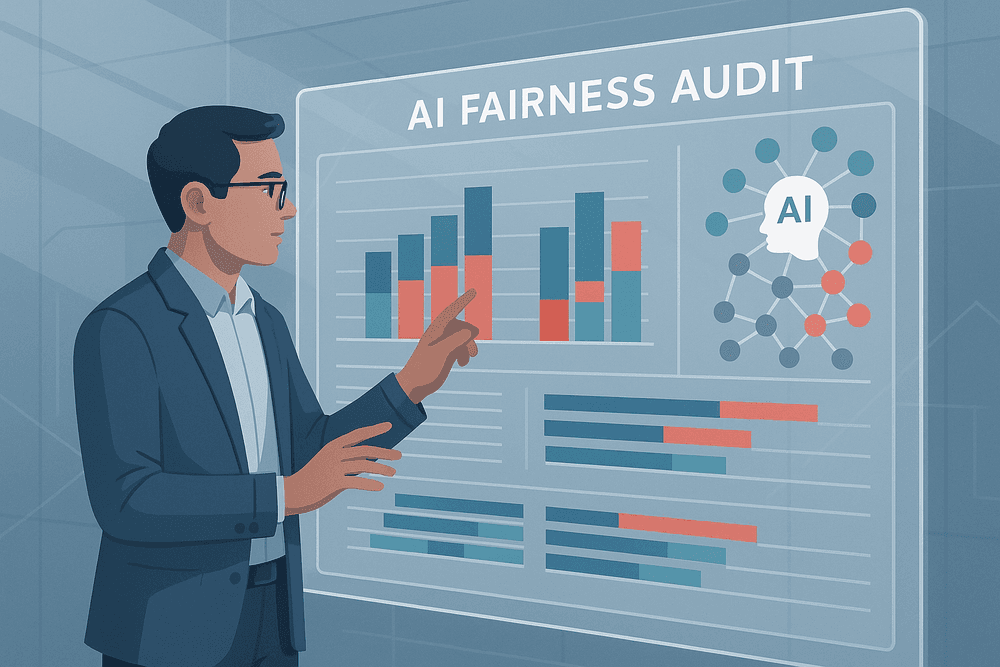
You can't fix a problem you can’t see. Before implementing any ai bias mitigation strategies, you must first systematically identify where and how algorithmic inequity manifests in your systems. An AI fairness audit is not just a technical check; it's a foundational process for building responsible AI. This framework provides a clear path to measure, analyze, and visualize bias, turning abstract concerns into actionable data points.
Key Metrics for Measuring Fairness and Unpacking Bias
Fairness isn't a one-size-fits-all concept. Its definition depends heavily on the social context and intended use of your AI model. Therefore, selecting the right fairness metrics is a critical first step. Here are three of the most common group fairness metrics used to quantify algorithmic bias:
- Demographic Parity (or Statistical Parity): This metric requires that the proportion of positive outcomes (e.g., loan approvals, job offers) is equal across different protected groups (e.g., gender, race). While simple to understand, it can be problematic if the underlying base rates of qualification actually differ between groups.
- Equal Opportunity: This metric focuses on fairness for qualified individuals. It stipulates that the true positive rate should be the same for all groups. In other words, a person who is qualified for a loan should have an equal chance of being approved, regardless of their demographic background. This is often preferred in scenarios like hiring or lending where merit is key.
- Equalized Odds: A stricter version of Equal Opportunity, this metric demands equality for both the true positive rate and the false positive rate across all groups. This ensures that qualified candidates are treated equally and that unqualified candidates are also treated equally, minimizing errors for all populations.
Steps to Conduct a Comprehensive AI Fairness Audit
A systematic audit provides the evidence needed to guide your bias mitigation efforts. Follow these steps to conduct a thorough review of your model’s performance.
- Define Your Fairness Goals: In collaboration with domain experts, ethicists, and stakeholders, determine what "fairness" means for your specific application. Is it more important to ensure equal outcomes for all or equal opportunities for the qualified?
- Identify Protected Attributes and Subgroups: Clearly define the sensitive attributes (e.g., race, age, gender, disability) and the specific subgroups within them that you will be auditing for bias.
- Select and Calculate Metrics: Based on your fairness goals, choose the most appropriate metrics. Use established open-source tools like IBM's AI Fairness 360, Google's What-If Tool, or Microsoft's Fairlearn to systematically compute these metrics for each subgroup.
- Analyze and Document the Disparities: Compare the metric scores across different groups. Pinpoint which groups are being disadvantaged and by how much. A comprehensive report should document your methodology, findings, and the specific areas where bias is most pronounced.
Leveraging Data Visualization to Spot Hidden Biases
Raw numbers and statistical tables can be difficult to interpret. Data visualization transforms complex audit results into intuitive insights, making it easier for both technical and non-technical stakeholders to understand the impact of bias. Effective visualizations are a cornerstone of powerful ai bias mitigation strategies.
- Disaggregated Performance Dashboards: Instead of one overall confusion matrix or accuracy score, create separate ones for each demographic subgroup. This can immediately reveal if your model is significantly more accurate for one group than another.
- Feature Distribution Plots: Create histograms or density plots to see how key input features are distributed across different groups. This can help identify upstream biases in the training data itself.
- Fairness Metric Comparison Charts: Use bar charts to plot the values of your chosen fairness metrics (e.g., true positive rate) for each subgroup side-by-side. These charts provide a clear, immediate visual comparison of performance gaps.
A Deep Dive into Core AI Bias Mitigation Strategies
Tackling bias in AI isn't a single action but a multi-stage process. Effective AI bias mitigation strategies can be applied at three critical points in the machine learning lifecycle: before training (pre-processing), during training (in-processing), and after training (post-processing). Understanding when and how to apply these techniques is key to building fairer systems.
Pre-Processing: Sanitizing and Balancing Your Datasets
The most intuitive and often most impactful approach to fighting bias is to fix the data itself. The principle of "garbage in, garbage out" holds especially true for AI; if your training data reflects historical biases, your model will learn and amplify them. Pre-processing strategies focus on cleaning and rebalancing the dataset before it ever reaches the model.
Key techniques include:
- Re-sampling: This involves altering the composition of the dataset to ensure fair representation. You can use oversampling to duplicate instances from underrepresented groups or undersampling to remove instances from overrepresented groups. The goal is to present the model with a more balanced view of the world.
- Re-weighing: Instead of changing the data, this method assigns different weights to data points. Instances belonging to a minority group are given a higher weight, signaling to the algorithm that they are more important to get right during training.
- Data Augmentation: For certain types of data, like images, you can create new, synthetic data points for underrepresented groups. This enriches the dataset without relying solely on existing, potentially biased, examples.
In-Processing: Adjusting Algorithms for Fairer Outcomes
Sometimes, you can't completely sanitize the data, or pre-processing isn't enough. In-processing techniques modify the learning algorithm itself to reduce bias during the training phase. This approach integrates fairness directly into the model's optimization process.
Common in-processing methods are:
- Fairness Constraints: You can add mathematical constraints to the model's objective function. These constraints penalize the model for making biased decisions, forcing it to find a balance between accuracy and fairness metrics like demographic parity or equal opportunity.
- Adversarial Debiasing: This sophisticated technique involves training two models simultaneously. The primary model (the "predictor") works on the main task (e.g., predicting creditworthiness), while a second "adversarial" model tries to predict a sensitive attribute (e.g., race or gender) from the predictor's output. The predictor is trained to not only be accurate but also to "fool" the adversary, making its predictions independent of the sensitive attribute.
Post-Processing: Calibrating Predictions to Minimize Harm
Post-processing methods are applied after a model has been trained. These are particularly useful when you have a pre-trained "black box" model that you cannot modify or retrain. The focus here is on adjusting the model's outputs or predictions to achieve fairer results. This is the final line of defense in the suite of AI bias mitigation strategies.
A primary technique is:
- Threshold Calibration: Many models output a probability score (e.g., the likelihood of loan default). A standard threshold (e.g., 50%) is used to make a binary decision. Post-processing can involve setting different decision thresholds for different demographic groups to ensure fairness metrics, like an equal rate of loan approvals (equal opportunity), are met across groups. This calibration corrects the final outcome without altering the underlying model.
Top Tools and Frameworks for Implementing Bias Mitigation
Moving from theory to practice requires the right toolkit. While understanding concepts is crucial, hands-on tools are what empower developers and data scientists to implement effective ai bias mitigation strategies. The tech industry's leaders have developed powerful open-source frameworks, and a new ecosystem of startups is emerging to fill the gaps. Here’s a look at the most influential tools you can use today.
IBM's AI Fairness 360 vs. Google's What-If Tool: A Head-to-Head Comparison
Two of the most popular bias mitigation tools come from IBM and Google, but they serve fundamentally different purposes. Choosing the right one depends on whether you need to diagnose or to operate.
IBM AI Fairness 360 (AIF360): The Developer's Toolkit
Think of AIF360 as a comprehensive surgical kit for your machine learning pipeline. This open-source Python library is built for data scientists and engineers who need to programmatically detect and correct bias.
- Core Strength: It provides an extensive collection of over 70 fairness metrics and more than 10 state-of-the-art bias mitigation algorithms.
- How It Works: AIF360 algorithms can be applied at every stage of the model lifecycle:
- Pre-processing: Modifying the training data itself (e.g., Reweighing).
- In-processing: Adjusting the learning algorithm to incorporate fairness constraints.
- Post-processing: Adjusting the model's predictions to improve fairness.
- Best For: Teams that need a powerful, code-first approach to integrate fairness checks and fixes directly into their model development and CI/CD pipelines.
Google's What-If Tool (WIT): The Investigator's Magnifying Glass
If AIF360 is the surgical kit, WIT is the advanced diagnostic dashboard. Integrated into TensorBoard and Jupyter/Colab notebooks, this tool is designed for visual exploration and building intuition about model behavior.
- Core Strength: Its interactive interface allows you to slice and visualize your dataset, compare the performance of multiple models, and edit individual data points to see—as the name suggests—"what if" the input were different.
- How It Works: WIT helps you probe your model by answering questions like, "How does my model's prediction confidence change if I change a user's age?" or "Which data points are most frequently misclassified for a specific demographic group?"
- Best For: Product managers, analysts, and ML engineers who need to understand a model’s fairness implications, identify potential problem areas, and communicate those findings to non-technical stakeholders.
The Verdict: AIF360 is for fixing bias with algorithms. WIT is for finding and understanding it through visualization. They are highly complementary; you might use WIT to identify a fairness issue and then turn to AIF360 to implement a technical solution.
How to Integrate Microsoft's Fairlearn into Your Workflow
Microsoft's Fairlearn sits in a sweet spot, offering both assessment and mitigation in a user-friendly Python package that integrates seamlessly with Scikit-learn. It’s an excellent choice for teams looking for a practical and integrated approach to ai bias mitigation strategies.
- Define Sensitive Features: First, you identify the sensitive attributes in your data (e.g., gender, race) that you want to evaluate for fairness.
- Assess with the Dashboard: Fairlearn’s interactive dashboard allows you to visualize the trade-offs between model performance (like accuracy) and fairness metrics (like Demographic Parity or Equalized Odds). This helps you see exactly how your model impacts different subgroups.
- Apply Mitigation Algorithms: Fairlearn specializes in powerful in-processing mitigation techniques, such as GridSearch and ExponentiatedGradient. These algorithms retrain your model to find one that optimizes for predictive accuracy while staying within fairness constraints you define.
- Compare and Select: The dashboard lets you compare the behavior of your original, unmitigated model against several mitigated versions, helping you choose the best model that aligns with your organization's ethical AI principles.
Emerging Startups in the Responsible AI Space
Beyond the tech giants, a vibrant startup ecosystem is building the next generation of AI fairness and governance tools. These companies often provide enterprise-grade solutions that operationalize responsible AI across an entire organization. Keep an eye on firms specializing in:
- AI Governance and Monitoring: Platforms that offer end-to-end model observability, detecting drift, data quality issues, and fairness regressions in real-time after a model is deployed.
- Third-Party Auditing: Independent services that audit AI systems for bias and compliance with emerging regulations, providing a crucial layer of accountability.
- Fair Synthetic Data Generation: Companies that create high-quality, privacy-preserving synthetic data designed to be balanced from the start, helping to train fairer models from the ground up.
Real-World Use Cases: AI Bias Mitigation Strategies in Action
Theory is one thing, but applying ai bias mitigation strategies in the real world is where the true challenges and successes emerge. By examining practical examples, we can understand how different techniques are deployed to create fairer, more equitable AI systems. From human resources to finance, organizations are actively working to correct algorithmic injustices.
Case Study: Mitigating Gender Bias in a Hiring Algorithm
A major technology firm developed an AI tool to screen resumes and shortlist candidates for engineering roles. Initially, the model showed a significant bias, consistently ranking male candidates higher. The root cause was historical data: the company had predominantly hired men in the past, and the AI learned to perpetuate this pattern.
To correct this, the company implemented a multi-stage mitigation plan:
- Pre-processing: The data science team used a technique called re-weighing. They assigned a higher weight to applications from qualified female candidates in the training data, forcing the model to treat their qualifications as equally important. They also removed gender-coded language and proxies, such as attendance at all-women's colleges.
- In-processing: During the model’s training phase, they introduced "fairness constraints." This involved adding a mathematical rule to the learning process that penalized the model if its predictions showed a statistical disparity between genders, guiding it toward more equitable outcomes.
- Post-processing: After deployment, the firm continuously monitored the algorithm’s outputs using the "equal opportunity" fairness metric. This ensured that the true positive rate (correctly identifying a qualified candidate) was the same for both men and women, preventing the model from drifting back toward its original biased state.
How Financial Institutions are Reducing Bias in Loan Approvals
The financial sector faces immense pressure to use AI for efficiency while adhering to strict fair lending laws. A leading bank discovered its automated loan approval model was disproportionately denying loans to applicants from minority communities, even when their financial profiles were strong.
Their approach to bias mitigation focused on transparency and data integrity:
- Proxy Variable Auditing: The bank conducted a thorough audit to find and remove proxy variables. For instance, certain zip codes, which correlated highly with race, were removed as input features to prevent the model from indirectly using protected characteristics to make decisions.
- Explainable AI (XAI): They integrated XAI frameworks like LIME (Local Interpretable Model-agnostic Explanations) into their workflow. This allowed loan officers to see the top factors contributing to any given AI decision. If a loan was denied, they could verify that the denial was based on legitimate financial criteria (e.g., debt-to-income ratio) and not biased proxies.
- Fairness-Aware Feature Selection: Instead of just choosing features that maximized accuracy, the team used algorithms that selected a combination of features that produced both high accuracy and high fairness scores across different demographic groups.
Lessons Learned: A Look at High-Profile AI Bias Failures
Examining past failures provides crucial insights into what can go wrong.
- Amazon's Scrapped Recruiting Tool: This infamous case taught the industry that simply removing explicit variables like "woman" is insufficient. The AI learned to penalize resumes containing proxies like "women's chess club," proving that effective ai bias mitigation strategies must go deeper than surface-level fixes.
- COMPAS Recidivism Algorithm: The COMPAS system, used to predict the likelihood of a defendant re-offending, was found to have a much higher false positive rate for Black defendants than for white defendants. The lesson here is the critical importance of choosing the right fairness metric; a model can satisfy one definition of fairness (e.g., overall accuracy) while violating another (e.g., equal false positive rates).
- Biased Facial Recognition: Numerous early facial recognition systems showed significantly lower accuracy for women and people of color. This was a direct result of training datasets overwhelmingly composed of white male faces. It serves as a powerful reminder that bias mitigation starts at the very beginning: with inclusive and representative data collection.

Conclusion: Building a Long-Term Strategy for Ethical AI
The journey to fair and equitable AI doesn't end with a single model audit or the application of one debiasing technique. Mitigating bias is an ongoing commitment—a cultural shift that requires robust governance, continuous vigilance, and a proactive mindset. The most effective ai bias mitigation strategies are not one-off fixes but are woven into the very fabric of an organization's AI lifecycle. This final section provides a blueprint for building a sustainable framework for ethical AI, ensuring your systems remain fair, accountable, and trustworthy over time.
Creating Your AI Governance and Ethics Committee
To move from theory to practice, you need a dedicated body to champion and enforce ethical principles. An AI Governance and Ethics Committee is a cross-functional team responsible for providing oversight and ensuring accountability.
Who should be involved?
- Technical Leads: Data scientists, machine learning engineers, and AI architects who understand the models intimately.
- Business Leaders: Product managers and executives who can align ethical goals with business objectives.
- Legal and Compliance Experts: Specialists who can navigate the complex regulatory landscape.
- Ethicists and Social Scientists: Professionals trained to identify potential societal harms and unintended consequences.
- Domain Experts: Individuals with deep knowledge of the area where the AI will be deployed (e.g., healthcare, finance).
- Diverse Stakeholder Representatives: Members who can represent the perspectives of customers, end-users, and communities affected by the AI.
This committee's primary role is to set clear policies, review high-risk AI projects, define and approve fairness metrics, and serve as the ultimate decision-making body for complex ethical dilemmas.
A Checklist for Continuous Monitoring and Model Maintenance
AI models are not static. They can degrade or develop new biases as data patterns shift over time—a phenomenon known as model drift. A continuous monitoring plan is essential.
- ✅ Schedule Regular Audits: Perform automated and manual fairness audits on a quarterly or bi-annual basis to check performance against your established metrics.
- ✅ Monitor for Data Drift: Implement systems that alert you when the live production data begins to differ significantly from the training data, as this is a primary cause of re-emerging bias.
- ✅ Establish Feedback Loops: Create clear, accessible channels for users and internal teams to report suspected instances of bias. Take every report seriously and investigate promptly.
- ✅ Define Retraining Protocols: Don't just retrain on more data. Establish clear criteria for when a model must be retrained, focusing on incorporating new, diverse, and balanced datasets.
- ✅ Maintain Living Documentation: Keep a comprehensive, up-to-date log of all ai bias mitigation strategies applied, their impact, audit results, and any changes made to the model.
Your Next Steps to Implement Fairer AI Systems Today
Building a long-term strategy can feel daunting, but you can start making a meaningful impact immediately. Here are your next steps:
- Conduct a Bias Audit: Select one high-impact AI system currently in production and perform a thorough bias audit. Use this as a baseline to understand your current risk exposure.
- Assemble a Task Force: Even before forming a formal committee, gather a small, passionate group of individuals from different departments to begin discussing AI ethics and company standards.
- Invest in Education: Organize training sessions for your technical and product teams on unconscious bias, fairness metrics, and ethical AI design principles.
- Launch a Pilot Project: Choose one of the ai bias mitigation strategies discussed in this guide and apply it to a single model. Document the process and measure the results to build a business case for broader implementation.
By taking these deliberate steps, you shift from a reactive to a proactive stance, building not just better technology, but a foundation of trust with your users and society at large.