
September 26, 2025
Why an AI Grading Assistant is Your New Classroom MVP
Why an AI Grading Assistant is Your New Classroom MVP
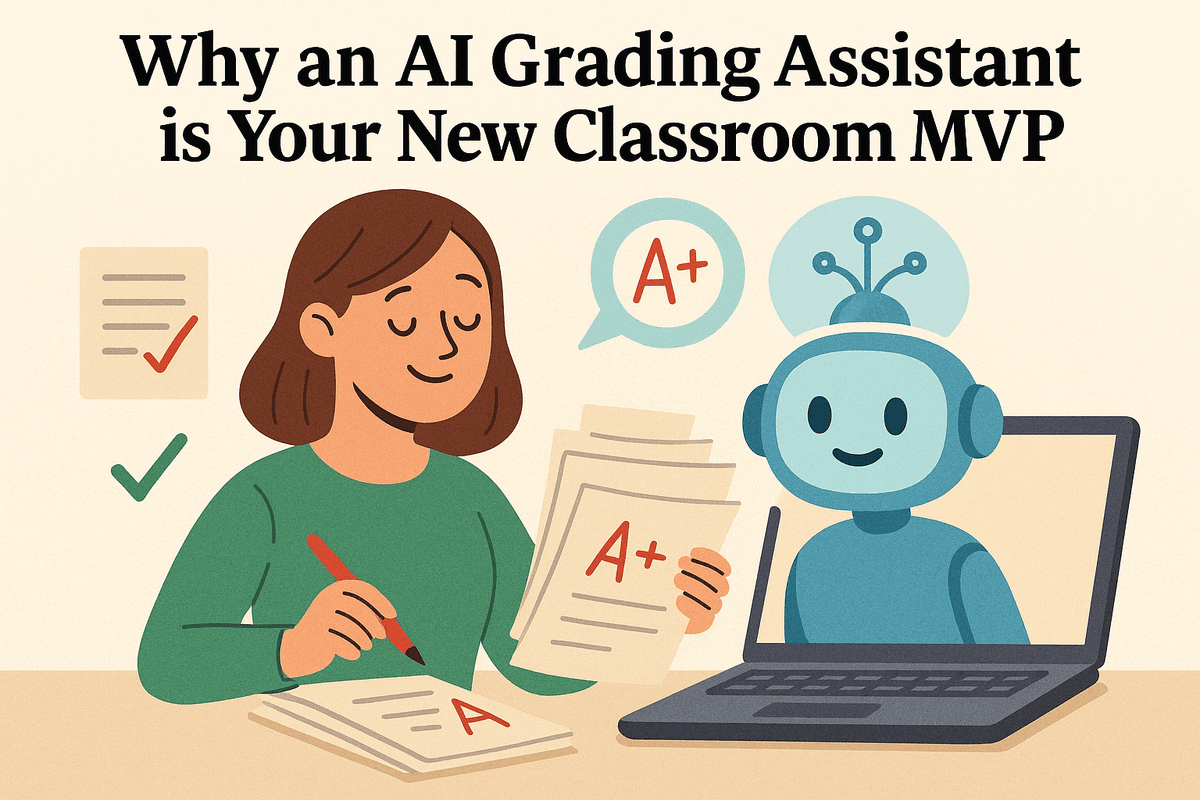
The term "MVP" usually stands for Most Valuable Player, but in the modern classroom, it could just as easily mean "Most Valuable Partner." For today's overworked educators, that partner is increasingly an AI grading assistant. This isn't about replacing the critical human element of teaching; it's about augmenting it, freeing you from the repetitive, time-consuming aspects of your job so you can focus on what truly matters: your students. Let's break down what this technology is and why it's becoming an indispensable tool.
What Exactly is an AI Grading Assistant and How Does It Work?
At its core, an AI grading assistant is a sophisticated software tool that uses artificial intelligence, primarily machine learning and Natural Language Processing (NLP), to evaluate student work. Think of it as a highly trained, tireless teaching assistant that you train to understand your specific grading criteria.
The process is surprisingly straightforward:
- You Define the Standard: You provide the AI with your rubric, scoring guidelines, and often a few examples of graded assignments (e.g., A-level, B-level, and C-level work).
- The AI Learns: The system analyzes these inputs to understand the nuances of your expectations, from critical thinking and argumentation to grammar and structure.
- It Gets to Work: The AI then applies this learned knowledge to a new batch of student submissions, providing a preliminary grade and, more importantly, specific feedback tied directly to your rubric.
You always remain in control. The AI offers a draft of the grading, which you can quickly review, adjust, and approve. It handles the initial heavy lifting, allowing you to focus on providing high-level, personalized insights.
Beyond Speed: The Real Benefits of Automated Grading
While saving time is the most obvious benefit, the true value of an AI grading assistant lies in the qualitative improvements it brings to the classroom. The speed of the AI directly translates into a faster feedback loop for students, allowing them to learn from their mistakes while the material is still fresh in their minds.
Beyond this, the key advantages include:
- Unwavering Consistency: An AI applies the rubric with perfect consistency across every single paper, at any time of day. It doesn't get tired or have its judgment clouded after grading the 50th essay, eliminating the unintentional grading drift that can happen during long sessions.
- Enhanced Objectivity: By focusing strictly on the pre-defined criteria, AI helps mitigate unconscious bias, ensuring every student's work is evaluated on its own merit.
- Actionable Classroom Insights: Many tools can aggregate data to show you common misconceptions or areas where the entire class is struggling, providing invaluable data to inform your next lesson plan.
Reclaiming Your Time: A Look at the Modern Educator's Workload
The life of a modern educator extends far beyond the bell. The hours are filled with lesson planning, administrative duties, parent communication, and professional development. Piled on top of all that is the mountain of grading, a task that can consume evenings and weekends, leading to burnout. Studies consistently show that teachers work well over the standard 40-hour week, with a significant portion of that overtime dedicated to assessment.
This is where an AI grading assistant becomes a game-changer. By automating the most repetitive parts of grading, it gives you back your most valuable resource: time. This isn’t just time to rest and recharge; it's time you can reinvest into more impactful educational activities. Imagine having more hours for one-on-one student mentoring, developing creative and engaging lesson plans, or collaborating with colleagues. By taking on the grading burden, this technology empowers you to be the educator you've always wanted to be—present, engaged, and focused on the art of teaching.
Unpacking the Core Features of a Powerful AI Grading Assistant
Beyond simply saving time, a truly effective ai grading assistant is a multifaceted tool designed to enhance the entire educational experience. It’s not about replacing the educator but empowering them with a suite of intelligent features. Let's break down the core components that transform these platforms from a novelty into a necessity.
Automated Scoring for Multiple-Choice and Short-Answer Questions
The most immediate benefit of an ai grading assistant is its ability to handle objective assessments with lightning speed and perfect accuracy. While this has long been the case for multiple-choice questions, modern AI takes it a step further with short-answer questions. Instead of relying on rigid keyword matching, sophisticated algorithms use Natural Language Processing (NLP) to understand the semantic meaning behind a student's response. This means the AI can recognize a correctly answered question even if it’s phrased differently than the answer key, providing a more nuanced and fair evaluation while eliminating the tedious manual work of grading hundreds of similar responses.
Providing Instant, Personalized Feedback on Essays and Reports
This is where an ai grading assistant truly shines as a pedagogical partner. Instead of waiting days or weeks for feedback, students can receive constructive comments on their written work almost instantly. The AI can analyze essays and reports for a wide range of criteria, including:
- Grammar and Syntax: Highlighting errors and suggesting corrections.
- Structure and Cohesion: Assessing the logical flow of arguments and the organization of paragraphs.
- Clarity and Conciseness: Identifying convoluted sentences and offering more direct alternatives.
- Rubric-Based Analysis: Scoring the work against pre-defined criteria, showing students exactly where they met or missed expectations.
This immediate feedback loop allows students to learn and revise while the assignment is still fresh in their minds, fostering a more dynamic and effective learning process.
Integrating Plagiarism Detection and Originality Scoring
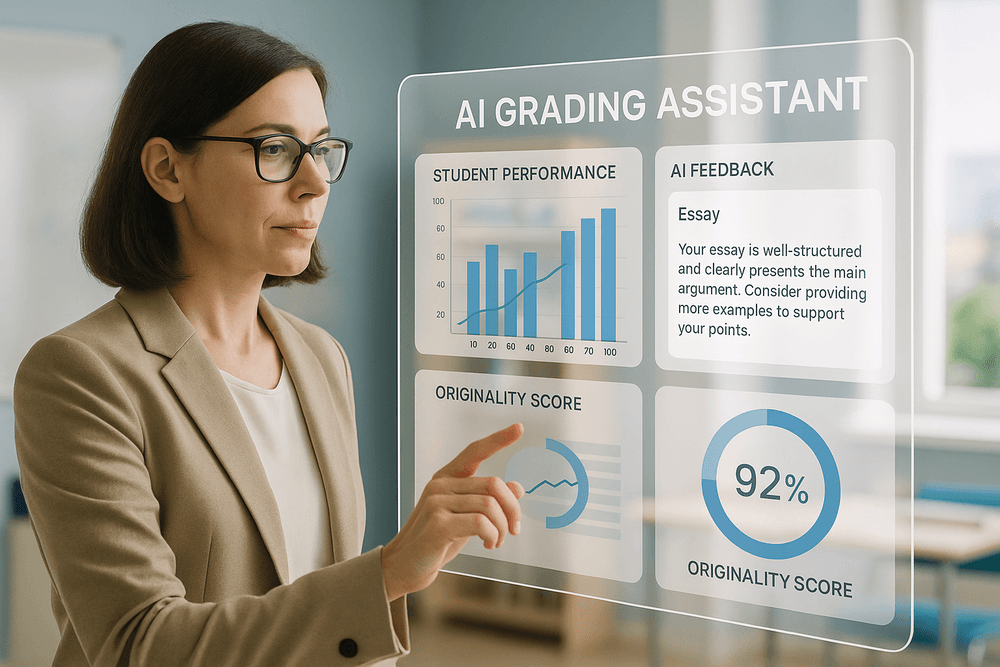
Maintaining academic integrity is paramount. A top-tier ai grading assistant integrates powerful plagiarism detection directly into the workflow, saving you the hassle of using separate third-party tools. These systems scan submissions against a vast database of academic papers, publications, and web content. More importantly, they provide a detailed originality report or score. This isn't just a simple pass/fail for plagiarism; it highlights specific passages and their sources, creating a valuable teachable moment for students on proper citation, paraphrasing, and the importance of original thought.
Leveraging Analytics to Track Student Performance Trends
A powerful ai grading assistant does more than just grade individual assignments; it aggregates data to reveal actionable insights. The analytics dashboard can provide a high-level view of student performance, helping you quickly identify:
- Common Misconceptions: See which questions an entire class struggled with, signaling a topic that may need re-teaching.
- Individual Progress: Track a single student's performance over the semester to spot patterns and intervene early if they begin to fall behind.
- Assessment Effectiveness: Analyze how well your questions are evaluating student knowledge, allowing you to refine assessments for future use.
This data-driven approach empowers educators to move from reactive grading to proactive teaching, tailoring their instruction to the specific needs of their students.
Comparing the Best AI Grading Assistant Tools on the Market
Navigating the crowded market of educational technology can be overwhelming. With numerous platforms claiming to be the ultimate solution, how do you choose the right ai grading assistant for your unique classroom needs? The best tool for a university-level computer science course might not be the ideal fit for a high school English class. Here, we break down three leading contenders—Gradescope, Turnitin, and GradesAI—and outline the key factors you should consider to make an informed decision.
Gradescope: Strengths in STEM and Large-Scale Assessments
Originally developed to handle the complex demands of STEM subjects, Gradescope has become a powerhouse for educators managing large-scale assessments. Its standout feature is the ability to intelligently group similar answers, whether they are handwritten, typed, or even segments of code. This allows you to grade an entire group of identical responses at once, applying feedback and rubric items in a single click.
This powerful ai grading assistant excels at handling a wide variety of assignment formats, including exams with complex equations, bubble sheets, and programming projects with autograders. Its dynamic rubric ensures that any changes made to a grading criterion are automatically applied to all previously graded submissions, guaranteeing consistency. If your primary challenge is managing high-volume, technical, or handwritten assignments, Gradescope offers an unparalleled level of efficiency and precision.
Turnitin: Combining Plagiarism Checking with AI-Powered Feedback
While best known for its industry-leading plagiarism detection, Turnitin has evolved into a comprehensive feedback and grading platform. Through its Feedback Studio, it integrates originality checking with robust grading tools, making it a formidable ai grading assistant, especially for writing-intensive courses. The platform uses AI to help educators provide more meaningful and consistent feedback.
Features like QuickMarks allow you to drag and drop pre-written comments for common writing errors, while the rubric tool simplifies criteria-based scoring. More recently, Turnitin has incorporated AI-driven insights that can identify patterns in student writing and offer constructive suggestions. By combining its legendary plagiarism checker with advanced feedback capabilities, Turnitin positions itself as an essential tool for upholding academic integrity while streamlining the grading workflow for essays and research papers.
GradesAI: A Look at User-Friendliness and Integration
For educators seeking a straightforward, intuitive, and highly integrated solution, GradesAI is a compelling option. This platform prioritizes user experience, making it easy for instructors to get started with minimal training. Its core strength lies in its seamless integration with popular Learning Management Systems (LMS) like Canvas, Moodle, and Blackboard, allowing it to fit effortlessly into existing digital classroom ecosystems.
GradesAI focuses on providing instant, personalized feedback for a range of assignment types, from short-answer questions to detailed essays. As an emerging ai grading assistant, it leverages machine learning to adapt to your grading style, offering suggestions that align with your pedagogical approach. Its clean interface and focus on simplifying the grading process make it an excellent choice for instructors who want to harness the power of AI without a steep learning curve.
Key Factors to Consider When Choosing Your Tool
Before committing to a platform, evaluate these critical factors:
- Pricing: Models vary widely, from per-student or per-submission fees to institutional site licenses. Investigate what’s included in each tier and watch for any hidden costs associated with premium features or support.
- LMS Integration: A quality ai grading assistant should feel like a natural extension of your existing workflow. Check for deep integration with your institution's LMS to ensure grade passback and roster syncing are seamless.
- Subject Suitability: Does the tool support your specific needs? STEM educators should prioritize platforms that handle equations and code, while humanities instructors will benefit more from advanced textual analysis and plagiarism detection. Always confirm the tool is optimized for your subject matter and common assignment types.

Real-World Impact: An AI Grading Assistant in Action
Theory and features are one thing, but the true test of any educational tool is its performance in a real classroom. How does an ai grading assistant actually change the day-to-day workflow for educators? From packed high school classrooms to large university lectures, the impact is tangible, saving time and enhancing the learning experience.
Case Study: Streamlining Essay Grading in a High School English Class
The Challenge: Ms. Albright, a dedicated 11th-grade English teacher, faced a recurring mountain: 125 five-page essays on The Great Gatsby. Providing timely, meaningful, and consistent feedback on grammar, structure, and argumentation was a monumental task that consumed her nights and weekends, leaving her feeling drained and less prepared for actual in-class instruction.
The Solution: After researching her options, Ms. Albright implemented an ai grading assistant integrated with her school’s learning management system. She configured it with her specific analytical essay rubric, training it to identify thesis strength, textual evidence, and organizational flow. The AI provided an initial layer of feedback on every paper, flagging grammatical errors, highlighting repetitive phrasing, and checking each paragraph against the rubric’s criteria.
The Outcome:
- Time Saved: Ms. Albright reported a 60% reduction in her overall grading time.
- Deeper Feedback: Freed from correcting basic syntax and structure, she could focus her own comments on higher-order concerns like nuance, voice, and the complexity of student arguments.
- Faster Turnaround: Students received initial feedback within 48 hours, allowing them to review the AI's suggestions and her personalized notes while the assignment was still fresh in their minds.
Case Study: Ensuring Consistent Feedback in a Multi-TA University Course
The Challenge: Dr. Chen, a professor for a 300-student introductory psychology course, struggled to ensure grading fairness across his four teaching assistants (TAs). Despite providing a detailed rubric, each TA had a slightly different interpretation, leading to student complaints about inconsistent scores for similar work.
The Solution: Dr. Chen introduced an ai grading assistant as a standardized foundation for his TAs. Before the main grading began, the entire team collectively calibrated the AI using a sample set of assignments. Once calibrated, the AI grader processed all submissions, providing a baseline score and objective comments based on the agreed-upon standards.
The Outcome:
- Improved Fairness: The AI served as an unbiased arbiter, ensuring every student's work was initially measured against the exact same criteria, significantly reducing TA-to-TA variability.
- Enhanced TA Efficiency: TAs used the AI's feedback as a starting point. They could then quickly add their own qualitative insights and discipline-specific advice, transforming their role from primary graders to expert commentators.
- Data-Driven Insights: The platform provided Dr. Chen with an overview of common mistakes across all 300 students, allowing him to address widespread misconceptions in his next lecture.
From Burnout to Breakthrough: Educator Testimonials
- "The ai grading assistant gave me my weekends back. I can now spend more time planning creative lessons and less time with a red pen. It's been a game-changer for my work-life balance." – Sarah J., 6th Grade Teacher
- "I was skeptical, but this AI grader is incredibly sophisticated. It helps me provide consistent, rubric-aligned feedback at scale. My students appreciate the speed and clarity, and I can focus on mentoring them." – Dr. David Lee, Economics Professor
- "Using an ai grading assistant isn’t about replacing the teacher; it’s about augmenting our abilities. It handles the tedious parts of grading, so I can focus on the human part: teaching, guiding, and inspiring my students." – Maria Flores, High School History Department Head
Best Practices for Integrating an AI Grading Assistant into Your Workflow
Adopting an ai grading assistant is more than just flipping a switch; it's about thoughtfully weaving a powerful new tool into your pedagogical practice. A strategic approach ensures you harness its full potential for efficiency, consistency, and deeper student insight. By following these best practices, you can make the transition smooth and impactful for both you and your students.
Setting Up Your First Assignment for AI-Powered Grading
The key to a successful first run with an ai grading assistant is to start smart. Don't begin with a complex, high-stakes final exam. Instead, choose a well-structured, low-stakes assignment like a weekly reading response, a short-answer quiz, or a lab report summary.
Before you begin, ensure your assignment has two critical components:
- Clear Prompts: Vague questions lead to varied answers that can confuse an AI. Craft precise prompts that guide students toward a specific type of response.
- A Detailed Rubric: Your rubric is the AI's instruction manual. Break down grading criteria into specific, measurable components. The more detailed your rubric, the more accurately the AI can apply it, leading to consistent and reliable AI-powered grading.
How to Train the AI for Maximum Accuracy and Fairness
An ai grading assistant is not an out-of-the-box expert on your specific course material; you need to train it. This crucial calibration process aligns the AI with your unique grading style and expectations.
The process typically involves you grading a small, representative sample of submissions (usually 10-20) yourself. As you grade, the AI learns your patterns, how you weigh different rubric criteria, and the type of feedback you provide.
To maximize accuracy and fairness:
- Grade a Diverse Sample: Select a range of submissions, including excellent, average, and poor examples, to give the AI a complete picture.
- Review and Refine: Once the AI has graded the rest of the assignments, spot-check its work. Review its suggested scores and feedback, making corrections where necessary. Every correction you make further refines the model, making it more accurate for future assignments.
Communicating the Use of AI Grading Tools to Your Students
Transparency is essential for maintaining trust. Inform your students that you are using an ai grading assistant and explain why. Frame it as a tool to provide them with faster, more consistent, and more detailed feedback, which in turn frees up your time for more personalized support, like one-on-one meetings and richer class discussions.
Assure them that you are still in complete control. Explain the "human-in-the-loop" process: the AI provides a first pass, but you, the instructor, review the results, make final adjustments, and have the ultimate say on every grade. This clarity helps prevent misconceptions and fosters a positive view of the technology as a supportive element of the course.
Using AI Insights to Inform and Adapt Your Teaching Strategies
The true power of an ai grading assistant extends beyond simply saving time. The best platforms provide powerful analytics and insights into student performance. Use this data to become a more responsive and effective educator.
Look for trends in the grading data. Does the AI report show that 70% of the class struggled with a specific concept or question? That’s your cue to revisit the topic in your next lecture, create a supplementary tutorial, or open a discussion forum about it. By identifying common misconceptions quickly, you can intervene at the moment of need, adapting your teaching strategies to address learning gaps before they widen.

The Future of Assessment: Your Next Steps with an AI Grading Assistant
Embracing an ai grading assistant is more than just adopting a new tool; it's a strategic step toward a more efficient, equitable, and impactful educational future. As we look ahead, the integration of AI in assessment is poised to become standard practice. The key is to move forward thoughtfully, ensuring the technology serves your institution's unique goals and empowers your educators. Here’s how to take the next steps.
Making the Right Choice for Your Institution
Not all AI grading platforms are created equal. Selecting the right ai grading assistant requires a careful evaluation of your specific needs. Before committing, consider the following critical factors:
- LMS Integration: Does the tool seamlessly integrate with your existing Learning Management System (LMS), such as Canvas, Blackboard, Moodle, or Google Classroom? A smooth integration is crucial for a frictionless workflow for both instructors and students.
- Subject and Assignment Versatility: Can the assistant handle the types of assignments you use most, from multiple-choice questions to complex essays, coding projects, or mathematical proofs? Look for a solution designed for your specific disciplines.
- Customization and Control: A superior ai grading assistant puts the educator in the driver's seat. Ensure you can easily customize rubrics, adjust grading parameters, and override AI suggestions. The goal is to augment, not replace, professional judgment.
- Data Security and Privacy: Student data is sensitive. Verify that the provider complies with relevant regulations like FERPA and GDPR and has robust security protocols in place to protect institutional and student information.
The Evolving Role of the Educator in an AI-Powered World
A common concern is that AI will diminish the role of the educator. The reality is quite the opposite. By automating the repetitive, time-consuming aspects of grading, an ai grading assistant elevates the educator's role, shifting their focus from tedious administration to high-impact mentorship.
Instead of spending late nights grading, educators can now:
- Become Learning Architects: Devote more time to designing innovative, engaging curricula and hands-on learning experiences.
- Act as Data-Informed Mentors: Use the analytics provided by the AI to identify struggling students or common misconceptions across a class, allowing for timely, targeted interventions.
- Foster Deeper Connections: Reinvest reclaimed hours into one-on-one student meetings, personalized feedback sessions, and fostering a collaborative classroom environment.
The AI handles the "what" (the score), freeing the educator to focus on the "why" and "how"—guiding students toward genuine understanding and critical thinking. The human touch remains not just relevant, but more important than ever.
Ready to Save Time? How to Get Started
The journey toward a more efficient workflow begins with a single step. Exploring an ai grading assistant doesn't require an immediate institution-wide overhaul. The best approach is to start small and see the benefits firsthand.
- Identify a Pilot Group: Select a department or a few tech-forward instructors who are open to testing a new solution for a single semester.
- Research and Select a Tool: Based on the criteria above, choose a highly-rated platform that offers a free trial or a pilot program.
- Schedule a Demo: A live demonstration is the best way to see the software in action and ask specific questions related to your curriculum and workflow.
- Launch Your Trial: Set clear success metrics for your pilot. Do you want to reduce grading time by 50%? Increase the frequency of feedback? Gather feedback from both instructors and students at the end of the trial.
Ready to see how an AI grading assistant can transform your institution? Explore a free trial or request a demo today to take the first step toward reclaiming valuable time and redefining the future of assessment.