
October 8, 2025
Why an AI Citation Generator is Your New Best Friend in
Why an AI Citation Generator is Your New Best Friend in Research
Let's be honest: the last thing you want to do after writing a brilliant research paper is spend hours wrestling with commas, italics, and publication dates. Manually creating a bibliography is tedious, frustrating, and prone to error. This is where an AI citation generator transforms from a helpful tool into an indispensable academic partner.
So, what exactly is an AI-powered generator, and how does it work its magic? Unlike older, template-based tools where you manually input every detail, an AI citation generator uses advanced technologies like Natural Language Processing (NLP) and machine learning. You simply provide a URL, a PDF file, or a DOI (Digital Object Identifier), and the AI gets to work. It intelligently scans the source, identifies key information—like the author, title, publication date, and journal—and assembles it into a perfectly formatted citation in the style of your choice. It’s not just filling in blanks; it’s actively understanding and extracting data.
Slash Your Research Time: The Top 3 Benefits
For students and academics juggling tight deadlines, time is the most valuable resource. An AI citation generator gives you that time back by streamlining the most laborious parts of academic writing.
- Instant Formatting and Style Switching: Need to convert your entire bibliography from APA 7th edition to MLA 9th? What used to take hours of painstaking manual adjustments now takes a single click. An AI tool has the rules for hundreds of citation styles (including Chicago, Harvard, and Vancouver) programmed in, ensuring you meet any requirement instantly.
- Automated Data Extraction: Say goodbye to manually typing out long author lists or journal titles. An AI citation generator pulls this information directly from the source’s metadata. This not only saves an incredible amount of time but also drastically reduces the risk of typos that can compromise your citation’s validity.
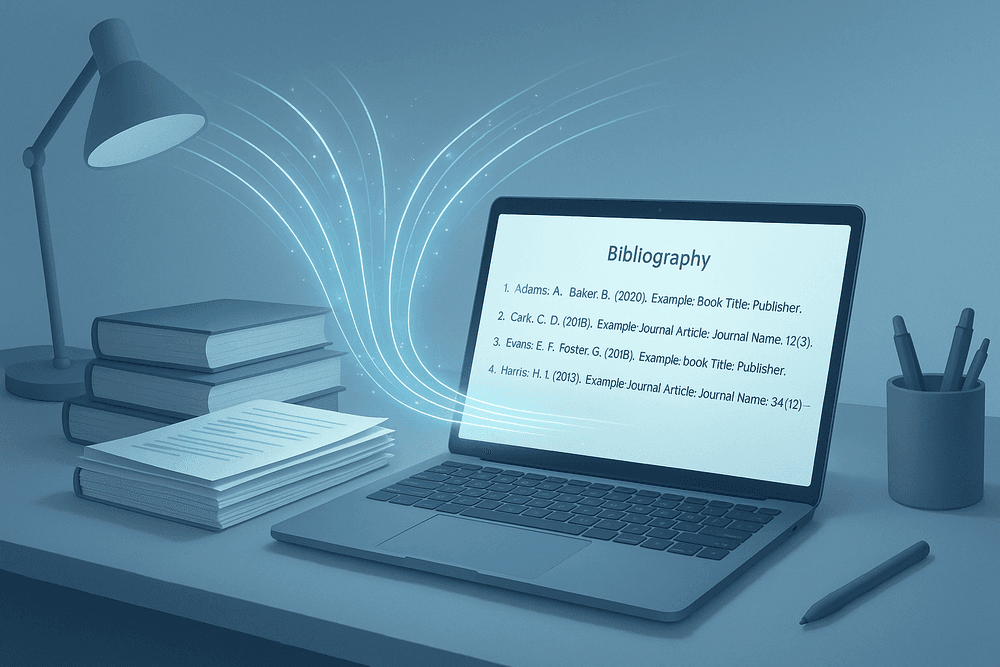
- Effortless Bibliography Management: The best AI tools act as a central library for all your research. You can organize sources by project, add annotations, and build your works cited page as you go. When you’re ready, the tool compiles and alphabetizes everything automatically, delivering a polished, professional reference list without the last-minute panic.
Moving Beyond Copy-Paste: How AI Improves Citation Accuracy
Speed is a major advantage, but the true power of an AI citation generator lies in its commitment to accuracy. The old method of copying and pasting citation information from online databases or the source itself is a recipe for error. Websites often contain formatting mistakes, missing data, or use outdated style rules.
An AI-driven tool bypasses these issues by pulling information from more reliable, structured data when available. Furthermore, the AI is constantly updated to reflect the latest changes in major style guides. When the 8th edition of MLA or the 7th edition of APA were released, these tools were among the first to implement the new rules correctly. This means you can be confident your citations are not just fast, but fundamentally correct, protecting your academic credibility and helping you avoid accidental plagiarism.
The Best AI Citation Generator Tools Compared
Navigating the world of academic referencing can be daunting, but the right ai citation generator can transform it from a tedious chore into a seamless process. With countless options available, choosing the best one depends entirely on your specific needs—whether you're a high school student tackling your first research paper or a seasoned academic managing a vast library of sources. To help you decide, we’ve broken down three of the top contenders, each excelling in a different area.
Tool A: Best for Overall Ease of Use and Multiple Citation Styles
For students and writers who value speed, simplicity, and versatility, Tool A stands out as the ultimate all-rounder. Its interface is exceptionally intuitive; you can generate a complete citation in seconds by simply pasting a URL, ISBN, or DOI. The AI-powered engine quickly parses the source and pulls the necessary metadata, presenting it in a clean, editable format.
Where Tool A truly shines is its extensive support for hundreds of citation styles, from the common (APA, MLA, Chicago) to the niche-specific (ASA, IEEE, Turabian). This flexibility makes it a perfect companion for undergraduates who switch between different classes and formatting requirements. While it offers a robust free version, its premium plan unlocks advanced features like a plagiarism checker and unlimited bibliography storage, making it a comprehensive and user-friendly ai citation generator for nearly any academic task.
Tool B: The Best Free AI Citation Generator
If your primary concern is cost, Tool B is the undisputed champion. It offers a completely free, ad-supported service that doesn’t compromise on core functionality. This makes it the go-to choice for budget-conscious students who need a reliable tool for straightforward assignments without committing to a subscription.
Despite being free, Tool B provides surprisingly accurate citations for the most widely used styles, including APA 7, MLA 9, and Chicago 17. The platform is streamlined for one purpose: creating quick, correct citations from web pages, books, and journal articles. You won’t find the advanced library management or collaboration features of paid tools, but for generating a bibliography for a single paper, it's an incredibly powerful and accessible solution. It proves that a high-quality ai citation generator doesn't have to come with a price tag.
Tool C: Ideal for Advanced Researchers Needing Library Integration
Designed for graduate students, academics, and professional researchers, Tool C is more than just a citation generator—it's a complete research management ecosystem. Its standout feature is deep integration with reference management libraries like Zotero and Mendeley, as well as direct connections to university databases and Google Scholar. This allows you to import sources, organize them into projects, and annotate PDFs all within one platform.
Tool C’s AI excels at handling complex and obscure source types, ensuring maximum accuracy for dissertations, theses, and journal publications. It also includes collaboration features, allowing research teams to share and manage a central source library. While it comes with a premium subscription, the investment is justified for serious researchers who need a powerful, centralized hub to streamline their entire workflow.
Feature-by-Feature Comparison: Price vs. Accuracy vs. Style Support
- Price: Tool B leads the pack as a completely free ai citation generator. Tool A operates on a freemium model, offering core features for free with a subscription for advanced capabilities. Tool C is a premium-only service, geared towards professionals and institutions who need its powerful integration features.
- Accuracy: All three tools offer high accuracy for standard sources. However, Tool C often has a slight edge due to its direct database integrations, which minimize metadata errors. Tool A is highly reliable for most academic needs, while Tool B provides solid results but may require an occasional double-check for more complex sources. Remember, a final human review is always recommended.
- Style Support: Tool A offers the broadest range of styles, making it ideal for multidisciplinary students. Tool C also has extensive support, with a focus on journal-specific formats for academic publishing. Tool B covers the essential styles (APA, MLA, Chicago, Harvard) perfectly, which is sufficient for the majority of high school and early undergraduate work.
Core Features Every Top-Tier AI Citation Generator Must Have
Not all citation tools are built the same. While many can create a basic citation, a truly top-tier ai citation generator goes far beyond that, acting as a genuine research partner. When you're evaluating your options, a few core features separate the merely helpful from the absolutely indispensable. These capabilities are designed to streamline your workflow, eliminate errors, and give you back your most valuable resource: time. Let’s break down the non-negotiable features you should look for.
Seamless Automatic Source Fetching
The days of manually typing author names, publication dates, and journal titles are over. The hallmark of a modern ai citation generator is its ability to automatically fetch source information with minimal input. You should be able to simply paste a URL for a website, a DOI (Digital Object Identifier) for a journal article, or an ISBN for a book, and watch the tool instantly populate every required field. This feature is a game-changer, drastically reducing the time spent on data entry and, more importantly, minimizing the risk of human error that can lead to an inaccurate citation. A superior tool will pull comprehensive, accurate metadata in seconds, letting you focus on your research, not on tedious administrative tasks.
Comprehensive Support for All Major Citation Styles
Academic writing is not a one-style-fits-all world. Your psychology professor requires APA, your literature professor demands MLA, and your history professor insists on Chicago. A premier ai citation generator must offer extensive support for thousands of citation styles, covering all major formats (APA, MLA, Chicago, Harvard, Vancouver, etc.) and many niche, journal-specific ones. Beyond sheer quantity, quality is key. The platform must stay current with the latest official updates, such as APA 7th Edition or MLA 9th Edition. This ensures your citations are not just formatted correctly but are compliant with the most recent academic standards, protecting your grade and your credibility.
Effortless Integration with Writing Tools
The most disruptive part of the traditional citation process is the constant context-switching—flipping between your document and your citation tool. The best solutions eliminate this friction with seamless integrations for Google Docs and Microsoft Word. These add-ons or plugins embed the citation generator directly into your writing environment. This allows you to search your source library, create new citations, and insert in-text citations without ever leaving your document. As you add sources, the tool automatically compiles and formats your bibliography or works cited page at the end of your paper, updating it in real-time as you make changes. This integrated workflow keeps you in the zone and makes citing as you write an effortless reality.
Smart Bibliography and Project Management
Your research doesn't live in a single document. A top-tier ai citation generator functions as a centralized hub for all your research materials. Cloud storage is essential, allowing you to access your source library from any device, anywhere. But the best tools go further, offering robust project management features. You should be able to organize your sources into distinct projects or bibliographies for different papers or classes. Look for features like adding annotations, tags, or notes to your sources to keep your thoughts organized. This transforms the tool from a simple generator into a powerful, long-term research database that grows with you throughout your academic career.
How to Master Your AI Citation Generator: Best Practices
An AI citation generator is a powerful ally in your academic journey, transforming a tedious task into a streamlined process. But like any advanced tool, its effectiveness depends on the user. To truly master it and produce flawless citations every time, you need to move beyond simply copying and pasting. These best practices will ensure your bibliographies are accurate, professional, and impeccable.
Trust, but Verify: The Golden Rule of AI Citations
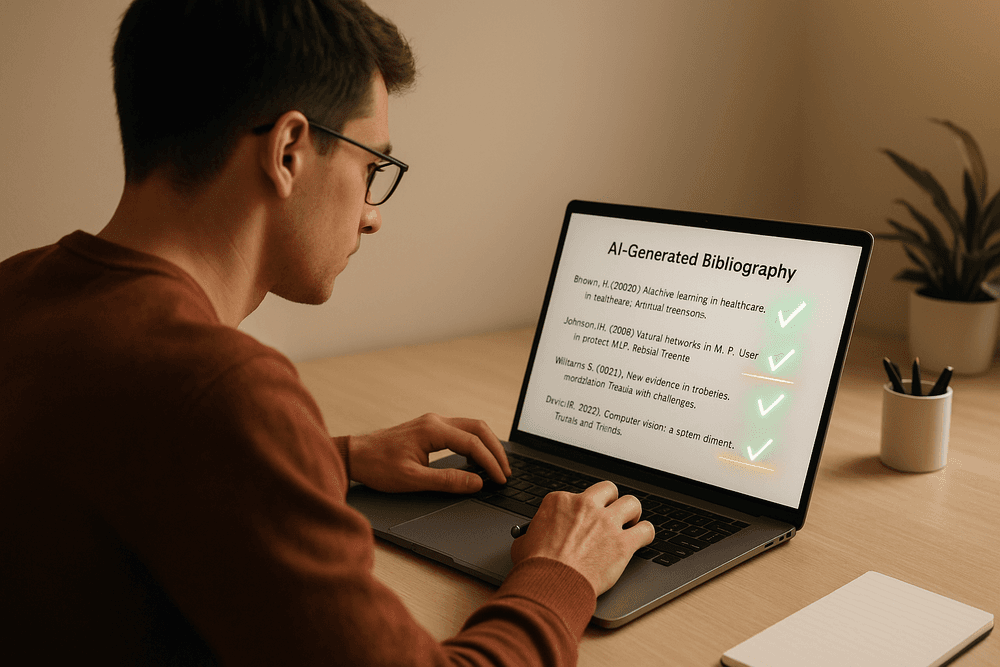
The most critical step in using any AI tool is the final human review. While an ai citation generator dramatically reduces the chance of error, it’s not infallible. It pulls metadata from various sources, which can sometimes be incomplete or incorrectly formatted.
Before finalizing your bibliography, perform a quick audit of each entry. Create a mental checklist and verify the following:
- Author(s): Are all names spelled correctly and in the proper order?
- Publication Date: Is the year (and sometimes month or day) accurate?
- Titles: Is the capitalization correct for your chosen style (e.g., sentence case for APA article titles, title case for MLA)?
- Publication Information: Is the journal name, volume, issue, and page range correct? For a book, is the publisher right?
- Digital Identifiers: Is the DOI (Digital Object Identifier) or URL present and functional?
Think of the AI-generated citation as an expertly prepared first draft—your job is to be the final editor.
Citing Beyond the Book: Handling Digital and Non-Traditional Sources
Academic research now pulls from a diverse range of sources, including YouTube videos, social media posts, podcasts, and online lectures. Citing these can be tricky, as the rules are newer and more complex.
Fortunately, a high-quality ai citation generator is built to handle these modern formats. The key is providing the tool with the correct information. When citing a YouTube video, for example, ensure you have:
- The name of the person or channel that uploaded the video (the "author").
- The full date the video was published.
- The exact title of the video.
- The URL.
Always double-check the latest edition of your style guide (APA, MLA, Chicago, etc.) for its specific rules on these sources, as conventions can evolve. Your AI tool will handle the formatting, but it relies on you to supply the right components.
From Chaos to Cohesion: Organizing Your Bibliography
A perfect bibliography starts with good organization from day one. Don't wait until your paper is finished to hunt down every source you referenced. This is where the project management features of your AI citation generator become invaluable.
Adopt this simple workflow:
- Create a Project: As soon as you begin your research, create a new project or folder within your citation tool.
- Add Sources Immediately: Every time you find a relevant article, video, or book, add it to your project list immediately.
- Export and Review: Once your paper is complete, use the tool’s function to generate your full bibliography or works cited page. This ensures nothing is forgotten. Finally, give it one last review for alphabetical order and consistent formatting.
Sidestepping Common Pitfalls and Formatting Fouls
A final manual proofread helps you catch subtle but common errors that can slip past automated systems. Watch out for these frequent mistakes:
- Incorrect Source Type: Ensure the AI correctly identified the source. Was it a journal article or a chapter in an edited book? The formatting rules are different.
- Missing Information: Sometimes a DOI isn't available, but your style guide might require an access date for a URL. Make sure all necessary fields are complete.
- URL vs. DOI: Whenever a DOI is available for an online article, it should always be used instead of a URL. A DOI is a permanent identifier, while a URL can change or break.
Real-World Use Cases: Putting an AI Citation Generator to Work
The theoretical benefits of speed and accuracy are compelling, but where does an AI citation generator truly prove its worth? It's in the high-stakes, deadline-driven environments where managing sources can make or break a project. From the solitary marathon of a dissertation to fast-paced professional reporting, these tools are transforming workflows. Let's explore how people are putting them to work in the real world.
Case Study: Conquering the Dissertation with Seamless Source Management
The dissertation is the Mount Everest of academic writing, and its bibliography can feel like a treacherous climb in itself. A typical doctoral candidate may juggle hundreds of journal articles, books, and primary sources. Manually tracking, formatting, and cross-referencing this volume of information is a recipe for stress and error.
This is where an AI citation generator becomes an indispensable research partner. Imagine a Ph.D. candidate building their literature review. Instead of a sprawling spreadsheet and dozens of open tabs, they use a browser extension to add sources to a centralized digital library with a single click. The AI instantly parses the metadata, identifying authors, publication dates, and DOIs. As they write, they can insert perfectly formatted in-text citations without ever leaving their document.
The true magic happens at the end. The weeks once spent manually compiling and formatting a reference list are condensed into seconds. The AI citation generator produces a flawless bibliography in the required style (APA, Chicago, Turabian, etc.), freeing the candidate to focus on what matters most: their research and analysis.
Group Project Game-Changer: Creating a Shared Bibliography in Minutes
Every student knows the pain of the group project bibliography. The task often falls to one unlucky person who has to chase down sources from team members, decipher handwritten notes, and wrangle a dozen different formatting attempts into a single, cohesive list. It's a classic collaboration bottleneck.
An AI citation generator with collaborative features completely eliminates this friction. Here’s how it works:
- Create a Shared Project: The group starts a shared folder within the citation tool.
- Add Sources Collaboratively: As each member finds relevant articles or websites, they add them directly to the shared library. The AI normalizes all the data.
- Generate a Unified List: When the report is complete, any team member can generate the final, consolidated works cited page or reference list.
What used to be a multi-hour task filled with frustration becomes a simple, one-click process. This ensures consistency, fairness in workload, and a more professional final submission.
Beyond Academia: How Professionals Use AI Citation Tools
Citations are not just for term papers. In the professional world, they are the bedrock of credibility. Market researchers, consultants, technical writers, and even marketing teams rely on proper source attribution to build trust and demonstrate authority.
Consider a consulting firm preparing a whitepaper for a major client. Every statistic, industry trend, and expert quote must be meticulously cited to back up their recommendations. An AI citation generator allows the team to do this efficiently, ensuring every source is captured and formatted according to a consistent style. This not only bolsters the report's authority but also protects the firm from accusations of plagiarism. Similarly, a medical writer drafting a clinical trial summary can use an AI tool to manage hundreds of complex scientific references, guaranteeing precision where it matters most. For professionals, an AI citation generator isn't just a convenience—it's a tool for maintaining integrity and excellence.

Conclusion: The Future of Academic Research with AI
The landscape of academic research is rapidly evolving, and AI is at the forefront of this transformation. As we've explored, an AI citation generator is no longer a luxury but a fundamental tool for students, researchers, and writers aiming for efficiency and precision. By automating the tedious and error-prone task of formatting citations, these tools free up valuable mental energy, allowing you to focus on what truly matters: your research, analysis, and arguments. The future isn't about replacing human intellect but augmenting it, and in the world of academic writing, AI-powered citation is your most reliable assistant.
Which AI Citation Generator is Right for You? A Final Checklist
Choosing the perfect tool depends on your specific needs. Before you commit, run through this final checklist to ensure you’ve found the best match for your academic workflow.
- Citation Styles Supported: Does the tool offer the primary styles you use, such as APA 7, MLA 9, Chicago, or Harvard? Check for a comprehensive library if you work across different disciplines.
- Source Versatility: Can the generator handle a wide range of source types? Look for functionality that easily cites websites, academic journals, books, YouTube videos, and PDFs.
- Accuracy and Verification: How reliable is the output? The best AI citation generator tools are transparent about their accuracy and may provide links or context to help you double-check the information.
- User Experience (UX): Is the interface clean and intuitive? Consider tools with browser extensions or integrations (like Google Docs or Word) for a seamless workflow.
- Core Features vs. Extras: Do you just need citations, or would you benefit from an all-in-one platform with a plagiarism checker, grammar assistant, or summarizer?
- Pricing Model: Does the cost fit your budget? Evaluate free, freemium, and premium subscription plans to find a balance between features and affordability.
Get Started: Your Next Steps to Citation Perfection
Ready to streamline your writing process? Follow these simple steps to integrate an AI citation tool into your work today.
- Identify Your Needs: Use the checklist above to define your must-have features.
- Test the Top Contenders: Take advantage of free trials or freemium plans for two or three tools that caught your eye in our guide.
- Integrate into Your Workflow: Once you've chosen a winner, install its browser extension and bookmark the web app. Make it a go-to resource from the start of your next project.
- Always Proofread: Remember, AI is a powerful assistant, not a replacement for your critical eye. Always give your bibliography a final review before submitting your work.
Frequently Asked Questions (FAQ) about AI Citation Tools
Are AI citation generators 100% accurate?
While they are exceptionally accurate and drastically reduce the risk of human error, no tool is 100% perfect. Data can be missing from a website's metadata, or a specific rule might be misinterpreted. It's best practice to use an AI generator to do the heavy lifting and then conduct a final, quick review against your style guide's requirements.
Can an AI citation generator help me avoid plagiarism?
Yes, indirectly. A core component of avoiding plagiarism is proper attribution. By making it fast and easy to create accurate citations for every source you use, an ai citation generator ensures you give credit where it's due. This practice is a crucial defense against accidental plagiarism. For a complete check, however, you should use a dedicated plagiarism checker.
Is using an AI citation generator considered cheating?
No. Using an AI citation generator is widely accepted and considered a smart academic practice, much like using a spell checker or a calculator. These tools manage the technical formatting of your work, allowing you to focus on the intellectual quality of your research and writing. However, it's always a good idea to check your specific institution's or professor's academic integrity policies.