
October 17, 2025
Why AI-Powered Research Paper Summarization is a Game-
Why AI-Powered Research Paper Summarization is a Game-Changer
In the world of academia and professional research, information isn't just power—it's overwhelming. Every day, thousands of new studies are published, creating a relentless flood of data. For anyone trying to stay on the cutting edge, this presents a significant challenge. This is where the transformative power of AI-powered research paper summarization comes into play, turning an insurmountable task into a manageable one.
The Problem: Drowning in an Ocean of Academic Literature
Have you ever stared at a list of 50+ academic papers for a literature review and felt a sense of dread? You're not alone. The "publish or perish" culture has led to an exponential growth in scholarly articles. Sifting through dense, jargon-filled texts to find the few golden nuggets of information relevant to your work is a monumental task.
Traditionally, this process involves hours of meticulous reading, highlighting, and note-taking for each and every paper. This time-consuming effort often becomes a major bottleneck, slowing down research, delaying projects, and making it difficult to keep up with the latest advancements in your field. The sheer volume of content means that crucial insights can easily be missed, buried deep within a paper that you simply didn't have time to read thoroughly.
The Solution: How AI Transforms Hours of Reading into Minutes
Imagine condensing an entire 30-page research paper into a concise, digestible summary in under a minute. This is the core value of AI-powered research paper summarization. These advanced tools leverage Natural Language Processing (NLP) and machine learning algorithms to read and comprehend complex academic texts with incredible speed and accuracy.
Instead of just shortening the text, the AI identifies the essential components of the paper:
- The core research question or hypothesis
- The methodology used
- The key findings and results
- The main conclusions and implications
The AI effectively acts as a highly efficient research assistant, providing you with a high-level overview that allows you to instantly assess a paper's relevance. What once took hours of manual effort can now be done in minutes, freeing you up to focus on critical analysis, synthesis, and developing your own unique insights rather than getting bogged down in preliminary reading.
Who Can Benefit from Automated Summarization Tools?
The application of AI-driven summarization extends across various domains, empowering anyone who interacts with academic literature.
University Students and Graduate Researchers
For students tackling thesis work or extensive literature reviews, these tools are invaluable. They can rapidly sift through dozens of potential sources, identify foundational papers, and grasp complex concepts without spending weeks on initial reading.
Academics and Scientists
Researchers and academics can stay current with the latest breakthroughs in their field and adjacent disciplines with greater efficiency. AI summarization helps in preparing for conferences, conducting peer reviews, and quickly identifying gaps in existing research to explore.
Industry Professionals
Professionals like doctors, engineers, data scientists, and policy analysts need to base their work on the latest evidence. An AI research paper summarization tool bridges the gap between academic discovery and practical application, allowing them to absorb and implement cutting-edge findings without the academic time commitment.
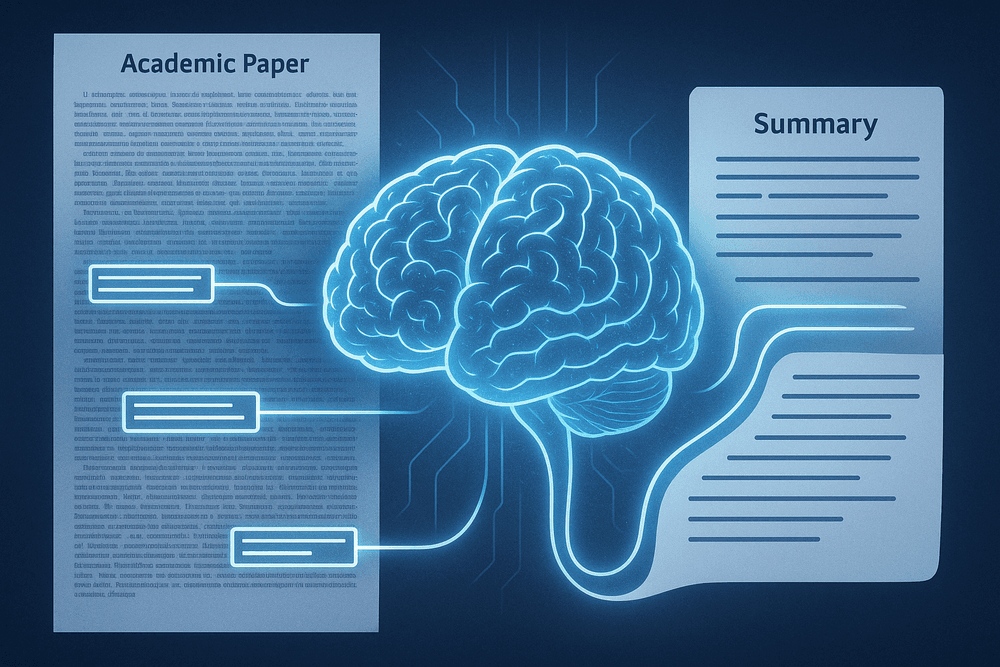
Top Tools for AI Research Paper Summarization Compared
Choosing the right tool for AI research paper summarization can feel overwhelming. With so many options available, the best choice depends entirely on your specific needs—whether you require a deep, scholarly analysis or a quick overview on the go. To help you decide, we’ve compared three leading tools, each excelling in a different area. We’ll also break down the core technology that powers them, so you can make an informed choice.
Tool A: Best for Deep, Nuanced Analysis
When your goal is to truly understand the intricate arguments and methodologies of a dense academic paper, Tool A is the undisputed champion. It goes beyond simple keyword extraction, employing sophisticated AI to grasp context, identify underlying assumptions, and synthesize complex ideas into a coherent, detailed summary. This makes it an invaluable asset for PhD candidates, researchers, and academics who need a thorough understanding for their literature reviews or grant proposals. Its strength lies in its ability to perform high-quality research paper summarization that preserves the original author's nuance, often feeling like you have a research assistant providing a detailed brief.
Tool B: Best for Speed and Multi-Language Support
For professionals and students working under tight deadlines or with international sources, Tool B is a game-changer. Its primary advantage is speed. You can upload multiple documents or paste links and receive concise summaries in seconds. Furthermore, its robust multi-language support breaks down barriers, allowing you to quickly get the gist of papers published in languages you don’t speak fluently. This tool is perfect for initial literature screening, helping you rapidly decide which papers warrant a deeper read. While the summaries may be less detailed than those from Tool A, its efficiency in processing high volumes of text makes it a productivity powerhouse.
Tool C: Best for Free Option for Students and Casual Users
Not everyone needs a premium, feature-packed subscription. Tool C stands out as the best free solution for effective research paper summarization. It’s incredibly accessible and easy to use, making it ideal for undergraduate students getting their feet wet with academic literature or casual learners exploring a new topic. Simply paste your text or upload a file, and you’ll get a solid, digestible summary of the key points. While it may lack the advanced analytical depth or multi-document features of its paid counterparts, it reliably delivers the core information you need to understand a paper's main findings and conclusions without any financial commitment.
Key Differences: Abstractive vs. Extractive Summarization
Understanding the technology behind these tools helps you choose wisely. Most AI research paper summarization tools use one of two methods:
Extractive Summarization
Think of this method as a smart highlighter. Extractive summarizers identify the most important sentences and phrases from the original text and pull them out verbatim to form a summary. This approach is fast and guarantees factual accuracy because it doesn't alter the source material. Tools focused on speed, like Tool B and C, often rely on this method. The downside is that the resulting summary can sometimes feel disjointed or lack a smooth narrative flow.
Abstractive Summarization
This is a more advanced technique where the AI acts like a human expert. It reads and comprehends the entire document and then generates a new summary in its own words. This results in summaries that are more coherent, natural-sounding, and often easier to read. A tool like Tool A, known for its nuanced analysis, heavily utilizes abstractive methods. The trade-off is that it's more computationally intensive and carries a very small risk of misinterpreting the source material, though modern models are incredibly accurate.
Must-Have Features in a Research Paper Summarization Tool
The digital ocean of academic literature is vast, and an AI tool is your lifeboat. But not all tools are created equal. To truly supercharge your workflow, you need a solution that goes beyond basic text reduction. The best platforms for research paper summarization are packed with thoughtful features designed for the rigorous demands of academia and professional research. When evaluating your options, look for these four non-negotiable features.
Adjustable Summary Length and Detail Level
Your summarization needs change depending on the task at hand. Sometimes you need a 30,000-foot view to quickly vet a paper’s relevance. Other times, you require a granular, multi-paragraph summary to prepare for a discussion or draft a literature review. A top-tier research paper summarization tool puts you in control.
Think of it as a precision dial for information. An effective tool allows you to generate:
- Short abstracts or key bullet points for rapid screening.
- Medium-length summaries that capture the core arguments, methodology, and results.
- Detailed, comprehensive overviews that function as in-depth executive summaries, perfect for deep analysis without a full re-read.
This flexibility ensures the output is always fit for purpose, saving you the manual effort of either condensing a long summary or trying to expand a short one.
Accurate Citation and Reference Handling
In the academic world, a claim without a source is just an opinion. A summary that doesn't link back to the original text is not only unhelpful but also a potential minefield for accidental plagiarism. This is where a crucial feature comes in: traceable and accurate citation handling.
A reliable AI summarizer won’t just give you a block of text. It will actively link its generated sentences and key findings back to their exact location in the source document. This allows for instant verification, so you can click to see the original context, check the author’s exact phrasing, and pull direct quotes with confidence. This feature is fundamental to maintaining academic integrity and makes the process of building an annotated bibliography significantly more efficient and trustworthy.
Support for Multiple File Formats (PDF, DOCX, URL)
Research doesn't arrive in a single, neat format. You might download a locked PDF from a journal database, receive a DOCX draft from a colleague, or stumble upon a crucial article on a webpage. A cumbersome workflow that requires you to constantly convert files is a major productivity killer.
The best tools for research paper summarization are format-agnostic. They should seamlessly accept a variety of inputs, including:
- PDFs: The standard for published academic papers.
- DOCX: For pre-prints, drafts, and other unpublished manuscripts.
- URLs: For direct summarization of web articles, blog posts, and online reports.
This versatility removes friction from your research process, allowing you to move directly from discovery to understanding without any tedious intermediate steps.
Integration with Research Management Software
A powerful summarizer shouldn't exist in a vacuum. It should be a connected part of your broader research ecosystem. For academics and students, this means seamless integration with popular reference and research management software like Zotero, Mendeley, and EndNote.
Imagine a workflow where you can send a paper directly from your Zotero library to the summarizer and have the generated summary automatically saved back into your library as a note attached to the original reference. This creates a closed-loop system, transforming your reference manager from a simple citation database into a dynamic, searchable knowledge base. This integration elevates a research paper summarization tool from a simple utility to a central command center for your entire literature review process.
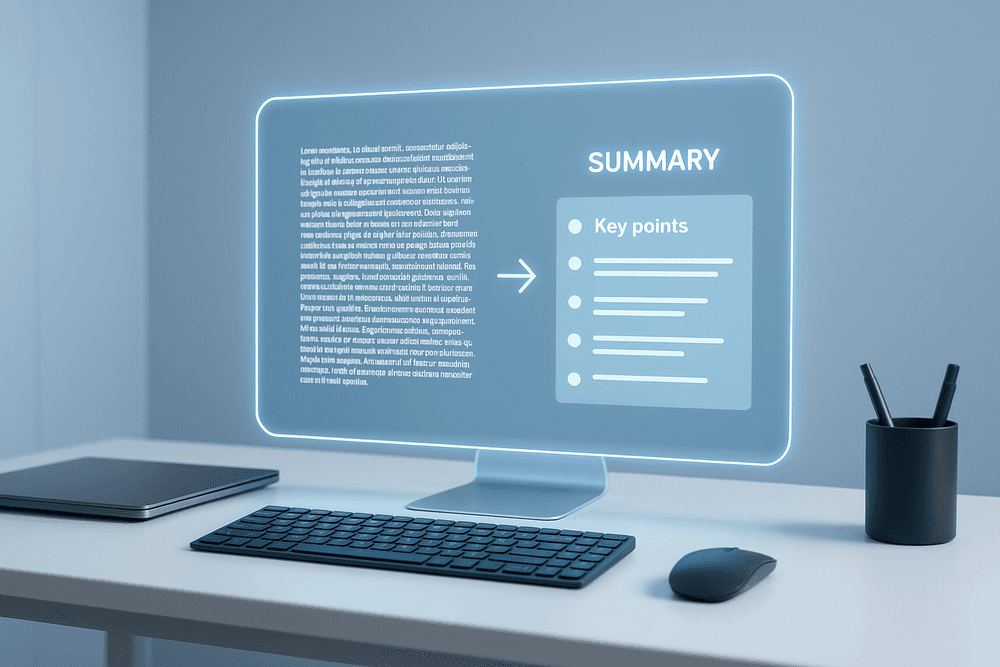
A Step-by-Step Guide to Effective Research Paper Summarization
Navigating the world of AI-powered tools can feel overwhelming, but a structured approach can transform them into indispensable research assistants. By following a clear workflow, you can ensure your research paper summarization process is not only fast but also accurate and genuinely useful. Here’s how to move from a dense academic document to clear, actionable insights in four manageable steps.
Step 1: Choosing and Preparing Your Source Document
The quality of your summary starts with the quality of your input. Before you even upload a file, take a moment to prepare your source material for the best possible outcome.
- Select the Right Format: Most AI summarizers work best with clean, text-based files like PDFs or direct URLs to the article. If you have a scanned document, ensure it has been processed with Optical Character Recognition (OCR) so the text is selectable and not just an image. A low-quality scan will lead to a garbled, nonsensical summary.
- Conduct a Quick Manual Scan: Don't go in blind. Spend 60 seconds reading the paper's abstract, introduction, and conclusion yourself. This gives you a foundational understanding of the author's main argument, hypothesis, and key findings. This mental framework is crucial for a later step: evaluating the AI's output critically.
- Check for Compatibility: Ensure the document is in a language supported by your tool and isn't locked or protected in a way that prevents the AI from accessing the text.
Step 2: Defining Your Summarization Goals and Parameters
A generic summary is rarely as useful as one tailored to your specific needs. The power of modern research paper summarization tools lies in their ability to adapt to your goals. Clearly define what you want before you click "summarize."
- Identify Your Purpose: Are you trying to get a quick overview to see if the paper is relevant? Or are you looking for specific details about the methodology, the dataset used, or the study's limitations? Your goal dictates the kind of summary you need.
- Adjust the Parameters: Leverage the tool's settings. You can often control:
- Length: Choose between a short abstract, a list of bullet points, or a more detailed, multi-paragraph summary.
- Focus: Some advanced tools allow you to ask specific questions like, "What was the primary conclusion?" or "Summarize the literature review section." This directs the AI to extract the most relevant information for your task.
- Format: Decide if you want a narrative summary or a more structured output, like a list of key findings and supporting evidence.
Step 3: Critically Evaluating the AI-Generated Output
This is the most important step in the entire process. Never accept an AI-generated summary at face value. AI is a powerful assistant, but it lacks the human capacity for true comprehension and critical analysis.
- Check for Accuracy: Compare the summary against the key sections you pre-scanned (abstract, conclusion). Does the AI’s version align with the author's main points? Watch for "hallucinations"—instances where the AI invents information that isn't in the source text.
- Assess for Completeness: Did the AI miss anything crucial? Often, AI summarizers excel at pulling out findings but may overlook important context, such as the study's limitations, ethical considerations, or suggestions for future research.
- Evaluate Nuance and Context: Academic writing is filled with nuance (e.g., "suggests," "may indicate," "correlates with"). Ensure the AI hasn't oversimplified these subtleties into definitive statements. The difference between "correlation" and "causation" is massive, and a poorly generated summary might miss it.
Step 4: Integrating Key Insights into Your Notes or Draft
Once you've verified the summary's accuracy, it's time to put it to work. The goal is to integrate the knowledge, not just copy the text.
- Paraphrase and Synthesize: Use the summary as a guide to write notes in your own words. This practice aids retention and ensures you are genuinely understanding the material. Direct copy-pasting from an AI summary into your work is a serious academic integrity violation.
- Build Your Annotated Bibliography: The AI-generated summary provides an excellent starting point for an entry in an annotated bibliography. Refine it with your own critical evaluation of the paper’s strengths and weaknesses.
- Cite the Original Source: Always remember that the AI is a window to the original paper. When you incorporate an idea or a finding into your writing, you must cite the actual research paper, not the summarization tool. Use the summary to identify powerful quotes, but retrieve them directly from the source document to ensure perfect accuracy and proper citation.
Real-World Use Cases for Research Paper Summarization
The theoretical benefit of saving time is clear, but the true power of AI-powered research paper summarization comes alive in its practical, real-world applications. Across academia, industry, and public service, these tools are not just a convenience—they are transforming workflows, accelerating discovery, and enabling smarter decisions. From the graduate student’s desk to the corporate lab, AI is fundamentally changing how we interact with complex information.
Accelerating Literature Reviews for Theses and Dissertations
The literature review is the backbone of any thesis or dissertation, but it's often a monumental task. Graduate students face a sea of academic papers and must identify the foundational, relevant, and cutting-edge works in their field. This is where research paper summarization becomes an indispensable ally. Instead of spending weeks manually sifting through abstracts and introductions, students can use AI to rapidly triage dozens of papers in a single afternoon. A well-generated summary reveals a paper's core argument, methodology, and key findings, allowing a researcher to decide in minutes whether it warrants a full read. This dramatically speeds up the process of mapping a field, identifying key debates, and uncovering the crucial "gap in the literature" that their own research will fill.
Staying Current with Industry Breakthroughs for R&D Teams
In the hyper-competitive world of technology and science, staying current isn't just an advantage; it's a necessity. Research and Development (R&D) teams are under constant pressure to innovate and outpace competitors. AI summarization tools act as a powerful intelligence-gathering engine, scanning and digesting a high volume of newly published papers, patents, and conference proceedings. Instead of having highly paid engineers and scientists spend hours reading, AI can deliver distilled briefings on relevant advancements. This helps teams quickly spot emerging technologies, monitor competitors' research, and identify new avenues for product development. By reducing information overload, AI-powered research paper summarization helps foster a more agile and informed innovation cycle.
Making Complex Medical Studies Accessible for Practitioners
For doctors, nurses, and other healthcare professionals, practicing evidence-based medicine is the gold standard. However, the firehose of new medical research is impossible to keep up with, and clinical studies are often dense with complex statistics and specialized terminology. AI summarizers can bridge this critical gap between research and practice. By translating a lengthy clinical trial report into a concise, understandable summary, these tools highlight the essential information: patient population, intervention, key outcomes, and clinical implications. This allows a busy practitioner to quickly grasp the takeaways of a new study during a lunch break, ensuring their clinical decisions are informed by the very latest scientific evidence and ultimately improving patient care.
Streamlining Policy and Market Research Reports
Policy analysts, financial advisors, and market researchers depend on synthesizing vast amounts of information to provide actionable insights. Their work often involves combing through lengthy government reports, academic economic studies, and detailed market analyses to identify trends and data points. AI-driven research paper summarization automates this laborious extraction process. An analyst can feed a 100-page report into a tool and receive a bulleted summary of its main arguments, statistical findings, and conclusions in seconds. This allows for rapid environmental scanning and trend analysis, enabling them to produce briefings, build strategic plans, and make data-driven recommendations with greater speed and accuracy.

Conclusion: The Future of Research and Your Next Steps
We've journeyed through the revolutionary landscape of AI-powered academic tools, and the conclusion is clear: AI research paper summarization is not a fleeting trend but a fundamental shift in how we approach scholarly literature. By harnessing these technologies, you can break down complex information, accelerate your literature review process, and dedicate more time to critical analysis and original thought. The future of research is efficient, accessible, and deeply integrated with intelligent assistants. Now, it's time to put this knowledge into action and transform your own workflow.
Final Checklist: Selecting the Right Tool for You
As you prepare to choose your AI research companion, this final checklist will help you select the best fit for your specific needs. A thoughtful choice now will save you countless hours later.
- Accuracy and Nuance: Does the tool consistently capture the core arguments, methodology, and findings without misinterpretation? Always test it with a paper you know well before relying on it for new material.
- Customization: Can you adjust the summary length, format (e.g., bullet points vs. paragraph), or focus on specific sections of the paper? A tool that adapts to your project is invaluable.
- Integration: Does it work with your existing workflow? Look for integrations with reference managers like Zotero or Mendeley, or browser extensions for on-the-fly summarization.
- User Experience: Is the interface intuitive and easy to navigate? A clunky or confusing tool can defeat the entire purpose of saving time and reducing friction.
- Pricing Model: Does the cost align with the features offered? Evaluate free trials and subscription plans to find a sustainable option for your budget and usage frequency.
Ethical Considerations and Avoiding Plagiarism
Embracing AI research paper summarization comes with a profound responsibility to uphold academic integrity. These tools are powerful aids, but they demand mindful usage. Remember these crucial ethical guidelines:
- AI as an Assistant, Not an Author: Treat these tools as a starting point, not a final source. They are designed to aid your understanding, not replace it. The critical thinking, interpretation, and synthesis remain your intellectual responsibility.
- Verify, Don't Trust Blindly: Always cross-reference the AI-generated summary with the original paper. AI can sometimes miss crucial context or misinterpret complex jargon. The original source is always the ground truth.
- Cite the Source, Not the Summary: Never, under any circumstances, copy and paste an AI-generated summary directly into your work. This is plagiarism. The summary helps you understand the source, which you must then cite properly according to your institution's guidelines. Use the insights you gain to formulate your own sentences and arguments.
Start Your First AI-Powered Research Paper Summarization Today
The barrier to entry has never been lower. You are now equipped with the knowledge to navigate this exciting technology responsibly and effectively. Don't wait for the future of research to arrive—it's already here.
Choose a tool that resonated with you from our guide, or use the checklist above to explore a new one. Find a dense, challenging paper from your reading list and run it through the platform. See firsthand how an AI research paper summarization tool can distill its core concepts in minutes. This simple action is your first step toward a more streamlined and insightful academic workflow, unlocking a new level of productivity in your scholarly pursuits.