August 6, 2025
Why AI Performance Monitoring is Non-Negotiable
Why AI Performance Monitoring is Non-Negotiable
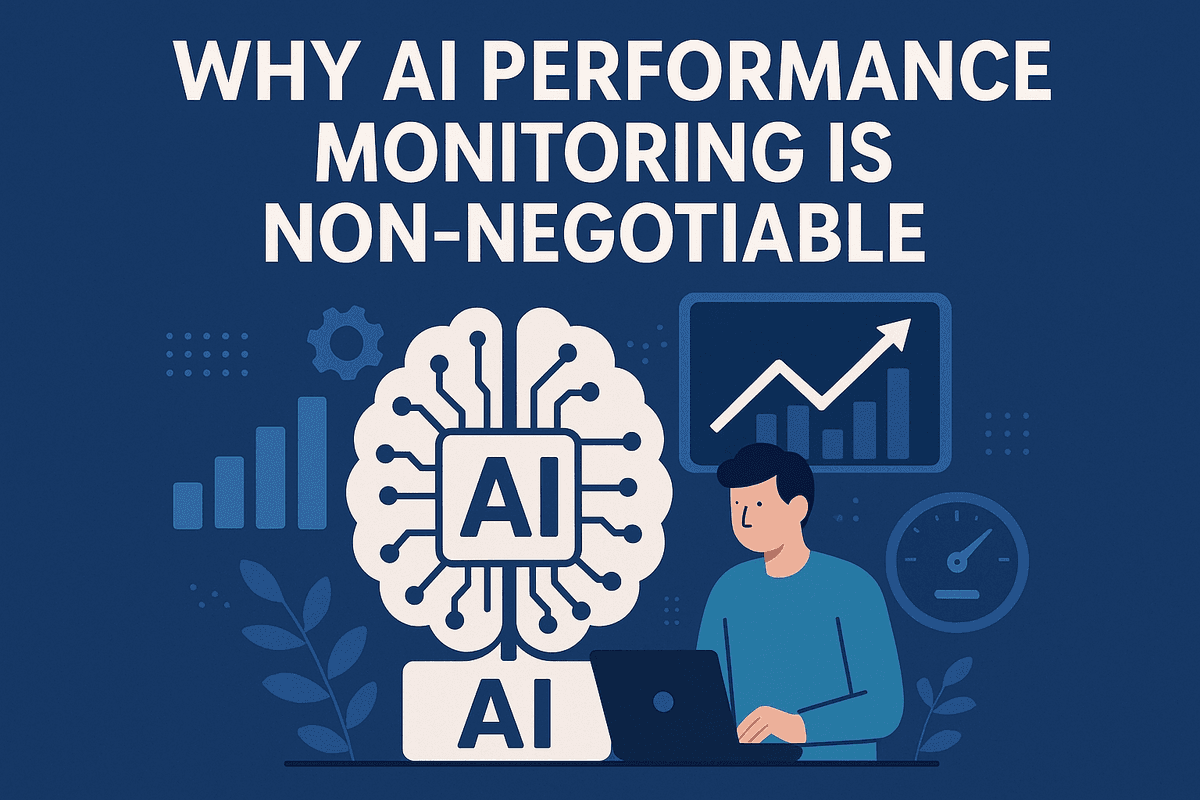
Imagine this: your team has spent months building a state-of-the-art AI model. It aced every test in the lab, achieving stellar accuracy. You deploy it into production with high hopes, only to find that weeks or months later, its performance has quietly degraded. The recommendations are slightly off, the forecasts are less reliable, and the classifications are subtly biased. This isn't a hypothetical scenario; it's the default outcome for AI systems left unmanaged in the wild.
The transition from a sterile training environment to the dynamic, unpredictable real world is where even the best models can fail. This is precisely why AI performance monitoring is not a luxury, but a fundamental necessity for any organization relying on machine learning.
What Happens When Good AI Models Go Bad in Production?
A model’s initial accuracy is just a snapshot in time. Once deployed, it encounters a world that is constantly changing. This change manifests in two primary ways:
- Data Drift: The statistical properties of the input data the model receives in production begin to differ from the data it was trained on. A fraud detection model trained on transaction data from 2021 might struggle with the new consumer behaviors and payment methods of 2024.
- Concept Drift: The relationship between the input data and the outcome you're trying to predict changes. For example, the factors that defined a "good" loan applicant before an economic downturn may no longer hold true during a recession.
Without active monitoring, these drifts are silent killers. They slowly erode model performance, leading to a cascade of poor decisions that can go unnoticed until significant damage is done.
Defining AI Performance Monitoring: Beyond Basic Accuracy
So, what is AI performance monitoring? It’s the continuous, systematic process of tracking, analyzing, and managing a model’s behavior and effectiveness in a live production environment. It moves far beyond a simple pre-launch accuracy score.
A robust AI performance monitoring strategy provides a holistic view by tracking a range of critical metrics, including:
- Predictive Performance: How are metrics like accuracy, precision, recall, and F1-score trending over time?
- Drift Detection: Are the input data distributions and underlying concepts remaining stable?
- Operational Health: Is the model responding quickly (latency)? Can it handle the request volume (throughput)? Are there technical errors?
- Fairness and Bias: Is the model performing equitably across different user segments?
This proactive approach allows you to catch issues early, understand why performance is changing, and take corrective action—like retraining or recalibrating—before it impacts your business.
The Hidden Costs of Unmonitored AI Systems
Ignoring AI performance monitoring introduces substantial and often hidden costs that extend far beyond the IT department. The consequences of a degrading model can be severe:
- Financial Erosion: A decaying demand-forecasting model leads to costly inventory mistakes. A flawed lead-scoring model wastes sales efforts on unqualified prospects. These subtle inefficiencies add up to significant revenue loss.
- Reputational Damage: When a customer-facing AI fails—like a chatbot giving nonsensical answers or a recommendation engine pushing irrelevant products—it erodes customer trust and damages your brand's reputation.
- Operational Drag: Teams are forced into a reactive, firefighting mode, manually correcting bad AI outputs and spending countless hours diagnosing problems that a proper monitoring system would have flagged automatically.
- Compliance and Ethical Risks: In regulated fields like finance and healthcare, a biased or underperforming model can lead to discriminatory outcomes, resulting in hefty fines and serious legal consequences.
Ultimately, launching an AI model without a plan for monitoring its performance is like sending a ship to sea without a crew or navigation tools. It might start on the right course, but it's only a matter of time before it drifts into dangerous waters.
Core Metrics for Effective AI Performance Monitoring
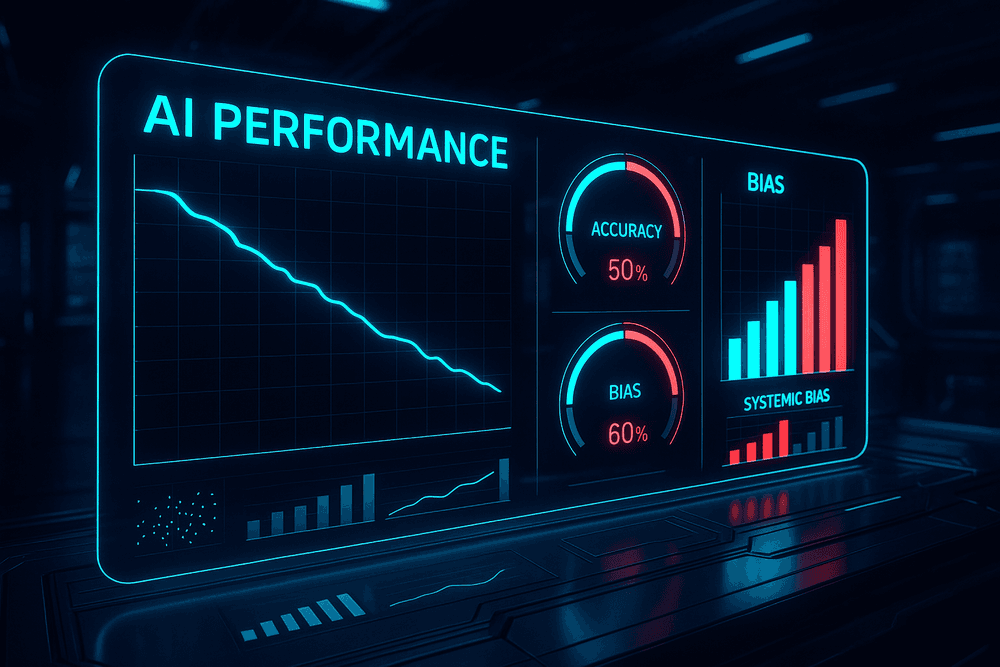
Once an AI model is deployed, the real work of ensuring its long-term value begins. Effective AI performance monitoring isn't about a single "good/bad" score; it's about continuously tracking a suite of core metrics that, together, paint a complete picture of model health and reliability. These metrics act as your early warning system, alerting you to issues before they impact business outcomes or user trust.
Tracking Model Drift and Concept Drift Over Time
Your model was trained on a snapshot of the world, but the world is constantly changing. This evolution leads to two types of "drift" that are critical to monitor:
- Concept Drift: This occurs when the fundamental relationships between your model's inputs and outputs change. For example, in a product recommendation engine, a new viral trend could suddenly change what "popular" means, making the model's existing understanding obsolete. The statistical properties of the target variable itself are changing.
- Model Drift (or Prediction Drift): This is the direct consequence of concept drift or data drift—it’s the degradation of your model's predictive power over time. As the real-world data deviates further from the training data, the model's predictions become less accurate. Proactive AI performance monitoring allows you to detect this decay, identify its root cause, and schedule retraining before performance drops to unacceptable levels.
Real-Time Accuracy, Precision, and Recall Metrics
While drift provides a high-level view of changing conditions, you still need to measure raw predictive power. For classification models, three metrics are fundamental:
- Accuracy: The simplest metric, representing the percentage of all predictions that were correct. While useful, it can be misleading for imbalanced datasets (e.g., a fraud model that is 99% accurate simply by predicting "not fraud" every time).
- Precision: Answers the question: "Of all the positive predictions the model made, how many were actually correct?" High precision is crucial when the cost of a false positive is high, such as incorrectly flagging a legitimate bank transaction as fraudulent.
- Recall (or Sensitivity): Answers the question: "Of all the actual positive cases, how many did the model correctly identify?" High recall is vital when the cost of a false negative is high, such as failing to detect a cancerous tumor in a medical scan.
Monitoring these metrics in real-time is a cornerstone of any robust AI performance monitoring strategy, providing immediate feedback on your model's operational effectiveness.
Detecting and Mitigating Unwanted Model Bias
An AI model can be technically accurate but operationally a failure if it exhibits bias. Model bias occurs when a model produces systematically prejudiced results against certain subgroups, often due to imbalanced or unrepresentative training data. For example, a loan approval model might unfairly deny applicants from a specific demographic.
Effective AI performance monitoring must include fairness metrics. This involves segmenting your model's predictions by sensitive attributes (like age, gender, or geography) and comparing performance metrics across these groups. Detecting significant disparities is the first step toward mitigation, which can involve collecting more representative data, using algorithmic debiasing techniques, or retraining the model with fairness constraints.
Monitoring Data Integrity and Input Quality
The principle of "garbage in, garbage out" is absolute in AI. Your model's performance is fundamentally dependent on the quality of the data it receives for predictions. Therefore, monitoring input data is a non-negotiable part of the process. Key areas to watch include:
- Data Schema Changes: Unexpected changes in data format, new categories, or altered data types can break the model's pipeline.
- Distribution Shifts: A sudden change in the statistical distribution of an input feature (e.g., a surge in traffic from a new country) can push the model into scenarios it has never seen.
- Data Quality Issues: Track the rate of null values, outliers, or nonsensical entries. A sudden spike in missing data for a critical feature will inevitably degrade model performance.
Best Practices for a Robust AI Performance Monitoring Strategy
Deploying an AI model is just the beginning of its lifecycle. To ensure it consistently delivers value and doesn't become a liability, you need a proactive and structured strategy. Effective AI performance monitoring isn't about occasional spot-checks; it's a continuous process built on a foundation of clear, actionable best practices. Adopting these pillars will transform your monitoring from a reactive chore into a strategic advantage.
Establish Clear Performance Baselines and Degradation Thresholds
You can't know if your model is underperforming if you haven't defined what "good performance" looks like. This is where baselines come in. Before your model ever sees live production data, you must establish its performance baseline using a holdout validation or test dataset. This baseline is your benchmark—a snapshot of your model's peak performance on key metrics like accuracy, F1-score, precision, recall, and latency under controlled conditions.
Once you have your baseline, the next critical step is to define degradation thresholds. These are pre-determined limits that, if crossed, signify an unacceptable drop in performance. For example, you might decide that a 5% drop in accuracy or a 20% increase in prediction latency is a trigger for investigation. These thresholds are the guardrails of your AI performance monitoring system, turning raw data into clear signals that demand action.
Set Up Automated Alerts for Proactive Anomaly Detection
In a live environment, model performance can degrade in an instant. Relying on manual checks is inefficient and puts you at risk of discovering problems only after they've impacted your users and business outcomes. The solution is automated alerting.
A robust monitoring platform should be configured to automatically track key indicators of model health, such as:
- Data Drift: Significant changes in the statistical properties of input data.
- Concept Drift: Changes in the underlying relationship between inputs and outputs.
- Metric Spikes: Sudden drops in accuracy or surges in error rates.
- Latency Issues: Unacceptable delays in generating predictions.
When a metric breaches a pre-defined threshold, the system should instantly trigger an alert through channels like Slack, PagerDuty, or email. This proactive approach allows your MLOps and data science teams to investigate and resolve issues before they escalate, ensuring system reliability and user trust.
Integrate a Human-in-the-Loop (HITL) Feedback System
While automation is key, human expertise remains invaluable. A Human-in-the-Loop (HITL) system creates a feedback mechanism where human experts can review, validate, or correct the AI's predictions. This is particularly crucial for ambiguous cases or high-stakes decisions where model confidence is low.
Integrating an HITL workflow serves two primary purposes. First, it acts as a safety net, catching errors that automated checks might miss. Second, and more importantly, every human correction provides a high-quality, labeled data point. This feedback is gold for your retraining pipeline, allowing you to continuously improve the model by teaching it from its real-world mistakes. This symbiotic relationship between human and machine is a hallmark of a mature AI performance monitoring strategy.
Create a Clear Rollback and Retraining Plan
No matter how well you monitor, a model will eventually need to be updated or rolled back. Hope is not a strategy; a documented plan is. Your team must have a clear, pre-defined process for two critical scenarios:
- Rollback Plan: If a newly deployed model causes a severe issue, you need an "emergency stop" button. This plan should detail the technical steps to quickly and safely revert to a previously known stable version, minimizing business disruption.
- Retraining Plan: When monitoring detects sustained performance degradation, it's time to retrain. This plan should outline the triggers for retraining (e.g., crossing a drift threshold), the data sources to be used (including HITL feedback), the validation process for the new model, and the steps for deploying it safely into production.
This plan closes the monitoring loop, ensuring that insights gathered from your system lead directly to corrective actions and a healthier, more accurate AI.
The Modern Toolkit for AI Performance Monitoring
Choosing the right tools is the cornerstone of a successful AI performance monitoring strategy. Without the proper toolkit, even the most sophisticated models can fail silently in production. The modern MLOps landscape offers a rich ecosystem of solutions, from flexible open-source libraries to powerful managed platforms. Navigating these options to find the best fit for your team and infrastructure is a critical first step.
Open-Source vs. Managed AI Monitoring Platforms
The first major decision is whether to build on an open-source foundation or invest in a managed, commercial platform. Each path offers distinct advantages.
- Open-Source Tools (e.g., Evidently AI, WhyLabs): These solutions provide maximum flexibility and control. They are ideal for teams with strong engineering capabilities who want to build a completely custom AI performance monitoring stack.
- Pros: No licensing fees, highly customizable, strong community support, and avoids vendor lock-in.
- Cons: Requires significant setup and maintenance overhead, a steeper learning curve, and lacks dedicated enterprise support.
- Managed Platforms (e.g., Fiddler AI, Arize, Datadog): These are SaaS products that offer a turnkey solution. They are designed for rapid deployment and ease of use, making them perfect for teams who want to focus on insights rather than infrastructure.
- Pros: Quick setup, dedicated customer support, enterprise-grade features like role-based access control, and intuitive user interfaces.
- Cons: Incurs subscription costs, may be less customizable, and can lead to vendor lock-in.
Essential Features to Look for in a Monitoring Tool
Regardless of your choice, any effective AI performance monitoring tool should include a core set of features:
- Automated Drift Detection: The ability to automatically detect both data drift (changes in input data distributions) and concept drift (changes in the relationship between inputs and outputs).
- Performance & Quality Metrics: Real-time tracking of key model metrics (accuracy, precision, recall, F1-score) and data quality issues (null values, type mismatches).
- Model Explainability (XAI): Integrations with XAI frameworks like SHAP or LIME to help you understand why a model made a specific prediction, which is crucial for debugging.
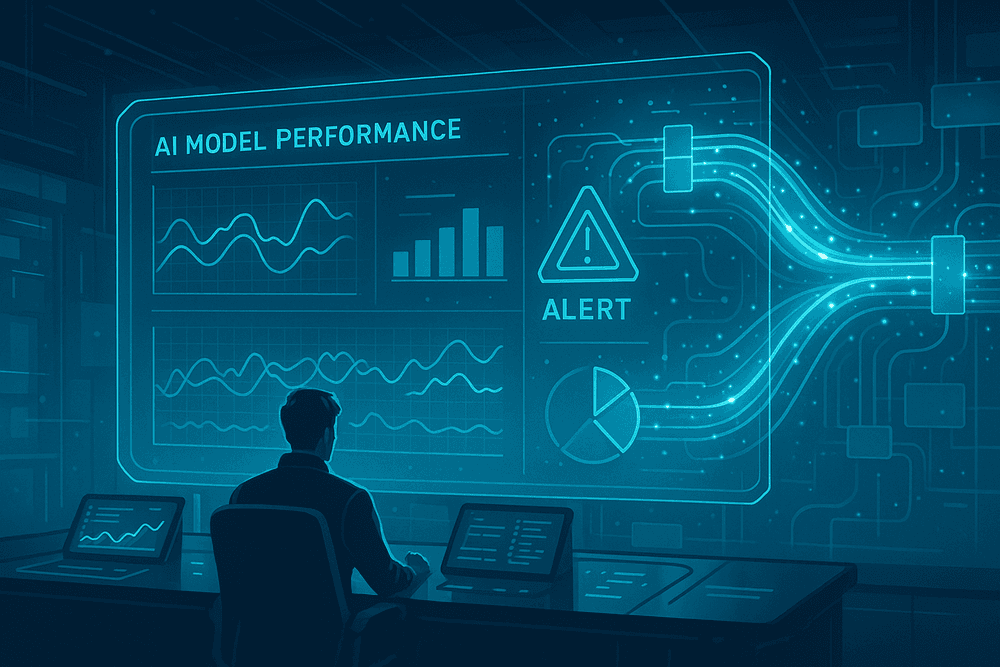
- Customizable Dashboards & Alerting: Intuitive, shareable dashboards for visualization and a robust alerting system that can notify you via Slack, email, or PagerDuty when key metrics cross predefined thresholds.
- Scalability and Flexibility: The tool must be able to handle your production traffic and scale as your use cases grow. It should also be flexible enough to monitor various model types, from classical machine learning to LLMs.
How to Integrate Monitoring into Your Existing MLOps Pipeline
Effective AI performance monitoring is not an afterthought; it's an integral part of the MLOps lifecycle. Integration should be seamless. Most modern tools provide SDKs and APIs for easy implementation. Key integration points include:
- Prediction Logging: Instrument your model serving environment (e.g., a REST API endpoint) to send model inputs and outputs to the monitoring platform in real-time or in batches.
- Connecting Ground Truth: Establish a pipeline to feed ground truth data back to the monitoring tool as it becomes available to calculate performance metrics like accuracy.
- Automated Retraining Triggers: Configure your monitoring tool to trigger a retraining pipeline via webhooks or API calls when significant drift or performance degradation is detected.
AI Performance Monitoring in Action: Real-World Use Cases
Theoretical knowledge is valuable, but seeing AI performance monitoring in practice reveals its true business impact. The following case studies illustrate how organizations across different industries leverage monitoring to protect their investments, mitigate risk, and ensure their AI systems deliver consistent value.
Case Study 1: Maintaining Recommendation Engine Relevancy in E-Commerce
The Challenge: An online fashion retailer deployed a sophisticated recommendation engine to personalize the shopping experience and boost sales. Initially, the model performed exceptionally well, increasing average order value by 15%. However, after six months, user engagement with the recommendations plummeted. New fashion trends, seasonal shifts, and changing consumer behavior had caused significant concept drift, making the model's suggestions feel outdated and irrelevant.
The AI Performance Monitoring Solution: The company implemented a comprehensive AI performance monitoring platform. They began tracking key business metrics like click-through rate (CTR) and conversion rate for recommended products in real-time. Additionally, they monitored for data drift by setting up alerts for changes in the distribution of input features like product categories, price points, and user demographics.
The Outcome: The monitoring system quickly flagged the declining CTR and identified a significant drift in user interaction data. This triggered an automated alert for the MLOps team to retrain the model on fresh data. By establishing this continuous feedback loop, the retailer now maintains recommendation relevancy, protects its revenue stream, and keeps customers engaged with personalized content that reflects current trends.
Case Study 2: Ensuring Fairness in a FinTech Credit Scoring Model
The Challenge: A financial technology firm developed an AI model to automate credit scoring and loan application decisions, aiming for faster and more accurate approvals. While the model showed high accuracy during testing, there was a major concern about unintentional bias. A model that inadvertently discriminates against protected demographic groups could lead to severe regulatory penalties and reputational damage.
The AI Performance Monitoring Solution: Beyond standard metrics like accuracy and precision, the firm integrated fairness-specific tracking into their AI performance monitoring framework. They continuously monitored metrics like demographic parity (ensuring the rate of positive outcomes is similar across groups) and equal opportunity (ensuring the true positive rate is consistent). The system was configured to alert compliance and data science teams if these fairness metrics crossed a predefined, ethically sound threshold.
The Outcome: The monitoring system provided an ongoing, auditable record of the model's fairness. On one occasion, it detected a subtle bias emerging after a shift in application data. The team was able to diagnose the issue—an input feature was acting as an unfair proxy for a demographic attribute—and deploy a retrained, debiased model before any significant harm was done. This proactive approach to AI performance monitoring ensures regulatory compliance and builds trust with customers.
Case Study 3: Preventing Failures in Predictive Maintenance AI
The Challenge: A manufacturing giant used an AI model to predict machinery failures on its production line, scheduling maintenance to prevent costly, unplanned downtime. The model relied on data from dozens of IoT sensors. However, sensors can degrade, get recalibrated, or fail entirely, leading to silent failures where the input data no longer reflects reality. This data drift could cause the model to miss an impending breakdown, defeating its entire purpose.
The AI Performance Monitoring Solution: The MLOps team implemented a robust AI performance monitoring strategy focused on input data integrity and model confidence. The system continuously monitored the statistical properties of data from each sensor, flagging any anomalous drifts or changes in data patterns. It also tracked the model's prediction confidence scores, alerting operators when the model became uncertain about its predictions for a specific piece of equipment.
The Outcome: This two-pronged approach has been instrumental in maintaining operational reliability. The monitoring system has caught several instances of sensor degradation, allowing technicians to replace the hardware before it corrupted the model's predictions. By ensuring the health of both the input data and the model's output, the company has successfully prevented critical equipment failures, saving millions in potential downtime and repair costs.
Conclusion: Future-Proofing Your AI Investment
Deploying an AI model is not the finish line; it’s the starting line. As we've explored, the dynamic nature of real-world data means that even the most sophisticated models will degrade over time. The true value of your AI initiative is not in its initial launch but in its sustained, reliable performance. This is where a strategic approach to AI performance monitoring becomes your most critical asset, transforming a potentially fragile project into a future-proof, value-generating engine for your business. It is the essential practice that safeguards your investment and ensures your models continue to deliver on their promise long after deployment.
Key Takeaways for Maintaining AI Model Health
To distill the core principles of effective model management, keep these takeaways in mind. They are the pillars of a resilient and trustworthy AI ecosystem.
- Proactivity Trumps Reactivity: Don't wait for customer complaints or silent failures to erode your bottom line. A robust AI performance monitoring framework allows you to proactively detect subtle issues like data drift, concept drift, and performance decay, enabling you to intervene before they cause significant business impact.
- Monitor Beyond Accuracy: While accuracy is a vital metric, it only tells part of the story. A holistic view is non-negotiable. Your monitoring strategy must encompass data integrity, drift detection, prediction latency, operational health (CPU/memory usage), and, most importantly, the downstream business KPIs your model is designed to influence.
- Automation is a Necessity, Not a Luxury: In a production environment, manual spot-checks are inefficient, unscalable, and prone to human error. Automating your monitoring processes with dashboards, real-time alerts, and scheduled health reports is fundamental to building an effective MLOps culture and ensuring consistent oversight.
- Monitoring is a Collaborative Effort: Effective AI performance monitoring bridges the gap between technical and business teams. When data scientists, MLOps engineers, and business stakeholders have shared visibility into model performance, they can collaborate more effectively to diagnose issues, prioritize fixes, and align AI outcomes with strategic goals.
Your First Steps to Implementing AI Performance Monitoring
Getting started doesn't have to be an overwhelming task. You can begin building a foundational monitoring practice today by taking these concrete steps.
- Establish Your Baseline: Define what "good" looks like. Document your model's performance on your validation dataset across key metrics like accuracy, precision, and F1-score. This baseline will be your ground truth for detecting future degradation.
- Identify Critical Metrics: Start small but smart. Select 3-5 initial metrics to track. Prioritize at least one statistical metric (e.g., accuracy), one drift metric (e.g., Population Stability Index for feature drift), and one operational metric (e.g., prediction latency).
- Choose the Right Tooling: Evaluate tools that fit your technical stack and team's expertise. The market includes powerful open-source libraries for specific tasks and comprehensive end-to-end platforms for enterprise-grade governance. The goal is to find a solution that provides clear visualizations and integrates seamlessly into your workflow.
- Configure Initial Alerts: Set up a simple alerting system for your most critical metric. For example, create an automated alert that notifies your team if model accuracy drops by 5% below its baseline for three consecutive days. This is your first line of automated defense.
Schedule a Consultation to Assess Your Monitoring Needs
Every AI application has a unique risk profile and a distinct operational footprint. A generic approach to monitoring often leaves critical blind spots. If you’re ready to build a monitoring strategy that is tailored to your specific models, data pipelines, and business objectives, our experts can help.
We offer a complimentary consultation to help you navigate the complexities of AI performance monitoring. In this session, we will help you assess your current MLOps maturity, identify your models' biggest vulnerabilities, and outline a clear roadmap for implementing a robust monitoring framework that protects your AI investment.
[Schedule Your Free AI Monitoring Assessment Today]