
August 21, 2025
Why AI Is Your Next Big Idea Partner
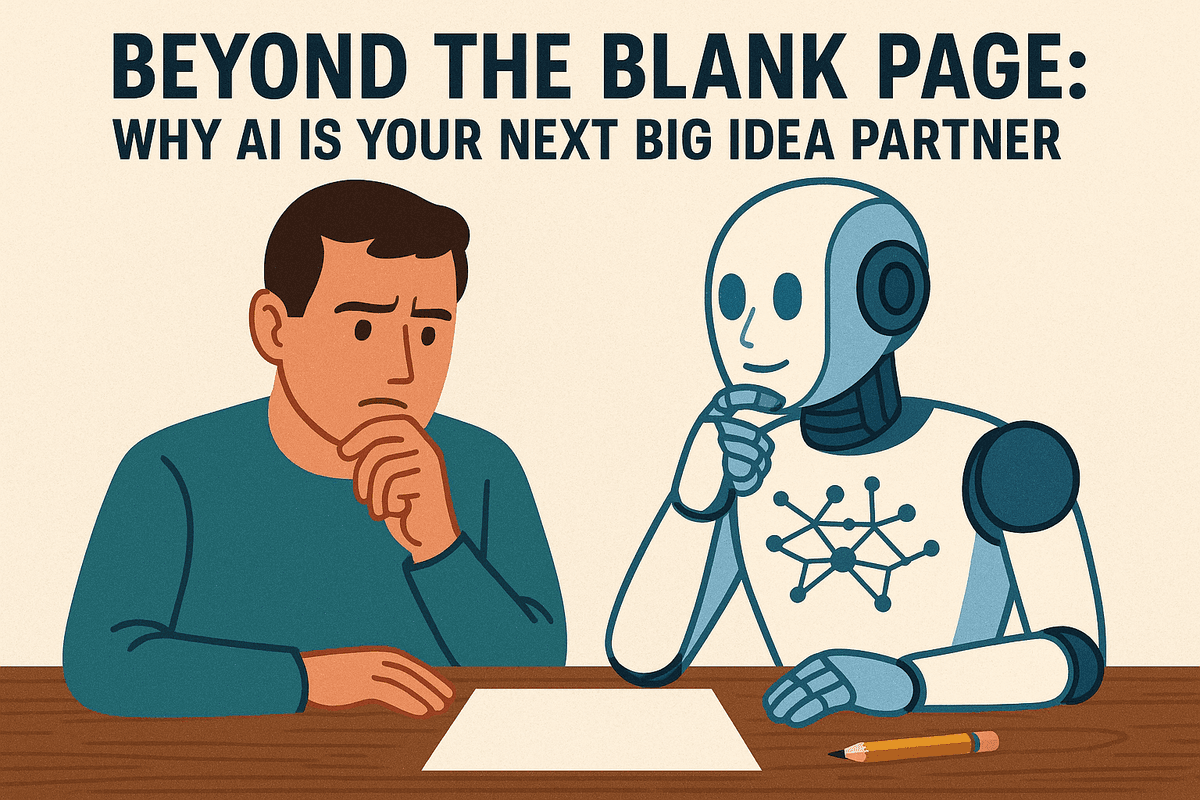
Beyond the Blank Page: Why AI Is Your Next Big Idea Partner
Every creator, marketer, and entrepreneur knows the feeling: the intimidating glare of a blank page, the pressure of an impending deadline, and the elusive spark of a truly great idea. For decades, we’ve relied on caffeine-fueled brainstorming sessions, whiteboards, and pure creative grit to push past this initial barrier. But what if you had a partner who never ran out of ideas, had access to nearly the entirety of human knowledge, and was ready to brainstorm 24/7? Welcome to the new era of creative collaboration, powered by Artificial Intelligence.
What Exactly is AI for Idea Generation?
At its core, AI for idea generation is not about replacing human ingenuity—it's about augmenting it. Think of it less as an autopilot for creativity and more as a super-powered co-pilot. These tools leverage sophisticated Large Language Models (LLMs) to process immense amounts of information, recognize hidden patterns, and generate novel concepts based on a simple prompt.
The best ai for idea generation acts as a catalyst. It can:
- Serve as a digital muse: Provide endless starting points when you’re feeling stuck.
- Act as a sparring partner: Challenge your assumptions by offering alternative perspectives or playing devil's advocate.
- Function as a research assistant: Synthesize information and present it as unique angles, content pillars, or strategic frameworks.
Whether you’re trying to name a new product, brainstorm a viral marketing campaign, or outline the chapters of a book, AI provides the raw material and diverse perspectives needed to get your creative engine running at full speed.
How AI Can Revolutionize Your Creative Workflow
Integrating AI into your ideation process is more than just a novelty; it’s a fundamental upgrade to your entire creative workflow. The immediate impact is a dramatic increase in speed and volume. Where a team might brainstorm a dozen solid ideas in an hour, an AI can produce a hundred in seconds, instantly widening the pool of possibilities.
This revolution goes beyond mere quantity. AI excels at "adjacent thinking"—connecting seemingly unrelated concepts to forge fresh, innovative pathways you might have otherwise missed. It breaks you out of cognitive ruts and industry echo chambers, introducing a diversity of thought that is crucial for true innovation. For teams, this means less time spent on preliminary brainstorming and more time dedicated to refining and executing the strongest concepts. Finding the best ai for idea generation tool for your team can transform sluggish creative meetings into dynamic, high-output sessions that drive tangible results.
Setting the Stage: What to Expect in This Guide
Now that we’ve established the "why," it's time to dive into the "how" and "which." This guide is your definitive roadmap to navigating the exciting landscape of AI-powered ideation. We will move from theory to practical application, giving you the clarity needed to make an informed decision.
Here’s what’s ahead:
- A Head-to-Head Comparison: We’ll break down the features, strengths, and ideal use cases for the top AI idea generation platforms on the market.
- Actionable Use Cases: Discover real-world examples of how professionals are using these tools to generate everything from content calendars to new business models.
- Implementation Blueprints: Get practical tips for integrating these tools into your personal and team workflows for maximum impact.
Our goal is simple: to equip you with the knowledge to select the best ai for idea generation and turn it into your most valuable creative partner. Let’s get started.

The Ultimate Showdown: Finding the Best AI for Idea Generation
With so many powerful models competing for the top spot, choosing the best AI for idea generation can feel overwhelming. The truth is, the "best" tool often depends on your specific goal. Are you looking for a rapid-fire list of blog topics, a deeply nuanced brand concept, or a data-driven content strategy? Each of the leading AIs brings a unique set of strengths to the brainstorming table. Let’s break down the titans of the industry to see which one aligns with your creative process.
ChatGPT-4: The Versatile All-Rounder for Brainstorming
Think of ChatGPT-4 as the ultimate creative Swiss Army knife. Built on a massive dataset, its key strength is its sheer versatility and speed. If you’re feeling stuck and need to generate a high volume of diverse ideas quickly, ChatGPT-4 excels. It’s perfect for classic brainstorming techniques like list generation, SCAMPER, or creating mind maps.
Best for:
- Rapidly generating dozens of ideas for marketing angles, product names, or content pillars.
- Overcoming writer's block by exploring a topic from multiple, unexpected perspectives.
- General-purpose creative tasks where speed and variety are more important than immediate depth.
Claude 3 Opus: The Champion of Nuanced and Contextual Ideas
Where ChatGPT is a sprinter, Claude 3 Opus is a creative marathon runner. Its standout feature is its enormous context window and sophisticated reasoning ability. This allows it to grasp complex instructions and maintain context over long conversations, making it the best AI for idea generation when nuance and depth are critical. Feed it a detailed creative brief, a brand style guide, or a lengthy research document, and Opus will produce ideas that feel thoughtful, coherent, and perfectly aligned with your vision.
Best for:
- Developing complex brand narratives or multi-faceted campaign concepts.
- Refining a vague initial thought into a fully-fleshed-out, sophisticated idea.
- Brainstorming creative solutions that require a deep understanding of a specific tone or audience.
Google Gemini: The Research-Powered Content Ideator
Gemini’s superpower is its direct, real-time integration with the Google ecosystem. This connection makes it an unparalleled tool for generating ideas that are timely, relevant, and grounded in real-world data. While other models operate on static datasets, Gemini can pull from current search trends, news, and online discussions to inform its suggestions. This makes it an invaluable partner for SEO specialists, content marketers, and journalists.
Best for:
- Generating blog post or video ideas based on trending keywords and "People Also Ask" queries.
- Finding fresh, data-informed angles for content creation in a crowded niche.
- Brainstorming product features or business ideas based on current market gaps.
Niche vs. Generalist Tools: Making the Right Choice
While ChatGPT, Claude, and Gemini are powerful generalists, it’s also worth considering specialized, niche AI tools. These platforms are designed for a single purpose, such as generating business names, writing ad headlines, or creating social media hooks. While they lack the flexibility of the larger models, their outputs are often more refined and tailored to the specific task. The ideal workflow often involves both: use a generalist AI for broad, blue-sky thinking, then turn to a niche tool to perfect the final execution. Your choice for the best AI for idea generation ultimately hinges on your workflow—whether you need a versatile creative partner or a precision instrument.
Decoding the Features: What Makes a Great AI Idea Generator?
The quest for the best AI for idea generation goes beyond simply finding a tool that can answer a question. The real magic lies in features that transform a simple chatbot into a dynamic creative partner. Not all AI platforms are created equal, and understanding the key differentiators is crucial for unlocking truly innovative output. These capabilities empower you to steer the AI from generic suggestions toward bespoke, actionable concepts tailored precisely to your needs.
Mastering Prompt Engineering for Limitless Creativity
The most fundamental feature of any great AI is its ability to understand and execute complex instructions. This is where prompt engineering—the art of crafting detailed and effective prompts—comes into play. The quality of your ideas is directly proportional to the quality of your input.
- Weak Prompt: "Give me some marketing ideas."
- Powerful Prompt: "Act as a senior marketing strategist for a new brand of sustainable, high-performance running shoes. Our target audience is environmentally conscious millennials aged 25-40. Generate five unconventional marketing campaign ideas that focus on community-building and brand storytelling, avoiding traditional digital ads."
The best tools are highly responsive to nuance, context, and constraints. They allow you to define a role, set a goal, specify a format, and provide context, turning a simple query into a strategic brainstorming session.
Multi-Modal Inputs: Using Images and Voice to Spark Ideas
Inspiration isn’t limited to text, and your AI shouldn’t be either. Leading-edge AI idea generators now incorporate multi-modal capabilities, allowing you to use images, documents, and even voice notes as the starting point for brainstorming. Imagine uploading a photo of a product prototype and asking the AI to generate a list of potential names and taglines. Or, you could record a spontaneous voice memo during your commute and have the AI transcribe it, summarize the key points, and expand on your fledgling idea with related concepts and research directions. This flexibility caters to different creative styles and captures inspiration at the moment it strikes.
Custom Instructions and 'Personas' for Tailored Output
To achieve consistently relevant and high-quality ideas, you need an AI that learns your preferences. This is where custom instructions and "persona" settings become a game-changer. This feature allows you to provide the AI with standing orders about your company, your role, your brand's tone of voice, and your specific goals.
For example, you could instruct the AI: "Always respond from the perspective of a witty, slightly irreverent brand copywriter. Your ideas should be bold, challenge the status quo, and be written for a Gen Z audience." This pre-programming ensures every brainstorming session is already aligned with your strategic framework, saving you valuable time on refinement and making the tool feel like a true extension of your team.
Integration Capabilities with Your Existing Workflow
The best AI for idea generation doesn't force you into a new, isolated ecosystem. It seamlessly integrates with the tools you already use every day. An idea is only valuable if it can be easily shared, developed, and put into action. Look for platforms that offer robust integrations with software like Slack, Notion, Google Workspace, Trello, or Jira. The ability to generate a project plan and instantly export it to your project management tool, or to brainstorm content ideas and send them directly to your content calendar, is what separates a novelty gadget from an indispensable productivity powerhouse.

A Practical Guide: How to Use the Best AI for Idea Generation
Knowing which tools to use is only half the battle. The true art lies in knowing how to use them effectively. The quality of your output is directly tied to the quality of your input. By following a structured process, you can transform any of the best AI for idea generation from a simple suggestion box into a powerful innovation partner. Here’s a four-step framework to guide you from a blank page to a brilliant, actionable strategy.
Step 1: Clearly Define Your Goal or Problem
Before you type a single word into an AI, you must have absolute clarity on what you want to achieve. The principle of "garbage in, garbage out" is especially true for AI. A vague request will yield vague, generic, and often useless ideas. A specific, well-defined goal sets the stage for a targeted and relevant brainstorming session.
Instead of asking, “Give me business ideas,” define your parameters. A much better starting point is: “I want to generate ideas for a low-cost, subscription-based service targeting remote workers in urban areas who struggle with work-life balance.” This precision gives the AI the necessary constraints to produce focused, high-potential concepts.
Step 2: Crafting Powerful Opening Prompts that Work
Your initial prompt is the most critical part of the process. It’s your creative brief for the AI. A powerful prompt goes beyond a simple question and provides role, context, constraints, and a clear objective.
- Weak Prompt: “Marketing ideas for a coffee shop.”
- Powerful Prompt: “Act as a world-class marketing expert specializing in local businesses. Generate 10 unique, low-budget marketing campaign ideas for a new independent coffee shop in a competitive neighborhood. The target audience is college students and young professionals. The goal is to increase foot traffic by 30% in the next quarter. Focus on community-building events and social media engagement.”
This detailed prompt tells the AI who to be, what to do, who it's for, and what success looks like. This is how you leverage the best AI for idea generation to get expert-level results.
Step 3: Iterating and Refining AI-Generated Concepts
Your first set of AI-generated ideas is a starting point, not a final product. The real magic happens in the follow-up conversation. Treat the AI as a brainstorming partner. Dive deeper into the concepts that catch your eye and discard the ones that don’t align.
Use conversational prompts to refine the output:
- “Expand on idea #3. What are the first five steps to execute it?”
- “Combine the best elements of ideas #2 and #7 into a single, cohesive campaign.”
- “What are the potential risks or downsides of idea #5? Suggest ways to mitigate them.”
- “Rewrite these ideas to have a more playful and humorous tone.”
This iterative dialogue helps you chisel away at the raw output, shaping it into something truly original and tailored to your specific needs.
Step 4: Turning Raw Ideas into Actionable Strategies
An idea is only valuable if it can be implemented. The final step is to use the AI to bridge the gap between concept and action. Once you’ve refined an idea you love, prompt the AI to help you build an initial roadmap.
Ask the AI to:
- “Create a project brief for the ‘Community Art Night’ idea. Include objectives, target audience, key activities, and a sample timeline.”
- “Draft an outline for a social media content calendar to promote this concept.”
- “List the key performance indicators (KPIs) we should track to measure the success of this strategy.”
By using AI throughout this final stage, you can quickly move from a creative spark to a structured, well-defined plan, dramatically accelerating your innovation pipeline.
Real-World Success Stories: AI for Idea Generation in Action
Theory is one thing, but seeing results is what truly matters. How are professionals actually using AI to spark groundbreaking ideas and drive success? These case studies highlight the tangible impact of integrating AI into the creative process, transforming challenges into triumphs across diverse industries.
Case Study: Developing a Viral Marketing Campaign from Scratch
The Challenge: A startup beverage company was launching a new line of wellness drinks aimed at Gen Z. Their marketing team was small, and their initial brainstorming sessions produced generic, uninspired concepts that failed to capture the target audience's attention. They needed a fresh, culturally relevant angle—and fast.
The AI-Powered Solution: The team turned to a generative AI model. They fed it a rich prompt including:
- Target Audience Data: Demographics, psychographics, common slang, and preferred social media platforms (TikTok, Instagram).
- Brand Voice: Energetic, authentic, and slightly irreverent.
- Product Details: Key ingredients, health benefits, and unique flavor profiles.
- Goal: Create concepts for a low-budget, high-impact viral marketing campaign.
The AI generated a list of 20 distinct campaign ideas. One concept, titled "The #SipAndSwitch Challenge," immediately stood out. It involved a TikTok trend where users would film their reaction to tasting the drink for the first time, "switching" their mood from tired to energized. The AI even provided sample video scripts, suggested trending audio, and brainstormed potential influencer partnerships.
The Result: The marketing team refined the AI's concept and launched the #SipAndSwitch campaign. It took off organically, garnering millions of views and a 300% increase in social media engagement within two weeks, proving that the best AI for idea generation can be a powerful catalyst for viral success.
Case Study: Brainstorming New Product Features for a SaaS Company
The Challenge: A successful project management SaaS company was facing increased competition. Their product roadmap felt incremental, not innovative. They needed to identify breakthrough features that would solve deep user pain points and create a new competitive advantage.
The AI-Powered Solution: The product team used an AI tool capable of analyzing large datasets. They fed it thousands of pieces of unstructured user feedback from support tickets, App Store reviews, and community forums. They then used a conversational AI to brainstorm solutions based on the synthesized data. They prompted it with questions like, "Based on recurring complaints about 'meeting fatigue' and 'information overload,' propose three new features."
The AI identified a core theme: users felt overwhelmed by notifications and struggled to prioritize tasks. It suggested a feature called "Focus Flow," an AI-powered daily planner that would automatically silence non-critical notifications, bundle similar tasks, and schedule "deep work" blocks based on the user's calendar and past productivity patterns.
The Result: The "Focus Flow" feature was developed and released. It was an instant hit, with user surveys showing a 40% reduction in reported feelings of daily overwhelm. This data-driven approach, powered by the best AI for idea generation, led to a feature that directly addressed a critical user need, boosting customer satisfaction and retention.
Case Study: Outlining a Best-Selling Novel with an AI Co-Author
The Challenge: A fantasy author was struggling with the "soggy middle" of her latest novel. She had a strong beginning and a clear ending but couldn't connect the two with a compelling plot. The world was complex, the characters were numerous, and she was experiencing severe writer's block.
The AI-Powered Solution: The author used a specialized AI writing assistant designed for creative fiction. She treated the AI not as an author but as a tireless brainstorming partner and co-plotter. She uploaded her existing chapters and character notes, then began a dialogue with the AI.
She used it to:
- Explore "What If" Scenarios: "What if the supposedly loyal mentor secretly has their own agenda? Give me five possible motivations."
- Weave Subplots: "Generate a subplot for the side character, a rogue mage, that intersects with the main quest in the third act."
- Pacing and Structure: "Outline the remaining chapters using the three-act structure, ensuring the midpoint introduces a major reversal."
The Result: By offloading the structural and logical heavy lifting to the AI, the author was able to break through her creative block and focus on what she does best: crafting prose, developing character voice, and building emotional resonance. The AI helped her map out a tight, thrilling plot in a matter of days, not months. The resulting novel hit the bestseller list, praised for its intricate and unpredictable story.

Conclusion: Choosing Your Co-Pilot for Infinite Creativity
The journey through the landscape of AI-powered ideation reveals a powerful truth: there is no single "best" tool, only the best tool for you. The ideal creative co-pilot is one that seamlessly integrates into your existing workflow, amplifies your unique strengths, and speaks the language of your industry. Your choice ultimately hinges on your primary creative output and collaboration style.
Final Verdict: Which AI is Best for Your Specific Needs?
To make the decision clearer, consider which of these professional profiles best describes your needs:
- For Solo Creators, Writers, and Marketers: If your work is text-centric—drafting blog posts, developing marketing campaigns, or structuring strategic plans—a language model-focused tool is your strongest ally. Its prowess in generating outlines, refining copy, and exploring semantic variations will accelerate your process from blank page to polished draft.
- For Visual Thinkers, Designers, and Product Teams: When ideas take shape visually, a tool with multimodal capabilities for generating mind maps, mood boards, and even initial design mockups from simple prompts is indispensable. It provides a dynamic canvas for those who think in images, layouts, and user flows.
- For Collaborative Enterprise Teams: For organizations that thrive on synergy, a platform that integrates with tools like Slack and Asana is the clear winner. By offering features for shared digital whiteboards and asynchronous brainstorming, it transforms idea generation from a solo pursuit into a unified, transparent team effort.
Finding the best AI for idea generation isn't about finding a magic bullet; it's about selecting the specialist that best complements your creative genius.
Quick-Reference Comparison Chart
| AI Archetype | Best For | Standout Feature | Typical Pricing Model |
| :--- | :--- | :--- | :--- |
| The Textual Architect | Writers, Marketers, Strategists | Advanced NLP for structured outlines & content refinement | Freemium, Per-User Subscription |
| The Visual Synthesizer | Designers, Artists, UX/UI Teams | AI-powered mind mapping & visual concept generation | Tiered Subscription (based on features) |
| The Team Hub | Corporate Teams, Project Managers | Seamless integration with collaboration & PM software | Enterprise (Per-Seat Licensing) |
Your Next Step to Unlocking Boundless Innovation
You've surveyed the landscape, understood the key players, and identified the archetypes. Now, the most crucial step awaits: action. The true potential of these tools is not realized through reading, but through doing. Think of this technology not as a vending machine for ideas, but as an intelligent sparring partner—one that can challenge your assumptions, build upon your sparks of inspiration, and push you past creative plateaus.
The most effective way to begin is with a small, focused experiment. Don't try to overhaul your entire creative process overnight. Instead, choose the tool from our guide that resonated most with your needs and commit to a single test run.
- Select Your Co-Pilot: Pick the platform that aligns with your primary work (text, visual, or team-based).
- Sign Up for a Free Trial: Nearly every top-tier AI tool offers a trial or a freemium version. Use it.
- Define a Micro-Challenge: Take one specific, small-scale problem you're currently facing. It could be "Generate ten headlines for our new landing page," "Create a mind map for a Q3 marketing campaign," or "Brainstorm three alternative user onboarding flows."
- Engage and Iterate: Spend 30 focused minutes interacting with the AI. Prompt it, refine its outputs, and use its suggestions as launching pads for your own thinking.
By taking this deliberate first step, you move from a passive observer to an active participant in the creative revolution. The future of innovation belongs to those who learn to collaborate with intelligence, both human and artificial. Your co-pilot is waiting. It’s time to start the engine and explore the limitless horizons of your own creativity, amplified by the best AI for idea generation you can find.