
November 10, 2025
Why AI Grammar Correction is Your New Writing Assistant
Why AI Grammar Correction is Your New Writing Assistant
Remember the days when a red squiggly line under a word was the peak of digital writing assistance? For years, the built-in spell checker was our only safety net, catching obvious typos but remaining blissfully unaware of context, tone, or clarity. It couldn’t tell you that you used the right word in the wrong place or that your sentence was grammatically correct but completely confusing. Today, that simple proofreader has evolved into a sophisticated partner: the AI grammar correction assistant.
This transformation is powered by giant leaps in artificial intelligence, specifically in natural language processing (NLP) and machine learning. Instead of just matching words against a dictionary, modern AI tools analyze sentence structure, understand context, and learn from billions of lines of text to provide insights that go far beyond basic spelling and punctuation. They are no longer just editors; they are coaches, helping you communicate more effectively.
What Can AI Grammar Checkers Do That Your Word Processor Can't?
While the spell checker in Microsoft Word or Google Docs is great for catching simple errors, an AI-powered platform operates on a completely different level. It doesn't just see words; it understands the intent and structure behind them.
Here’s what a dedicated AI grammar correction tool can do that its predecessors can’t:
- Provide Contextual Understanding: Your word processor won't flag "I love you're new dog" because "you're" is a correctly spelled word. An AI tool, however, understands the context and knows you mean "your." It masters homophones (like their/there/they're), subtle punctuation rules, and complex grammatical structures that basic checkers ignore.
- Enhance Tone and Style: Writing is about more than just correctness. AI assistants can analyze your tone and offer suggestions to make it more confident, formal, friendly, or analytical, depending on your audience. It can identify sentences that sound passive or uncertain and recommend more impactful alternatives.
- Improve Clarity and Conciseness: AI excels at spotting wordy phrases, redundant words, and convoluted sentences. It acts as a professional editor, suggesting ways to trim the fat from your writing, eliminate jargon, and rephrase sentences to be clearer and more direct. This ensures your message is not only correct but also easy to understand.
- Ensure Consistency: In a long document, an AI tool can spot inconsistencies that a human eye might miss, such as switching between "e-mail" and "email" or using different date formats.
A Quick Look at the Top AI Grammar Correction Tools Today
The market for AI writing assistants is booming, with several standout platforms leading the way. While we’ll explore them in more detail later, here are a few of the most trusted names in AI grammar correction:
- Grammarly: The industry giant, known for its user-friendly interface and comprehensive real-time feedback on grammar, spelling, style, and tone across almost any app or website.
- ProWritingAid: A favorite for authors and long-form writers, this tool provides incredibly detailed reports on everything from sentence structure and pacing to clichés and alliteration.
- QuillBot: A versatile suite of tools that combines a robust grammar checker with a powerful paraphraser, summarizer, and citation generator, making it an all-in-one academic and professional writing hub.
How Does AI Grammar Correction Technology Work?
Ever wonder what’s happening behind the screen when your writing tool suggests a better phrase or catches a subtle mistake? It’s not magic—it's a powerful combination of computer science and linguistics. Modern ai grammar correction goes far beyond the simple, rule-based spell checkers of the past. It delves into the very structure of language to understand your intent and help you communicate more effectively.
Understanding Natural Language Processing (NLP) in Grammar Tools
At the core of every advanced grammar checker is Natural Language Processing (NLP), a field of artificial intelligence that gives computers the ability to read, understand, and interpret human language. When you type a sentence, the NLP engine performs several key tasks almost instantly:
- Tokenization: The AI first breaks your text down into smaller pieces, or "tokens," which can be individual words, punctuation marks, or even parts of words.
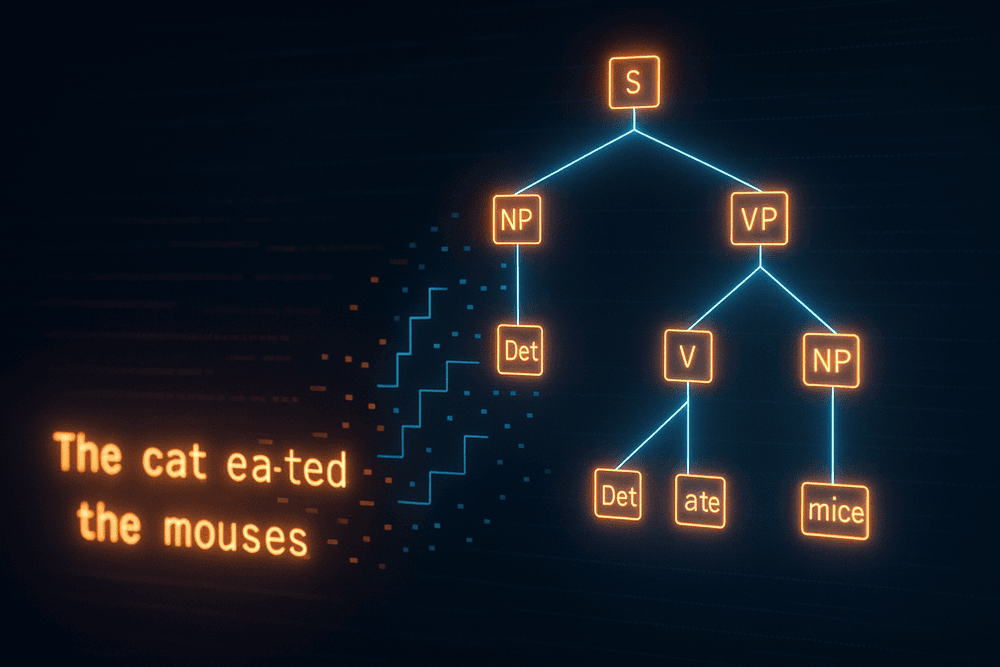
- Part-of-Speech (POS) Tagging: Next, it analyzes each token to identify its grammatical role. It labels words as nouns, verbs, adjectives, adverbs, and so on. This is crucial for understanding the sentence's structure.
- Parsing: The AI then analyzes the grammatical arrangement of the words in the sentence (its syntax). It builds a "tree" that shows how words relate to each other, helping it spot structural errors like subject-verb disagreement or dangling modifiers.
This foundational analysis allows the tool to understand the mechanics of your writing, but the real intelligence comes from how it learns from data.
How AI Models Learn Context, Tone, and Nuance
This is where the "learning" in machine learning comes into play. The most sophisticated ai grammar correction tools are powered by massive neural networks, often Large Language Models (LLMs), that have been trained on billions of sentences from books, articles, websites, and academic papers.
Through this extensive training, the AI doesn't just memorize grammar rules; it learns the intricate patterns, rhythms, and relationships within a language. This is how it develops an understanding of:
- Context: The AI can differentiate between words with multiple meanings (like "lead" the metal vs. "lead" the verb) based on the surrounding words. It understands that "Their going to the store" is incorrect, while "Their dog is going to the store" uses "their" correctly.
- Tone: By analyzing countless examples, the AI learns to recognize different writing styles. It can tell if your tone is formal, casual, academic, or creative and provide suggestions that align with your intended voice.
- Nuance: The model grasps the subtle shades of meaning in language, helping you choose the perfect word to convey your exact message.
Beyond Grammar: AI's Role in Improving Style and Clarity
The ultimate goal of modern ai grammar correction isn't just to produce error-free text, but to create powerful, clear, and engaging writing. These tools act as a digital writing coach, offering suggestions that elevate your prose. The AI can identify and help you fix common stylistic issues, including:
- Wordiness and Redundancy: Flagging phrases like "in order to" or "due to the fact that" and suggesting more concise alternatives like "to" or "because."
- Passive Voice: Highlighting sentences where the subject is being acted upon (e.g., "The ball was hit by him") and suggesting a more direct, active form ("He hit the ball").
- Clarity and Flow: Recommending ways to break up long, convoluted sentences or rephrase awkward passages to improve readability.
By combining a deep grammatical analysis with stylistic intelligence, these AI-powered systems help you not only say what you mean but say it in the best way possible.
The Best AI Grammar Correction Tools Reviewed and Compared
With a crowded market of digital writing assistants, finding the right one can feel overwhelming. The key is to match a tool's strengths to your specific writing needs. While many platforms offer similar core functionalities, their advanced features and user experience vary significantly. We’ve analyzed the top contenders to help you choose the best AI grammar correction service for your work.
Grammarly: The Industry Standard for AI Writing Assistance
Grammarly has become synonymous with AI-powered writing help, and for good reason. Its intuitive interface and powerful real-time suggestions make it an indispensable tool for millions. It goes far beyond basic spell-checking, offering corrections for grammar, punctuation, conciseness, and clarity. Its browser extensions and app integrations are seamless, providing support across emails, social media, and documents.
Key Strengths:
- Ease of Use: Unmatched in its simplicity and real-time feedback.
- Tone Detector: A premium feature that analyzes your word choice to ensure your message lands with the intended tone (e.g., confident, friendly, analytical).
- Broad Integration: Works flawlessly across most platforms where you write.
Grammarly is the perfect all-rounder for students, professionals, and casual writers who need a reliable safety net to catch errors and improve the overall quality of their daily writing.
QuillBot: A Powerful Tool for Paraphrasing and Grammar
While it features a robust grammar checker, QuillBot’s standout feature is its state-of-the-art paraphrasing tool. It’s designed for users who need to not only correct their writing but also rephrase it for clarity, vary their vocabulary, or adjust the tone. The integrated grammar checker works alongside the paraphraser, ensuring that any rewritten sentences are both grammatically sound and contextually appropriate.
Key Strengths:
- Advanced Paraphraser: Offers multiple modes (e.g., Standard, Fluency, Formal) to restructure sentences without losing the original meaning.
- Integrated Tools: Includes a summarizer, citation generator, and co-writer to create a comprehensive writing ecosystem.
- Vocabulary Enhancement: Excellent for non-native English speakers or writers looking to expand their word choice.
QuillBot is the ideal choice for academics, students, and content creators who frequently need to reword text to avoid plagiarism and enhance readability.
ProWritingAid: The Best Choice for Long-Form Content Creators
ProWritingAid is less of a quick-fix tool and more of a comprehensive writing mentor. It’s built for authors, editors, and anyone tackling lengthy documents. This tool provides incredibly detailed feedback through over 20 different reports, analyzing everything from sentence structure and pacing to clichés, overused words, and dialogue tags. While it offers excellent real-time AI grammar correction, its true power lies in its deep-dive analysis that helps you improve the craft of writing itself.
Key Strengths:
- In-Depth Reports: Provides actionable insights on style, readability, and structural elements that other tools miss.
- Specialized Integrations: Works seamlessly with writing software like Scrivener and Final Draft.
- Custom Style Guides: Allows users to create their own writing rules, making it perfect for teams and organizations maintaining a consistent voice.
Choosing Your AI Grammar Tool: Free vs. Premium Features
Your final decision will likely come down to your specific needs and budget.
- Free Versions: Most top-tier tools offer a free plan that covers critical grammar, spelling, and punctuation errors. For casual writing and proofreading emails or social media posts, a free version is often sufficient.
- Premium Versions: Upgrading unlocks the full potential of these AI platforms. Premium features typically include advanced style and tone suggestions, sentence restructuring, plagiarism detection, and more detailed analytical reports. If writing is a core part of your profession or academic life, a premium subscription is a worthwhile investment in producing polished, professional, and effective content.
Ultimately, the best AI grammar correction tool is the one that integrates smoothly into your workflow and addresses your biggest writing challenges.

Unlocking Advanced Features with AI Grammar Correction
While catching typos and grammatical missteps is the core function, the true power of modern ai grammar correction lies in its advanced features that function like a dedicated writing coach. These intelligent tools go beyond mere correctness to help you craft content that is compelling, clear, and perfectly suited for its purpose. By leveraging sophisticated algorithms, they analyze your writing on a much deeper level, offering insights that can elevate your work from good to exceptional. Let’s explore the key features that unlock this next level of writing assistance.
Mastering Tone Detection for Different Audiences
Have you ever written an email that came across as too aggressive or a message that felt too casual for a professional setting? Tone is a subtle but critical element of effective communication. Advanced AI grammar correction tools are equipped with sophisticated tone detectors that analyze your word choice, phrasing, capitalization, and punctuation to gauge how your writing will be perceived.
The tool can identify tones like:
- Formal
- Informal
- Confident
- Optimistic
- Analytical
- Friendly
For instance, if you’re writing a cover letter, the AI might suggest replacing a casual phrase like "I'm pretty good at sales" with a more confident "I am proficient in driving sales growth." This ensures your message not only is grammatically perfect but also strikes the precise emotional chord you intend for your specific audience.
Ensuring Originality with Integrated Plagiarism Checkers
For students, academics, journalists, and content creators, originality is non-negotiable. Accidentally using language that is too similar to a source can have serious consequences. Many top-tier AI writing assistants now include a built-in plagiarism checker that scans your document against billions of web pages and academic databases. This feature provides a crucial safety net, highlighting any passages that may be unintentionally borrowed and often providing the source link so you can cite it properly or rephrase the content to ensure your work is entirely your own.
Improving Readability with Sentence Restructuring Suggestions
A grammatically correct sentence isn't always a good sentence. Long, convoluted phrasing and excessive jargon can make your writing difficult to understand, causing your reader to lose interest. This is where AI-powered readability analysis shines. These tools identify and flag:
- Overly long or complex sentences
- Passive voice constructions
- Wordy and redundant phrases
- Vague or weak word choices
Instead of just pointing out the problem, the AI offers concrete suggestions. It might recommend splitting a run-on sentence into two clearer ones or replacing a passive phrase like "the report was written by the team" with the more direct and engaging "the team wrote the report." These micro-adjustments dramatically improve clarity and impact.
Maintaining Consistency with Custom Style Guides
For businesses and organizations, maintaining a consistent brand voice across all communications is vital. Premium ai grammar correction platforms cater to this need with custom style guides. Teams can input their specific rules—such as how to write a product name (e.g., "AI-Writer," not "ai writer"), preferred terminology, rules on using the Oxford comma, or even a list of words to avoid. The AI then enforces these rules across all documents, ensuring that every blog post, press release, and internal memo aligns perfectly with the established brand identity. This automates the editing process and guarantees a unified, professional voice at scale.
Putting AI Grammar Correction to Work: Practical Use Cases
The true power of ai grammar correction isn't just about fixing commas and spelling errors; it's about elevating the quality and impact of your writing across every platform. These tools act as a digital co-pilot, ensuring clarity, professionalism, and confidence no matter what you're writing. Let's explore some of the most common and impactful ways to integrate this technology into your daily workflow.
Crafting Professional Emails That Get Replies
In the professional world, first impressions are everything, and often, that first impression is an email. A message riddled with typos or awkward phrasing can undermine your credibility before the recipient even gets to your main point. An AI grammar checker goes beyond basic spell check to refine your tone, suggest more concise wording, and ensure your message is clear and professional. By eliminating ambiguity and grammatical mistakes, you reduce the cognitive load on your reader. This makes your email easier to understand and act upon, significantly increasing your chances of getting a thoughtful and timely reply.
Writing SEO-Optimized Blog Posts with Confidence
For content creators and marketers, high-quality writing is non-negotiable. Search engines like Google prioritize content that is not only relevant but also well-written and easy to read. Grammatical errors and clunky sentences can lead to a higher bounce rate, signaling to search algorithms that your content is low-quality. Using ai grammar correction is a crucial step in the SEO writing process. It allows you to focus on your keyword strategy, content structure, and storytelling, while the AI handles the meticulous task of polishing your prose. This safety net gives you the confidence to publish content that will both rank well and resonate with your audience.
Polishing Academic Papers and Essays for Better Grades
When submitting an academic paper, the strength of your argument is paramount. However, poor grammar and syntax can distract your professor and obscure your brilliant ideas, potentially leading to a lower grade. AI writing assistants are invaluable for students. They can spot complex grammatical issues, from dangling modifiers to incorrect verb tenses, that are easy to miss after hours of research and writing. Many advanced tools also offer style suggestions to improve academic tone and even feature plagiarism detectors. By running your essays and papers through an AI checker, you can submit work that is clear, articulate, and academically sound.
Boosting Your Social Media Presence with Error-Free Posts
Social media moves fast, but a careless typo can live forever in a screenshot. For brands, influencers, and professionals, maintaining a polished online presence is essential for building trust and authority. A simple grammatical error in a tweet, a LinkedIn post, or an Instagram caption can make you or your brand look unprofessional. An AI grammar correction tool, often integrated directly into your browser, provides a real-time safety net. It quickly catches mistakes before you hit "post," ensuring your message is always clear, correct, and on-brand, helping you engage your audience effectively and maintain a sterling reputation.
Conclusion: The Future of Writing with AI Grammar Correction
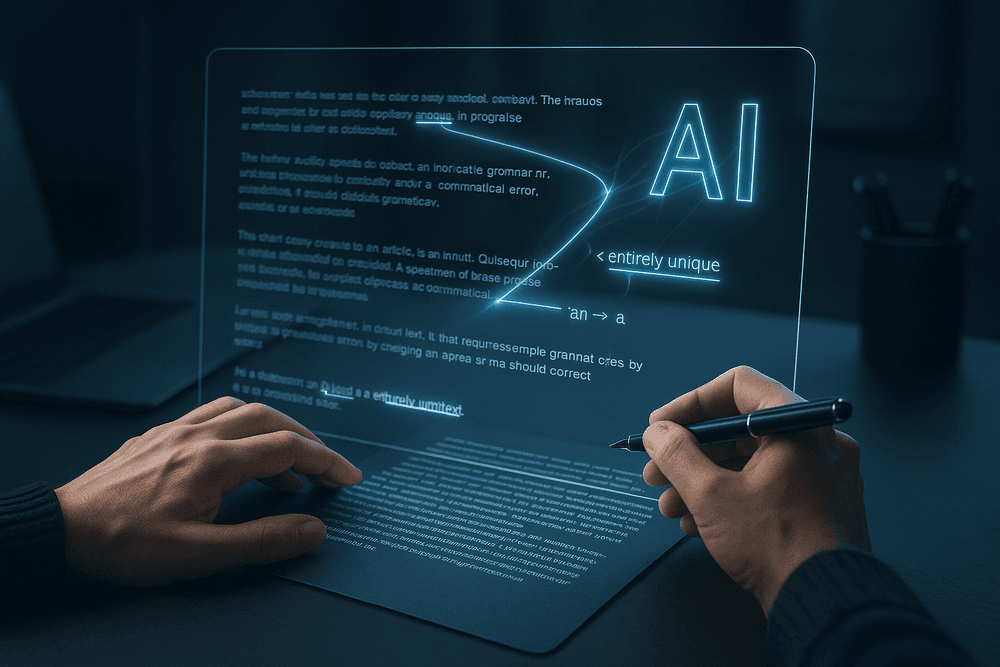
We've explored how artificial intelligence is fundamentally changing the way we write, moving far beyond the simple red squiggly lines of traditional spell checkers. AI grammar correction is no longer just a safety net; it's a dynamic co-pilot, enhancing clarity, refining tone, and boosting our confidence as communicators. As this technology continues to evolve, its role in our creative and professional lives will only expand. The question is no longer if you should use an AI writing assistant, but which one is the perfect fit for your unique needs.
Final Checklist: How to Choose the Right Tool for You
Selecting the best ai grammar correction tool can feel overwhelming, but it boils down to a few key factors. Before you commit, run through this final checklist to ensure you’re making the right choice:
- Accuracy and Contextual Awareness: Does the tool understand the nuances of your writing? Look for an assistant that goes beyond basic errors to catch subtle mistakes in tone, phrasing, and context.
- Seamless Integration: Your writing assistant should work where you do. Check for compatibility with your favorite platforms, whether it's a browser extension, a Microsoft Word add-in, or an integration with Google Docs.
- Feature Set: Do you just need grammar and spelling, or are you looking for more? Top-tier tools offer style suggestions, tone detection, plagiarism checks, and advanced formatting tips to elevate your content.
- User Experience: A cluttered or confusing interface can disrupt your writing flow. Opt for a tool that is intuitive, non-intrusive, and provides clear, actionable suggestions.
- Pricing and Value: Evaluate the free and premium plans. A free version might be enough for casual use, but professionals and students often benefit from the advanced features that paid plans unlock.
Beyond Correction: The Future of AI in Content Creation
The horizon for AI in writing is incredibly bright and extends far beyond simple fixes. The next generation of AI writing assistants is evolving from being a proofreader to becoming a true creative partner. The future of ai grammar correction is about augmentation, not replacement.
Imagine an AI that not only corrects your proposal but also suggests stronger data points to include. Picture a tool that helps you brainstorm blog post ideas, generates compelling outlines, and even helps you rewrite sentences to match a specific brand voice perfectly. We are already seeing the early stages of this with AI-powered content generation, predictive text that completes your thoughts, and real-time SEO analysis. This collaborative future will empower writers to focus on high-level strategy and creativity, leaving the granular and repetitive tasks to their intelligent assistants.
Start Your Journey to Flawless Writing Today
Don't let small grammatical errors undermine your big ideas. Whether you're a student striving for a better grade, a professional drafting a critical email, or a content creator building an audience, clear and polished writing is non-negotiable. Embracing the power of ai grammar correction is the single most effective step you can take to elevate your communication.
Explore the tools we've discussed, experiment with their free trials, and find the one that clicks with your workflow. Your journey to becoming a more confident, clear, and impactful writer starts now.