
October 23, 2025
Why AI Customer Service is Now an Essential Business
Why AI Customer Service is Now an Essential Business Strategy
In today's hyper-competitive digital marketplace, customer expectations are at an all-time high. Gone are the days of 9-to-5 support and lengthy ticket queues. Modern consumers demand instant, personalized, and effective resolutions, anytime and anywhere. This is where AI customer service transitions from a futuristic concept into a foundational business strategy. It’s no longer a question of if you should adopt AI, but how quickly you can integrate it to meet and exceed these new standards.
Beyond the Buzzword: Defining AI Customer Service
So, what is AI customer service, really? It’s far more than a simple, pre-programmed chatbot answering "yes" or "no." True AI-powered support is a sophisticated ecosystem of technologies—including machine learning (ML), natural language processing (NLP), and predictive analytics—designed to understand, manage, and resolve customer inquiries with human-like intelligence and digital efficiency.
This technology manifests in several powerful ways:
- Intelligent Chatbots and Voicebots: These bots can understand context, decipher intent, and handle complex, multi-step conversations, from tracking an order to troubleshooting a technical issue.
- Automated Ticket Routing: AI analyzes incoming support tickets, categorizes them by topic and urgency, and instantly routes them to the best-equipped agent, dramatically reducing resolution times.
- Proactive Support: By analyzing user behavior, AI can anticipate potential problems and offer solutions before the customer even has to ask.
The goal isn't to replace human agents but to augment them, creating a powerful synergy where technology handles the routine and humans manage the exceptions.
The Evolution from Manual Queues to Intelligent Automation
The traditional customer support model is burdened with inefficiency. Human agents spend a significant portion of their day answering the same repetitive questions, manually routing tickets, and searching for information across disparate systems. This leads to agent burnout, longer wait times for customers, and an inability to scale during peak demand.
Intelligent automation fundamentally rewrites this script. By deploying an AI customer service solution, businesses can automate up to 80% of routine inquiries. This monumental shift has a ripple effect across the entire operation:
- Frees Human Expertise: Agents are liberated from monotonous tasks, allowing them to focus on complex, high-empathy interactions that truly require a human touch.
- Boosts Efficiency: AI works 24/7 without breaks, handling thousands of conversations simultaneously and providing instant answers that once took minutes or hours.
- Enhances Scalability: Whether you have a sudden influx of 100 or 10,000 customer inquiries, an AI system can scale instantly to meet the demand without compromising service quality.
Meeting the Demands of the Always-On Customer
Perhaps the most compelling reason AI customer service is essential is its impact on the customer experience itself. Today's consumers live in an on-demand world, and their expectations for support reflect that. They don't want to wait for an email response or be put on hold.
AI directly meets this need for immediacy by providing 24/7, instant support across all digital channels. A customer can get a question answered at 3 AM on a Sunday just as easily as they could during business hours on a Tuesday. This constant availability doesn't just solve problems; it builds trust and loyalty. Furthermore, AI-driven personalization ensures that every interaction is relevant. By tapping into customer data, AI can provide tailored recommendations and solutions, making customers feel understood and valued, transforming a simple support query into a positive brand experience.

The Core Technologies Driving AI Customer Service
The term "AI customer service" represents not a single product, but a sophisticated ecosystem of technologies working in concert to create a smarter, faster, and more empathetic support experience. Understanding these core components reveals how AI is fundamentally transforming the way businesses interact with their customers. From instant answers to predicting future needs, these technologies are the engines powering the revolution.
AI-Powered Chatbots for Instant Query Resolution
At the forefront of AI customer service are advanced chatbots and virtual assistants. Gone are the days of clunky, rule-based bots that could only respond to specific keywords. Today’s AI-powered chatbots leverage Natural Language Processing (NLP) and Machine Learning (ML) to understand the context and intent behind a customer's query.
They can handle a high volume of common questions—such as "What is your return policy?" or "Where is my package?"—around the clock, providing instant resolutions without human intervention. This 24/7 availability not only meets modern customer expectations for immediate support but also frees up human agents to focus their expertise on complex, high-stakes, or emotionally charged issues that require a human touch.
Intelligent Ticketing Systems That Automate Workflows
Behind the scenes, AI is revolutionizing the traditional helpdesk ticketing system. Instead of agents manually sorting, categorizing, and assigning support tickets, intelligent systems automate the entire workflow.
Using AI, these platforms can instantly analyze the content of an incoming ticket to determine its subject, urgency, and even the customer's sentiment. Based on this analysis, the ticket is automatically routed to the best-equipped agent or department, prioritized in the queue, and tagged for tracking. Some systems can even suggest relevant knowledge base articles or canned responses to help agents resolve issues faster. This level of automation streamlines operations, reduces resolution times, and ensures critical customer issues are never lost in the shuffle.
Sentiment Analysis to Understand Customer Emotions
One of the most powerful applications within AI customer service is sentiment analysis. This technology gives businesses the ability to gauge the emotional tone behind written or spoken language, classifying interactions as positive, negative, or neutral.
When a customer is typing with frustration or using negative keywords, the system can flag the conversation in real-time, allowing a human supervisor to intervene or escalate the issue before it intensifies. Beyond individual interactions, sentiment analysis provides invaluable macro-level insights. By analyzing thousands of conversations, companies can measure overall customer satisfaction, identify points of friction in the customer journey, and pinpoint areas for service improvement. It adds a crucial layer of emotional intelligence to digital support channels.
Predictive Analytics for Proactive Support
The most forward-thinking application of AI customer service is moving from a reactive to a proactive model with predictive analytics. By analyzing vast datasets of historical customer behavior, support interactions, and purchase history, AI models can identify patterns and forecast future outcomes.
This allows businesses to anticipate customer needs before they even arise. For example, analytics might predict that a customer who has visited a specific FAQ page three times is likely to submit a support ticket, and can proactively offer help via a chatbot. It can also identify customers at high risk of churn, enabling the support team to reach out with targeted solutions or offers to retain their business. This shift toward proactive engagement turns customer service from a cost center into a powerful driver of customer loyalty and growth.
Key Benefits of Integrating AI into Your Customer Service
Integrating artificial intelligence into your support strategy is more than just a technological upgrade; it's a fundamental shift that unlocks unprecedented efficiency and creates more meaningful customer relationships. By automating routine tasks and harnessing the power of data, AI customer service provides a powerful competitive advantage. Let's explore the transformative benefits that businesses are realizing today.
Slash Response Times and Operational Costs
In today's fast-paced world, speed is everything. Customers expect immediate answers, and waiting on hold is a quick path to frustration. This is where AI customer service excels. AI-powered chatbots and virtual assistants are available 24/7, providing instant responses to frequently asked questions without any wait time. This immediate engagement dramatically improves customer satisfaction and reduces churn.
Simultaneously, this automation drives significant cost savings. By handling the high volume of simple, repetitive inquiries, AI deflects tickets that would otherwise require human intervention. This allows you to serve more customers without proportionally increasing your support team headcount. The result is a leaner, more efficient operation with lower overhead costs, allowing you to reallocate budget to other strategic growth areas.
Deliver Consistent, High-Quality Support at Scale
Human agents are invaluable, but they are also human. Performance can vary based on mood, workload, or time of day. AI, on the other hand, provides unwavering consistency. It draws from a centralized knowledge base to deliver accurate, on-brand information every single time, eliminating the risk of human error or inconsistent messaging.
This consistency is crucial for scaling your operations. Whether you're handling a hundred inquiries a day or ten thousand during a holiday rush, an AI customer service system performs with the same speed and accuracy. It ensures that every customer receives the same high standard of care, regardless of volume, time zone, or the complexity of their initial query. This reliability builds trust and reinforces a positive brand image.
Empower Human Agents to Focus on Complex Issues
One of the most powerful benefits of implementing AI is its ability to augment, not replace, your human team. By automating the mundane and predictable tasks—like password resets, order tracking, and basic product questions—AI frees up your skilled agents to concentrate on what they do best: solving complex, high-stakes problems.
This creates a more strategic and fulfilling work environment. Agents are no longer bogged down by repetitive work and can dedicate their expertise and empathy to nuanced situations that require critical thinking and a human touch. This synergy between AI and human intelligence elevates your entire support operation, ensuring that simple issues are resolved instantly and complex ones receive the expert attention they deserve.
Create Hyper-Personalized Customer Experiences with Data
Generic, one-size-fits-all support is a thing of the past. Modern customers expect brands to know them and anticipate their needs. AI customer service makes this possible by analyzing vast amounts of data in real-time, including a customer's purchase history, browsing behavior, and past support interactions.
Armed with this insight, AI can deliver hyper-personalized experiences. It can proactively offer solutions based on a user's recent activity, recommend products tailored to their preferences, or guide them through a process with an understanding of their specific account details. This data-driven approach transforms a standard support interaction into a bespoke experience, making customers feel understood and valued, which in turn fosters deep, long-lasting loyalty.

Best Practices for a Successful AI Customer Service Implementation
Transitioning to an AI-powered support model is more than a tech upgrade—it's a strategic shift that can redefine your customer experience. To unlock the full potential of AI customer service, a thoughtful implementation plan is non-negotiable. It's the difference between creating a frustrating, robotic loop and a streamlined, intelligent support system. By following a few core best practices, you can ensure your implementation is a resounding success.
Choose the Right AI Platform for Your Business Goals
The market is filled with AI solutions, but the best one is the one that aligns directly with your objectives. Before you start evaluating vendors, define what success looks like for your team. Are you trying to reduce first-response times, offer 24/7 support, or decrease ticket volume for your human agents?
Your specific goals will dictate the features you need. A retail business might prioritize a chatbot with advanced product recommendation capabilities, while a SaaS company may need an AI that can guide users through complex technical troubleshooting. Don't be swayed by the platform with the longest feature list; focus on the one that solves your core customer service challenges effectively. Evaluate its scalability, customization options, and how well it works on the channels your customers already use.
Integrate AI Seamlessly with Your Existing CRM
For an AI to be truly effective, it cannot operate in a silo. A seamless integration with your Customer Relationship Management (CRM) and other key systems is crucial for creating a personalized and context-aware experience. When your AI customer service tool can access a customer's purchase history, past support tickets, and contact information, it can move beyond generic scripts to provide truly helpful, tailored answers.
This integration also creates a single source of truth for your entire team. All AI interactions should be logged in the CRM, so if a conversation needs to be escalated, the human agent has the full context instantly. This prevents customers from having to repeat themselves—a major point of friction—and empowers your agents to resolve issues faster. Look for platforms with robust APIs and pre-built integrations to make this connection as smooth as possible.
Train Your AI Models with Quality Data for Better Performance
An AI model is only as smart as the data it learns from. The old adage "garbage in, garbage out" is especially true here. To ensure your AI accurately understands customer intent, sentiment, and nuance, you must train it on a foundation of high-quality, relevant data.
Start by feeding it real historical conversation transcripts, help desk tickets, comprehensive knowledge base articles, and detailed FAQs. The cleaner and more diverse this data is, the better your AI will become at identifying and resolving a wide range of customer issues. This isn't a one-time task. A successful AI customer service strategy involves continuous training and refinement as your products evolve and new customer queries emerge.
Find the Perfect Balance Between Automation and the Human Touch
The ultimate goal of AI in customer service is not to replace your human agents but to augment their abilities and make them more effective. The most successful implementations strike a careful balance between efficient automation and empathetic human support.
Deploy AI to handle the high-volume, repetitive queries that consume a significant portion of your agents' time, such as order status updates, password resets, or basic product questions. This frees up your skilled human agents to focus on complex, sensitive, or high-value interactions that require emotional intelligence and creative problem-solving. Most importantly, always provide a clear, simple, and frictionless escalation path from the AI to a human. A customer should never feel trapped by a bot; they should feel empowered by a system that gets them the right kind of help, right when they need it.
Real-World Examples of AI Customer Service Excellence
The theoretical benefits of AI are compelling, but its true value shines in practical application. Across industries, businesses are leveraging AI customer service not just to cut costs, but to create faster, smarter, and more secure experiences. Let's explore three powerful case studies that showcase AI in action.
Case Study: The E-commerce Giant Slashing Support Tickets by 40%
The Challenge: A leading online fashion retailer was drowning in a sea of repetitive customer inquiries. Their support team spent most of its day answering the same questions: "Where is my order?", "How do I make a return?", and "Is this item in stock?". This high volume led to long wait times and agent burnout, while preventing the team from focusing on more complex, high-value customer issues.
The AI Solution: The company integrated a sophisticated AI customer service platform directly into their website and mobile app. This wasn't just a basic FAQ bot. The AI was powered by natural language processing (NLP) and connected securely to their order management and inventory systems. It could instantly provide personalized order tracking details, initiate a return process step-by-step, and check real-time stock levels for any product—all without human intervention.
The Result: Within six months, the retailer saw a staggering 40% reduction in inbound support tickets. Customer satisfaction with support interactions increased, as shoppers received instant answers 24/7. This powerful demonstration of AI customer service allowed human agents to shift their focus to personalized styling advice and resolving complex logistical challenges, dramatically improving overall service quality.
Case Study: How a SaaS Innovator Boosted CSAT with Proactive AI
The Challenge: A fast-growing B2B SaaS company noticed a dip in its Customer Satisfaction (CSAT) scores, particularly among new users. Customer feedback revealed that users often felt overwhelmed during the onboarding process and would only seek help after becoming frustrated. Their reactive support model was failing to create a positive initial experience.
The AI Solution: Instead of waiting for customers to ask for help, the company implemented a proactive AI chatbot. This smart assistant monitored user behavior within the software in real-time. If a user hesitated on a particular page for too long or repeatedly failed to use a key feature correctly, the AI would proactively engage them with a helpful pop-up. It offered contextual tips, links to relevant tutorial videos, or the option to connect with a live agent.
The Result: This proactive AI customer service strategy was a game-changer. The company saw a 15-point increase in their CSAT score within the first quarter. The number of support tickets related to onboarding dropped by 30%, as the AI addressed potential issues before they escalated. Users felt supported and guided, leading to higher feature adoption rates and improved long-term customer retention.
Case Study: Fortifying Security and Speed in Finance with AI
The Challenge: A major financial institution was facing a dual challenge: increasing threats from sophisticated fraud and customer frustration with slow, manual identity verification processes. Opening a new account or authorizing a large transaction required cumbersome document submissions and long review times, leading to high abandonment rates.
The AI Solution: They deployed an AI-powered identity verification system. When a customer needed to be verified, they were guided through a simple, seconds-long process on their smartphone. The AI used a combination of facial recognition, liveness detection (to ensure it was a real person), and optical character recognition (OCR) to instantly scan and validate government-issued IDs. The system cross-referenced data against multiple security databases to flag potential risks in real-time.
The Result: The customer onboarding time was reduced from days to under two minutes. This frictionless experience drastically cut down on application abandonment. More importantly, the AI customer service tool proved more accurate than human review at detecting fraudulent documents, strengthening the institution's security posture. It's a prime example of how AI can enhance both customer experience and operational security simultaneously.
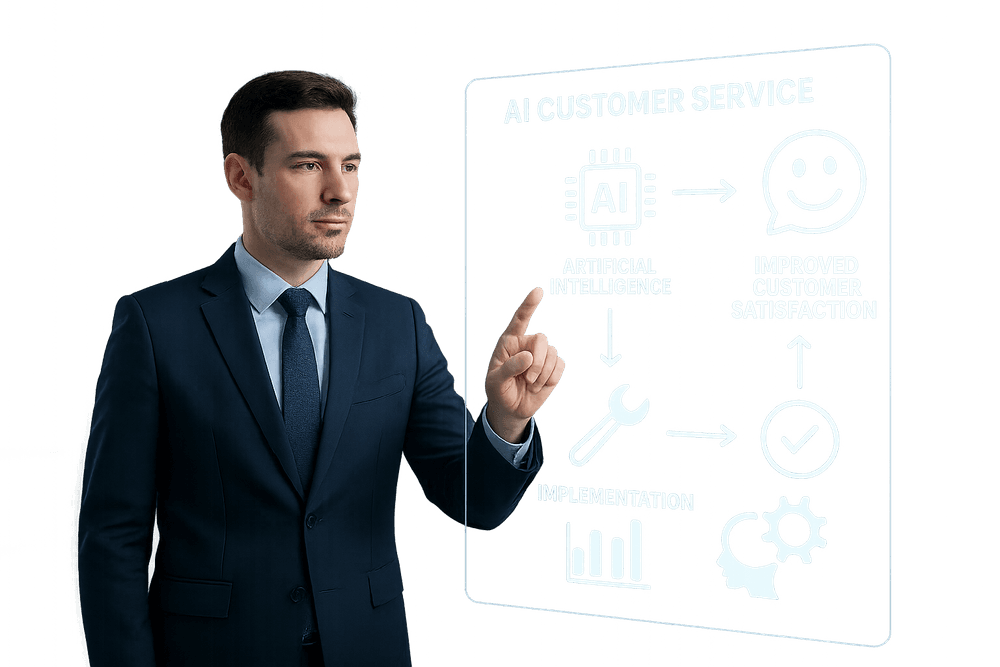
The Future is Now: Your Next Steps in AI Customer Service
Moving from theory to action is the most critical step in transforming your support operations. Adopting AI customer service isn't a distant-future project; it's a strategic imperative for businesses aiming to stay competitive today. Here’s how you can map out your journey, from building the initial business case to launching a successful pilot program.
Building a Rock-Solid Business Case for AI Adoption
To secure buy-in from leadership, you need to frame AI customer service not as an expense, but as a high-return investment. Go beyond the buzzwords and focus on quantifiable metrics that directly impact the bottom line.
Your business case should center on key performance indicators (KPIs) like:
- Reduced Cost-Per-Contact: Calculate how much you can save by automating routine inquiries, freeing up human agents for more complex, value-driven interactions.
- Improved First-Contact Resolution (FCR): AI can instantly provide accurate, consistent answers to common questions, resolving issues on the first try and boosting customer satisfaction.
- Increased Agent Productivity: When AI handles repetitive tasks, your support team can manage a higher volume of complex tickets, reducing burnout and improving employee retention.
- Enhanced Customer Satisfaction (CSAT): Offering 24/7, instantaneous support meets modern customer expectations, directly leading to higher satisfaction and loyalty.
Key Considerations Before You Invest
Jumping into an AI implementation without proper planning can lead to wasted resources and frustrated customers. Before you sign any contracts, carefully evaluate these critical factors:
- Data Readiness: Effective AI models are trained on data. Do you have a clean, accessible repository of historical customer interactions, FAQs, and help-desk articles? Your AI is only as smart as the information you feed it.
- Integration Capabilities: Your new AI customer service tool must work harmoniously with your existing tech stack, including your CRM and helpdesk software. Avoid creating data silos that disrupt workflows and create a disjointed customer experience.
- The Human-AI Partnership: Plan for a seamless handover process from AI to a human agent. The goal is augmentation, not replacement. Ensure the AI can intelligently identify when a customer needs human empathy and expertise, and make the escalation process frictionless.
- Scalability: Will this solution grow with your business? Choose a platform that can handle increasing interaction volumes and adapt to new channels and more complex use cases in the future.
How to Get Started with an AI Customer Service Pilot Program
A full-scale rollout is risky. A pilot program allows you to test, learn, and prove the value of AI in a controlled environment.
- Start Small: Identify a high-impact, low-risk use case. A great starting point is automating the top 10-20 most frequently asked questions that clog your support queues. This delivers immediate value without disrupting core operations.
- Define Success: What does a successful pilot look like? Set clear, measurable goals. For example: "Achieve a 25% containment rate for inbound chats" or "Reduce email response times for password-reset queries by 50% within 90 days."
- Involve Your Team: Your agents are your subject matter experts. Involve them in the selection and training process. Position the AI as a "co-pilot" designed to make their jobs easier and more rewarding. Their buy-in is essential for success.
- Measure, Learn, and Iterate: Continuously monitor your pilot's performance against your predefined KPIs. Gather feedback from both customers and agents. Use these insights to refine your approach before planning a wider rollout of your AI customer service strategy.