
October 20, 2025
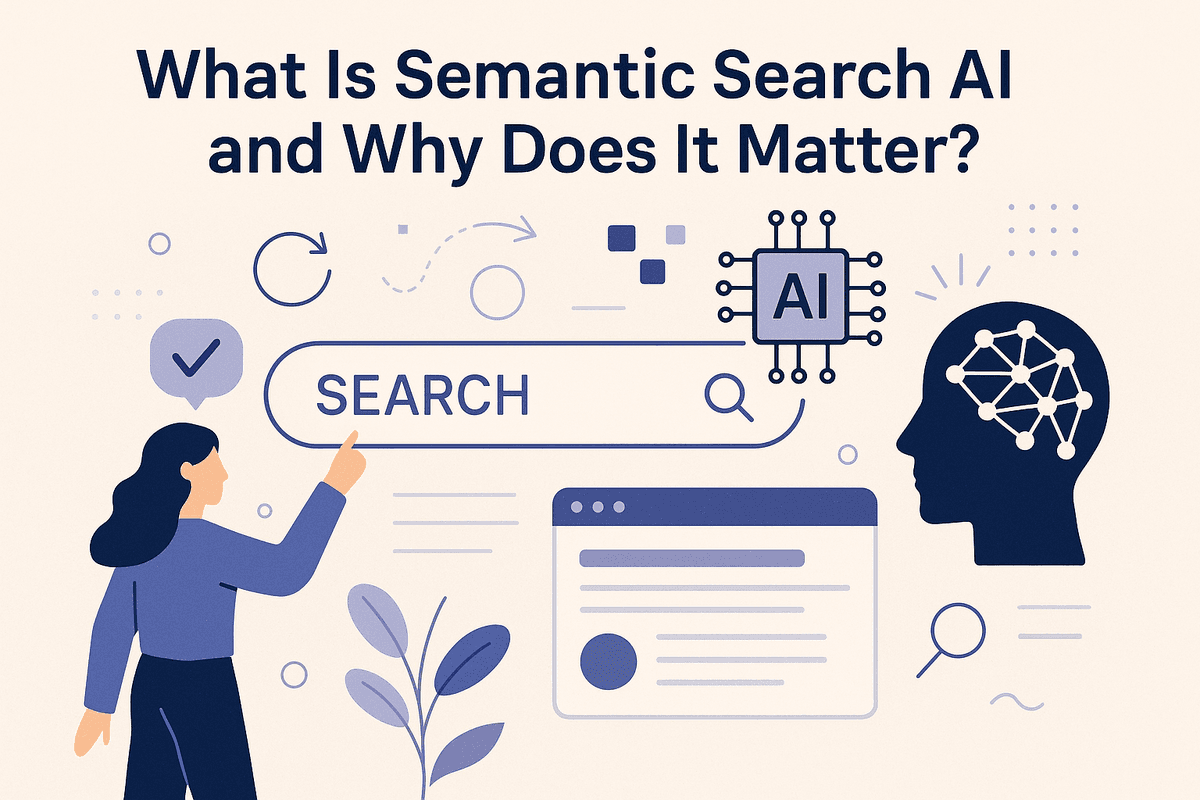
What Is Semantic Search AI and Why Does It Matter?
What Is Semantic Search AI and Why Does It Matter?
Remember the last time you hunted for a specific document, trying every possible keyword combination you could think of? "Marketing report Q3," "Q3 marketing analysis," "Third quarter results marketing"—only to come up empty-handed. This frustrating experience highlights the fundamental limitation of traditional keyword search: it's a matching game. It looks for exact words and phrases, often missing the mark entirely if your memory doesn't align perfectly with the text.
This is precisely where the next evolution in search technology changes the game.
How AI Understands Your Intent, Not Just Your Words
At its core, semantic search AI is a sophisticated technology that goes beyond literal keywords to understand the meaning and intent behind your query. Instead of just matching strings of text, it uses advanced artificial intelligence models, like Natural Language Processing (NLP), to grasp context, relationships between concepts, and the nuances of human language.
Think of it like this:
- Keyword Search is like a rigid librarian who can only find books if you provide the exact title. If you're off by a single word, they can't help you.
- Semantic Search AI is like an experienced research expert. You can describe what you're looking for—"that financial analysis from the project meeting last fall"—and they understand the concepts involved. They know "financial analysis" relates to "budget," "fall" could mean "Q3" or "September," and "project meeting" could be in the title or just the document's content.
This intelligent approach allows the system to connect your conversational query to the most relevant information, even if the exact words you used aren't present in the document.
Moving Beyond Keywords: The Next Evolution in Search
The shift from keyword matching to contextual understanding is not just an incremental improvement; it's a revolutionary leap. For decades, we’ve adapted our behavior to suit the limitations of search engines, learning to think in keywords. Semantic search AI flips this dynamic, creating technology that adapts to how we naturally think and communicate.
This evolution matters because it directly translates to higher efficiency and less friction in our daily workflows. When your search tool understands your intent, you get to the right information faster. You no longer need to guess the perfect combination of terms. You can simply ask a question or describe a concept, and the AI bridges the gap between your thoughts and your data. This is the same underlying technology that allows Google to understand complex questions and powers the voice assistants on your phone.
The Core Problem Semantic Search AI Solves for You
In today's digital world, the biggest challenge isn't a lack of information—it's information overload. We have vast repositories of knowledge stored in documents, emails, presentations, and team chats. The core problem semantic search AI solves is finding the precise needle of insight in that ever-growing digital haystack.
Traditional search tools often add to the chaos, forcing you to manually sift through dozens of irrelevant results. Semantic search cuts through this noise by:
- Finding conceptual matches: It retrieves documents about "employee compensation analysis" even if you search for "staff salary review."
- Understanding context: It can differentiate between "apple" the fruit and "Apple" the company based on the surrounding information.
- Reducing cognitive load: It eliminates the mental guesswork of remembering exact file names or phrasing, freeing up your focus for more important tasks.
Ultimately, it transforms your digital archive from a source of stress into a powerful, accessible knowledge base, ensuring the information you need is always just a simple question away.
Semantic Search AI vs. Keyword Search: A Fundamental Shift
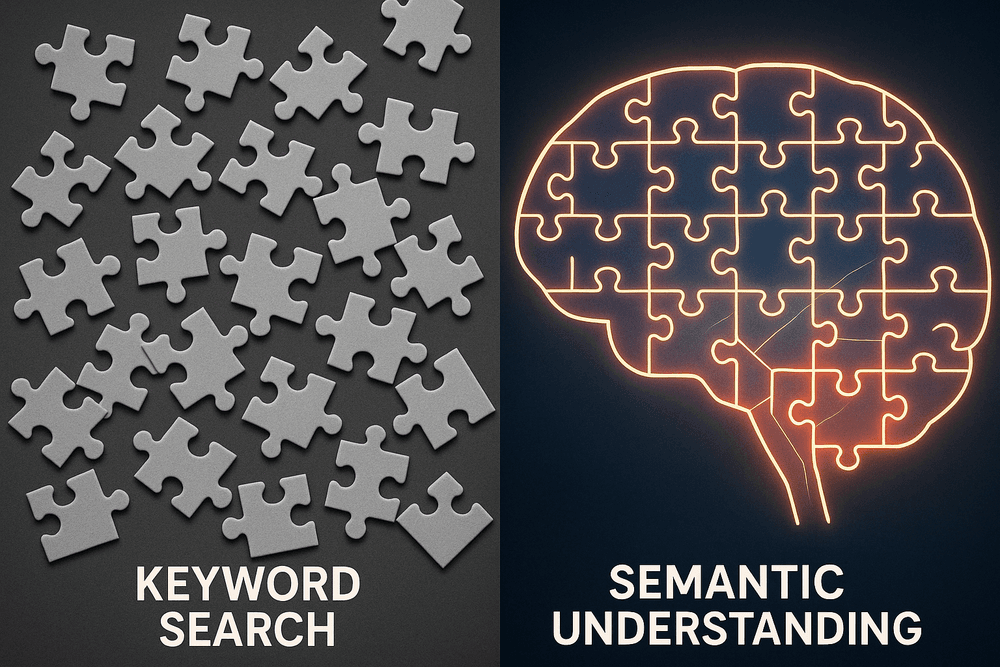
For decades, our digital lives have been governed by a simple rule: match the keyword, get the result. But as information becomes more complex and our questions more conversational, this old model is showing its age. This is where semantic search AI represents not just an upgrade, but a complete paradigm shift in how we find information. It's the difference between a system that recognizes words and one that understands meaning.
The Limitations of Traditional Keyword-Based Search
Traditional search engines operate like a meticulous but unintelligent file clerk. You give them a keyword or phrase, and they search their index for documents containing those exact strings. This method, known as lexical or keyword search, has significant limitations:
- It lacks context: It doesn't understand that "best remote work setup" and "top gear for a home office" are asking for the same thing. It treats "Apple" the company and "apple" the fruit as identical unless given other explicit clues.
- It struggles with ambiguity: A search for "Java" could return results about the programming language, the Indonesian island, or a type of coffee. The engine has no inherent way to know your intent.
- It forces you to "speak machine": We've all been trained to shorten our queries into a few potent keywords, guessing what combination will unlock the right documents. We ask "laptop cheap student" instead of the more natural "What's an affordable laptop for a university student?"
This approach places the burden of translation on the user, forcing us to think like a database index rather than simply asking a question.
Understanding Context, Nuance, and Relationships
Semantic search AI fundamentally changes the game by focusing on user intent and the contextual meaning of a query. Instead of just matching words, it uses advanced Natural Language Processing (NLP) and machine learning models to understand the relationships between concepts.
Think of it this way: keyword search is a dictionary, while semantic search is a knowledgeable librarian. You can tell the dictionary a word, and it will show you its definition. But you can ask the librarian a complex question, and they will understand what you’re really looking for, consider the nuances, and recommend the most relevant books, even if they don't contain the exact words you used. This powerful AI can decipher synonyms, conceptual hierarchies, and the underlying goal of your search to deliver far more accurate and relevant results.
See the Difference: Real-World Search Result Comparisons
The theoretical difference becomes crystal clear when you see it in action. Let’s compare how each system might handle the same conversational query.
Your Query: "How do I make our team meetings more effective and less of a time drain?"
Keyword Search Results:
A keyword-based system would latch onto terms like "team meetings," "effective," and "time drain." Your results would likely be a jumbled list of documents that contain these words, such as:
- An article titled "10 Ways to Run Effective Team Meetings." (Relevant)
- A forum post where a user complains about a "time drain." (Irrelevant)
- A company policy document outlining the schedule for team meetings. (Not helpful)
- A technical paper on "The Most Effective Way to Manage Server Time." (Completely wrong context)
Semantic Search AI Results:
A semantic search AI understands the intent behind the query—you want actionable advice to improve meeting productivity. It comprehends concepts like "effective" being the opposite of "time drain." The results would be a curated list directly addressing your problem:
- A guide to implementing the "Amazon Memo" culture for pre-meeting alignment.
- A template for creating a structured meeting agenda.
- A comparison of software tools designed to reduce meeting times.
- A chapter from a leadership book on fostering productive discussions.
The semantic results don't just find words; they solve your problem. This is the fundamental shift that makes semantic search AI an indispensable tool for modern knowledge work.
Under the Hood: How Semantic Search AI Technology Works
Ever wonder how a search tool seems to read your mind, understanding what you mean rather than just what you type? It’s not magic; it’s a sophisticated engine built on a trio of powerful technologies. A semantic search AI moves beyond simple keyword matching to grasp the intent and context behind your query. Let’s pop the hood and explore the core components that drive this intelligent process.
The Role of Natural Language Processing (NLP)
At the very start of your search journey is Natural Language Processing, or NLP. Think of NLP as the AI’s expert linguist. Its primary job is to bridge the gap between human language and computer comprehension. When you type a query like, “Find the presentation about our Q4 sales targets,” NLP gets to work deconstructing the sentence.
It identifies the key elements: the action ("Find"), the document type ("presentation"), and the crucial concepts ("Q4," "sales targets"). It understands grammar, recognizes entities, and deciphers the structure of your request. This initial breakdown is fundamental, transforming a simple string of text into a structured query that the system can begin to interpret for its underlying meaning.
Transforming Words into Meaning with Vector Embeddings
This is where the true "semantic" power comes to life. Computers don’t understand words, but they excel at math. Vector embeddings are a groundbreaking technique that translates words, phrases, and even entire documents into numerical representations called vectors.
Imagine a vast, multi-dimensional map of every concept in your knowledge base. On this map, related ideas are clustered together. The vector for “revenue” would be located very close to the vectors for “earnings” and “profit.” Similarly, the phrase “customer satisfaction report” would be near “client feedback analysis.”
A semantic search AI converts your query into a vector and then scours this map to find the document vectors that are closest to it. This is why you can search for “info on last month’s ad spend” and instantly find a document titled “October Marketing Budget Breakdown.” The system isn’t matching keywords; it’s matching the mathematical representation of the meaning itself.
How Machine Learning Continuously Improves Accuracy
A powerful semantic search system is never static; it’s a living, learning engine. This continuous improvement is driven by machine learning (ML). The AI models are initially trained on massive datasets, allowing them to build a robust understanding of language and relationships between concepts.
But the real learning happens with every search you perform. When you type a query and click on a result, you’re providing a subtle but crucial piece of feedback: you’re telling the AI, “This result was relevant to my intent.” The system uses this feedback to constantly refine its models. It learns the unique jargon of your team, understands which documents are most authoritative, and gets progressively better at predicting what you need. This feedback loop ensures the semantic search AI becomes more accurate, personalized, and indispensable over time.

Core Benefits of Using Semantic Search AI in Your Tools
Integrating semantic search AI into your applications isn't just an upgrade; it's a fundamental transformation of how users interact with information. While traditional search relies on matching exact keywords, semantic search understands context, intent, and relationships, delivering a superior experience with tangible benefits. By moving beyond simple text matching, you unlock a new level of intelligence and efficiency in your tools.
Get Hyper-Relevant Results Instantly
The most immediate advantage of semantic search AI is its ability to deliver precisely what the user is looking for, even if they don't use the exact right words. Traditional search engines often fail when a user's query uses synonyms or describes a concept without hitting a specific keyword present in the source document.
Semantic search overcomes this by understanding the meaning—the semantics—behind the query.
- Understands Intent: If a user searches for "ways to make my team collaborate better," the AI knows they are looking for project management techniques, communication tools, and meeting strategies, not just documents containing the words "team" and "collaborate."
- Handles Ambiguity: It can differentiate between "apple" the fruit and "Apple" the company based on the context of the search.
- Context-Aware: It grasps the nuances of natural language, providing answers that feel intuitive and genuinely helpful.
This capability drastically reduces the time users spend rephrasing queries or sifting through irrelevant results, providing the right information on the first try.
Uncover Hidden Connections in Your Data
Your knowledge base is filled with valuable information, but much of its potential remains untapped because traditional search can only find what is explicitly asked for. Semantic search AI acts as a knowledge discovery engine, revealing relationships and insights that would otherwise remain buried.
By mapping your data based on conceptual meaning, the AI can surface documents that are thematically related, even if they share no common keywords. For example, a search for "Q3 customer satisfaction report" might also suggest a document titled "Analysis of Support Ticket Trends from July to September." A keyword search would miss this connection, but a semantic model understands that both documents relate to customer experience during the same time period. This feature is invaluable for research, competitive analysis, and strategic planning, turning your data repository into a dynamic web of interconnected insights.
Boost Productivity in Your Knowledge Base or App
When users can find what they need without friction, productivity soars. In an organizational setting, employees spend significantly less time hunting for internal documentation, HR policies, or project files. This translates directly into more time spent on high-value tasks.
For customer-facing applications, an intelligent search function empowers users to self-serve effectively. They can find answers to their questions in your FAQ or help center without needing to contact a support agent. This not only improves the customer experience but also reduces the burden on your support team, allowing them to focus on more complex issues. Implementing semantic search AI transforms your search bar from a simple lookup tool into a powerful productivity engine.
Enhance User Experience and Engagement
A clunky, frustrating search experience is a primary reason users abandon an app or website. By allowing users to search in their own natural language, semantic search AI creates an intuitive and conversational interaction. They no longer have to guess the "correct" keyword to get the information they need.
This frictionless experience leads directly to higher user engagement and satisfaction. When a tool consistently understands and anticipates a user's needs, it builds trust and encourages deeper interaction. Users are more likely to return, spend more time within the application, and explore its features more fully. Ultimately, a smarter search function doesn't just deliver better results—it fosters a more positive, engaging, and valuable relationship with your users.
Real-World Use Cases for Semantic Search AI
The theoretical power of semantic search AI becomes tangible when we see it in action. Beyond a simple upgrade to the search bar, this technology is fundamentally reshaping how we interact with information across various industries. It moves us from a world of rigid keyword matching to one of fluid, intent-based discovery. Here are four key areas where semantic search is making a significant impact.
Revolutionizing Internal Knowledge Management
Large organizations sit on a goldmine of information stored in internal wikis, SharePoint sites, and document repositories. The problem? Finding the right information is often a frustrating exercise in guessing the exact keywords used in a document's title. An employee might search for "how much time off do I get?" and find nothing, because the official document is titled "Corporate PTO and Vacation Policy."
This is where semantic search AI transforms the employee experience. By understanding the intent behind the query, the system can instantly connect the natural language question to the conceptually related policy document. This dramatically reduces the time employees spend searching for information, decreases the burden on HR and IT support teams, and accelerates onboarding for new hires by making company knowledge truly accessible.
Powering Intelligent Customer Support Chatbots
We've all interacted with frustrating, keyword-driven chatbots that respond with "I'm sorry, I don't understand." These bots fail because they can't grasp context or nuance. An intelligent chatbot powered by semantic search AI operates on a completely different level.
When a customer types, "My package was supposed to be here yesterday but the tracking link is broken," a semantic system doesn't just look for "package" or "tracking." It understands the core problem: a delivery issue compounded by a technical fault. It can then access the knowledge base to provide a direct solution, such as alternative tracking methods or instructions for contacting a live agent for that specific issue. This leads to higher first-contact resolution rates, improved customer satisfaction, and a more efficient support operation.
Improving Product Discovery in E-commerce
In the competitive world of e-commerce, helping customers find what they want is paramount. Shoppers rarely use the exact product names or SKU numbers; instead, they search descriptively, like "durable running shoes for wide feet" or "a light summer dress with pockets."
Traditional search would struggle with these queries, often returning irrelevant results. A sophisticated semantic search AI solution, however, can interpret these attributes and concepts. It understands that "durable" relates to material quality, "wide feet" is a specific fit, and "light summer dress" implies certain fabrics and styles. By matching user intent to product attributes, e-commerce platforms can deliver hyper-relevant results, significantly boosting conversion rates, increasing average order value, and creating a more intuitive and satisfying shopping experience.
Enhancing Modern Productivity and Research Apps
The latest generation of productivity and research tools are more than just digital filing cabinets; they are active partners in our work. Semantic search AI is the engine driving this evolution. In a note-taking app, you can search for a concept like "my initial ideas for the Apollo project" and the AI will surface not only notes with that title but also related meeting minutes, web clippings about project management, and brainstorming sessions where similar ideas were discussed. For researchers, it can uncover connections between academic papers that don't share any specific keywords but discuss the same underlying theories. This turns a static archive of information into a dynamic knowledge base that helps users think, create, and discover connections they might have otherwise missed.

The Future Is Here: How to Get Started with Semantic Search AI
The conceptual leap from keyword matching to contextual understanding is complete. Now, the practical question is how to harness this power. Adopting semantic search AI isn't just about upgrading a tool; it's about upgrading your entire approach to information retrieval. Here’s how you can step into the future of search and make it a cornerstone of your productivity.
Choosing the Right AI-Powered Search Tool
With a growing market of intelligent search solutions, selecting the right one can feel daunting. Focus on a few core criteria to find a tool that aligns with your needs, rather than adapting your workflow to a tool.
- Integration Ecosystem: The best semantic search AI acts as a unified hub for all your knowledge. Ensure the tool seamlessly connects with the applications you use daily—Google Drive, Slack, Notion, Microsoft 365, Asana, and more. The broader the integration, the more powerful your search becomes.
- Contextual Accuracy: Put the tool to the test. Run queries that rely heavily on context, such as "that marketing report from last quarter with the chart on customer acquisition costs" or "what did Sarah say about the Project Phoenix deadline?" The quality of the results will reveal the sophistication of its AI.
- Security and Privacy: You are connecting your most sensitive data. Prioritize tools with robust, enterprise-grade security protocols, end-to-end encryption, and a transparent data privacy policy. Your data should be used to serve your results, not to train external models.
- User Experience (UX): A powerful engine is useless if the interface is clunky. Look for a clean, intuitive design that makes searching effortless. Speed is also critical; results should appear almost instantaneously to keep you in the flow of your work.
Key Trends Shaping the Future of Search
The evolution of semantic search AI is accelerating. Understanding where the technology is headed can help you make a future-proof choice and anticipate how your own workflows will evolve.
- Hyper-Personalization: The next wave of search will be deeply personalized. The AI will learn your role, your projects, and your collaborative patterns to surface results that are not just relevant to the query, but relevant to you.
- Multimodal Search: The search bar is expanding beyond text. Soon, you’ll be able to search using images, voice commands, or snippets of data. Imagine asking, "Find all documents that reference the logo in this image," and getting instant, accurate results.
- Proactive Intelligence: Search is becoming proactive. Instead of waiting for you to ask, future tools will anticipate your needs, surfacing relevant files for an upcoming meeting or suggesting research related to a document you’ve just opened.
- Generative Summaries: Integrating with Generative AI, search tools won't just find documents—they will synthesize them. You'll be able to ask complex questions and receive a summarized, coherent answer with citations pulled directly from your internal knowledge base.
Integrate Semantic Search into Your Workflow Today
Ready to make the switch? Follow these simple steps to seamlessly integrate a semantic search AI into your daily routine.
- Start with Core Connectors: Begin by connecting your two or three most critical applications, like your primary cloud storage and your team’s communication platform. This provides immediate value without overwhelming you.
- Rethink Your Search Habits: Make the universal search bar your first stop for finding anything. Ditch manual folder navigation. Practice asking questions in natural, conversational language. Instead of typing
report_finance_Q3_final_v2, ask "show me the final Q3 finance report." - Explore Advanced Features: Once you’re comfortable, start using filters (e.g., by person, date, or file type) and asking follow-up questions to refine your results. Treat the tool as an intelligent assistant that can narrow down information with precision.
- Share Your Success: The true power of semantic search is realized when the whole team embraces it. Share a quick win—like finding a critical contract in seconds—to demonstrate its value and encourage organization-wide adoption.