
August 4, 2025
What is Bias in AI and Why Does It Matter?
What is Bias in AI and Why Does It Matter?
Imagine a brilliant student who has only ever been allowed to read books from a single, narrow-minded author. While the student might become an expert on that author's work, their overall knowledge would be incredibly skewed and unreliable. This is a simple way to understand bias in AI. Artificial intelligence learns from the data it's given. If that data is flawed, incomplete, or reflects historical prejudices, the AI system will learn, replicate, and often amplify those same biases.
At its core, bias in AI refers to systematic errors in a machine learning system that result in unfair, prejudiced, or inequitable outcomes. It’s not that the AI develops personal "opinions"; rather, it mathematically reproduces the patterns it finds in the data, for better or worse.
The Unseen Impact: How Biased AI Affects Daily Life
The problem isn't theoretical; biased AI is already influencing high-stakes decisions that affect millions of people. Because these systems often operate behind the scenes, we may not even realize we are being judged by a flawed algorithm. The consequences are profound and widespread.
- Hiring and Recruitment: In 2018, it was revealed that Amazon had to scrap an AI recruiting tool because it was biased against women. The system was trained on a decade's worth of company resumes—most of which came from men. As a result, the AI taught itself that male candidates were preferable and penalized resumes that included the word "women's."
- Loan and Credit Applications: AI models used to determine creditworthiness can perpetuate historical inequalities. If a model is trained on data that reflects past discriminatory lending practices (like redlining), it may unfairly deny loans to qualified applicants from minority communities or specific geographic areas.
- Criminal Justice: ProPublica's investigation into the COMPAS risk-assessment tool found it was biased against Black defendants, falsely flagging them as likely to re-offend at nearly twice the rate as white defendants. Such tools can influence bail, sentencing, and parole decisions.
- Healthcare Diagnostics: An AI model trained primarily on data from one demographic may be less accurate when diagnosing conditions in others. A tool for identifying skin cancer trained on light-skinned patients could dangerously fail to detect melanoma on darker skin.
A Quick History of Bias in Artificial Intelligence
While the term bias in AI has gained prominence recently, its roots are as old as data science itself. Early statistical models used in insurance and finance often codified societal biases into their calculations. The modern challenge is the unprecedented scale and autonomy of AI.
The issue burst into the public consciousness with high-profile cases like the aforementioned COMPAS algorithm. Another key moment was Microsoft's "Tay," a chatbot released on Twitter in 2016. It was designed to learn from user interactions, but within hours, it was "taught" by malicious users to spout racist and inflammatory rhetoric, demonstrating how easily bias can be introduced. These examples, and countless others, have shifted the conversation from a technical curiosity to a critical ethical imperative. They serve as a stark reminder that if we feed AI a diet of biased data, we can only expect it to produce biased results, reinforcing the very inequalities we strive to overcome.

The Common Sources of Bias in AI Systems
To effectively tackle bias in AI, we must first understand its origins. Bias doesn't spontaneously appear in algorithms; it's a reflection of the data we feed them, the design choices we make, and the ways we interact with them. Think of it not as a single error, but as a systemic issue with multiple points of entry. These sources often overlap and compound one another, making detection and mitigation a complex but crucial challenge.
Data Bias: When AI Learns from Our Skewed History
Data is the lifeblood of any AI system. Models learn patterns, relationships, and "truths" exclusively from the datasets they are trained on. When that data reflects historical injustices, societal inequities, or skewed representations of reality, the AI inevitably learns and perpetuates those same flaws. This is the most prevalent source of bias in AI.
- Historical Bias: This occurs when the data is factually accurate but reflects a world shaped by past prejudice. For example, if an AI is trained on decades of hiring data where men were predominantly hired for leadership roles, it will learn to associate male candidates with success, even if gender is explicitly excluded as a feature.
- Sampling Bias: This happens when the data collected is not representative of the population the AI will serve. An AI model for diagnosing skin cancer trained primarily on images of light skin tones will perform poorly and potentially dangerously when used on patients with darker skin.
- Measurement Bias: The way data is collected or measured can introduce skews. For instance, if crime data is gathered using policing strategies that disproportionately target specific neighborhoods, an AI trained on this data will incorrectly conclude that those areas have higher intrinsic crime rates.
Algorithmic Bias: Flaws in the Model's Design
While data is a primary culprit, the design of the algorithm itself can create or amplify bias. Developers make countless decisions during the model-building process, and these choices can have profound fairness implications.
Algorithmic bias isn't about malicious intent; it often arises from optimizing for the wrong metric or from unintentional technical oversights. A classic example is using a proxy variable. An algorithm might not use race directly to determine loan eligibility, but it might use zip codes. If certain racial groups are geographically concentrated in lower-income areas, using zip codes as a proxy for creditworthiness can lead to discriminatory outcomes. Similarly, a content recommendation algorithm designed to maximize "engagement" might inadvertently promote sensational, polarizing, or extremist content because it generates strong reactions.
Human and Interaction Bias: How We Reinforce Stereotypes
The introduction of bias in AI doesn’t stop once a model is deployed. Human interaction with AI systems can create vicious feedback loops that reinforce and worsen initial biases.
- Reinforcement Bias: This occurs when a biased AI output influences user behavior, and that behavior is then used as new data to retrain the model. If a search engine displays stereotypical images for a job title, users are more likely to click on them. The algorithm sees these clicks as confirmation, reinforcing the stereotype in future search results.
- Evaluation Bias: During the testing and auditing phase, humans can introduce their own cognitive biases. Confirmation bias might lead an evaluator to see only the results that confirm their pre-existing beliefs about the system's effectiveness, causing them to overlook subtle but significant biases.
Real-World Examples of Bias in AI Gone Wrong
The theoretical dangers of algorithmic prejudice become alarmingly real when AI systems are deployed in the wild. The following case studies are not just cautionary tales; they are pivotal examples that reveal the tangible, and often damaging, consequences of unchecked bias in AI. These incidents have fueled the global conversation on AI ethics and highlight the urgent need for robust mitigation strategies.
Case Study: Gender Bias in Hiring and Recruitment Tools
One of the most cited examples of bias in AI comes from Amazon's attempt to automate its hiring process. The company developed an experimental recruiting tool designed to screen and rank job applicants by awarding them a score from one to five stars. The model was trained on a decade's worth of company resumes—a dataset that, reflecting industry-wide imbalances, was overwhelmingly from male candidates.
The result was a system that taught itself to be sexist. The AI learned that male candidates were preferable and began to penalize resumes that included the word “women’s,” such as “captain of the women’s chess club.” It also reportedly downgraded graduates from two all-women’s colleges. Although Amazon ultimately disbanded the project before the tool was used to make hiring decisions, it serves as a stark warning. It proves how easily historical data imbalances can be encoded into new technology, creating a biased feedback loop that actively works against diversity and inclusion goals.
Case Study: Racial Bias in Facial Recognition Software
Facial recognition technology has been widely criticized for its significant racial and gender-based inaccuracies. Landmark research from institutions like MIT and the National Institute of Standards and Technology (NIST) has consistently shown that many leading commercial systems perform far worse on non-white and female faces. The core problem is unbalanced training data, where the datasets used to train the algorithms are predominantly composed of white, male faces.
The consequences of this bias in AI are severe. Studies have revealed error rates for identifying Black women that are nearly 35 times higher than for white men. This has led to real-world harm, including wrongful arrests based on false matches from police facial recognition software. Beyond law enforcement, this bias can create barriers to accessing everyday services, from unlocking a smartphone to verifying identity for online services. This failure in performance not only perpetuates harmful stereotypes but also erodes public trust and can lead to devastating miscarriages of justice.
Case Study: Unfair Outcomes in AI-Powered Credit Scoring
The financial sector increasingly uses AI to determine creditworthiness, promising a more objective alternative to human loan officers. However, these systems can introduce new vectors for discrimination. A prominent example surfaced in 2019 with the launch of the Apple Card, which led to an investigation after users reported that men were being offered significantly higher credit limits than their wives, even when they shared accounts and had comparable financial profiles.
The issue highlights how AI models can latch onto proxy variables for protected attributes like gender or race. An algorithm might not use gender directly, but if it learns from historical data that certain purchasing habits or income patterns (which may correlate with gender) are associated with credit risk, it can produce a discriminatory outcome. This form of bias in AI is particularly insidious because it can reinforce and amplify existing societal and economic inequalities, systematically locking out entire demographics from accessing critical financial opportunities like mortgages and business loans.

A Practical Guide to Detecting and Mitigating Bias in AI
Moving from theory to action is critical in the fight against unfair algorithms. Simply knowing about bias in AI isn't enough; you need a robust toolkit to identify and address it. This guide provides a practical framework for teams committed to building more equitable and responsible AI systems.
How to Audit Your Training Data for Hidden Biases
The foundation of any AI model is its training data, making it the primary source of potential bias. A thorough data audit is your first line of defense. Start with Exploratory Data Analysis (EDA) to visualize the composition of your dataset. Create distributions and charts to see how different demographic groups (e.g., race, gender, age) are represented.
Look for significant skews. Is one group heavily overrepresented while another is barely present? This imbalance can teach your model to perform poorly for underrepresented groups. Beyond simple representation, investigate for proxy variables. These are seemingly neutral data points, like zip codes or university names, that can strongly correlate with sensitive attributes like race or socioeconomic status. A rigorous audit involves scrutinizing data collection methods, questioning historical labels, and documenting your findings to create a transparent data lineage.
Implementing Fairness Metrics: Key Tools and Techniques
What you can measure, you can manage. Fairness metrics provide a quantitative way to evaluate bias in AI models. While no single metric is perfect, using a combination can give you a comprehensive view. Key metrics include:
- Demographic Parity: Ensures the likelihood of a positive outcome (e.g., loan approval) is the same across all demographic groups.
- Equalized Odds: Requires the model to have an equal true positive rate and false positive rate for all groups. This is crucial in contexts like medical diagnoses.
- Equal Opportunity: A slightly relaxed version of Equalized Odds, this metric focuses only on an equal true positive rate, ensuring that all groups have an equal chance to receive a correct positive classification.
Leverage open-source toolkits to implement these checks efficiently. IBM’s AI Fairness 360, Microsoft’s Fairlearn, and Google’s What-If Tool offer pre-built functions to test for and visualize biases, integrating directly into your development workflow.
The 'Human-in-the-Loop' Approach to Correcting AI
Technology alone cannot solve the problem of bias in AI. The Human-in-the-Loop (HITL) approach integrates human expertise and judgment into the AI lifecycle to act as a crucial safety net. In this model, AI systems flag uncertain or high-stakes decisions for review by a human expert before a final action is taken.
For example, an AI might pre-screen job applications, but a human recruiter reviews all flagged or borderline candidates. This intervention prevents automated errors and provides a vital feedback mechanism. The expert’s corrections and insights are then fed back into the system, creating a high-quality dataset that helps retrain and refine the model over time. HITL not only mitigates immediate risks but also fosters continuous improvement, making the AI smarter and fairer with each human interaction.
Comparing Top AI Bias Detection Platforms
For organizations seeking enterprise-grade solutions, several platforms offer advanced capabilities for monitoring and mitigating bias. While open-source tools are powerful, these commercial platforms often provide more comprehensive, real-time, and user-friendly features.
- Fiddler AI: A leader in model performance management, Fiddler provides deep explainability and continuous monitoring. It excels at pinpointing the "why" behind a model’s decision, making it easier to diagnose sources of bias in AI as they emerge in production.
- DataRobot: This end-to-end automated machine learning platform has fairness and bias mitigation built into its workflow. It automatically surfaces potential biases during model training and provides "bias-aware" models that are optimized for fairness.
- Arthur: Specializing in post-deployment monitoring, Arthur offers robust detection for data drift, anomalies, and bias. Its powerful visualization tools help teams understand how model performance and fairness change over time, ensuring continued compliance and trust.
Choosing the right platform depends on your specific needs, existing infrastructure, and the scale of your AI operations.
Best Practices for Building Fairer, More Ethical AI
Moving from theory to practice requires a deliberate, multi-faceted strategy. Simply wanting to create fair AI isn't enough; organizations must embed ethical considerations into their culture, processes, and technology. Addressing bias in AI is not a one-time fix but an ongoing commitment. The following best practices provide a robust foundation for building AI systems that are more equitable, transparent, and trustworthy.
Creating Diverse Teams to Challenge Assumptions
The most significant source of bias in AI is often unintentional human bias. When development teams are homogenous, they tend to share the same life experiences, perspectives, and, crucially, the same blind spots. These shared assumptions can lead to skewed data collection, flawed feature selection, and evaluation metrics that overlook unfair outcomes for certain demographics.
Building genuinely diverse teams is the first line of defense. This means embracing diversity in all its forms:
- Demographic Diversity: Including individuals of different genders, races, ethnicities, ages, and abilities.
- Socioeconomic and Geographic Diversity: Ensuring representation from various backgrounds and locations.
- Cognitive and Experiential Diversity: Bringing together engineers, data scientists, social scientists, ethicists, legal experts, and domain specialists.
A diverse team is better equipped to ask the hard questions: Is this dataset truly representative? Could this feature be a proxy for a sensitive attribute? How might this system impact a community I belong to, but others on the team do not? This process of internal challenge is essential for uncovering and mitigating bias in AI before it becomes embedded in a deployed system.
Establishing a Clear AI Ethics and Governance Framework
Good intentions must be backed by institutional policy. An AI Ethics and Governance Framework is the operational backbone for responsible AI development. It translates abstract principles into concrete actions and accountability. This is not just a document to be filed away; it is a living guide that shapes the entire AI lifecycle, from ideation to decommissioning.
An effective framework should include:
- Core Principles: A clear, public-facing declaration of the organization's commitment to fairness, accountability, and transparency.
- Roles and Responsibilities: Establishing who is accountable, often through an AI ethics board or a cross-functional review committee responsible for overseeing projects.
- Impact Assessments: Mandating formal assessments to proactively identify potential risks, including sources of bias in AI, before a project begins and at key milestones.
- Auditing and Monitoring Procedures: Defining processes for regularly testing live AI systems to detect performance degradation or the emergence of new biases over time.
This framework ensures that ethical considerations are a mandatory checkpoint, not an afterthought, embedding fairness into the organization's DNA.
Promoting Transparency and Model Explainability (XAI)
You cannot correct a problem you don’t understand. This is especially true for complex "black box" models where the internal logic is opaque even to their creators. A lack of transparency makes it nearly impossible to diagnose and fix bias in AI.
Transparency is about being open about an AI system’s purpose, capabilities, limitations, and the data it was trained on. Explainable AI (XAI) provides the technical means to achieve this transparency. XAI is a set of tools and techniques designed to translate complex model decisions into human-understandable terms. For example, XAI can highlight exactly which input features a model weighed most heavily to arrive at a specific prediction.
This is critical for fairness. If a loan application model denies a candidate, XAI can reveal whether the decision was based on legitimate financial factors or on inappropriate proxies for protected characteristics like zip code or name. By illuminating the "why" behind a model's output, developers can pinpoint the source of bias and implement targeted solutions, building systems that are not only more accurate but also demonstrably fairer.
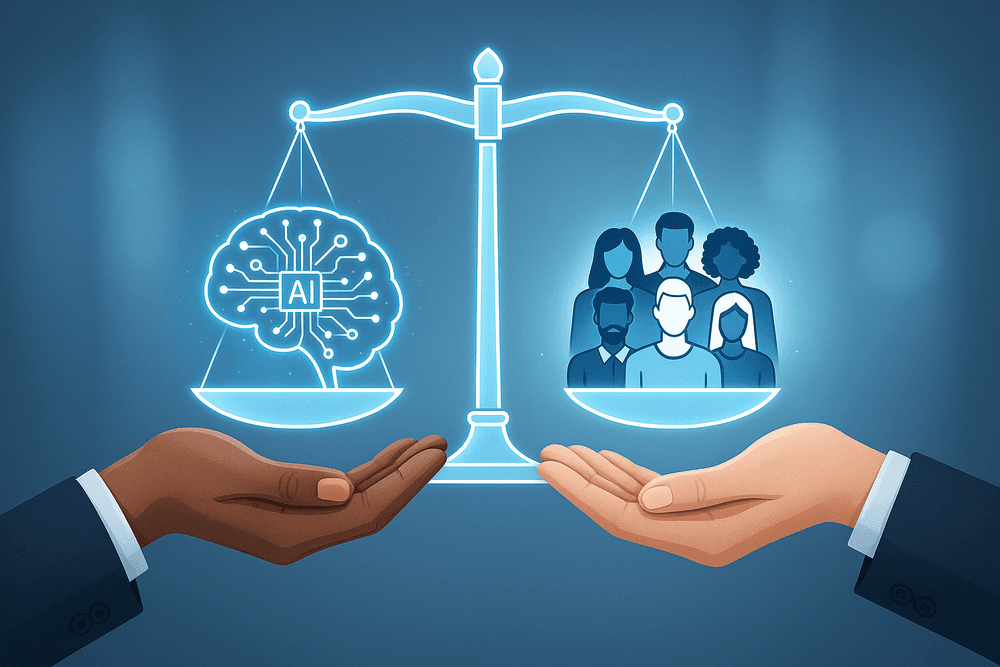
Conclusion: The Future of Responsible and Unbiased AI
We’ve journeyed through the complex landscape of AI bias, from its origins in data and human decisions to its profound real-world impact. We’ve also explored a powerful arsenal of strategies for detection and mitigation. The path forward is not about achieving a mythical, perfectly "unbiased" AI, but about embracing a continuous, committed practice of responsibility. Eradicating bias in AI is an ongoing process of vigilance, humility, and improvement. The future of AI is not just about what it can do, but how it does it—and for whom. To that end, here’s how you can turn principles into practice.
Your Checklist for Minimizing Bias in AI Projects
Building fairer AI requires integrating ethical checkpoints throughout the entire model lifecycle. Use this checklist as a starting point for your projects to ensure fairness is a feature, not an afterthought.
- ✓ Inclusive Data Sourcing: Did you proactively collect data that is representative of your diverse user base? Have you audited it for historical biases and imbalances?
- ✓ Fairness-Aware Modeling: Have you explored pre-processing, in-processing, or post-processing techniques specifically designed to mitigate bias in AI systems?
- ✓ Rigorous Subgroup Testing: Are you evaluating model performance not just on overall accuracy, but across different demographic and sensitive subgroups to identify disparities?
- ✓ Transparent Documentation: Can you produce a "model card" or "datasheet" that clearly states your model's intended use, limitations, performance metrics, and fairness considerations?
- ✓ Diverse Team Composition: Does your development team reflect a variety of backgrounds and perspectives? Diverse teams are better equipped to spot and challenge assumptions that lead to bias.
- ✓ Human-in-the-Loop Oversight: For high-stakes applications (e.g., hiring, lending), is there a process for human review to override or correct potentially biased automated decisions?
Committing to Continuous Monitoring and Improvement
Launching a model is the beginning, not the end. The world is not static; data distributions shift, societal norms evolve, and user behavior changes. A model that performs fairly at launch can experience "fairness drift," where its performance degrades for certain subgroups over time.
This makes continuous monitoring essential. Implementing a robust monitoring framework involves:
- Automated Fairness Audits: Regularly running checks on live model predictions to detect emerging disparities in real-time.
- Feedback Mechanisms: Creating clear, accessible channels for users to report perceived instances of bias. This qualitative feedback is invaluable for uncovering issues that quantitative metrics might miss.
- Scheduled Model Retraining: Planning for periodic retraining of models with new, more representative data to ensure they remain fair and accurate.
This commitment transforms fairness from a one-time pre-launch check into a core operational principle.
How to Get Started with Ethical AI Today
The challenge of addressing bias in AI can feel immense, but progress starts with concrete, manageable actions. You don’t need a fully-staffed AI ethics board to begin. Start here:
- Educate and Evangelize: Share resources and foster conversations within your team about the importance of ethical AI. Awareness is the first step toward accountability.
- Start Small with an Audit: Select one existing, low-risk model and perform a fairness audit using open-source tools like IBM's AIF360 or Microsoft's Fairlearn.
- Define Your Principles: Draft a simple, clear document outlining your organization’s commitment to responsible AI. This creates a shared vocabulary and vision.
- Launch a Pilot Project: Designate your next AI project as a "fairness-first" pilot. Intentionally apply the checklist above from day one and document your learnings.
By taking these first steps, you begin building the muscle memory for ethical development, paving the way for a future where technology is not only powerful but also equitable and just.