
July 9, 2025
What Is an AI Storyteller and Why Your Brand Needs One
What Is an AI Storyteller and Why Your Brand Needs One
In the ever-evolving landscape of digital marketing, the way brands communicate is undergoing a seismic shift. We've moved from the meticulous, often slow-paced world of manual copywriting to a new frontier powered by intelligent technology. At the heart of this transformation is the AI storyteller—a sophisticated system designed not just to write text, but to weave compelling, data-driven narratives that build and strengthen your brand identity.
But what exactly is an AI storyteller? Think of it as more than just a content generator. It's a strategic partner that combines the creative spark of a human writer with the analytical power of a data scientist. By processing vast amounts of information—from customer demographics and engagement metrics to market trends and competitor analysis—it crafts stories that are not only well-written but also deeply relevant and personalized to your audience. This is the next step in the evolution of brand communication.
From Manual Copy to AI Narratives: A Content Evolution
For decades, brand storytelling was a purely human endeavor. Marketers and copywriters relied on intuition, experience, and small-scale focus groups to craft messages they hoped would resonate. While this approach produced iconic campaigns, it was inherently limited by human capacity. It was time-consuming, difficult to scale across multiple channels, and often struggled to deliver true one-to-one personalization.
An AI storyteller shatters these limitations. It automates the heavy lifting of content creation, enabling your brand to:
- Scale Effortlessly: Generate high-quality blog posts, social media updates, email campaigns, and video scripts in a fraction of the time.
- Maintain Consistency: Ensure a unified brand voice and messaging across all digital touchpoints, reinforcing your identity.
- Augment Creativity: Free your human marketing team from repetitive writing tasks, allowing them to focus on high-level strategy, creative direction, and fine-tuning the AI's output.
How AI Builds Authentic Audience Connections
A common misconception is that "artificial" intelligence cannot create "authentic" connections. The reality is precisely the opposite. Authenticity in marketing isn't about the origin of the content; it's about its relevance and resonance with the audience. An AI storyteller excels here by moving beyond assumptions and using hard data to understand what your audience truly cares about.
By analyzing user behavior, it can identify pain points, aspirations, and the specific language that connects with different segments. The result is hyper-personalized content that speaks directly to the individual, making them feel seen and understood. This data-driven empathy is the key to building genuine trust and fostering a loyal community around your brand.
The Core Value for Your Marketing Strategy
Integrating an AI storyteller into your marketing strategy isn't just an upgrade—it's a fundamental competitive advantage. The core value lies in its ability to unify creativity with analytics at scale. It transforms your content from a static asset into a dynamic, performance-driven engine for growth, ensuring every story you tell is optimized to achieve a specific business goal, from building awareness to driving conversions. In a crowded digital world, the brands that tell the most relevant, consistent, and compelling stories will win. An AI storyteller is the tool that makes it possible.
How to Select the Best AI Storyteller Platform
With a booming market of AI tools, choosing the right platform to craft your brand’s narrative can feel overwhelming. The goal isn't just to find a text generator; it's to find a strategic partner. The best ai storyteller for your business will seamlessly align with your brand identity, workflow, and strategic goals, transforming from a simple tool into a core component of your creative engine.
Core Features That Define a Superior AI Storyteller
When you start comparing platforms, move beyond the hype and focus on the features that directly impact the quality and consistency of your brand stories.
Tone, Style, and Voice Customization
Your brand voice is your unique personality, and your AI tool must be able to master it. Generic content won't build a memorable brand. Look for an ai storyteller that offers deep customization options:
- Brand Voice Cloning: The ability to upload existing content (like blog posts, mission statements, or successful ad copy) to train the AI on your specific tone, terminology, and cadence.
- Custom Style Guides: A feature that allows you to set permanent rules for the AI, such as always using a specific honorific, avoiding certain jargon, or adhering to a particular reading level.
- Adjustable Tone Sliders: Granular controls that let you dial the tone up or down for different contexts—from formal and professional for a whitepaper to witty and casual for a social media post.
Narrative and Formatting Flexibility
A compelling brand story isn't confined to a single format. Your AI partner should be a versatile creator, capable of adapting its output to various channels and objectives. Essential capabilities include:
- Multi-Format Generation: Can it produce long-form blog posts, concise social media captions, engaging video scripts, persuasive email sequences, and captivating product descriptions?
- Structural Control: Look for features that let you outline your story arc. A powerful ai storyteller allows you to define the introduction, rising action (the problem), climax (the solution), and conclusion, ensuring the narrative is structured and purposeful.
- Audience Personas: The ability to define your target audience within the tool, so the AI can tailor the language, examples, and emotional angle to resonate with specific customer segments.
Integrating an AI Storyteller into Your Martech Stack
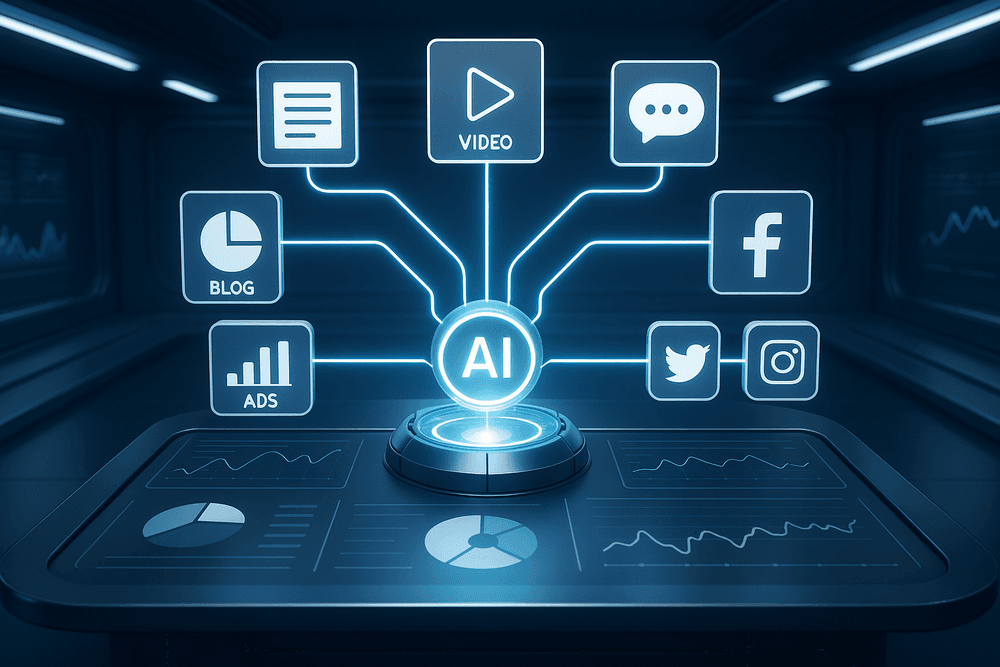
To truly unlock efficiency, your AI platform cannot operate in a silo. Seamless integration with your existing marketing technology (martech) stack is a non-negotiable for modern marketing teams. This transforms your ai storyteller from a content creator into a command center for your narrative strategy.
Prioritize platforms that offer robust APIs or native integrations with key systems like:
- Content Management Systems (CMS): Direct connections to WordPress, Webflow, or other CMS platforms to publish drafts with a single click.
- Social Media Schedulers: Integration with tools like Hootsuite, Buffer, or Sprout Social to streamline the creation and scheduling of social content.
- Customer Relationship Management (CRM): Connections to HubSpot, Salesforce, or other CRMs to leverage customer data for creating hyper-personalized story angles and email campaigns.
By ensuring your chosen tool communicates with the rest of your stack, you create a powerful, automated workflow that saves time, reduces manual errors, and provides a holistic view of your content's performance.
A Step-by-Step Guide to Using an AI Storyteller
Diving into the world of AI-powered brand storytelling is an exciting journey, but it’s more of a collaborative art than a simple push-button solution. To get the rich, compelling narratives you’re after, you need a strategy. Think of your AI storyteller not as a vending machine for content, but as a brilliant yet inexperienced apprentice who needs clear direction. Here’s how you can guide it to create magic for your brand.
Step 1: Define Your Brand Voice and Core Message
Before you write a single prompt, you must first teach the AI who you are. An AI can’t guess your brand’s personality, values, or unique quirks. This foundational step ensures every piece of content the AI generates feels consistent and authentically yours.
Start by creating a "Brand Bible" for your AI. This document should be your single source of truth and include:
- Core Message: What is the central idea or promise of your brand? Distill it into one or two powerful sentences.
- Brand Archetype & Personality: Are you the innovative Sage, the dependable Creator, or the adventurous Explorer? Define your personality traits (e.g., "witty, but not sarcastic," "inspirational and empowering," "tech-savvy and direct").
- Tone of Voice: Provide concrete examples. Instead of just saying "friendly," specify "friendly like a helpful expert at a workshop, not like a casual acquaintance at a party."
- Vocabulary: List key terms, phrases, and product names to use consistently. Just as importantly, list words and jargon to avoid.
Feeding this information into your AI model’s custom instructions or including it in your prompts will train it to speak your brand’s language fluently.
Step 2: Craft Your First Narrative with Smart Prompts
Now that the AI understands your identity, it’s time to give it a task. The quality of your output is directly tied to the quality of your input, or "prompt." A well-crafted prompt is a detailed creative brief.
A powerful prompt for an AI storyteller typically includes these four elements:
- Role: Tell the AI who it should be. For example: "Act as a master brand storyteller."
- Context: Provide the essential background. "You are writing for [Your Brand], a company that [Your Core Message]. Our brand voice is [Your Defined Voice]."
- Task: Clearly state what you want. "Write a 250-word brand story about our founder’s 'aha' moment that led to the creation of our flagship product. Focus on the struggle and the ultimate breakthrough."
- Parameters: Set the creative guardrails. "The story should evoke a sense of inspiration and perseverance. The target audience is aspiring entrepreneurs. End with a hopeful and forward-looking statement."
Experiment with different parameters like story length, format (e.g., a blog post, a social media caption, a video script), and creativity level to see how the AI responds.
Step 3: The Crucial Step of Refining and Humanizing
The first draft from your AI is rarely the final version. This is where your human expertise becomes indispensable. The AI provides an excellent, structured foundation, but the final polish is what elevates the content from good to unforgettable.
Humanizing the AI-generated content is the step that infuses it with a soul. Here’s your refinement checklist:
- Inject Emotional Nuance: Add sensory details, personal anecdotes, or subtle emotional shifts that an AI might overlook. Does the story feel right?
- Check for Authenticity: Read the text aloud. Does it sound like something a human from your company would actually say? Adjust awkward phrasing and smooth out the rhythm.
- Fact-Check and Verify: An AI can occasionally "hallucinate" or invent details. Ensure all facts, figures, and claims are accurate and align with your brand’s reality.
- Strengthen the Connection: Weave in specific cultural references, inside jokes, or shared experiences that resonate deeply with your niche audience.
This human-AI partnership is the future of content creation. By mastering this collaborative process, you can leverage the speed and scale of an AI storyteller while retaining the authenticity and emotional intelligence that truly connects with people.

Best Practices for AI-Powered Brand Storytelling
Unlocking the full potential of an ai storyteller goes beyond simply generating text. It requires a strategic approach that blends technological power with human oversight. By following best practices, you can ensure your AI-generated narratives are not only creative but also authentic, consistent, and ethically sound.
Keep Your Brand Voice Consistent
An AI tool doesn’t inherently understand your brand's soul. Without proper guidance, it can produce generic content that feels disconnected from your identity. To maintain consistency, you must train your ai storyteller with a robust brand framework.
- Develop a Detailed Brand Bible: This is your most critical asset. Your brand bible should include your mission, vision, core values, target audience personas, and, most importantly, your brand voice and tone. Is your brand witty, authoritative, empathetic, or minimalist? Provide specific examples of good and bad copy.
- Create Custom Instructions: Feed your brand bible directly into your AI tool. Most advanced platforms allow for custom instructions or style guides. Prime your ai storyteller with commands like, "Write in an encouraging and expert tone, using simple language and avoiding corporate jargon," before every prompt.
- Review and Refine: Treat the first few outputs as a training exercise. Continuously review the AI-generated content against your style guide. Refine your prompts and instructions based on what works and what doesn’t. This iterative process teaches the AI to align more closely with your unique voice over time.
Use Your AI Storyteller as a Creative Catalyst
One of the most exciting applications of an ai storyteller is its ability to break through creative blocks and uncover new narrative angles you might have missed. Instead of using it as a simple content factory, treat it as your tireless brainstorming partner.
Challenge your AI with exploratory prompts to discover fresh perspectives:
- Reframe Your Origin Story: "Tell our company’s founding story from the perspective of our very first customer."
- Explore Metaphors: "Generate five metaphors that connect our software’s efficiency to forces of nature."
- Imagine Alternative Scenarios: "What if our brand was a character in a sci-fi movie? Write a short monologue for them."
Using an ai storyteller in this way pushes the boundaries of your brand’s narrative territory. It can help you find unexpected emotional hooks and conceptual frameworks that resonate deeply with your audience, transforming your content from predictable to unforgettable.
Navigate the Ethical Landscape and Avoid Common Pitfalls
With great creative power comes great responsibility. Deploying an AI for brand storytelling requires careful attention to ethics and a commitment to avoiding common pitfalls that can damage your brand’s reputation.
- Prioritize Human Oversight: Never publish AI-generated content without a thorough human review. AI can "hallucinate" facts, misinterpret data, or create claims that are factually incorrect. Your team is the ultimate guardian of accuracy and truth.
- Be Mindful of Bias: AI models are trained on vast datasets from the internet, which contain inherent human biases. Scrutinize all outputs for stereotypes, exclusionary language, or biased perspectives. Ensure your storytelling is inclusive and reflects your brand’s commitment to fairness.
- Maintain Originality: The biggest pitfall of over-relying on an ai storyteller is producing soulless, generic content that lacks a human touch. The AI is excellent at building a foundation, but the final emotional polish, nuance, and strategic insight must come from a human creative. Use AI to draft, ideate, and accelerate, but always add your unique human spark to make the story truly yours.
Inspiring Use Cases: An AI Storyteller in Action
Theory is one thing, but seeing an ai storyteller transform a brand’s communication strategy is where the magic truly happens. This technology isn't just about generating text; it's about building scalable, personalized, and high-impact brand narratives. Let’s explore three real-world scenarios where an ai storyteller becomes an indispensable part of the marketing team.
Case Study: Creating Engaging Social Media Campaigns at Scale
The Challenge: A fast-growing direct-to-consumer lifestyle brand needed to maintain a vibrant presence across Instagram, TikTok, Twitter, and LinkedIn. Their small marketing team was struggling to produce a constant stream of fresh, platform-specific content that stayed true to their "adventurous and mindful" brand voice. Creative burnout was high, and post quality was becoming inconsistent.
The Solution: The brand integrated an ai storyteller into their content workflow. They started by feeding the AI their core brand voice guidelines and the central theme of their upcoming quarterly campaign: "The Urban Escape." From this single creative brief, the ai storyteller generated hundreds of assets. It produced witty, concise tweets, inspiring Instagram captions with relevant hashtag suggestions, short video scripts for TikTok, and more professional thought-leadership posts for LinkedIn. The AI could instantly reframe the same core message for different audience mindsets on each platform.
The Outcome: The brand was able to double its posting frequency without hiring more staff. More importantly, engagement rates climbed by 35% as the content became more consistently creative and tailored to each channel. The marketing team was freed from the daily content grind, allowing them to focus on high-level strategy, community management, and analyzing the performance data generated by their new AI partner.
Case Study: Developing Compelling Product Descriptions That Convert
The Challenge: An e-commerce marketplace specializing in artisan home goods had over 5,000 unique products. Their product descriptions were dry and technical, listing only materials and dimensions. This failed to communicate the value and story behind each handcrafted item, leading to high bounce rates and low conversion.
The Solution: They deployed an ai storyteller trained on compelling e-commerce copy. For each product, they provided the AI with basic data points: the artisan's name, the origin of the materials, the crafting process, and key features. The ai storyteller transformed this raw data into evocative, benefit-driven narratives. A simple "ceramic mug" became a "hand-thrown stoneware mug, designed to make your morning ritual a moment of tranquil artistry." It generated multiple versions for A/B testing, focusing on different emotional triggers like "coziness," "sustainability," or "unique design."
The Outcome: Within three months, product page conversion rates increased by an average of 22%. The unique, story-rich descriptions also significantly improved SEO, driving more organic traffic. Customers began leaving reviews that mentioned the product stories, proving that the narrative had successfully created a stronger emotional connection and perceived value.
Case Study: Automating Personalized Email Marketing Narratives
The Challenge: A subscription box service wanted to reduce churn by building a deeper relationship with its subscribers. Their generic, one-size-fits-all email campaigns had low open rates, and personalized outreach was not feasible at scale.
The Solution: The company connected an ai storyteller to its CRM. The AI analyzed customer data—past purchases, skipped boxes, and viewed items—to craft hyper-personalized email narratives. If a customer consistently chose coffee-related items, the AI would draft an email about the origin story of the next featured roaster. If a user paused their subscription, the AI generated a gentle re-engagement story highlighting a future product they would love based on their preference profile.
The Outcome: Email open rates jumped from 18% to 45% for these personalized narrative campaigns. The company saw a 15% reduction in customer churn over six months because subscribers felt seen and valued. The ai storyteller turned their email list from a simple broadcast channel into a powerful tool for building individual, long-term brand loyalty.

The Future is Now: Your Next Chapter with an AI Storyteller
The narrative around artificial intelligence in creative fields is undergoing a profound transformation. We’ve moved past the fear-fueled headlines of replacement and entered a new, more exciting era of collaboration. The most forward-thinking brands no longer view AI as a simple tool for automation but as a dynamic creative partner. An AI storyteller isn’t here to write for you; it’s here to write with you, to augment your vision, and to help you tell your brand’s story at a scale and speed previously unimaginable.
Embracing this partnership means letting go of manual limitations. Imagine an assistant that can analyze thousands of customer data points to find a hidden narrative thread, draft ten different versions of a campaign story in minutes, or suggest creative angles you hadn't considered—all while you focus on the high-level strategy, emotional resonance, and final polish. This is the new creative workflow: a seamless blend of human ingenuity and machine intelligence, where your AI storyteller handles the heavy lifting, freeing you to be the ultimate arbiter of your brand's voice and soul.
Your Final Checklist for Launching an AI Storytelling Strategy
Embarking on this journey requires a clear flight plan. Before you hand over the reins, run through this final launch checklist. It’s designed to ensure your AI-powered narrative takes off smoothly and heads in the right direction, delivering authentic and impactful results from day one.
- Solidify Your Core Narrative: Revisit your brand’s fundamental "why." What is your mission, who are your heroes (customers), and what is the central conflict you solve? Your AI storyteller is a powerful amplifier; ensure you're giving it a clear and compelling message to amplify.
- Select the Right Platform: Not all AI tools are created equal. Evaluate different platforms based on your specific needs. Do you require long-form content, snappy social media copy, or personalized email sequences? Choose a partner that aligns with your content goals and integrates with your existing marketing stack.
- Train Your Digital Apprentice: This is the most crucial step. A generic AI produces generic content. To achieve true brand alignment, you must train your model on your specific voice, tone, style guides, past successful campaigns, and customer personas. The more it learns from you, the more it will sound like you.
- Establish a Human-in-the-Loop Workflow: Define who guides, reviews, and provides the final approval for all AI-generated content. This human oversight is non-negotiable. It ensures brand safety, factual accuracy, and infuses the final product with the nuanced emotional intelligence that only a human can provide.
- Set Clear and Measurable KPIs: How will you define success? Go beyond vanity metrics. Track key performance indicators like conversion rates on AI-assisted landing pages, engagement on AI-drafted social posts, and shifts in brand sentiment.
- Launch a Pilot Project: Resist the urge to overhaul your entire content strategy overnight. Start with a single, controlled campaign or content channel. Use this pilot to test your workflow, refine your prompts, and gather data before scaling your AI storyteller strategy across the organization.
The technology is ready. The potential is limitless. The only remaining question is what story you will choose to tell.