
August 3, 2025
What is an AI Model Marketplace and Why Should You Care?
What is an AI Model Marketplace and Why Should You Care?
In the rapidly evolving world of artificial intelligence, building a custom model from scratch is no longer the only path to innovation. Enter the AI model marketplace—a dynamic, centralized platform that is fundamentally changing how developers and businesses access and deploy AI. Think of it as an "App Store for AI," but instead of mobile applications, it offers a vast library of pre-trained, ready-to-use artificial intelligence models.
Beyond the hype, a modern AI model marketplace is an end-to-end ecosystem. It's a digital hub where data scientists and AI companies can publish their models, and developers, product managers, and businesses can discover, evaluate, and integrate them directly into their own applications and workflows via APIs. These platforms go far beyond simple listings, providing crucial infrastructure for versioning, billing, and secure deployment.
The Core Problem They Solve for Developers and Businesses
The traditional approach to AI development is resource-intensive. It demands deep expertise, massive datasets for training, significant computational power, and months—if not years—of development time. This high barrier to entry has historically kept powerful AI capabilities locked within large tech corporations.
An AI model marketplace directly addresses this challenge by solving the classic "build vs. buy" dilemma.
- For Businesses: The primary benefit is strategic acceleration. Instead of investing millions in an in-house AI research team, a company can license a state-of-the-art model for a fraction of the cost. This drastically reduces time-to-market for new AI-powered features, lowers R&D risk, and democratizes access to cutting-edge technology, allowing even small businesses to compete.
- For Developers: The value lies in efficiency and focus. Developers are freed from the complex and time-consuming task of building foundational models like language translation or object detection. Instead of reinventing the wheel, they can leverage a proven, high-performance model from the marketplace and concentrate their efforts on the unique logic and user experience of their application.
From Discovery to Deployment: A Quick Overview
Navigating an AI model marketplace is designed to be a straightforward process, transforming a complex engineering challenge into a simple workflow. The journey typically involves three key stages:
- Discovery: Users browse or search a curated catalog of models. They can filter by task (e.g., sentiment analysis, image generation, voice transcription), industry, pricing model, or popularity to find the perfect solution for their specific use case.
- Evaluation: Before committing, users can scrutinize a model's performance. Marketplaces provide detailed documentation, performance benchmarks, and often an interactive "playground" where developers can test the model with their own data via a simple interface to see the results in real-time.
- Deployment: Once a model is selected, the marketplace provides everything needed for seamless integration. This typically includes secure API keys, code snippets in various programming languages (like Python, JavaScript, or cURL), and SDKs. The platform handles the complex backend infrastructure, scaling, and maintenance, allowing developers to make a simple API call to embed powerful AI into any application.

Comparing the Top AI Model Marketplace Platforms
Navigating the world of AI models can feel like exploring a bustling city with countless districts. Each major AI model marketplace offers a unique culture, specialty, and set of tools. Understanding these differences is key to finding the perfect model for your project efficiently. Let's compare the leading platforms.
Hugging Face: The Community-Driven Behemoth
If the AI world has a town square, it’s the Hugging Face Hub. It's less a corporate storefront and more a sprawling, collaborative ecosystem. With hundreds of thousands of models, datasets, and demos (Spaces), it has become the de facto destination for the open-source AI community.
- Strengths: Its primary power lies in its community and the unparalleled breadth of its offerings, especially in Natural Language Processing (NLP) thanks to its famous
transformerslibrary. The integration is seamless; you can find, test, and download a model with just a few lines of code. - Best For: Developers, researchers, and startups who value open-source collaboration, rapid prototyping, and access to the absolute latest community-driven models. It's the go-to platform for experimentation and building with cutting-edge technology.
TensorFlow Hub: Google's Ecosystem for Pre-Trained Models
Developed and maintained by Google, TensorFlow Hub (TF Hub) is a library dedicated to reusable, pre-trained model components. While it hosts complete models, its core value is in providing pieces—like text embeddings or image feature vectors—that you can easily plug into your own TensorFlow or Keras models for fine-tuning (transfer learning).
- Strengths: Its tight integration with the TensorFlow ecosystem (including TF.js for web and TFLite for mobile) is its biggest selling point. The models are well-documented, reliable, and optimized for the framework.
- Best For: Developers who are already building within the TensorFlow ecosystem. It streamlines the process of adding sophisticated, pre-trained capabilities to an existing application without needing to switch frameworks.
Cloud Platforms: AWS, Azure, and Google Cloud
For enterprises, the AI marketplaces integrated into the major cloud platforms offer a powerful, streamlined experience. These platforms combine model discovery with the MLOps, security, and billing infrastructure businesses already trust.
- AWS SageMaker Marketplace: Offers a vast collection of free and commercial models from third-party vendors that deploy directly into Amazon SageMaker. Its strength is providing a secure, end-to-end environment for enterprise-grade AI, from procurement to deployment and monitoring.
- Azure AI Marketplace: Similar to AWS, this is integrated into the Azure Machine Learning ecosystem. It emphasizes enterprise-ready, compliant, and scalable models, allowing businesses to find and deploy solutions from trusted partners directly within their cloud environment.
- Google Cloud's Vertex AI Model Garden: This is Google’s unified AI model marketplace, providing access to over 100 foundation models, including Google’s own state-of-the-art models (like Gemini and PaLM) alongside popular open-source options. Its seamless integration with the Vertex AI platform makes it a one-stop shop for building and deploying generative AI applications.
Emerging & Niche Marketplaces to Watch
The landscape is continuously expanding beyond the giants. Platforms like Replicate are gaining traction by focusing on a simple, API-first approach, making it incredibly easy to run complex generative models without managing infrastructure. We are also seeing the rise of specialized marketplaces targeting specific industries, such as healthcare or finance, offering curated, domain-specific models. These niche players signal a maturing market, catering to specialized needs with tailored solutions.
Essential Features of a High-Quality AI Model Marketplace
Navigating the world of AI can be complex, but a top-tier AI model marketplace acts as your trusted guide. However, not all platforms are created equal. To truly accelerate your projects and ensure a return on investment, you need to know what to look for. Here are the essential features that separate a great AI model marketplace from a merely good one, empowering you to make the right choice.
Clear Documentation and Transparent Performance Metrics
Think of model documentation as the instruction manual for a powerful tool. Without it, you’re flying blind. A high-quality marketplace provides comprehensive documentation for each model, often in the form of "model cards." These should clearly outline the model's architecture, the data it was trained on (including potential biases), its intended use cases, and its limitations.
Equally important are transparent and verifiable performance metrics. Don't settle for vague claims of "high accuracy." Look for specific, industry-standard metrics relevant to the model's task, such as:
- For Classification: F1-score, Precision, Recall, and Accuracy.
- For all models: Latency (how fast it responds) and throughput (how many requests it can handle).
A trustworthy AI model marketplace presents this data clearly, allowing you to objectively compare models and understand exactly how they will perform in a real-world scenario.
Seamless API Access and Effortless Integration
An AI model is only as useful as your ability to connect it to your application. The best marketplaces prioritize developer experience with well-documented, stable APIs. This is the bridge that allows your software to communicate with the model. Look for platforms that offer code snippets, interactive API explorers, and Software Development Kits (SDKs) for popular programming languages like Python, JavaScript, and Java. The goal is to make integration a "plug-and-play" experience, drastically reducing development time and complexity. A seamless integration process means your team can move from discovery to deployment in days, not months.
Transparent Licensing, Pricing, and Usage Rights
This is where the fine print matters immensely. A premier AI model marketplace will be upfront about all associated costs and legal constraints.
- Licensing: Understand the model's license. Is it open-source with a permissive license like MIT or Apache 2.0, allowing for broad commercial use? Or does it come with a more restrictive or proprietary commercial license? This information should be impossible to miss.
- Pricing: The pricing structure must be clear and predictable. Common models include pay-per-API-call, monthly or annual subscriptions based on usage tiers, or even free tiers for experimentation. Avoid platforms with hidden fees or convoluted pricing that makes it hard to forecast costs.
- Usage Rights: Be crystal clear on how you can use the model and its outputs. Can it be used for commercial products? Are there any restrictions on the type of data you can process?
A Vibrant Community and Diverse Model Selection
Innovation doesn't happen in a vacuum. A thriving community is a strong indicator of a healthy marketplace. Look for active forums, user reviews, and a system for reporting issues. This ecosystem provides invaluable support, surfaces creative use cases, and helps vet the quality of the models.
Finally, variety is key. A robust AI model marketplace isn’t just a shop; it’s a comprehensive library. It should host a wide array of pre-trained models across numerous domains—from Natural Language Processing (NLP) and Computer Vision to audio analysis and time-series forecasting. This diversity ensures you can find the right tool for your specific job, saving you the immense cost and effort of training a model from scratch.
How to Successfully Leverage an AI Model Marketplace
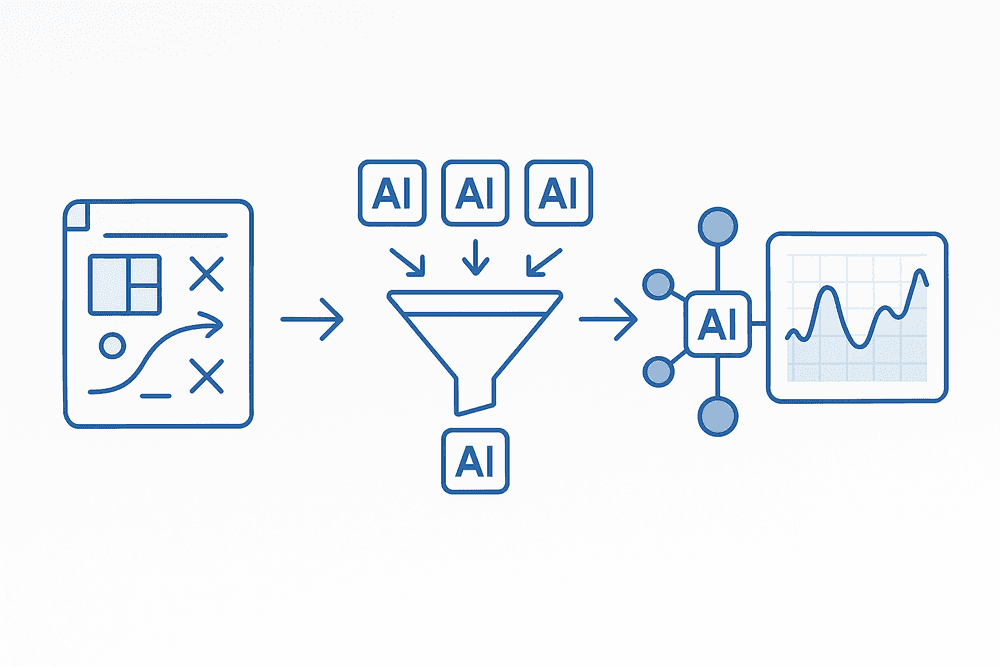
Finding a model on an ai model marketplace is just the beginning. To truly unlock its value and drive tangible results, you need a strategic approach that covers everything from initial planning to post-deployment maintenance. Following a structured process ensures you select the right asset, integrate it effectively, and maintain its performance over time. Here’s a four-step guide to transforming a promising model into a powerful business solution.
Step 1: Clearly Defining Your Project Requirements
Before you even open a browser tab, the most critical step is to define precisely what you need the AI model to do. A vague goal like "improve customer service" is a recipe for failure. Instead, drill down into specifics. A clear definition acts as your compass, guiding your search within the vast landscape of an ai model marketplace.
Start by answering these fundamental questions:
- Business Problem: What specific challenge are you solving? Is it sentiment analysis for customer feedback, object detection in security footage, or churn prediction from user activity data?
- Data: What is the type, volume, and quality of the data you have available for the model? Is it text, images, or structured numerical data? The model you choose must be compatible with your data's format and scale.
- Performance Metrics: How will you measure success? Define your key performance indicators (KPIs), such as required accuracy, acceptable latency (response time), and prediction throughput.
- Constraints: What are your limitations regarding budget, computational resources, and in-house technical expertise?
Answering these questions first will dramatically narrow your search and prevent you from wasting time on models that are a poor fit for your project.
Step 2: A Checklist for Vetting and Selecting the Right Model
With your requirements in hand, you’re ready to evaluate potential candidates. Think of this as a due diligence process. Not all models are created equal, and a thorough vetting process is essential for selecting a reliable and effective solution from an ai model marketplace.
Use this checklist to systematically assess each model:
- Comprehensive Documentation: Does the model have clear, detailed documentation explaining its architecture, the dataset it was trained on, its intended use cases, and its known limitations? A lack of good documentation is a major red flag.
- Verified Performance Metrics: Review the published metrics (e.g., accuracy, F1-score, MAE). Do these metrics align with the KPIs you defined in Step 1? Look for results validated on standard benchmark datasets.
- Licensing and Usage Rights: Carefully read the license. Is it open-source? Does it permit commercial use? Are there any restrictions or attribution requirements you need to follow?
- Provider Reputation & Community Feedback: Who created the model? Are they a reputable research institution, a known company, or an active community contributor? Check for reviews, ratings, and discussions in forums to gauge real-world performance and support.
- Technical Compatibility: Confirm that the model’s expected input/output formats are compatible with your data pipeline and that its dependencies align with your technology stack.
Step 3: Fine-Tuning a Pre-Trained Model vs. Using It Out-of-the-Box
Once you’ve selected a model, you face a key decision: use it as-is or adapt it to your specific data?
- Using Out-of-the-Box: This approach is best for general, well-defined tasks where the pre-trained model's knowledge is sufficient. For example, using a general-purpose language model for standard text summarization. It's the fastest and simplest path to deployment, requiring minimal ML expertise.
- Fine-Tuning: This involves taking the pre-trained model and training it further on your own, smaller, domain-specific dataset. This is the ideal approach when you need the model to understand niche terminology, specific visual styles, or unique data patterns. For instance, fine-tuning a general image classifier to recognize your company's specific product line. While it requires more effort and a labeled dataset, fine-tuning almost always results in significantly higher accuracy for specialized tasks.
The right choice depends on your project’s demand for specificity versus its need for speed and simplicity.
Step 4: Monitoring Deployed Models for Performance and Drift
Deployment is not the finish line. AI models operate in a dynamic environment, and their performance can degrade over time—a phenomenon known as "model drift." This happens when the real-world data the model sees in production starts to differ from the data it was trained on.
To ensure your model remains effective, you must implement a robust monitoring strategy:
- Track Key Metrics: Continuously monitor the performance metrics you defined in Step 1, such as accuracy and latency. Set up automated alerts to notify you of any significant drops in performance.
- Detect Data Drift: Monitor the statistical properties of the input data. If the new data's distribution changes significantly, it’s a strong indicator that the model’s performance may soon degrade.
- Establish a Retraining Cadence: Don't wait for performance to plummet. Proactively schedule regular model retraining or fine-tuning with fresh data to keep it current and accurate. Many modern MLOps platforms integrated with an ai model marketplace can help automate this lifecycle.
From Theory to Impact: AI Model Marketplace Use Cases
The true value of an ai model marketplace isn't just in the variety of models it holds, but in its ability to translate complex AI theory into tangible business outcomes. These platforms act as catalysts, enabling organizations of all sizes to deploy sophisticated AI without the prohibitive costs and timelines of ground-up development. Let's explore three powerful use cases that demonstrate how businesses are turning to these marketplaces to solve real-world problems and drive incredible results.
How a Startup Accelerated Product Launch with a Pre-Trained NLP Model
Imagine a lean startup aiming to disrupt the customer service industry with an intelligent feedback analysis tool. Their goal is to automatically categorize customer reviews, support tickets, and social media comments by sentiment and topic. The primary challenge? Building a proprietary Natural Language Processing (NLP) model requires massive labeled datasets, specialized machine learning expertise, and months of R&D—resources the startup simply doesn't have.
Instead of starting from zero, the founders turned to an ai model marketplace. There, they quickly identified a high-performance, pre-trained model for sentiment analysis and intent recognition. With clear documentation and a simple API, their small development team integrated the model into their application in just a couple of weeks. This strategic move allowed the startup to bypass the lengthy and expensive model development phase entirely. They launched their minimum viable product (MVP) three months ahead of schedule, securing early customers and crucial investor funding that might have otherwise gone to a competitor.
Boosting E-commerce Sales with a Computer Vision Model
An established online fashion retailer faced a common challenge: static, rule-based product recommendations were failing to engage customers and drive cross-sells. They needed a more dynamic and intuitive way to help shoppers discover products and build complete outfits, but developing an in-house visual search and recommendation engine was a complex, multi-year project.
The e-commerce team explored an ai model marketplace and discovered a ready-to-deploy computer vision model specializing in fashion apparel. The model could not only identify individual items in an image (a shirt, pants, a handbag) but also find visually similar products across their entire inventory. By integrating this model, the retailer launched two game-changing features: “Shop the Look,” which let customers buy an entire outfit from a single promotional photo, and a “Visually Similar” carousel on product pages. This led to a 15% increase in average order value and a significant lift in customer engagement, proving how an ai model marketplace can directly fuel revenue growth.
Improving Operational Efficiency via a Predictive Maintenance Model
A mid-sized manufacturing firm was struggling with costly, unplanned downtime on its production line. Their maintenance approach was either reactive—fixing machines only after they failed—or based on an inefficient fixed schedule, which often led to unnecessary servicing or catastrophic failures. The firm had years of sensor data (temperature, vibration, pressure) from its machines but lacked the in-house data science capabilities to build a reliable predictive model.
The operations manager discovered a predictive maintenance model on an ai model marketplace specifically designed to analyze time-series data from industrial sensors and forecast the probability of equipment failure. After deploying and fine-tuning the model with their data, the firm shifted from a reactive to a predictive maintenance strategy. Alerts now notify technicians of potential issues days or weeks in advance, allowing them to schedule repairs during planned downtime. The result was a 40% reduction in unexpected equipment failures and a 25% decrease in annual maintenance costs, showcasing the profound operational efficiencies unlocked by accessible AI.

Conclusion: Finding the Right AI Model Marketplace for Your Goals
The journey into the world of artificial intelligence has never been more accessible, and the key to unlocking its potential often lies in finding the perfect platform. As we've explored, the ideal AI model marketplace is not a one-size-fits-all solution but a strategic partner that aligns perfectly with your unique project requirements, technical capabilities, and business objectives. The landscape is vast and varied, from the comprehensive, cloud-integrated ecosystems of AWS, Google Cloud, and Azure to the community-driven, open-source havens like Hugging Face and specialized, niche platforms. The right choice is the one that empowers you to move from idea to implementation with speed, confidence, and efficiency.
Recap: Matching Your Needs to the Right Platform
Your starting point dictates your destination. A startup looking for a cost-effective, pre-trained NLP model for a customer service chatbot will have vastly different needs than an enterprise data science team that requires a secure, scalable environment to fine-tune a proprietary computer vision model.
- For developers and researchers: Platforms like Hugging Face offer unparalleled access to the latest open-source models and a vibrant community for collaboration and innovation.
- For businesses integrating with existing infrastructure: The marketplaces from cloud giants provide seamless integration, robust security, and scalable MLOps tools that fit neatly into your current workflows.
- For those seeking specific, ready-to-deploy solutions: Niche marketplaces and platforms like an AI model marketplace focused on specific industries can provide highly-tuned models that accelerate time-to-value without extensive in-house expertise.
The critical takeaway is to evaluate each platform not on its size, but on its fit. Consider the model variety, documentation quality, pricing structure, and integration capabilities before committing.
The Future of AI Accessibility Through Marketplaces
The rise of the AI model marketplace is more than a trend; it's a fundamental shift in how we access and deploy artificial intelligence. These platforms are democratizing AI, breaking down barriers that once limited advanced technology to a handful of tech titans. We are moving toward a future where AI is a utility—a component that can be easily found, tested, and integrated into any application.
Looking ahead, we can expect even greater specialization, with marketplaces emerging for hyper-niche domains like agricultural analytics, legal document review, and personalized medicine. Competition will continue to drive down costs, improve model quality, and foster the development of even more user-friendly tools for deployment and monitoring. These marketplaces are not just repositories; they are evolving into dynamic ecosystems that fuel innovation and make sophisticated AI accessible to all.
Start Your Search Today: A Quick-Start Checklist
Feeling ready to dive in? Use this checklist to guide your search for the right AI model marketplace and ensure you make a choice that sets your project up for success.
- Define Your Problem: What specific business challenge are you trying to solve? Clearly outline your use case (e.g., image classification, text summarization, fraud detection).
- Assess Your Resources: What is your budget? What is your team's technical skill level? Do you need a low-code/no-code solution or do you have data scientists ready to fine-tune models?
- Evaluate Model Quality and Documentation: Look for platforms with transparent model cards that detail performance metrics, training data, and potential biases. Clear, comprehensive documentation is non-negotiable.
- Consider the Ecosystem and Integration: Will the platform integrate smoothly with your existing cloud services, databases, and applications? Check for APIs and SDKs that match your tech stack.
- Review Licensing and Compliance: Scrutinize the licensing terms. Are the models cleared for commercial use? Does the platform adhere to data privacy and security standards relevant to your industry (e.g., GDPR, HIPAA)?
- Test with a Pilot Project: Before full-scale deployment, select a promising model and run a small, controlled test. This will reveal any unforeseen challenges with integration, performance, or cost.