
June 28, 2025
What is an AI Model Marketplace and Why is it a Game-Changer

What is an AI Model Marketplace and Why is it a Game-Changer?
Not long ago, integrating artificial intelligence into a project meant embarking on a long, costly, and resource-intensive journey. It required a specialized team of data scientists and ML engineers to collect massive datasets, spend countless hours on expensive hardware training a model from scratch, and then grapple with the complexities of deployment. Today, that paradigm is being completely rewritten by the rise of the AI model marketplace.
Think of it as an app store, but for intelligence itself. An AI model marketplace is a digital platform where pre-trained AI models are curated, listed, and made available for others to use. Instead of building a complex natural language processing (NLP) model from the ground up, a developer can now browse a marketplace, find a suitable pre-trained model for sentiment analysis, and integrate it into their application in a fraction of the time. This fundamental shift from "build" to "buy" is democratizing access to powerful technology and accelerating innovation at an unprecedented scale.
The Core Benefits: Speed, Cost, and Innovation
The advantages of leveraging an AI model marketplace are transformative, fundamentally changing how organizations approach AI development.
Supercharge Your Speed to Market
The most immediate benefit is a dramatic reduction in development time. A process that once took months or even years can now be completed in days or weeks. By using a pre-trained model as a foundation, teams can skip the most time-consuming steps of data collection and initial training. This allows for rapid prototyping, faster MVP launches, and the ability to add sophisticated AI features to existing products without derailing roadmaps. In a competitive landscape, this speed is a decisive advantage.
Drastically Reduce Development Costs
Building an AI model from scratch is a significant financial investment. The costs include acquiring and labeling massive datasets, paying for thousands of hours of powerful GPU compute time, and funding the salaries of a highly specialized team. An AI model marketplace slashes these costs by converting a large capital expenditure into a more manageable operational expense. You pay for access to a ready-made solution, often through a subscription or pay-per-use API, allowing even startups and small businesses to wield the same AI power as large enterprises.
Unlock a World of Innovation
These marketplaces are vibrant ecosystems of cutting-edge technology. They give you direct access to state-of-the-art models developed by leading research labs and individual experts from around the world. Whether you need advanced computer vision for object detection, a sophisticated algorithm for fraud prediction, or a generative model for creating content, you can find it without needing an in-house R&D department to invent it first. This accessibility fosters a culture of experimentation, empowering teams to test new ideas and solve problems in novel ways.
Who Are These Marketplaces For?
An AI model marketplace serves a diverse range of users, each finding unique value on the platform:
- Developers: For software developers, these marketplaces are a treasure trove of powerful tools. They can quickly find and integrate AI functionality into their applications via simple APIs, focusing on building great user experiences instead of getting bogged down in the underlying machine learning complexity.
- Businesses and Product Managers: Business leaders can browse for solutions to specific challenges, from automating customer support to optimizing supply chains. It allows them to validate the ROI of an AI initiative with minimal risk before committing to a larger investment.
- Researchers and Data Scientists: These experts can use foundational models from a marketplace as a powerful starting point for their own specialized work, fine-tuning them for unique tasks. Furthermore, it provides a platform for them to monetize their own creations, contributing to the ecosystem while generating revenue.

Comparing the Titans: A Look at the Top AI Model Marketplace Platforms
Once you understand the value of an ai model marketplace, the next step is choosing the right one for your project. The landscape is diverse, with platforms catering to different needs, from open-source communities to enterprise-grade cloud ecosystems. Each offers a unique blend of models, tools, and integration capabilities. Let's break down the major players to help you find the perfect fit.
Hugging Face: The Community-Driven Hub
Often called the "GitHub for machine learning," Hugging Face has become the de facto central hub for the open-source AI community. Its strength lies in its sheer volume and collaborative spirit. With hundreds of thousands of models, datasets, and interactive demos (Spaces), it's an unparalleled resource for discovery and experimentation. Hugging Face is particularly dominant in Natural Language Processing (NLP) thanks to its popular transformers library, which makes downloading and implementing state-of-the-art models a matter of a few lines of code. For developers seeking the latest open-source innovations and a vibrant, supportive community, the Hugging Face Hub is the premier ai model marketplace and an essential first stop.
TensorFlow Hub & PyTorch Hub: The Ecosystem-Specific Platforms
For developers deeply integrated into a specific deep learning framework, the native hubs are often the most direct and efficient path to finding compatible models.
- TensorFlow Hub (TF Hub): As Google's official model repository, TF Hub provides a rich collection of pre-trained models and model components optimized specifically for the TensorFlow ecosystem. It excels at offering reusable pieces, like text embeddings or image feature vectors, that can be easily plugged into a larger TensorFlow pipeline, accelerating development without compatibility headaches.
- PyTorch Hub: Similarly, PyTorch Hub serves the vast PyTorch community, offering a curated set of models that can be loaded directly within a PyTorch workflow. It prioritizes simplicity and reproducibility, ensuring models can be implemented with minimal friction.
Cloud-Based Options: AWS, Google, and Azure AI Marketplaces
The major cloud providers offer robust AI marketplaces designed for enterprise-scale deployment, security, and streamlined billing.
- AWS Marketplace: Leveraging the world's largest cloud platform, the AWS Marketplace features a vast catalog of AI/ML models from third-party vendors. Its key advantage is seamless integration with AWS services like SageMaker, allowing businesses to find, subscribe to, and deploy models directly into their production environment with unified billing.
- Google Cloud (Vertex AI Model Garden): Google's offering is a curated collection of powerful foundation models and task-specific models from both Google and its partners. Integrated into the powerful Vertex AI platform, it simplifies the process of tuning and deploying models at scale.
- Microsoft Azure Machine Learning: Azure provides a model catalog within its Machine Learning studio, focusing on enterprise-grade models that are secure, compliant, and ready for production. It offers a curated selection of open-source models optimized for the Azure environment.
Niche Players and Specialized Model Repositories
Beyond the titans, a growing number of specialized platforms serve specific needs. Platforms like Replicate focus on making it incredibly easy to run complex models via a simple API call, abstracting away the underlying infrastructure. Other niche repositories might specialize in models for specific industries, such as medical imaging, or tasks like 3D asset generation. Exploring these smaller players can often uncover the perfect, highly-specialized tool for a unique project, proving that the best ai model marketplace is the one that best fits your specific use case.
Key Features to Demand from Your AI Model Marketplace
Not all platforms are created equal. Choosing the right ai model marketplace is the difference between accelerating your project and getting bogged down by technical debt and legal ambiguity. Think of a great marketplace not as a simple store, but as a complete workbench designed to make you successful. When evaluating your options, demand a platform that excels in these four critical areas.
Model Discovery, Search, and Filtering
The first challenge in any ai model marketplace is finding the perfect model for your specific use case. A vast library is useless if you can't navigate it efficiently. A top-tier platform moves beyond a basic search bar and offers a powerful, multi-faceted discovery engine.
Look for granular filtering options that allow you to narrow down choices by:
- Task: Image classification, natural language processing, sentiment analysis, object detection, etc.
- Framework: TensorFlow, PyTorch, Scikit-learn, ONNX, and others.
- Data Type: Models trained on text, images, audio, or tabular data.
- License: Clear filtering for open-source (e.g., MIT, Apache 2.0) vs. commercial licenses.
- Pricing: Options to filter by free, pay-per-use, or subscription models.
The best marketplaces also curate collections, highlighting trending models, industry-specific solutions, or models optimized for particular hardware, saving you valuable research time.
Evaluating Model Performance, Documentation, and Licensing
Once you’ve found a promising model, you need to verify its quality and suitability. Transparency is non-negotiable. A trustworthy marketplace provides a comprehensive evaluation toolkit right on the model's page. This includes standardized performance metrics like accuracy, F1 score, latency, and throughput, often presented on leaderboards for easy comparison. The ability to test the model with your own data through a live, interactive demo is a huge plus.
Equally important is documentation. Insist on clear, thorough documentation that covers:
- An overview of the model’s architecture and training data.
- Detailed API specifications with input/output formats.
- Practical code snippets for quick integration.
- Explicitly stated limitations and potential biases.
Finally, licensing information must be front and center. Ambiguity here can lead to serious legal and compliance issues down the road. The marketplace should clearly state the terms of use for every model, ensuring you can deploy it confidently in your intended environment.
Secure and Seamless API Integration and Deployment
Finding and vetting a model is only half the battle. The true test of an ai model marketplace is how easily it allows you to integrate that model into your application. Look for a seamless developer experience that prioritizes security and speed.
Key integration features include instantly available API endpoints, well-managed API keys, and robust SDKs for popular programming languages like Python, JavaScript, and Java. The platform should provide copy-and-paste code examples that work out of the box, drastically reducing the time from discovery to implementation. Furthermore, consider deployment flexibility. Does the marketplace offer scalable, serverless API hosting, or does it allow you to download the model to run on your own infrastructure for maximum control and privacy?
Community Support, Tutorials, and User Reviews
An AI model doesn't exist in a vacuum. A vibrant ecosystem of support can make all the difference, especially when you encounter an issue or want to optimize performance. A great marketplace fosters a strong community through forums, discussion boards, or direct lines of communication with model creators.
Beyond direct support, look for rich educational resources. A comprehensive library of tutorials, getting-started guides, and real-world case studies helps you unlock the full potential of a model. Finally, never underestimate the power of peer feedback. User reviews and ratings provide invaluable, real-world insights into a model's performance, ease of use, and any quirks the official documentation might miss. This social proof is a powerful signal of a model's true value.
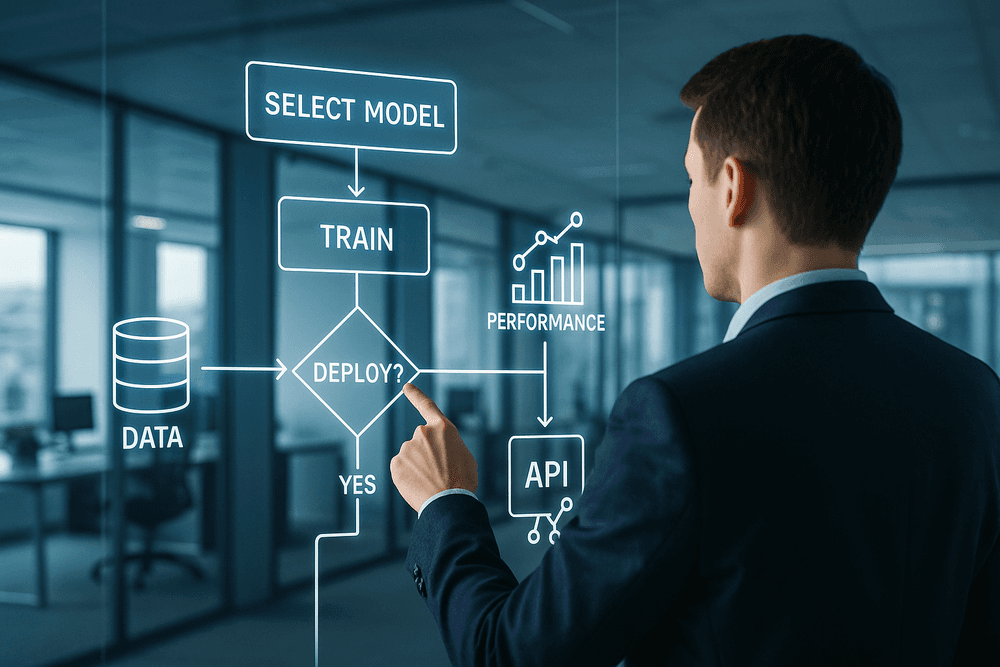
A Practical Guide: How to Choose and Deploy from an AI Model Marketplace
Navigating the vast landscape of an ai model marketplace can feel overwhelming, but with a structured approach, you can efficiently find, test, and deploy the perfect model for your project. Moving from browsing to a successful deployment requires a clear, step-by-step process. Here’s how to do it right.
Step 1: Define Your Project Requirements and Constraints
Before you even open a browser tab to an ai model marketplace, you need a detailed blueprint of your needs. This foundational step prevents wasted time and resources on models that are a poor fit. Start by answering these critical questions:
- Core Problem: What specific business problem are you trying to solve? Be precise. Instead of "improve customer service," aim for "automate sentiment analysis of support tickets to prioritize urgent issues."
- Data Specifics: What kind of data will the model process (text, images, tabular data)? What format is it in? Do you have enough high-quality, labeled data for potential fine-tuning?
- Budget: What is your budget for licensing the model? Consider not just the upfront cost but also the ongoing compute costs for inference (running the model).
- Infrastructure: Where will the model run? On a cloud platform (AWS, GCP, Azure), on-premise servers, or on an edge device? Your choice will dictate compatibility requirements.
- Compliance: Are there any legal or regulatory constraints, such as GDPR or HIPAA, that govern data privacy and model explainability?
Step 2: Vet Models on Performance and Use Cases
With your requirements in hand, you can begin evaluating candidates. Look beyond the flashy titles and dig into the details.
- Performance Metrics: Don't be swayed by a single accuracy score. For a classification model, examine precision, recall, and the F1-score to understand its trade-offs. For a medical diagnostic model, high recall (minimizing false negatives) might be more critical than precision.
- Training Data: A model is only as good as the data it was trained on. Scrutinize the documentation to understand the dataset's origin, size, and diversity. A model trained on generic web images will likely fail at identifying specific industrial machine parts unless it's fine-tuned.
- Use Cases and Documentation: The best listings in an ai model marketplace provide comprehensive documentation, example code snippets, and clear use cases. Look for models with interactive demos or notebooks (e.g., Jupyter, Colab) that allow you to test them with sample inputs.
- Licensing: Check the model's license carefully. An Apache 2.0 or MIT license is generally permissive for commercial use, while others might have restrictions.
Step 3: A Checklist for Seamless Integration
You’ve chosen a promising model. Now, ensure it can integrate smoothly into your existing workflow. Use this checklist to de-risk the deployment phase:
- API and SDK: Does the model offer a REST API or a client SDK in your preferred language (e.g., Python, JavaScript)?
- Input/Output Schema: Do you clearly understand the expected format for input data and the structure of the output JSON or other formats?
- Dependencies: What software libraries, frameworks (TensorFlow, PyTorch), and versions does the model rely on? Mismatched dependencies are a common integration headache.
- Scalability and Latency: What is the model's inference time? Can it be deployed in a containerized environment (like Docker) to scale with user demand?
Best Practices for Testing and Fine-Tuning
A pre-trained model is a starting point, not a final product. The final steps—testing and tuning—are what transform a generic tool into a specialized asset.
- Test with Your Own Data: Always validate the model's performance on your own real-world data, not just the sample data provided. This is the only way to uncover biases or performance gaps relevant to your specific use case.
- Fine-Tuning: If the out-of-the-box performance isn't sufficient, fine-tuning is your next step. This involves retraining the last few layers of the pre-trained model on your specific dataset. When fine-tuning, start with a small learning rate to avoid erasing the model's pre-trained knowledge. By systematically working through these stages, you can confidently leverage any ai model marketplace to accelerate your development lifecycle and build powerful, intelligent applications.
Real-World Impact: Success Stories Powered by an AI Model Marketplace
The theoretical benefits of an AI model marketplace are compelling, but its true value is revealed in the real-world applications already transforming industries. The abstract concept of a "model library" becomes a powerful engine for innovation when placed in the hands of visionary builders. From nimble startups racing to market to established enterprises seeking a competitive edge, businesses are leveraging these platforms to redefine what’s possible. Let’s explore concrete examples of how an AI model marketplace acts as a direct catalyst for success.
How Startups Are Launching Products Faster with Pre-Built Models
For a startup, speed is everything. The race to build a minimum viable product (MVP), attract users, and secure funding is relentless. This is where an AI model marketplace becomes a game-changing accelerator.
Consider a health-tech startup aiming to build an app that analyzes meal photos to provide instant nutritional estimates. Developing a proprietary food recognition model from scratch would require millions of labeled images, a team of specialized data scientists, and months—if not years—of R&D. Instead, the startup turns to a marketplace and finds a high-accuracy, pre-trained computer vision model for food identification.
By integrating this model via a simple API call, they slash their development timeline from a year to a few weeks. Their limited engineering resources can now focus on what makes their product unique: the user interface, personalized recommendations, and a seamless customer experience. This allows them to launch faster, validate their idea with real users, and demonstrate traction to investors, all without the prohibitive upfront cost and time sink of foundational AI development.
Enterprise Use Case: Enhancing Data Analysis in Finance
In the high-stakes world of finance, insight is currency. Large investment firms and banks are constantly sifting through an ocean of data—news articles, earnings reports, regulatory filings, and social media chatter—to predict market movements.
A leading investment bank wanted to enhance its risk assessment models by incorporating real-time sentiment analysis. Building a sophisticated Natural Language Processing (NLP) model that understands the unique nuances of financial jargon is a massive undertaking. The solution was found in an enterprise-grade AI model marketplace. They licensed a state-of-the-art sentiment analysis model specifically fine-tuned for financial text.
The impact was immediate. The model was securely deployed within their private cloud and integrated into their data pipeline, processing thousands of documents per minute to generate precise sentiment scores. This new layer of intelligence allowed their analysts and algorithms to detect market shifts earlier, identify hidden risks in their portfolio, and make more informed trading decisions, giving them a quantifiable advantage over competitors.
Creative Applications: Powering Next-Gen Art and Content Creation
The creative industry is undergoing a profound transformation, driven by generative AI. An AI model marketplace is democratizing access to this complex technology, fueling a new wave of innovative tools.
Imagine a small software company developing a next-generation photo editor. Their killer feature is the ability to transform any user photo into a work of art in the style of Van Gogh or Picasso. Developing the generative models for this style transfer is incredibly difficult. By accessing a marketplace, they can license multiple pre-trained style-transfer models, each an expert in a different artistic style. This allows them to offer a rich and diverse feature set from day one.
Similarly, content creation platforms are leveraging powerful language models from marketplaces to build AI writing assistants. These tools can now generate blog posts, marketing copy, and email campaigns from a few simple prompts, empowering creators and businesses to produce high-quality content at an unprecedented scale. The marketplace acts as the engine, allowing developers to build on the shoulders of giants and focus on creating unique user-facing applications.

The Future is Collaborative: What's Next for the AI Model Marketplace?
The AI landscape is undergoing a significant transformation. The era of the monolithic, resource-hungry model is giving way to a more dynamic, efficient, and specialized ecosystem. This evolution isn't just a technical curiosity; it’s the driving force behind the future of the AI model marketplace, making these platforms more critical than ever.
The dominant trend is the rise of smaller, specialized models. Instead of a single, massive model trying to do everything, developers are achieving better results with nimble models trained for specific tasks—like sentiment analysis for retail feedback, defect detection in manufacturing, or legal document summarization. These models are not only more accurate for their given niche but are also faster, cheaper to run, and easier to integrate. This shift is turning the AI model marketplace into a vibrant bazaar of purpose-built tools, where businesses can find the exact solution they need without the overhead of a giant, all-purpose AI.
Your First Steps into the Marketplace
Ready to harness this power for your own projects? Getting started with an AI model marketplace is more straightforward than you might think. Here’s a simple roadmap to guide you from discovery to implementation:
- Define Your Use Case: Before you start browsing, clearly identify the problem you want to solve. Are you trying to automate customer support? Analyze financial data? Generate marketing copy? A clear objective will be your compass for navigating the vast options available.
- Explore and Evaluate: Dive into a leading marketplace and start searching based on your use case. Don't just look at the model's name; scrutinize its documentation. Pay close attention to its performance metrics, the data it was trained on, and user reviews. A well-documented model is a sign of a reliable developer.
- Test in a Sandbox Environment: The best marketplaces allow you to test models before committing. Use their API playground or a trial period to run the model with a sample of your own data. This is a crucial step to verify that its performance meets your real-world needs and integrates smoothly with your existing tech stack.
- Integrate and Monitor: Once you’ve chosen a model, integrate it into your application via its API. But your work isn’t done. Continuously monitor the model's performance to ensure it delivers consistent value, and keep an eye on the marketplace for new versions or even better alternatives as the community innovates.
From Consumer to Contributor: Sharing Your Models
The true power of the AI model marketplace lies in its collaborative nature. It's not just a place to consume AI; it's a platform to contribute and shape its future. If you’ve developed a unique, high-performing model, sharing it can establish your reputation, generate revenue, and accelerate innovation across the industry.
To contribute, you'll generally need to:
- Package Your Model: Prepare your model in a standard format like ONNX, TensorFlow Lite, or PyTorch.
- Create Stellar Documentation: This is non-negotiable. Provide clear instructions, code snippets for common use cases, and transparent performance benchmarks. The better your documentation, the more likely people are to trust and adopt your model.
- Choose a License: Decide whether you want to offer your model for free under an open-source license or for a fee under a commercial license. Marketplaces provide the framework to manage both.
By contributing, you join a global community of developers pushing the boundaries of what's possible. You get valuable feedback, connect with other experts, and play a direct role in building the next generation of AI tools.