
August 14, 2025
What is an AI Model Marketplace and Why Should You Care?
What is an AI Model Marketplace and Why Should You Care?
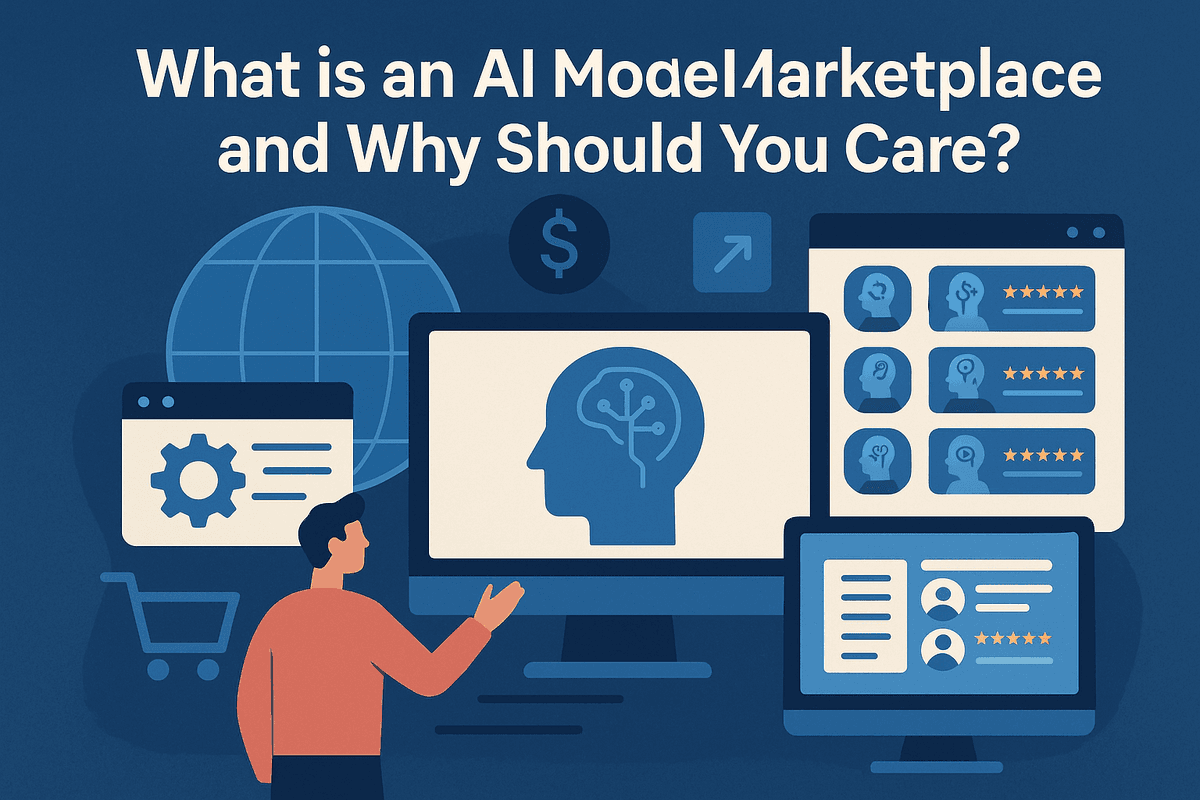
Imagine an app store, but instead of mobile applications, it’s filled with powerful, pre-built artificial intelligence brains ready to be integrated into your projects. That, in essence, is an AI model marketplace. It’s a dynamic, centralized hub where developers, data scientists, and businesses can discover, access, and deploy pre-trained AI models for a vast range of tasks.
Beyond the Code: Defining the Modern AI Model Marketplace
An AI model marketplace is far more than a simple code repository like GitHub. It’s a curated ecosystem designed for action. While a repository might give you raw code, a marketplace provides deployment-ready assets. These platforms offer:
- Pre-trained Models: Sophisticated models for tasks like natural language processing, computer vision, and predictive analytics that have already been trained on massive datasets.
- APIs and Endpoints: Simple ways to connect to and use the models without needing to manage the underlying infrastructure.
- Detailed Documentation: Clear instructions, performance benchmarks, and use-case examples to help you choose the right tool for the job.
- Fine-tuning Environments: Tools that allow you to customize a general-purpose model with your own data for specialized tasks.
Think of it as the difference between getting a bag of flour and buying a professionally made pizza base. One requires significant time and expertise to become useful, while the other lets you start adding your unique toppings immediately.
The Core Problem They Solve: Accelerating AI Development Cycles
Building a high-performing AI model from scratch is a monumental undertaking. The traditional workflow involves collecting and cleaning colossal datasets, designing complex architectures, and then spending weeks or even months on expensive, resource-intensive training. For most organizations, this process is a significant barrier to innovation.
This is the critical pain point an AI model marketplace eliminates. It short-circuits the development lifecycle, allowing teams to bypass the most time-consuming and costly stages. Instead of starting from zero, you can stand on the shoulders of giants by leveraging a state-of-the-art model as your foundation. This radical acceleration slashes development timelines from months to days, democratizing access to powerful AI and enabling you to get your intelligent applications to market at unprecedented speed.
Who Benefits Most? From Indie Developers to Enterprise Teams
The value of an AI model marketplace extends across the entire tech landscape, empowering a diverse range of users:
- Indie Developers & Startups: These platforms level the playing field. A solo developer can now integrate world-class language translation or object detection into their app without a multi-million dollar R&D budget, allowing them to compete on the merit of their ideas, not the depth of their pockets.
- Data Scientists & ML Engineers: For practitioners, marketplaces are a massive productivity engine. They can stop reinventing the wheel and focus their valuable expertise on fine-tuning models for unique business challenges, delivering tangible value much faster.
- Enterprise Teams: In large organizations, these hubs reduce risk and fuel innovation. Teams can rapidly prototype new features, benchmark different models for a specific use case, and integrate proven AI solutions into existing workflows without a massive upfront investment, fostering a culture of agile experimentation and continuous improvement.

Exploring the Top AI Model Marketplace Platforms in 2024
The AI model marketplace landscape is diverse, with each platform catering to specific needs, from open-source collaboration to enterprise-grade deployment. Choosing the right one can significantly accelerate your development lifecycle. Let's explore four of the most influential platforms that are shaping how we access and deploy pre-trained AI models in 2024.
Hugging Face: The Open-Source Community Hub
Hugging Face has cemented its reputation as the vibrant, community-driven hub for open-source machine learning. More than just a repository, it's a collaborative ecosystem where researchers and developers converge. This AI model marketplace is particularly dominant in the Natural Language Processing (NLP) space, famously hosting the transformers library.
Users can access tens of thousands of pre-trained models for tasks ranging from text summarization to image classification. The platform’s strength lies in its accessibility and tooling, which allows for easy model downloading, fine-tuning, and sharing. With integrated features like Datasets for training data and Spaces for building live demos, Hugging Face is the ideal environment for experimentation, academic research, and developers who value community-driven innovation.
TensorFlow Hub: Google's Ecosystem for Production-Ready Models
For developers deeply integrated into the Google and TensorFlow ecosystem, TensorFlow Hub (TF Hub) is an indispensable resource. This platform offers a curated collection of pre-trained models that are optimized for performance, scalability, and ease of use within the TensorFlow framework. Each model comes with standardized documentation and is designed to be easily retrainable.
TF Hub excels at providing production-ready components. You can find models in various formats, including SavedModels for server-side deployment and TF.js for in-browser applications. A key advantage is its collection of TF Lite models, which are specifically designed for efficient execution on mobile and edge devices. If your goal is to quickly integrate a reliable, well-vetted model into a TensorFlow-based application, this AI model marketplace is a top contender.
AWS SageMaker Marketplace: For Seamless Cloud Integration
Tailored for businesses operating within the Amazon Web Services (AWS) cloud, the AWS SageMaker Marketplace is a powerful platform for discovering, purchasing, and deploying AI models directly into your production environment. It bridges the gap between model creators and consumers in a secure, scalable, and commercially focused setting.
The key benefit is its native integration with Amazon SageMaker. You can subscribe to a model from hundreds of sellers and deploy it with just a few clicks, without managing the underlying infrastructure. The platform supports both free and paid models, with billing conveniently handled through your existing AWS account. For enterprises seeking a streamlined procurement process, robust security, and the ability to deploy AI models at scale within their cloud infrastructure, the SageMaker Marketplace is unmatched.
NVIDIA NGC: High-Performance Models for GPU-Intensive Tasks
NVIDIA NGC (NVIDIA GPU Cloud) is an AI model marketplace engineered for one primary purpose: maximum performance on NVIDIA GPUs. This hub provides a wealth of AI models, pre-trained scripts, and Helm charts that are highly optimized for NVIDIA’s hardware and software stack. It’s the go-to platform for data scientists and ML engineers tackling computationally demanding tasks in areas like computer vision, conversational AI, and high-performance computing (HPC).
Models on NGC are often packaged in containers with all necessary dependencies, ensuring reproducibility and simplifying deployment across on-premises servers and cloud environments. By leveraging NVIDIA’s deep expertise in GPU acceleration, NGC enables users to achieve state-of-the-art performance and drastically reduce training times. If your project demands cutting-edge speed and efficiency for GPU-intensive workloads, NVIDIA NGC is the essential resource.
Decoding an AI Model Marketplace: Must-Have Features
Navigating the landscape of an ai model marketplace can feel overwhelming. With thousands of models available, how do you pinpoint the one that perfectly aligns with your project's needs and technical infrastructure? A high-quality marketplace isn't just a repository; it's a well-designed ecosystem built on four essential pillars that empower users to discover, evaluate, and deploy AI with confidence.
Model Discovery and Searchability: Finding the Right Tool for the Job
The core function of any marketplace is discoverability. A vast library of AI models is useless if you can't efficiently find what you're looking for. A top-tier ai model marketplace must offer robust search and filtering capabilities. Look for platforms that allow you to sort models by specific tasks (e.g., text summarization, object detection, voice transcription), machine learning frameworks (like TensorFlow, PyTorch, or ONNX), and data types. Advanced search functionality, including keyword matching and curated collections for specific industries like healthcare or finance, is a significant plus. The goal is to spend less time searching and more time building, making the process of finding the right pre-trained model as seamless as possible.
Easy Deployment Options: From APIs to On-Premise Solutions
Finding the model is only half the battle; deploying it is where the value is realized. The best platforms cater to a wide spectrum of technical requirements and expertise levels. Essential deployment features include:
- Managed APIs: For quick integration and prototyping, a simple, pay-as-you-go API endpoint is invaluable. This allows developers to access the model's power without managing any underlying infrastructure.
- Containerized Downloads: For teams that require more control, privacy, or custom configurations, the ability to download models in container formats like Docker is crucial for on-premise or private cloud deployment.
- SDKs and Code Snippets: To accelerate development, an effective ai model marketplace provides well-documented Software Development Kits (SDKs) and ready-to-use code snippets in popular languages like Python or JavaScript.
Evaluating Model Cards, Documentation, and Community Support
Trust and transparency are non-negotiable. Before committing to a model, you need a clear understanding of its capabilities and limitations. This is where comprehensive documentation comes in. Look for detailed "model cards"—standardized documents that outline the model's architecture, training data, performance benchmarks, and, crucially, its known biases and ethical considerations. Strong community support, including user reviews, ratings, and active forums, provides an additional layer of validation. This ecosystem of information helps you assess a model's real-world performance and suitability for your specific use case.
Understanding Pricing Models: Free vs. Commercial Licenses
Finally, a transparent and flexible pricing structure is key. An ai model marketplace typically features a mix of free, open-source models and premium, commercially licensed ones. It's vital to understand the terms. Open-source licenses (like MIT or Apache 2.0) often permit broad use, but you must check the specifics. Commercial models may operate on various pricing schemes, such as pay-per-API-call, monthly subscriptions with usage tiers, or one-time licensing fees for perpetual use. A trustworthy marketplace will clearly display all costs and licensing agreements upfront, ensuring there are no surprises and allowing you to budget your AI projects effectively.
How to Leverage an AI Model Marketplace for Business Growth
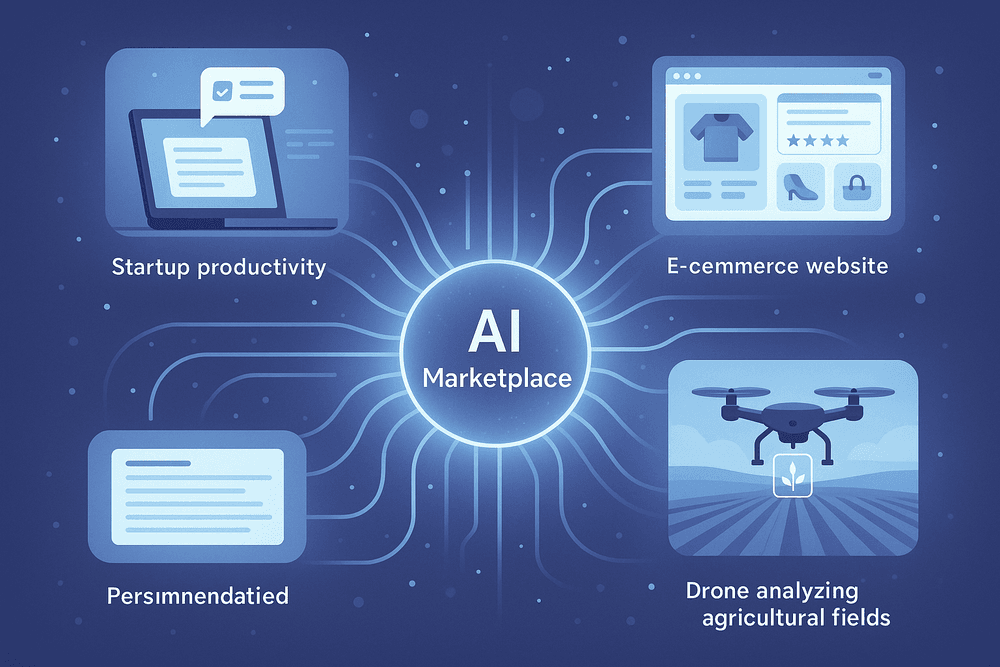
The theoretical benefits of an ai model marketplace are clear, but its true power is revealed through real-world application. From nimble startups to global enterprises, organizations are tapping into these platforms to accelerate innovation, solve complex problems, and gain a significant competitive edge. Let's explore three practical use cases that illustrate how businesses can translate access to pre-trained models into tangible growth.
Use Case 1: A Startup Enhancing Its App with Natural Language Processing
The Challenge: A small startup is developing a productivity app designed to help users organize and summarize meeting notes. Their core expertise is in user interface design and cloud infrastructure, not in building complex Natural Language Processing (NLP) models from scratch. Developing a proprietary summarization algorithm would require hiring expensive AI specialists and spending months on research and development—time and capital they simply don't have.
The Solution: The development team turns to an ai model marketplace. Within hours, they identify several high-performing text summarization and sentiment analysis models. They select a model with a straightforward API, robust documentation, and a pay-as-you-go pricing structure that fits their budget.
The Outcome: Instead of a six-month development cycle, the team integrates the AI feature in under a week. The app can now automatically generate concise meeting summaries and even gauge the overall tone of the discussion. This allows the startup to launch a powerful, differentiated product much faster, validate their market, and focus their lean resources on refining their core user experience. The marketplace acted as a critical launchpad, providing advanced capabilities without the prohibitive upfront investment.
Use Case 2: E-commerce Giant Personalizing Recommendations Instantly
The Challenge: A large e-commerce retailer wants to move beyond basic "customers who bought this also bought..." recommendations. Their goal is to deliver hyper-personalized, real-time suggestions based on a user's immediate browsing behavior, past purchases, and even the visual characteristics of the products they view. Building and maintaining such a sophisticated system in-house would be a massive, ongoing project for their data science team.
The Solution: The company’s machine learning division uses an ai model marketplace to benchmark and test state-of-the-art recommendation engines. They find a specialized model that excels at real-time collaborative filtering and another that powers visual search, allowing users to find similar items by uploading a photo.
The Outcome: By integrating these pre-trained models, the retailer rapidly deploys a next-generation personalization engine. Conversion rates increase as customers discover more relevant products, leading to a direct uplift in revenue. The in-house team can now focus on fine-tuning these models with their proprietary data, rather than building the foundational technology, ensuring they stay ahead of the competition.
Use Case 3: Researchers Accelerating Computer Vision Breakthroughs
The Challenge: A university research lab is working on an agricultural project to identify crop diseases from drone imagery. The team has a limited, specialized dataset of labeled images. Training a computer vision model from the ground up to achieve high accuracy would require a dataset millions of images larger and immense computational power, delaying their research significantly.
The Solution: The researchers browse an ai model marketplace and find a powerful, pre-trained image recognition model (like a YOLO or ResNet variant) that has already been trained on a massive, general-purpose image library. Using a technique called transfer learning, they use this model as a foundation.
The Outcome: The foundational model already understands fundamental visual features like shapes, edges, and textures. The research team only needs to fine-tune it on their smaller, specific dataset of diseased and healthy plants. This drastically reduces training time from weeks to hours and achieves a higher accuracy than they could have otherwise. The marketplace provides the essential building blocks, empowering the researchers to focus on their unique problem and accelerate the path to discovery.
Best Practices for Choosing Models from an AI Marketplace
Navigating a bustling ai model marketplace can feel like searching for a needle in a haystack. With thousands of options at your fingertips, how do you select the one that will deliver real value without introducing risk? It comes down to a methodical approach focused on performance, integration, and scalability. By following these best practices, you can confidently choose and deploy models that accelerate your projects.
Vetting a Model: Performance, Bias, and Data Privacy
Before you commit to a model, it needs to pass a rigorous inspection. Look beyond the flashy marketing claims and dig into the technical and ethical details.
- Performance Metrics: Don't just look at overall accuracy. Depending on your use case, other metrics like precision, recall, or F1-score might be more important. A quality ai model marketplace will provide detailed performance reports. Test the model with your own sample data to see how it performs in a real-world context, not just on the curated dataset it was trained on.
- Bias and Fairness: An AI model is only as unbiased as the data it was trained on. Investigate the model's documentation for information on fairness audits and bias mitigation techniques. Does the marketplace provide transparency into the training data's demographics? Failing to check for bias can lead to reputational damage and flawed business outcomes.
- Data Privacy and Security: Understand the model's data requirements. Will your data be sent to a third-party server for processing? If so, what are their security protocols? Ensure the model and its provider comply with relevant regulations like GDPR or CCPA. The best models offer on-premise or VPC deployment options for maximum data control.
A Checklist for Seamless Integration
A powerful model is useless if you can't integrate it into your workflow. Use this checklist to ensure a smooth technical adoption.
- [✓] Review the API Documentation: Is it clear, comprehensive, and well-structured? Look for code snippets, SDKs in your preferred language, and detailed endpoint descriptions. Poor documentation is a major red flag.
- [✓] Check Dependencies and Environment: Confirm the model's required libraries, hardware (CPU/GPU), and software versions are compatible with your existing stack.
- [✓] Test in a Sandbox Environment: Before deploying to production, always test the model's API endpoints in a controlled sandbox. This helps you understand its response times, error handling, and output formats.
- [✓] Evaluate Support and Maintenance: What kind of support does the model provider offer? Is there a community forum, dedicated support channel, or a clear SLA (Service Level Agreement) for uptime and issue resolution?
Managing Costs and Scaling Your AI Operations
Choosing a model isn't just a technical decision; it's a financial one. Plan for both your current needs and future growth to avoid unexpected costs.
- Understand the Pricing Model: Marketplaces offer various pricing structures—pay-per-API-call, monthly subscriptions, or tiered usage plans. Model which option is most cost-effective for your projected volume. Beware of hidden costs related to data transfer or high-concurrency requests.
- Monitor Your Usage: Use dashboards and set up alerts to track your API consumption closely. This prevents bill shock and helps you identify opportunities for optimization.
- Plan for Scale: Can the model handle a sudden surge in traffic? Check the documentation for rate limits and scalability provisions. A model that works for a prototype may crumble under production-level load. Choosing a model from a reputable ai model marketplace often ensures it's hosted on scalable infrastructure, giving you a clear path from pilot to full-scale deployment.

The Future is Collaborative: Your Next Steps in the AI Model Marketplace
You’ve journeyed through the dynamic landscape of AI model marketplaces, understanding their power to democratize artificial intelligence and accelerate innovation. But this is not the end of the road; it's the starting line. The true potential of these platforms is unlocked when you move from observer to participant. The future of AI is not just about building in isolation but about leveraging the collective intelligence of a global community. An ai model marketplace is your gateway to that future, providing the tools and pre-built components to turn your most ambitious ideas into reality, faster than ever before.
Choosing Your First AI Model Marketplace: A Quick Checklist
Diving in can feel overwhelming, but selecting the right platform is a strategic decision. Before you commit, run through this final checklist to ensure the marketplace aligns with your goals:
- Define Your Core Need: Are you working on natural language processing, computer vision, or predictive analytics? Choose a marketplace that specializes in or has a strong repository for your specific domain.
- Evaluate Model Documentation: A model is only as good as its documentation. Look for clear explanations of the dataset used, performance metrics, and implementation instructions. Quality over quantity is key.
- Assess Integration and Deployment: How easily can you plug a model into your existing tech stack? Prioritize platforms with robust APIs, SDKs, and seamless deployment options (e.g., cloud endpoints, containerization).
- Understand the Cost Structure: From open-source models to pay-per-call APIs and subscription services, the financial models vary widely. Calculate the total cost of ownership, not just the initial price tag.
- Check the Community Vibe: A vibrant community is an invaluable resource. Look for active forums, user-contributed content, and strong developer support to help you troubleshoot and innovate.
Emerging Trends: What's Next for AI Model Sharing?
The ai model marketplace ecosystem is constantly evolving. Staying ahead of the curve means keeping an eye on these emerging trends that are shaping the future of collaborative AI:
- Specialized, Industry-Specific Hubs: Expect a rise in niche marketplaces tailored for industries like healthcare (offering HIPAA-compliant models), finance (for algorithmic trading), and manufacturing (for quality control).
- Federated Learning and Privacy: As data privacy becomes paramount, marketplaces will increasingly feature models trained via federated learning, allowing them to learn from decentralized data without ever compromising user privacy.
- Enhanced Interoperability: Standards like ONNX (Open Neural Network Exchange) will become even more critical, enabling developers to move models effortlessly between different frameworks and platforms, preventing vendor lock-in.
- AI Model "App Stores": The user experience will become increasingly consumerized, resembling an app store where you can browse, one-click-test, and deploy sophisticated AI models with minimal technical friction.
Your Call to Action: Start Exploring and Deploy Your First AI Model Today
The theory is valuable, but a practical application is where the true learning happens. The time to act is now. By leveraging a leading ai model marketplace, you can bypass months of development time, reduce costs, and focus your energy on what truly matters: solving unique problems and creating value.
Don't wait for the perfect project. Take these simple steps to get started this week:
- Pick a Platform: Revisit the marketplaces discussed—Hugging Face, TensorFlow Hub, or a cloud provider like AWS or Google—and create a free account.
- Find a Starter Project: Choose a simple, high-impact task. Can you classify customer feedback using a sentiment analysis model? Or identify objects in images with a pre-trained computer vision model?
- Follow a Quick-Start Guide: Every major platform offers excellent tutorials. Follow one step-by-step to deploy your first API endpoint.
- Experiment and Iterate: Once deployed, send it some data! See the results in real-time. This hands-on experience is the most powerful catalyst for understanding and innovation.
The collaborative AI revolution is here. Find your community, choose your tools, and deploy your first model today.