
September 23, 2025
What is an AI Model Marketplace and Why is it a Game-Changer
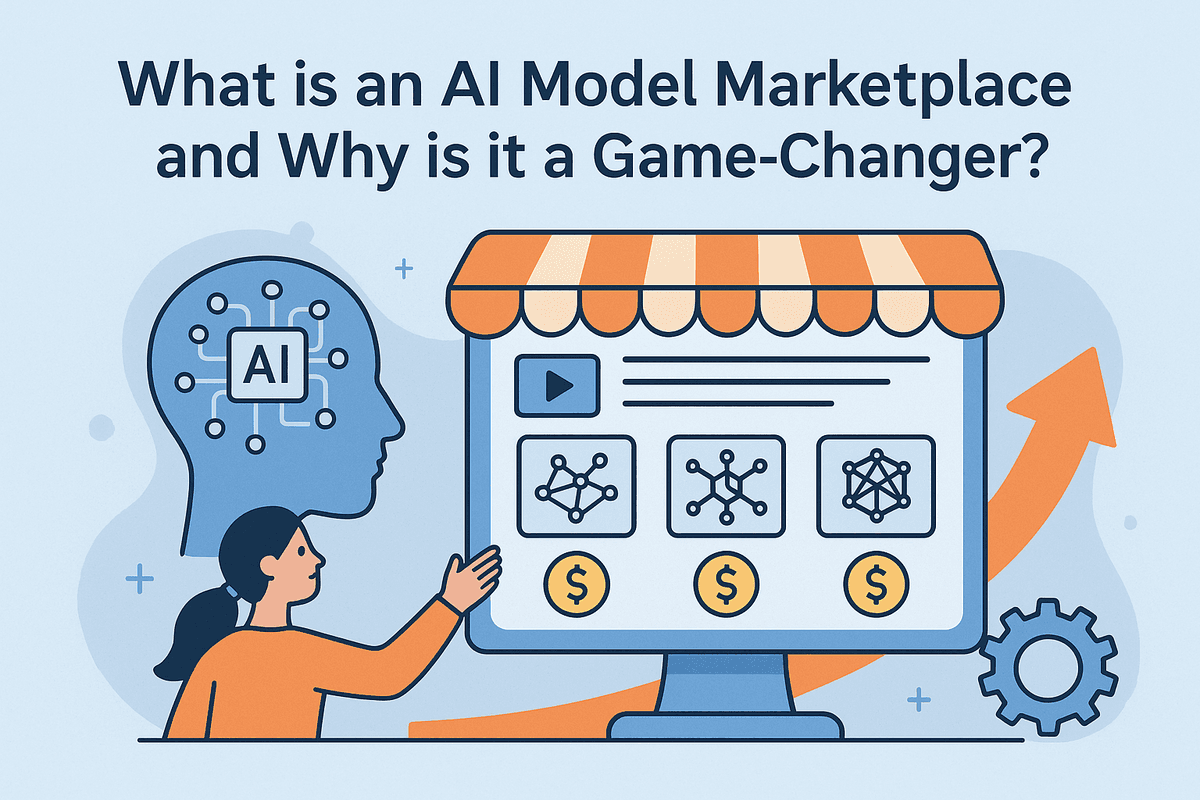
What is an AI Model Marketplace and Why is it a Game-Changer?
Let's cut through the jargon. At its core, an AI model marketplace is a centralized digital platform where developers, data scientists, and businesses can discover, test, and deploy pre-trained machine learning models. Think of it as an "App Store for AI." Instead of building a complex application from the first line of code, you start with a powerful, ready-to-use component. These marketplaces host a vast library of models designed for specific tasks—from natural language processing and computer vision to sentiment analysis and predictive forecasting. You can find everything from massive, open-source foundation models created by tech giants to highly specialized, niche models built by independent researchers. It's a one-stop shop for the building blocks of modern artificial intelligence.
The Core Problem: Why Building Every AI Model from Scratch is Inefficient
Before the rise of the AI model marketplace, integrating artificial intelligence into a product was a monumental undertaking. The process of building a model from the ground up is incredibly resource-intensive, often described as "reinventing the wheel" for every new project. This traditional approach requires:
- Massive Datasets: Sourcing, cleaning, and labeling petabytes of high-quality data is a complex and expensive challenge.
- Intense Computational Power: Training a sophisticated model requires weeks or even months on powerful, costly GPU clusters, racking up enormous cloud computing bills.
- Specialized Expertise: You need a dedicated team of highly paid data scientists and machine learning engineers with deep, specialized knowledge.
- Long Development Cycles: The journey from concept to a production-ready model can take anywhere from six months to several years, a timeline that kills agility and innovation.
This high barrier to entry effectively locked out small businesses, startups, and even many enterprise teams from leveraging the full potential of AI.
How an AI Model Marketplace Accelerates Development for Teams of All Sizes
This is where the AI model marketplace truly becomes a game-changer. It fundamentally alters the development landscape by democratizing access to powerful AI. Instead of starting from zero, teams can now stand on the shoulders of giants. Here’s how it accelerates innovation:
- Drastic Reduction in Time-to-Market: Why spend a year training a language model when you can license or download a state-of-the-art one in minutes? An AI model marketplace allows you to go from idea to proof-of-concept in days, not months, enabling rapid prototyping and deployment.
- Significant Cost Savings: By leveraging a pre-trained model, you sidestep the crippling costs associated with data acquisition, infrastructure, and the lengthy training process. This makes advanced AI financially viable for a much broader range of projects and organizations.
- Access to Cutting-Edge Technology: Marketplaces provide access to world-class models that most organizations could never hope to build themselves. You can integrate technology from leading AI labs directly into your products, ensuring you remain competitive without a massive R&D budget.
- Focus on Core Business Value: It allows your development team to stop worrying about the low-level complexities of model training and instead focus on what they do best: building unique applications and solving specific business problems using these powerful AI components.

Comparing the Top AI Model Marketplace Platforms
Choosing the right ai model marketplace depends entirely on your project's goals, existing tech stack, and scalability needs. Each platform offers a unique blend of community support, enterprise-grade features, and ecosystem integration. Let’s break down the leading contenders to see which one aligns best with your requirements.
Hugging Face: The Open-Source Community Leader
Often called the "GitHub for machine learning," Hugging Face is the undisputed champion of open-source collaboration. It's a vibrant, community-driven hub hosting hundreds of thousands of pre-trained AI models, datasets, and demos. Its core strength lies in its exceptional transformers library, which makes it incredibly simple to download and use state-of-the-art models, particularly for Natural Language Processing (NLP).
- Best For: Researchers, developers, and startups focused on experimentation and rapid prototyping with the latest open-source models.
- Key Features: A massive, diverse collection of models, seamless integration with popular ML frameworks, extensive documentation, and a highly active community for support. If you're looking for flexibility and access to cutting-edge research, this is the ai model marketplace to start with.
TensorFlow Hub: For Seamless Integration with Google's Ecosystem
TensorFlow Hub is Google’s repository for reusable machine learning components. While not as vast as Hugging Face, its primary advantage is its native, frictionless integration with the TensorFlow framework. This platform provides ready-to-use model pieces—like text embeddings or image feature vectors—that can be easily plugged into your TensorFlow code for transfer learning and fine-tuning. Models are well-vetted and often published directly by Google researchers, ensuring reliability.
- Best For: Developers and data scientists heavily invested in the TensorFlow or Google Cloud (e.g., Vertex AI) ecosystem.
- Key Features: Production-ready models optimized for TensorFlow, simple APIs for model deployment, and a focus on reusable model components that accelerate development.
AWS SageMaker & Azure AI: The Enterprise Cloud Titans
For businesses operating at scale, the ai model marketplace offerings from major cloud providers are often the default choice.
- AWS SageMaker JumpStart: More than just a marketplace, SageMaker is a complete MLOps platform. JumpStart is its feature for one-click discovery and deployment of foundation models, open-source models, and proprietary solutions. Its true power is its deep integration with the entire AWS ecosystem, offering enterprise-grade security, scalability, and managed infrastructure for training and deployment.
- Azure AI Model Catalog: Similarly, Azure's offering is woven into its comprehensive Azure AI Studio. The catalog provides access to a curated selection of models from industry leaders like Meta and Mistral, alongside Microsoft's own models. It emphasizes responsible AI tooling, governance, and seamless integration with Azure services for building end-to-end AI solutions.
- Best For: Large enterprises that need a fully managed, secure, and scalable environment for deploying pre-trained AI models within their existing cloud infrastructure.
NVIDIA NGC: High-Performance Models for GPU-Intensive Tasks
NVIDIA NGC is the specialized ai model marketplace for anyone who needs to squeeze every ounce of performance out of their hardware. This hub offers a curated collection of pre-trained models, containers, and SDKs that are meticulously optimized to run on NVIDIA GPUs. The focus here is less on quantity and more on raw, high-throughput performance for demanding tasks like advanced computer vision, conversational AI, and scientific computing.
- Best For: Organizations working on performance-critical applications in fields like medical imaging, autonomous systems, and high-performance computing (HPC).
- Key Features: GPU-optimized models for maximum inference speed, enterprise-grade support, and end-to-end toolkits for specific domains (e.g., Clara for healthcare, Riva for speech AI).
Essential Features to Look for in an AI Model Marketplace
Navigating a vast library of AI models can be overwhelming. The right ai model marketplace doesn't just host models; it provides a structured environment that simplifies discovery, validation, and deployment. When evaluating platforms, focus on features that build trust, streamline your workflow, and ensure the models you choose are both powerful and secure. Here are the critical capabilities to demand from any top-tier marketplace.
Model Discovery, Search, and Filtering Capabilities
The primary function of any marketplace is to help you find what you need quickly. A superior ai model marketplace moves beyond a simple keyword search. Look for advanced filtering options that let you narrow down your choices by specific criteria, such as:
- Task: Image classification, text summarization, sentiment analysis, object detection, etc.
- Framework: TensorFlow, PyTorch, Scikit-learn, ONNX.
- License Type: Filter for models with commercial-friendly licenses like Apache 2.0 or MIT.
- Data Source: The dataset the model was trained on (e.g., COCO, ImageNet).
- Popularity and Ratings: Sort by downloads, community ratings, or recent updates.
A powerful and intuitive search interface is your first line of defense against wasting time, ensuring you can quickly pinpoint the most relevant pre-trained AI models for your project.
Assessing Model Quality: Documentation, Benchmarks, and Licensing
Once you find a potential model, you need to verify its quality and suitability. A trustworthy marketplace makes this process transparent. Scrutinize these three areas:
- Documentation: Comprehensive documentation is non-negotiable. It should include clear instructions on model inputs and outputs, code snippets for implementation, and a "model card" detailing its intended uses, limitations, and potential biases.
- Benchmarks: Look for standardized performance metrics. How does the model perform on common industry benchmarks? The platform should present clear data on accuracy, precision, recall, latency, and resource consumption. Reproducible benchmarks allow for objective, side-by-side comparisons.
- Licensing: Every model comes with a license that dictates how it can be used. A good marketplace clearly displays the license (e.g., MIT, GPL, Creative Commons) and explains its implications. Misunderstanding a license can lead to serious legal and compliance issues, especially in a commercial setting.
Streamlined Deployment: API Access and One-Click Integrations
Finding a great model is only half the battle; integrating it into your application should be seamless. The best AI model marketplaces bridge the gap between discovery and production with developer-friendly deployment options. Key features include:
- Hosted API Access: The ability to call the model via a simple, secure API endpoint without having to manage the underlying infrastructure. This is the fastest way to test and integrate a model.
- One-Click Deployment: For more control, look for integrations that allow you to deploy the model directly to your cloud environment (AWS, GCP, Azure) with minimal configuration.
- Containerization Support: Platforms that provide models packaged in containers (like Docker) offer maximum portability and scalability, simplifying deployment in any environment.
Security and Compliance in a Third-Party Model Ecosystem
Using a third-party model means introducing external code into your systems, which carries inherent risks. A secure ai model marketplace actively mitigates these risks to protect its users. Look for platforms that prioritize security and compliance through:
- Vulnerability Scanning: Models should be automatically scanned for security vulnerabilities, malware, and malicious code before they are listed.
- Model Provenance: The marketplace should provide a clear history of the model's origin, including who uploaded it and what data it was trained on. This transparency is crucial for building trust.
- Compliance Certifications: For enterprise use, check if the platform itself adheres to industry standards like SOC 2, GDPR, or HIPAA, ensuring your data is handled according to strict regulatory requirements.

Best Practices: How to Choose the Right Model from an AI Marketplace
Navigating a bustling ai model marketplace can feel like searching for a needle in a haystack. With thousands of options, how do you find the one that perfectly fits your project? The key is a systematic approach that prioritizes your unique needs over flashy metrics. Follow these best practices to select, test, and deploy the right model with confidence.
Start with Your Use Case: Defining Project Requirements First
Before you even open a browser tab, the most crucial step is to look inward. Don't start by asking "What cool models are available?" Instead, ask, "What specific problem am I trying to solve?" A clearly defined use case is your compass for navigating any ai model marketplace.
Start by outlining your requirements:
- Objective: What is the primary goal? Is it sentiment analysis for customer reviews, object detection in security footage, or generating marketing copy?
- Data: What kind of data will the model process (e.g., text, images, tabular data)? What format is it in?
- Performance Metrics: How will you measure success? Define your minimum acceptable accuracy, precision, recall, or F1-score. Also, consider latency—how fast does the model need to be?
- Constraints: What is your budget for API calls or hosting? What are your computational limitations (CPU vs. GPU)?
Having these answers turns a vague search into a targeted mission, allowing you to filter out irrelevant models immediately.
A Practical Guide to Evaluating and Testing Pre-Trained Models
Once you've identified a few promising candidates, it's time for a hands-on evaluation. Never take a model's description at face value.
- Scrutinize the Model Card: A model card is its official resume. Look for details on the training dataset (to check for bias), intended use cases, and known limitations. A well-documented model is a sign of a quality provider.
- Analyze Reported Metrics: Compare the model's benchmark performance against your predefined success metrics. If you need 95% accuracy for medical image analysis, a model reporting 80% on a generic dataset won't cut it.
- Run a Sandbox Test: This is the most important step. Use the marketplace's testing environment or API to run a small, representative sample of your own data through the model. Its performance on a benchmark dataset can be very different from its performance on your specific data. This real-world test provides the best indicator of its future success.
Understanding the Nuances of Fine-Tuning vs. Off-the-Shelf Use
Your evaluation will lead to a critical decision: can you use the model as-is, or does it need further training?
- Off-the-Shelf (Zero-Shot/Few-Shot): This is the fastest and most cost-effective option. It's ideal for general tasks where the pre-trained model’s knowledge is sufficient. For example, using a large language model for standard text summarization often works great out of the box.
- Fine-Tuning: This process involves taking a pre-trained model and further training it on your own labeled dataset. It's necessary when you need the model to specialize in a niche domain, understand specific jargon, or identify unique objects. While it requires more effort and data, fine-tuning can dramatically boost performance for specialized tasks.
Avoiding Common Pitfalls: A Checklist for Success
As you finalize your choice, run through this checklist to ensure you haven’t missed anything critical.
- [ ] Problem-Solution Fit: Is this model genuinely the best solution for my defined problem?
- [ ] License & Usage Rights: Have I read the model's license? Does it permit my intended commercial or internal use?
- [ ] Data Privacy: How does the model API handle my data? Is it secure and compliant with regulations like GDPR?
- [ ] Scalability & Cost: Do I understand the full cost structure? Can the model scale with my application's growth without incurring prohibitive expenses?
- [ ] Provider Support: Is the model maintained? Is there a community or official support channel if I encounter issues?
Real-World Use Cases Powered by an AI Model Marketplace
The theoretical benefits of an AI model marketplace are clear, but its true power is demonstrated through real-world applications. Across industries, businesses are tapping into these platforms to accelerate innovation, reduce development costs, and unlock capabilities that were once reserved for tech giants. By providing ready-to-deploy solutions, marketplaces are democratizing AI and enabling companies to solve complex problems with unprecedented speed.
How Startups are Building NLP Features in Record Time
For a startup, speed is everything. Building a sophisticated Natural Language Processing (NLP) model from scratch requires vast amounts of data, significant computational power, and a team of specialized engineers—resources most early-stage companies lack. This is where an AI model marketplace becomes a game-changer.
Instead of spending months on model development, a lean startup can browse a marketplace for a pre-trained sentiment analysis model. Within days, they can integrate this model into their application to analyze customer reviews, social media comments, or support tickets, instantly gauging public perception. Similarly, a legal tech startup can leverage a pre-trained named entity recognition (NER) model to automatically extract key information like names, dates, and organizations from legal documents, saving hundreds of manual hours. This "plug-and-play" approach allows startups to validate ideas, launch features, and go to market in a fraction of the time and cost.
Enhancing E-commerce with Pre-Trained Computer Vision Models
The e-commerce landscape is fiercely competitive, and a superior customer experience is a key differentiator. Computer vision models are transforming online retail, and an AI model marketplace makes this technology accessible to businesses of all sizes.
Consider these applications:
- Visual Search: A retailer can integrate a pre-trained image similarity model, allowing customers to upload a photo of an item they like and instantly find similar products in the store’s inventory. This creates an intuitive and powerful shopping experience.
- Automated Product Tagging: Manually tagging thousands of products with attributes like color, style, and material is tedious and prone to error. A pre-trained object detection model can analyze product images and automatically generate accurate, consistent tags, improving on-site search and filtering.
- Personalized Recommendations: By deploying models that analyze a user’s visual preferences, online stores can offer "shop the look" features or recommend stylistically similar items, driving engagement and increasing the average order value.
Powering Predictive Analytics for Financial and Marketing Teams
Data-driven decision-making is crucial in finance and marketing. However, building reliable predictive models requires deep statistical knowledge and historical data. An AI model marketplace provides a shortcut, offering robust models that can be fine-tuned with a company's own data.
Financial teams can leverage pre-trained time-series forecasting models to predict sales revenue, inventory needs, or market trends with greater accuracy. Fintech companies can deploy battle-tested credit scoring models to assess loan applications quickly and reduce risk, without having to build a complex system from the ground up.
For marketing departments, the possibilities are equally transformative. A marketing team can use a pre-trained customer churn prediction model to identify at-risk customers and proactively target them with retention campaigns. They can also access customer lifetime value (CLV) models to segment their audience and allocate marketing budgets more effectively, ensuring they focus their efforts on the most profitable customer relationships.

Conclusion: Your Next Steps in the AI Model Marketplace Ecosystem
You've journeyed through the dynamic world of the AI model marketplace, a landscape teeming with innovation and opportunity. It's clear that these platforms are no longer a niche tool for data scientists but a foundational resource for any developer or business looking to build smarter, faster, and more efficiently. The barrier to entry for implementing sophisticated AI has been dramatically lowered. Now, the power to analyze sentiment, recognize images, or translate languages is just an API call away. Your next step is to move from understanding to action. This conclusion will serve as your launchpad.
Choosing the Right AI Model Marketplace for Your Needs
The "best" platform is the one that best fits your project's unique DNA. Before you commit, revisit your core requirements. Ask yourself:
- What is my specific use case? Are you focused on Natural Language Processing, computer vision, or audio analysis? Some marketplaces specialize, while others offer a broader catalog.
- What is my budget? Compare pricing structures. Do you prefer a predictable subscription fee, or does a flexible pay-per-use model make more sense for your expected traffic?
- What is my technical stack? Ensure the marketplace provides well-documented APIs and SDKs that integrate smoothly with your existing programming languages and infrastructure (e.g., Python, JavaScript, AWS, Azure).
- What level of support do I need? Evaluate the community forums, documentation quality, and enterprise support options. A strong community can be invaluable for troubleshooting.
Making a thoughtful choice here will save you significant time and resources down the road, ensuring the AI model marketplace you select acts as a true accelerator for your development.
A Quick-Start Guide to Your First Project
Ready to dive in? Taking your first step is simpler than you think. Follow this streamlined guide to get your initial project off the ground.
- Define a Clear, Solvable Problem: Start small. Instead of "revolutionize customer service," aim for "auto-categorize incoming support tickets based on topic." A well-defined problem is easier to match with a pre-trained model.
- Search and Filter: Navigate to your chosen marketplace. Use keywords like "text classification" or "topic modeling." Filter by license, popularity, and recent updates to narrow down the best candidates.
- Test in the Sandbox: Nearly every AI model marketplace offers a "playground" or a simple interface to test models with your own data samples. Upload a few examples of your support tickets and see how the model performs. Check its accuracy, speed, and response format.
- Integrate with the API: Once you've found a winner, grab your API key and the provided code snippets. Integrate the API call into a simple script or a development version of your application.
- Monitor and Iterate: Deploy your feature and watch its performance. Monitor your API usage and costs. The beauty of this ecosystem is that you can easily swap out models if a better one comes along.
Resources and Communities for Continuous Learning
The field of AI is evolving at an incredible pace. Staying current is key to leveraging its full potential. Tap into these resources to continue your journey:
- Official Platform Blogs & Documentation: The primary source for updates, tutorials, and best practices directly from marketplaces like Hugging Face, Google AI Hub, and AWS Marketplace.
- Online Communities: Engage with fellow developers on platforms like Reddit (r/MachineLearning), Stack Overflow, and specialized Discord channels. These are excellent places to ask questions and share solutions.
- GitHub Repositories: Explore the source code of popular models and see how others are implementing them in real-world projects.
- Newsletters and Publications: Subscribe to industry newsletters like The Batch or publications like Towards Data Science on Medium to stay informed about the latest breakthroughs and trends in the AI model space.
Your journey with the AI model marketplace is just beginning. By starting with a clear goal, testing diligently, and committing to continuous learning, you are well-equipped to build the next generation of intelligent applications.