
October 11, 2025
What is an AI Knowledge Base and Why Should You Care?
What is an AI Knowledge Base and Why Should You Care?
Remember the last time you scrolled endlessly through a company’s FAQ page, hunting for a specific answer? You tried different keywords, clicked on irrelevant links, and eventually gave up, frustrated. This outdated, static approach to information is a dead end for customers and a productivity killer for internal teams. It’s time for an evolution.
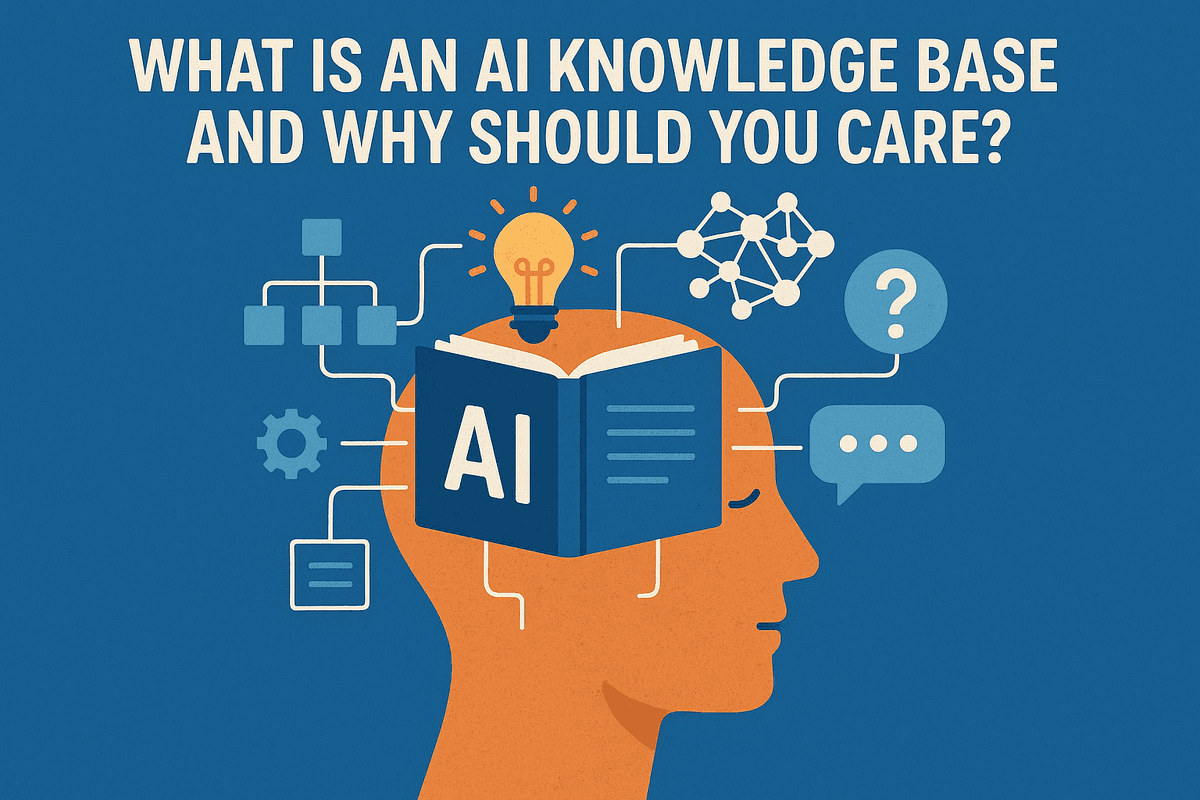
An AI knowledge base is not just a digital filing cabinet; it’s an intelligent, dynamic brain for your entire organization. It uses artificial intelligence, particularly Natural Language Processing (NLP), to understand context, semantics, and user intent. Instead of forcing users to guess the right keywords, it allows them to ask questions naturally, as if they were talking to a human expert, and get precise, relevant answers instantly. This technology transforms your scattered documents, past support tickets, and internal guides into a single source of truth that learns and improves over time.
Moving Beyond Traditional FAQs: The AI Revolution
For decades, the standard knowledge base has been little more than a collection of static articles organized into categories. Search functionality was basic, relying on exact keyword matches that often led to a dreaded "no results found" page. This created a rigid and often frustrating experience.
The AI revolution changes this paradigm completely. An AI knowledge base offers:
- Contextual Understanding: It doesn’t just match words; it understands the meaning behind the query. A user asking "How do I change my payment method?" and "update my credit card" will be guided to the same correct answer because the AI understands the intent is the same.
- Natural Language Interaction: Users can ask complex questions in conversational language. There’s no need to simplify queries into awkward keywords.
- Continuous Learning: Every interaction helps the system improve. It learns from user queries and feedback to provide more accurate and helpful answers over time, ensuring your knowledge base never becomes stale.
How AI Transforms Data into a Conversational Asset
At its core, an AI-powered knowledge base is a master of turning chaos into clarity. It ingests vast amounts of structured and unstructured data from various sources—think help center articles, PDFs, internal wikis, Slack conversations, and even past support ticket resolutions.
Here’s how it works its magic:
- Ingestion & Indexing: The AI scans and indexes all your information, breaking it down to understand concepts and relationships between different pieces of data.
- Semantic Understanding: Using machine learning models, it moves beyond keywords to grasp the semantic meaning of the content. It knows that "refund," "money back," and "return" are all related concepts.
- Conversational Interface: When a user asks a question, the AI searches its indexed "brain" for the most relevant information and synthesizes a direct, easy-to-understand answer, often citing the source documents.
This process transforms your passive repository of documents into a dynamic, conversational asset. Your company’s collective knowledge is no longer locked away in silos; it’s an active resource that both your customers and employees can talk to.
The Core Problem an AI Knowledge Base Solves for Your Business
The fundamental problem in any growing business is the "information gap." Knowledge is scattered, difficult to find, and inconsistently applied. This leads directly to inefficiency and frustration.
For your customers, it means longer wait times and repetitive questions while they wait for a human agent to find information that should be readily available. For your employees, it means hours wasted every week hunting for internal documentation, asking colleagues for help, and "reinventing the wheel" on solved problems.
An AI knowledge base directly solves this by creating a centralized, instantly accessible, and completely reliable source of truth. It bridges the information gap, leading to powerful business outcomes:
- Dramatically Reduced Support Tickets: Customers find answers themselves through intelligent self-service, freeing up your support team to handle high-value, complex issues.
- Empowered and Efficient Teams: Your internal teams, from support to sales, can get instant, accurate answers to their questions, boosting productivity and ensuring they provide consistent information.
- Enhanced Customer Satisfaction: Fast, accurate, 24/7 support builds trust and loyalty, creating a superior customer experience that sets you apart from the competition.

Core Features to Look for in an AI Knowledge Base
Not all knowledge management systems are created equal. A true AI knowledge base moves beyond simple storage and retrieval, becoming an active, intelligent hub for your organization's information. When evaluating solutions, prioritize these four core features to ensure you’re investing in a tool that drives real business value.
Harnessing Natural Language Processing (NLP) for Superior Search
The cornerstone of any modern AI knowledge base is its ability to understand language as humans do. Forget the days of rigid keyword matching where a user had to guess the exact right term to find information. Thanks to Natural Language Processing (NLP), an intelligent system can grasp the intent and context behind a query.
This means a user can ask "My login isn't working, what do I do?" and the AI understands this is the same as "password reset instructions" or "troubleshoot account access." It can handle typos, synonyms, and complex questions, delivering highly relevant answers instantly. This semantic search capability dramatically reduces friction for both customers seeking support and employees looking for internal information, ensuring they find what they need on the first try.
Automated Content Ingestion and Real-Time Updates
A knowledge base is only as good as the information it contains, and manual updates are a recipe for outdated content. A top-tier AI knowledge base should feature automated content ingestion. This allows the system to connect directly to your existing data sources—like Google Drive, Confluence, Zendesk, SharePoint, or even your public website—and automatically sync information.
Crucially, this process includes real-time updates. When a document is changed at the source, the AI immediately learns the new information, making it available for the next query. This creates a self-maintaining, "living" repository of knowledge that your team can trust to be current and comprehensive, eliminating the manual overhead and risk associated with stale information.
Seamless Integration with Chatbots, CRMs, and Slack
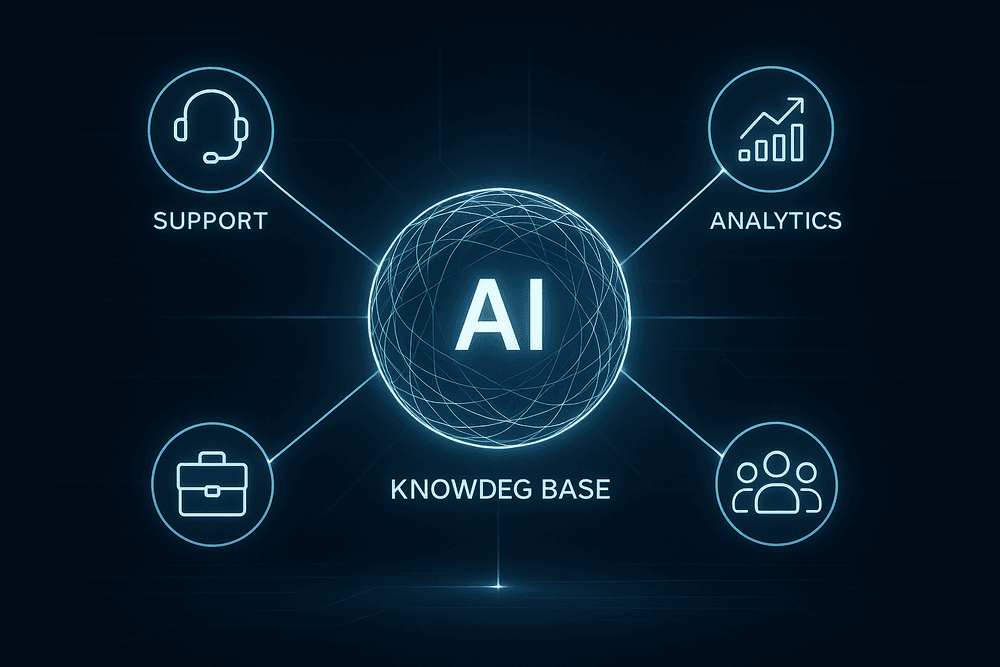
An AI knowledge base should not be an information silo; it should be the central brain that powers the tools your teams use every day. Seamless integrations are non-negotiable. Look for a platform that can plug directly into:
- Chatbots and Virtual Assistants: Power your bots with instant, accurate answers from the knowledge base, transforming them from simple, scripted tools into intelligent conversational agents.
- CRM Platforms (e.g., Salesforce, HubSpot): Equip your sales and support agents with context-aware information directly within the customer record, allowing them to resolve issues faster and more effectively.
- Collaboration Tools (e.g., Slack, Microsoft Teams): Enable employees to ask questions and get answers from the company's collective knowledge without ever leaving their workflow.
These integrations ensure that an AI knowledge base actively boosts productivity across the entire organization.
Leveraging Analytics to Identify and Fill Knowledge Gaps
A powerful AI knowledge base does more than just answer questions—it provides actionable insights. Robust analytics are essential for continuous improvement. The system should track key metrics like common search queries, questions that returned no results, and user feedback on the helpfulness of an answer.
This data is invaluable. It clearly illuminates "knowledge gaps"—areas where your documentation is missing, unclear, or insufficient to meet user needs. By analyzing these trends, you can proactively create the content your customers and employees are actually looking for. This creates a powerful feedback loop where the system not only provides information but also helps you make that information better over time.
Real-World Applications: How an AI Knowledge Base Drives Growth
An AI knowledge base isn't just a theoretical concept; it's a practical engine for business acceleration. By centralizing information and making it instantly accessible through intelligent search, this technology transforms key business functions. From delighting customers to empowering employees, the applications are tangible, measurable, and critical for scaling in a competitive market. Here’s how an AI knowledge base delivers real-world value across your organization.
Empower Your Customer Support with Instant, Accurate Answers
In customer support, speed and accuracy are everything. Customers expect immediate solutions, and support agents are under constant pressure to resolve issues on the first contact. Sifting through outdated wikis, scattered documents, and internal chat logs wastes precious time and leads to inconsistent answers.
An AI knowledge base revolutionizes this process by acting as a single source of truth for your support team. When an agent receives a query, they can ask the AI a natural language question and receive a precise, verified answer in seconds, complete with source citations. This system can power:
- Agent-Assist Tools: Integrated directly into helpdesk software like Zendesk or Intercom, providing real-time suggestions to agents as they type.
- Customer Self-Service: Fueling intelligent chatbots and FAQ pages, allowing customers to find solutions on their own, 24/7.
The result is a dramatic reduction in response times, a higher first-contact resolution rate, and a significant boost in customer satisfaction (CSAT) scores. Agents are freed from repetitive, low-level inquiries, allowing them to focus on complex cases that require a human touch.
Accelerate Employee Onboarding and Internal Training
Bringing new hires up to speed is traditionally a resource-intensive process. It involves hours of meetings, shadowing sessions, and a constant stream of questions directed at senior team members, pulling them away from their core responsibilities.
By implementing an internal AI knowledge base, you create a self-sufficient learning environment. New employees can confidently ask anything from "How do I set up my benefits?" to "What are the key steps in the project workflow?" and receive instant, standardized answers. This "always-on" digital mentor ensures everyone gets consistent information, reducing the burden on HR and team leads. This approach not only gets new hires to full productivity faster but also fosters a culture of empowerment and continuous learning for all employees, who can use it to refresh their knowledge on company policies and procedures at any time.
Equip Your Sales Team with On-Demand Product Expertise
A sales representative’s confidence is directly tied to their product knowledge. When a prospect asks a tough technical question on a call, hesitation can kill the deal’s momentum. Sales teams can’t be expected to memorize every feature, pricing tier, and competitive differentiator.
This is where an AI knowledge base becomes a sales team’s most valuable asset. It serves as a dynamic sales playbook, accessible from any device. A sales rep can instantly query the system for:
- Competitive Battle Cards: "Show me our advantages over Competitor X."
- Technical Specifications: "What are the integration capabilities of our enterprise plan?"
- Relevant Case Studies: "Find customer success stories in the finance industry."
By providing on-demand expertise, you empower your sales team to lead more compelling conversations, handle objections with authority, and tailor their pitches in real-time. This shortens the sales cycle, ensures messaging consistency, and ultimately drives more revenue.

How to Choose the Right AI Knowledge Base Software
Selecting the right ai knowledge base is a critical decision that will impact your team's productivity and customer satisfaction for years to come. The market is filled with options, but a powerful platform goes beyond just storing articles. It acts as an intelligent, central brain for your organization. To navigate your choices, focus on a core set of criteria and ask the tough questions before you sign a contract.
Key Evaluation Criteria: Scalability, Security, and Ease of Use
Your evaluation should be built on three fundamental pillars. A weakness in any one of these can undermine the entire investment.
- Scalability: Your business isn’t static, and your knowledge base shouldn't be either. A scalable ai knowledge base can grow with you. Consider this: will the platform slow down as you add thousands of documents? Can it handle a sudden spike in user queries during a new product launch? True scalability means the software performs seamlessly whether you have ten users or ten thousand, and a hundred articles or a hundred thousand.
- Security: Knowledge is power, and it’s also a sensitive asset. Robust security is non-negotiable. Look for platforms that offer end-to-end data encryption, granular access controls (role-based permissions), and compliance with major standards like GDPR, SOC 2, and HIPAA. You need to be confident that your proprietary company data and sensitive customer information are protected against unauthorized access.
- Ease of Use: If a tool is difficult to use, it won't be used. This applies to both the administrators managing the content and the end-users seeking information. The best systems feature an intuitive interface, a simple-to-use content editor (WYSIWYG), and straightforward workflows for updating and publishing information. For end-users, the search experience should feel as natural as using Google—fast, accurate, and effortless.
Comparing Top AI Knowledge Base Platforms
When you start comparing specific vendors, use a consistent framework to evaluate them. Look beyond the flashy marketing and dig into the features that deliver real value.
| Feature Area | What to Look For |
| --------------------- | ----------------------------------------------------------------------------------------------------------------------------------------------------------------------------------------------------------------------- |
| AI & Search Tech | Does it use Natural Language Processing (NLP) to understand query intent, not just keywords? Does it offer semantic search? Can it provide AI-powered content suggestions to agents or users in real-time? |
| Integrations | A knowledge base shouldn't be an island. Check for pre-built integrations with your essential tools like Salesforce, Zendesk, Slack, and Microsoft Teams. A robust API is crucial for creating custom connections. |
| Analytics & Insights | A great platform tells you what you don't know. Look for dashboards that reveal search trends, identify content gaps (unanswered questions), and measure article effectiveness to help you continuously improve your content. |
| Content Management | How easy is it to manage the content lifecycle? Features like version control, approval workflows, bulk import/export, and content health tracking are essential for maintaining a high-quality knowledge base. |
Questions Your Team Must Ask Before Committing
Before making your final decision, gather your stakeholders and ask potential vendors these critical questions. Their answers will reveal a lot about the product and the company behind it.
- Onboarding and Implementation: What does the setup process involve? What level of support will we receive to ensure a smooth transition?
- Customer Support: What are your standard support hours and channels? What does your Service Level Agreement (SLA) guarantee for uptime and response times?
- Customization: To what extent can we customize the platform’s appearance and user experience to match our brand identity?
- Product Roadmap: What new features are you planning for the next 6-12 months? How do you stay ahead of advancements in AI technology?
- Pricing Structure: Is your pricing based on users, usage, or features? Are there any hidden costs for implementation, support, or integrations we should be aware of?
Best Practices for Implementing Your AI Knowledge Base
Deploying an AI knowledge base is more than just a technical setup; it’s a strategic initiative that can transform your customer support and internal operations. To ensure a successful rollout and maximize your return on investment, follow these proven best practices. By focusing on high-impact content, ongoing maintenance, and team enablement, you can build a powerful resource that grows with your business.
Start with Your Most Common Customer Questions
The fastest way to demonstrate the value of your new AI knowledge base is to populate it with answers to the questions your team hears every single day. Don't try to document everything at once. Instead, focus on the "low-hanging fruit"—the 20% of questions that account for 80% of your support volume.
To identify these topics, dive into your existing data:
- Analyze support tickets: Look for recurring themes and frequently asked questions in your help desk software.
- Review chat and call transcripts: Identify common pain points and information requests that come up in real-time conversations.
- Consult your frontline team: Your support agents, sales representatives, and customer success managers know exactly what customers are asking. Involve them in the initial content creation process.
By addressing these high-volume inquiries first, you'll immediately reduce ticket volume, free up your agents' time, and provide customers with the instant answers they crave. This initial success builds momentum and showcases the immediate impact of your investment.
Develop a Strategy for Content Curation and Maintenance
An AI knowledge base is a living, breathing entity—not a static library. Without a clear plan for ongoing management, even the best content will become outdated and lose its value. A robust curation and maintenance strategy is crucial for long-term success.
Your strategy should define:
- Content Ownership: Assign subject matter experts (SMEs) within different departments to own specific categories of content. For example, the engineering team manages technical documentation, while marketing owns brand guidelines.
- Review Cadence: Establish a regular schedule (e.g., quarterly or bi-annually) for reviewing all articles to ensure accuracy, clarity, and relevance.
- Update Process: Create a simple workflow for updating information when products, features, or policies change.
- Gap Analysis: Leverage the analytics within your AI knowledge base software. Pay close attention to failed searches and user feedback to identify knowledge gaps and prioritize new article creation.
This proactive approach ensures your knowledge base remains a single source of truth that both customers and employees can trust.
Train Your Team to Maximize Adoption and ROI
Technology is only as effective as the people who use it. Proper training is essential for driving user adoption and unlocking the full potential of your AI knowledge base. Your training program should be tailored to different user groups.
For your customer support team, go beyond basic search functions. Train them on how to:
- Effectively reference articles in tickets and chats.
- Flag content that needs updating or clarification.
- Contribute their own knowledge by suggesting new articles based on customer interactions.
For internal teams like sales and marketing, demonstrate how the AI knowledge base can serve as a rapid-response tool for product specifications, competitor information, and company policies. When everyone understands how the platform makes their job easier, it becomes an indispensable part of their daily workflow, leading to greater efficiency, consistency, and a stronger return on your investment.
Conclusion: The Future of Information is an AI Knowledge Base
We've explored how an AI knowledge base transcends traditional data storage, evolving into a dynamic, intelligent engine that fuels your entire organization. It's not just about finding information faster; it's about empowering your teams with instant, contextual answers, streamlining workflows, and delivering an unparalleled customer experience. The shift from static FAQs and cluttered drives to a self-learning, predictive information hub is no longer a distant vision—it's the definitive next step for competitive businesses. The future of knowledge management isn't just storing data; it's activating it.
Ready to make this future your reality? Here's how to get started.
Your Quick-Start Implementation Checklist
Embarking on the journey to implement an AI knowledge base can feel daunting, but a structured approach simplifies the process. Follow this checklist to ensure a smooth and successful rollout:
- Audit Your Existing Content: Identify where your critical information lives. Is it in support tickets, Slack channels, Google Docs, or internal wikis? Understanding your current knowledge landscape is the first step toward centralization.
- Define Key Use Cases: Pinpoint your most significant pain points. Is it slow agent onboarding, high ticket volumes for repetitive questions, or difficulty finding internal policy documents? Prioritize the use case that will deliver the most immediate impact.
- Select the Right Software: Look for a platform with robust features like natural language search, seamless integrations with your existing tools (like Slack, Salesforce, or Zendesk), and powerful analytics. The right AI knowledge base software should be intuitive for both administrators and end-users.
- Launch a Pilot Program: Start with a small, focused group, such as a single customer support team or department. Gather feedback, measure initial results, and refine your content strategy before rolling it out to the entire organization.
Measuring the Impact on Productivity and Customer Satisfaction
The true value of an AI knowledge base is reflected in tangible business outcomes. To prove its ROI, track these key performance indicators (KPIs) before and after implementation:
Productivity Metrics:
- Reduced Ticket Resolution Time: How quickly can agents find answers and close tickets?
- Decreased Ticket Escalations: Are agents more empowered to solve complex issues without needing supervisor help?
- Faster Employee Onboarding: Measure the time it takes for new hires to become fully proficient and independent.
Customer Satisfaction Metrics:
- Improved First-Contact Resolution (FCR): Are more customer issues being solved during the very first interaction?
- Higher Customer Satisfaction (CSAT) Scores: Survey customers post-interaction to gauge their satisfaction levels.
- Increased Self-Service Adoption: Track the usage of your external-facing knowledge base to see how many customers are finding answers on their own.
Take the Next Step: Book a Demo Today
Moving from theory to action is the most crucial step. You’ve seen how an intelligent information hub can break down silos, supercharge your teams, and delight your customers. Now, it’s time to see it in action with your own data and use cases.
Stop letting valuable knowledge get lost in the shuffle. Empower your organization with a single source of truth that learns, adapts, and delivers the right answer, every time.
[Book Your Personalized Demo Today]