
July 30, 2025
What Is an AI Knowledge Base (And why Do You Need One)?
What Is an AI Knowledge Base (And why Do You Need One)?
Imagine all your company’s collective wisdom—every document, Slack thread, email, and training manual—instantly accessible and understood. That’s the promise of an AI knowledge base. It's not just another digital folder or a glorified FAQ page; it's a dynamic, self-improving brain for your organization.
Unlike traditional knowledge management systems that act like static libraries, an AI knowledge base is an active participant in your workflow. It uses artificial intelligence to understand, organize, and deliver information in a conversational, context-aware manner. It moves beyond simple keyword matching to grasp the intent behind a question, providing precise answers instead of a list of links. For businesses drowning in data, it’s the difference between searching for a needle in a haystack and having the needle handed to you.
Beyond Static FAQs: The Evolution of Knowledge Management
For years, knowledge management meant wikis, shared drives, and rigid FAQ pages. While better than nothing, these systems share critical flaws:
- Information becomes outdated: Content requires constant manual updates to stay relevant.
- Search is inefficient: Finding information relies on knowing the exact keywords or document title.
- Knowledge remains siloed: Information is trapped in different apps and formats, invisible to those who need it most.
This old model forces employees to spend, on average, 25% of their workweek searching for information. An AI knowledge base represents the next evolutionary step. It breaks down silos by integrating with all your existing tools (like Slack, Microsoft Teams, Confluence, and Google Drive) to create a single, unified source of truth that learns and adapts in real time.
How an AI Knowledge Base Solves Information Overload
In today's fast-paced environment, information overload is a major roadblock to productivity. An AI knowledge base cuts through the noise by delivering instant, reliable answers.
Instead of manually digging through endless documents, an employee can simply ask a question in natural language, such as, “What is our parental leave policy for employees in Germany?” The system doesn't just point to a 100-page HR manual; it synthesizes the relevant information and provides a direct, concise answer. This capability transforms workflows for every department:
- Customer Support: Agents get immediate, accurate answers to complex customer queries, reducing resolution times and improving satisfaction.
- HR & Operations: Employees can self-serve for common policy and procedure questions, freeing up HR teams for more strategic tasks.
- Sales & Marketing: Teams can instantly pull up the latest product specs, competitor analyses, and case studies.
The Core Components: AI, Machine Learning, and Your Data
The magic behind an AI knowledge base lies in the synergy of three core components:
- Your Data: This is the foundation. The system securely connects to your company’s existing information repositories, ingesting and indexing everything from formal documents to informal conversations.
- Artificial Intelligence (AI): This is the brain. It employs technologies like Natural Language Processing (NLP) to understand the nuances of human language, including context, sentiment, and intent.
- Machine Learning (ML): This is the engine for continuous improvement. With every interaction, the system learns. It tracks which answers are helpful and which are not, refining its accuracy and relevance over time. This ensures your knowledge base doesn't just stay current—it gets smarter.
Unlocking Key Features of a Modern AI Knowledge Base
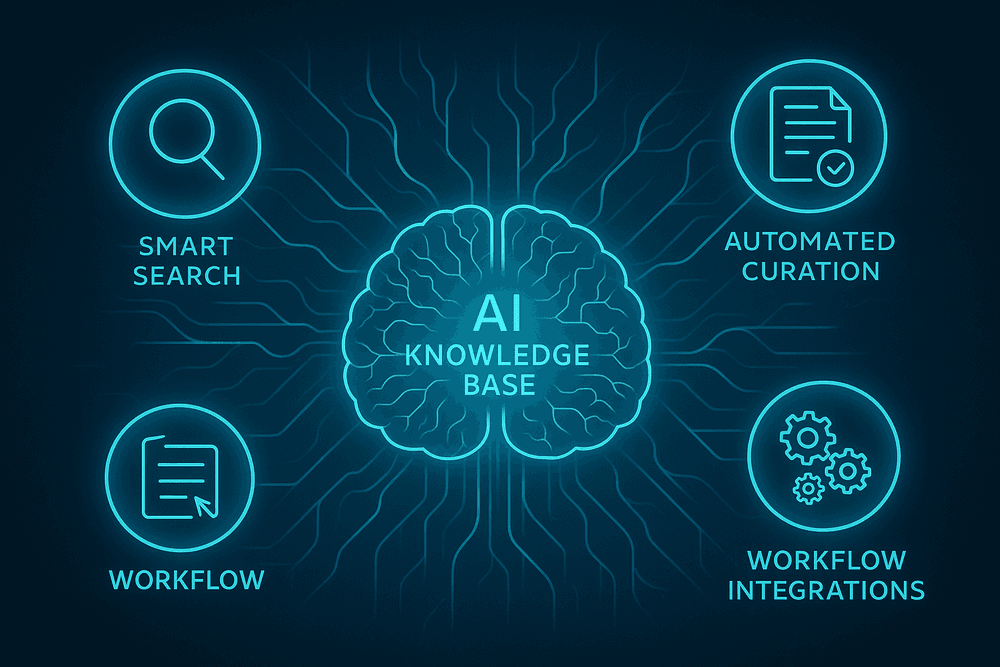
A traditional knowledge base is a digital filing cabinet—functional but passive. A modern ai knowledge base, however, is a dynamic, intelligent partner designed to actively enhance how your organization uses information. It moves beyond simple storage to deliver insights, automate maintenance, and integrate seamlessly into your daily operations. Let's explore the core features that make this transformation possible.
Leveraging Natural Language Processing (NLP) for Smart Search
How many times have you searched for something you know exists, only to get zero results because you didn’t use the exact keyword? This is the primary limitation of legacy systems. An ai knowledge base demolishes this barrier with Natural Language Processing (NLP).
NLP allows the search engine to understand human language, including intent, context, and semantics. Instead of just matching keywords, it comprehends the question behind the query.
- Traditional Search: A user searches for "expense report deadline" and finds nothing because the article is titled "Submitting T&E Forms."
- AI-Powered Search: A user asks, "When do I need to get my expenses in for this month?" The NLP model understands the intent and immediately pulls up the "Submitting T&E Forms" article, even highlighting the relevant section on deadlines.
This intelligent search capability dramatically reduces friction, empowers users to self-serve effectively, and ensures valuable knowledge is always accessible.
Automating Content Curation and Knowledge Discovery
A knowledge base is only as good as its content. In a fast-paced environment, information quickly becomes outdated, irrelevant, or duplicated. Manually auditing an entire library is a monumental task. An ai knowledge base automates this process through intelligent content curation. The system can:
- Identify Stale Content: Flag articles that haven't been viewed or updated in a long time for review.
- Detect Duplicates: Pinpoint and suggest merging overlapping or conflicting information to create a single source of truth.
- Uncover Knowledge Gaps: Analyze user search queries that yield no results. If multiple people are searching for "new remote work policy" and finding nothing, the system can automatically create a task for the relevant expert to write that article.
This turns knowledge management from a reactive chore into a proactive, self-improving cycle.
Integrating with Your Workflow: Slack, Teams, and More
The most effective tools are the ones that meet you where you are. Forcing employees to switch contexts and log into a separate platform to find information kills productivity. A key feature of a modern ai knowledge base is its ability to integrate directly into the applications your team uses every day.
Imagine a support agent in Microsoft Teams asking a bot, "What's our refund policy for international customers?" The bot instantly pulls the answer from the knowledge base and delivers it within the chat. A sales representative in Salesforce can get instant product specs without ever leaving the customer record. This concept, known as "knowledge in the flow of work," makes accessing information effortless and boosts adoption rates significantly.
Predictive Analytics for Proactive Support
The most advanced AI knowledge bases don't just answer questions—they anticipate them. By analyzing trends in search data, content usage, and even support tickets, the system can use predictive analytics to get ahead of potential issues. For instance, if the platform notices a sudden spike in searches related to a specific software feature after an update, it can proactively alert the product team to a potential bug or a widespread point of confusion. It can then recommend creating a new FAQ, a tutorial video, or a pop-up guide to address the issue before it escalates, empowering your team to move from a reactive support model to a truly proactive one.
Top Use Cases for an AI Knowledge Base Across Your Business
An AI knowledge base is far more than a digital filing cabinet; it's a dynamic engine for productivity and intelligence that can be deployed across your entire organization. By centralizing information and making it instantly accessible through intelligent search, this technology dismantles information silos and empowers every team to perform at its peak. Let’s explore the most impactful use cases that are transforming modern businesses.
Revolutionizing Customer Self-Service and Support Tickets
Today’s customers expect immediate answers, and a traditional, static FAQ page no longer suffices. This is where an AI knowledge base becomes a game-changer for customer support.
By powering a public-facing help center, it allows customers to ask questions in their own words and receive accurate, context-aware answers 24/7. This robust self-service capability directly reduces the number of incoming support tickets for common issues, freeing up your agents to handle more complex and high-value customer interactions. Furthermore, when a ticket is created, the AI can assist agents by automatically suggesting relevant articles and solutions, drastically cutting down on research and resolution times. The result is a win-win: customers get faster solutions, and your support team becomes more efficient and less burdened.
Accelerating Employee Onboarding and Internal Training
The first few weeks on the job are critical for a new employee’s success, but they are often filled with confusion and a scramble for information. An internal AI knowledge base transforms the onboarding process from a fragmented scavenger hunt into a streamlined, self-guided journey.
New hires can instantly find everything they need—from company policies and procedural guides to software tutorials and team-specific documentation—simply by asking. This empowers them to become self-sufficient and productive faster. Beyond onboarding, the platform serves as a "perpetual training" resource for all employees. When a new process is rolled out or a new tool is adopted, the knowledge base becomes the single source of truth, ensuring everyone has access to the latest information and facilitating continuous learning and upskilling across the company.
Empowering Sales Teams with Instant Product Knowledge
In a competitive market, a well-informed sales representative is an effective one. An AI knowledge base acts as a secret weapon for your sales team, providing them with the critical information they need, precisely when they need it.
Imagine a sales rep on a call who is asked a complex technical question. Instead of fumbling or promising to follow up, they can query the knowledge base and get an instant, accurate answer. This central hub can store product specifications, competitor battle cards, pricing structures, relevant case studies, and marketing collateral. By ensuring every member of the sales team is drawing from the same well of up-to-date, verified information, you guarantee messaging consistency and empower them to handle objections with confidence, ultimately shortening the sales cycle.
Streamlining IT and HR Helpdesk Operations
Internal support teams like IT and HR are often inundated with repetitive, low-level inquiries that consume a significant amount of their time. An AI knowledge base helps deflect a large portion of this workload through self-service.
Employees can resolve common IT issues themselves by searching for guides on setting up a VPN, troubleshooting a printer, or requesting new software. Similarly, they can find answers to frequent HR questions about leave policies, benefits enrollment, or expense reporting without creating a ticket. This immediate access to information not only improves the overall employee experience but also liberates your IT and HR professionals to focus on more strategic, complex projects that drive the business forward.

How to Choose the Right AI Knowledge Base Software
Selecting the right AI knowledge base is a critical decision that can dramatically impact your team’s efficiency and customer satisfaction. With a crowded market, making an informed choice requires a clear evaluation framework. The best platform isn't just a repository for information; it's an intelligent engine that integrates into your daily operations and grows with your organization.
Key Evaluation Criteria: Scalability, Integration, and Security
Before you even look at specific platforms, establish your non-negotiable requirements. Focus on these three foundational pillars to narrow down your options effectively.
Scalability
Your business is going to grow, and your AI knowledge base must be able to keep pace. A scalable solution can handle an increasing volume of content, a growing number of users, and a higher frequency of queries without a drop in performance. Ask potential vendors how their architecture supports growth and whether their pricing models accommodate expansion without exorbitant costs.
Integration
An AI knowledge base should not be an isolated island of information. To maximize its value, it must seamlessly connect with the tools your team already uses every day. Look for native integrations with platforms like Slack, Microsoft Teams, Salesforce, Zendesk, and Jira. A powerful API is also crucial for building custom connections, ensuring that knowledge is accessible directly within your existing workflows.
Security
You are entrusting the platform with your most valuable asset: your organizational knowledge. Robust security is non-negotiable. Evaluate each platform’s security posture by looking for features like data encryption (at rest and in transit), granular role-based access controls, single sign-on (SSO) capabilities, and compliance with industry standards like SOC 2 and GDPR.
Comparing Top AI Knowledge Base Platforms on the Market
Once you have your core criteria, you can begin comparing specific solutions. Instead of getting lost in feature lists, focus on how each platform performs in these key areas:
- Search and Discovery: The core of any AI knowledge base is its search capability. Test how well it understands natural language queries. Does it deliver accurate answers, not just links to documents? Look for platforms that use advanced AI to provide direct, context-aware responses and suggest related content.
- Content Management: How easy is it for your team to create, import, and maintain information? A good platform offers an intuitive editor, version control, and workflows for content verification. AI-powered features like identifying outdated articles or highlighting knowledge gaps are significant value-adds.
- Analytics and Insights: To continuously improve, you need data. The best systems provide a robust analytics dashboard showing what users are searching for, search success rates, and the most-used content. These insights are gold for understanding and filling your organization’s knowledge gaps.
Calculating the ROI of an AI Knowledge Base Investment
Justifying the expense of a new platform requires a clear understanding of its return on investment (ROI). You can build a strong business case by quantifying its benefits.
Start by calculating efficiency gains. Estimate the time employees save by getting instant answers instead of searching through drives or asking colleagues. For a support team, this translates to faster ticket resolution times and the ability to handle more customers.
Next, measure cost reductions. An effective self-service AI knowledge base directly reduces the number of inbound support tickets, lowering operational costs. It also accelerates new hire onboarding, cutting down ramp-up time and associated training expenses.
Finally, weigh these gains against the total cost of ownership, which includes subscription fees, implementation costs, and any ongoing administrative time. By demonstrating a clear, positive ROI, you can confidently prove that investing in the right AI knowledge base is not a cost—it’s a strategic move for future growth.
Best Practices for Implementing Your AI Knowledge Base
Deploying a powerful AI knowledge base is more than a simple software installation; it’s a strategic initiative that requires careful planning, a clear governance structure, and a focus on user adoption. To transform your organizational knowledge into a truly valuable asset, you need to follow a structured implementation process. These best practices will guide you from initial planning to long-term success, ensuring your new system becomes an indispensable tool for your entire organization.
Conducting a Knowledge Audit Before You Begin
Before you can build a house, you need to survey the land. Similarly, before implementing an AI knowledge base, you must conduct a thorough knowledge audit. This is a systematic inventory and analysis of your organization's current information assets. The goal is to understand what knowledge you have, where it resides, who owns it, and—most importantly—where the critical gaps are.
Start by mapping all existing knowledge repositories: shared drives, wikis, intranets, spreadsheets, Slack channels, and even the tacit knowledge held by your subject matter experts. During this process, identify and tag content that is Redundant, Outdated, or Trivial (ROT). This audit accomplishes two things: it prevents you from migrating clutter into your new system and provides a clean, high-quality dataset to train your AI, ensuring it delivers accurate and relevant results from day one.
Creating a Content Governance and Refresh Strategy
An AI knowledge base is a living entity; it's only as reliable as the information within it. Without a robust governance plan, even the most advanced system will quickly become a digital junkyard of outdated content. A content governance and refresh strategy establishes the rules of the road for your knowledge.
Your strategy should clearly define:
- Roles and Responsibilities: Designate content owners, subject matter experts (SMEs), and editors. Who has the authority to create, review, approve, and archive content?
- Content Standards: Create templates and style guides to ensure consistency in tone, voice, and formatting. This makes content easier for both humans and the AI to understand.
- Review Cadence: Set up automated reminders for content owners to review and update their articles. High-impact or frequently changing information might need a quarterly review, while foundational content can be checked annually.
Training Your Team to Trust and Adopt the New System
The greatest barrier to success isn’t technology—it’s adoption. If your team doesn’t trust or use the new AI knowledge base, your investment is wasted. A thoughtful change management and training plan is non-negotiable.
Focus on communicating the "why" behind the change. Show employees how the system will directly benefit them by providing instant answers, reducing repetitive questions, and making their work less frustrating. Go beyond basic "how-to" sessions and provide role-specific training that uses real-world scenarios. Identify and empower a few enthusiastic "champions" who can act as advocates and provide peer support. Finally, reduce friction by integrating the AI knowledge base directly into the platforms your team already uses daily, such as Microsoft Teams, Slack, or your CRM.
Measuring Success: KPIs for Your AI Knowledge Base
To justify your investment and drive continuous improvement, you must measure what matters. Tracking the right Key Performance Indicators (KPIs) will provide clear insights into the health, usage, and impact of your AI knowledge base.
Essential KPIs to monitor include:
- Adoption Rate: What percentage of employees are actively using the platform weekly or monthly?
- Search Success Rate: The ratio of successful searches (where a user clicks a result) to total searches.
- Time to Answer: How quickly are users finding the information they need? This can be measured via analytics and user surveys.
- Ticket Deflection (for support): The number of customer or internal support tickets avoided because users found answers themselves.
- Content Engagement: Track metrics like views, shares, and user feedback (upvotes/downvotes) to identify both high-value and underperforming content.

The Future Is Smart: Your Next Steps With an AI Knowledge Base
The transition is no longer a question of if, but when. In a business landscape defined by data velocity and immediate customer expectations, clinging to outdated, static knowledge repositories is a direct path to falling behind. The future of organizational intelligence is active, predictive, and powered by artificial intelligence. Taking the leap to an AI knowledge base isn't just an upgrade—it's a fundamental strategic shift toward a more resilient, efficient, and competitive organization. Here’s how to move forward.
Why an AI Knowledge Base Is No Longer Optional
In today's digital economy, information is your most valuable asset, but it's also your biggest challenge. Employees and customers are drowning in data, yet starved for answers. Traditional knowledge bases have become part of the problem; they are digital filing cabinets that require tedious manual tagging, are difficult to search, and often serve up outdated documents instead of direct answers.
An AI knowledge base fundamentally changes this dynamic. It transforms your scattered information into a cohesive, intelligent ecosystem that works for you.
- It anticipates needs: Instead of waiting for a query, it proactively suggests relevant information based on a user's role, current task, or customer history.
- It understands context: Leveraging Natural Language Processing (NLP), it comprehends the intent behind a question, delivering precise answers, not just a list of keyword-matched links.
- It learns and improves: Every interaction refines its understanding, making it smarter and more accurate over time with zero additional manual effort.
To operate without this capability is to accept inefficiency, slower customer service, and a widening knowledge gap as a permanent state of business. An AI knowledge base is now the standard for high-performing teams.
Building a Business Case for AI-Powered Knowledge Management
Securing executive buy-in requires a clear demonstration of value. An AI knowledge base isn't an expense; it's a high-return investment that pays dividends across the entire organization. Frame your business case around these core pillars of ROI:
- Drastic Productivity Gains: Calculate the time your teams waste searching for information. An AI knowledge base can slash search time by over 70%, instantly freeing up employees for high-value work. This translates directly into faster project completion, quicker sales cycles, and more innovation.
- Elevated Customer and Employee Experience: For customer support, this means immediate, 24/7 self-service resolutions and super-powered agents who can solve complex issues on the first call. Internally, it means new hires onboard faster and all employees feel more empowered and less frustrated.
- Reduced Operational Costs: Drive down support costs by deflecting tickets to highly effective self-service portals. Reduce compliance risks by ensuring everyone has access to the single source of truth. Minimize costly errors caused by teams using outdated information.
Get a Personalized Demo of an AI Knowledge Base in Action
Reading about the benefits is one thing. Seeing it transform your own information is another. Stop trying to imagine the impact and experience it firsthand.
A personalized demo will show you exactly how a leading AI knowledge base can be tailored to your specific business challenges. We’ll walk you through how the system can securely connect to your existing data—whether it's in SharePoint, Confluence, Slack, or Zendesk—and instantly begin turning that content into an intelligent, conversational resource. See for yourself how complex questions get direct, accurate answers in seconds.
Take the definitive next step in your knowledge management evolution. Schedule your personalized demo today and see how an AI knowledge base can unlock the collective intelligence of your organization.