
September 28, 2025
What Is an AI Grading Assistant and How Is It Changing
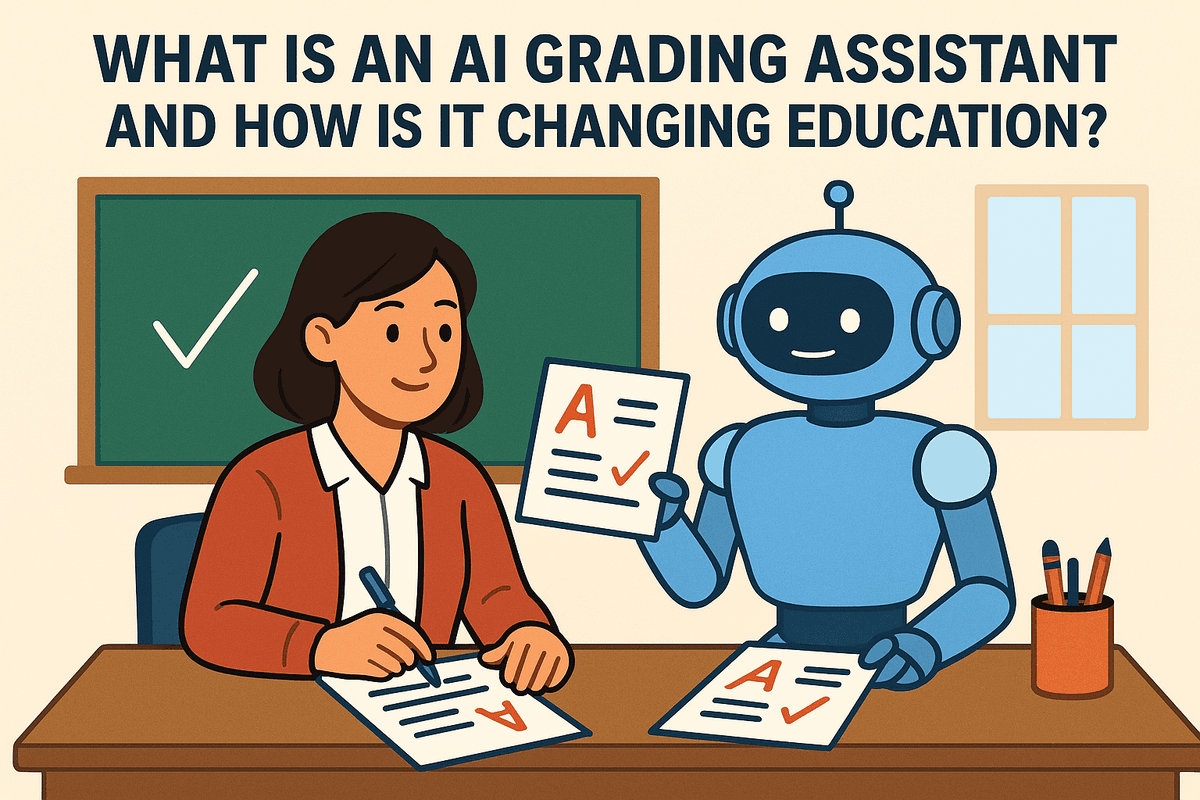
What Is an AI Grading Assistant and How Is It Changing Education?
For decades, the image of a dedicated teacher has been tied to a stack of papers and a red pen, spending countless late nights providing feedback. While the dedication remains, the tools are undergoing a powerful transformation. The rise of the AI grading assistant is not just about saving time; it's about fundamentally redefining the roles of assessment and feedback in the modern classroom. This technology is moving education beyond the limitations of manual grading and into a new era of efficiency and pedagogical focus.
Beyond the Red Pen: Defining the Modern Grading Assistant
So, what exactly is an AI grading assistant? It’s far more than a sophisticated spell-checker. It is a powerful software tool that leverages artificial intelligence, including machine learning (ML) and natural language processing (NLP), to analyze and evaluate student work. Unlike simple auto-graders that can only handle multiple-choice or fill-in-the-blank questions, a modern AI grading assistant can assess complex submissions like essays, short-answer responses, reports, and even computer code.
The system works by being trained on a specific rubric and examples provided by the educator. The teacher remains the expert in the driver's seat, defining what constitutes excellent, proficient, or developing work. The AI then learns these criteria and applies them consistently across every submission. It can identify key arguments, evaluate sentence structure, check for factual accuracy against provided sources, and measure performance against learning objectives. It’s designed to be a co-pilot, augmenting the teacher's expertise, not replacing it.
How AI Is Tackling Teacher Burnout One Paper at a Time
Teacher burnout is a critical issue, and the administrative burden of grading is a significant contributor. The sheer volume of assessments can consume nights and weekends, leaving educators with less time and energy for lesson planning, professional development, and direct student interaction.
This is where the AI grading assistant provides its most immediate relief. By automating the initial, often repetitive, stages of grading, it can reduce the time spent on assessments by up to 70-80%. This reclaimed time is invaluable. Instead of spending hours marking papers, teachers can reinvest that energy into what truly matters:
- Designing more creative and engaging lesson plans.
- Providing one-on-one support to students who are struggling.
- Facilitating dynamic classroom discussions.
- Focusing on higher-order feedback about ideas and critical thinking, rather than just grammatical corrections.
By handling the logistical heavy lifting, the AI empowers educators to shift from being graders to being true facilitators of learning.
The Core Promise: Objective, Consistent, and Instant Feedback
Beyond time savings, an AI grading assistant delivers on three core promises that enhance the learning experience for everyone.
- Objectivity: Even the most well-intentioned educator can be influenced by unconscious bias or fatigue. An AI grades purely on the pre-defined rubric, ensuring every student’s work is evaluated against the exact same standard, promoting fairness and equity in the classroom.
- Consistency: The AI applies the same level of scrutiny to the first paper it grades as it does to the last. This consistency is especially crucial in large courses or when multiple instructors are teaching the same subject, ensuring a standardized and reliable assessment process.
- Instant Feedback: For students, the lengthy wait for a grade can be a momentum-killer. An AI grading assistant provides detailed, actionable feedback almost immediately. This creates a powerful learning loop, allowing students to understand their mistakes and make improvements while the concepts are still fresh. This transforms assessment from a static endpoint into a dynamic, formative part of the learning journey.
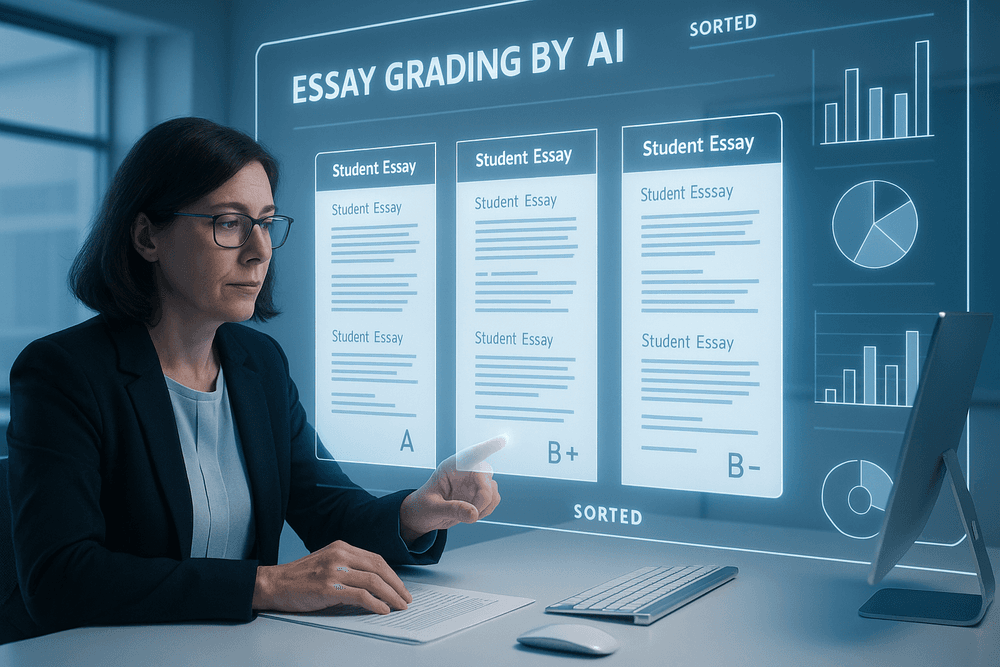
The Best AI Grading Assistant Tools of 2024
Navigating the landscape of AI grading tools can be daunting. With numerous platforms claiming to save time and enhance feedback, how do you choose the right one? The ideal ai grading assistant depends on your subject, class size, and pedagogical goals. Below, we break down some of the top contenders in 2024, each with unique strengths.
Gradescope: Strengths for STEM and Large-Scale Assessments
Gradescope, now part of the Turnitin family, has become a powerhouse in higher education, particularly for STEM (Science, Technology, Engineering, and Mathematics) disciplines. Its standout feature is the ability to digitize and grade handwritten assignments, exams, and problem sets at scale.
Instead of grading one student paper at a time, Gradescope’s AI groups similar answers together. This allows you to grade a single answer and apply the same feedback and score to every identical submission in the batch, drastically reducing repetitive work. Its flexible rubric system lets you make adjustments on the fly, which are then retroactively applied to all previously graded work, ensuring consistency. If you're managing a large lecture class with complex equations or diagrams, Gradescope is an exceptional ai grading assistant for maintaining rigor and efficiency.
Turnitin's AI Suite: From Plagiarism Detection to Formative Feedback
Long known as the gold standard for plagiarism detection, Turnitin has evolved into a comprehensive suite of assessment tools. Its core offering, Feedback Studio, integrates originality checking with powerful grading and feedback features. Educators can use "QuickMarks"—reusable, drag-and-drop comments—to provide targeted feedback on common writing issues.
The integration of Gradescope and the recent addition of an AI writing detection tool make Turnitin a multifaceted platform for upholding academic integrity while supporting student learning. It serves less as a pure automation tool and more as an educator’s co-pilot, flagging potential issues and streamlining the feedback loop. This makes it a robust choice for institutions focused on developing writing skills and ensuring originality.
Kritik & Peergrade: Combining Peer Assessment with AI Calibration
A different breed of ai grading assistant, platforms like Kritik and Peergrade leverage the power of peer-to-peer assessment, with AI acting as a moderator and quality control mechanism. In these systems, students anonymously grade a handful of their peers' submissions based on a rubric you provide. They also provide qualitative feedback.
The AI’s role is crucial: it analyzes the quality and accuracy of the feedback being given and calculates a “grading power” score for each student. This ensures that fair, high-quality evaluators have more weight, preventing bias and ensuring final grades are reliable. This approach not only saves instructor time but also fosters critical thinking and deepens students’ understanding of the course material by engaging them in the evaluation process itself.
Key Features to Look For When Choosing Your AI Grading Assistant
When selecting a tool, move beyond the marketing and evaluate it against your specific needs. Here are the critical features to consider:
- LMS Integration: Does the platform seamlessly integrate with your institution's Learning Management System (e.g., Canvas, Blackboard, Moodle)? Smooth integration is non-negotiable for a streamlined workflow.
- Subject Specificity: Is the tool built for your discipline? An AI designed for grading code will have different strengths than one designed for evaluating essays or mathematical proofs.
- Customization and Instructor Control: A great ai grading assistant empowers, not replaces, the educator. Look for tools that allow you to build and modify rubrics, override AI suggestions, and maintain full control over final grades.
- Quality of Feedback: Does the tool simply assign a score, or does it provide actionable, constructive feedback that helps students learn and improve? Look for features that explain the "why" behind the grade.
Core Features: What Can an AI Grading Assistant Actually Do?
Beyond the simple promise of saving time, a modern ai grading assistant is a sophisticated tool designed to enhance the entire assessment cycle. It’s not about replacing educators but empowering them with technology that handles the repetitive, time-consuming tasks, freeing them to focus on what matters most: teaching. Let's break down the core functionalities that make these platforms so transformative.
Automate Scoring with Smart, Rubric-Based Analysis
At its heart, an ai grading assistant excels at accurately and consistently scoring student work. This isn't a black-box process; you are in complete control. Educators provide the AI with their specific rubric—the same one they would use for manual grading. The system then learns to apply these criteria to evaluate everything from short-answer questions to complex essays and reports.
The key benefit is unparalleled consistency. The AI applies the rubric with the same precision to the first assignment as it does to the hundredth, eliminating the natural human biases and fatigue that can creep in during long grading sessions. This ensures every student's work is judged by the exact same standard, providing a fairer and more objective assessment. You can review, adjust, and override any AI-suggested score, ensuring you always have the final say.
Generate Personalized, Constructive Feedback at Scale
Providing meaningful, individualized feedback is one of the most impactful teaching practices, but it's also one of the most difficult to execute for large classes. An ai grading assistant solves this scalability problem. Instead of generic comments, the AI can generate specific, constructive feedback for each student based on their performance against the rubric.
For example, it can highlight the exact sentences where a student successfully demonstrated critical analysis or point to a paragraph that lacks sufficient evidence. The feedback can be configured to be encouraging, offering concrete suggestions for improvement. This allows every student to receive personalized guidance that helps them understand their strengths and weaknesses, enabling them to learn from their mistakes and improve on future assignments—a feat nearly impossible to achieve manually for dozens or hundreds of students.
Seamlessly Integrate with Your LMS
The best technology fits into your existing workflow, rather than forcing you to adopt a new one. Leading AI grading platforms are designed for seamless integration with major Learning Management Systems (LMS). Whether your institution uses Canvas, Blackboard, Moodle, D2L Brightspace, or Google Classroom, the ai grading assistant can plug directly into your environment. This means you can manage assignments, trigger the grading process, and sync scores back to your gradebook without ever leaving your familiar LMS dashboard. This tight integration minimizes the learning curve and makes adoption simple and efficient for faculty.
Unlock Actionable Insights with Student Performance Analytics
A powerful ai grading assistant does more than just grade individual papers; it aggregates data to reveal powerful insights into student performance at a class-wide level. Through intuitive dashboards and reports, educators can quickly identify trends and patterns. Are a majority of students struggling with a specific learning objective? Did one particular question on the exam prove to be more difficult than anticipated?
These analytics provide a clear, data-driven view of comprehension gaps, allowing instructors to intervene proactively. You can adjust your teaching strategy, provide supplemental resources for a difficult concept, or refine assignment instructions for the future. This transforms assessment from a simple evaluation tool into a dynamic source of feedback for improving your own instructional effectiveness.

Best Practices for Implementing an AI Grading Assistant
Successfully integrating an AI grading assistant into your workflow requires a thoughtful and strategic approach. It’s not just about adopting new technology; it’s about enhancing your teaching practice to provide better, faster feedback. By following these best practices, you can ensure a smooth transition and maximize the benefits for both you and your students.
Setting Up Your First AI-Powered Assignment for Success
The key to a successful first run is to start small and be deliberate. Don't overhaul your entire curriculum at once. Instead, choose a single, low-stakes assignment to pilot your new AI grading assistant. This reduces pressure and allows you to learn the system's nuances without impacting final grades.
Success hinges on clarity. Before you begin, develop a highly detailed and objective rubric. An AI model learns directly from the criteria you provide; any ambiguity will result in inconsistent grading. Clearly define what constitutes "excellent," "good," and "needs improvement" for each scoring category. Assignments with structured answers, such as short essays, lab reports, or problem sets, are often the best candidates for your initial implementation.
The Importance of Human Oversight: Training and Calibrating the AI
Remember, the tool is an assistant, not a replacement. You are always in control. The most crucial phase of implementation is training and calibration. Most platforms require you to grade an initial batch of submissions manually. This process "teaches" the AI how to apply your rubric consistently. The more accurate your initial grading, the more reliable the AI’s subsequent assessments will be.
Once the AI begins grading, your work isn’t over. Plan to spot-check a significant portion of the AI-graded submissions—especially in the beginning. Compare the AI’s score and feedback against your own judgment. This review process allows you to calibrate the AI grading assistant, correct its errors, and build confidence in its accuracy over time.
Communicating the Role of AI to Students and Stakeholders
Transparency is essential for building trust. Inform your students that you are using an AI grading assistant and explain why. Frame it as a tool to provide them with faster, more consistent, and more detailed feedback, freeing up your time to focus on in-class instruction and one-on-one support.
Explain the process clearly: the AI provides a first pass based on the rubric, but you, the instructor, perform the final review and have the ultimate say on every grade. This reassurance helps alleviate student anxiety about being graded by a machine. Likewise, keep administrators and parents informed, positioning the technology as a powerful supplement that enhances your professional expertise.
Addressing Ethical Considerations and Maintaining Academic Integrity
When choosing an AI grading assistant, prioritize student data privacy. Ensure the platform complies with relevant regulations like FERPA and has a clear policy on data security and usage.
Furthermore, be vigilant about mitigating bias. AI models can inadvertently learn and perpetuate biases present in the training data. Regular audits and spot-checks are critical to ensure the tool is grading equitably across all student demographics. While many AI grading tools also include plagiarism detection features, remember that the ultimate responsibility for upholding academic integrity remains with the educator and the institution. The AI is a powerful aid, but human ethical judgment is irreplaceable.
Real-World Impact: AI Grading Assistant Success Stories
The theoretical benefits of automated assessment are compelling, but the real test lies in its practical application. Across diverse educational landscapes—from large universities to specialized bootcamps—educators are leveraging AI to transform their workflows and enhance student learning. These success stories demonstrate how an AI grading assistant is not just a futuristic concept but a powerful tool delivering measurable results today.
Case Study: How a Large University Cut Grading Time by 70%
The Challenge: A major state university faced a common dilemma in its large-enrollment introductory courses. With lecture halls of over 400 students, the team of teaching assistants (TAs) was overwhelmed by the sheer volume of weekly quizzes and short-answer assignments. The grading bottleneck meant students often waited two to three weeks for feedback, long after the material had been covered in class.
The Solution: The university’s computer science department piloted an AI grading assistant for its "Introduction to Programming" course. The platform was configured with custom rubrics to evaluate code functionality, efficiency, and style. For written responses, it assessed keyword inclusion and conceptual accuracy. The system handled the initial, time-consuming pass on every submission, flagging complex or ambiguous answers for human review.
The Result: The implementation led to a staggering 70% reduction in the time TAs spent on grading. This reclaimed time was reinvested into more impactful student interactions, such as hosting smaller, more focused recitation sections and offering extended office hours. Students received detailed, consistent feedback within 48 hours, enabling them to correct misunderstandings while the concepts were still fresh.
Success Story: Improving Feedback Quality in a High School Writing Course
The Challenge: An experienced high school English teacher found herself spending the majority of her grading time on repetitive corrections of grammar, syntax, and citation formatting. She wanted to provide deeper feedback on her students' argumentation, critical thinking, and authorial voice but was constrained by time.
The Solution: She adopted an AI grading assistant specializing in writing analysis. The tool automatically highlighted grammatical errors and stylistic inconsistencies, providing students with direct links to explanatory resources. Crucially, it also analyzed essays against the teacher's rubric, identifying the strength of thesis statements, the use of supporting evidence, and the logical flow of paragraphs.
The Result: The AI handled the foundational "checklist" feedback, freeing the teacher to focus her comments on higher-order thinking. Her annotations became more like a mentorship dialogue, questioning students' assumptions and praising unique insights. Students reported that the combination of instant AI feedback and personalized teacher comments was the most comprehensive and helpful assessment they had ever received, leading to a marked improvement in their analytical writing skills.
Use Case: Providing Instant, Iterative Feedback in a Coding Bootcamp
The Challenge: The fast-paced, immersive environment of a coding bootcamp requires students to learn and apply new concepts rapidly. Waiting for an instructor to review code can halt progress and lead to frustration. The bootcamp needed a way to provide scalable, immediate feedback 24/7.
The Solution: The bootcamp integrated a specialized AI grading assistant directly into its learning platform. As students worked on coding challenges, they could submit their code at any time and receive an instant report. The AI ran a suite of tests to check for functionality, identified common bugs, and offered suggestions for optimizing their code based on industry best practices.
The Result: This created a dynamic and empowering learning loop. Students were no longer afraid to make mistakes; instead, they saw them as learning opportunities. They could iterate on their solutions—submitting, reviewing AI feedback, and refining their code—multiple times an hour. This constant, low-stakes assessment built both confidence and competence, dramatically accelerating their journey from novice to job-ready developer.

Conclusion: Is an AI Grading Assistant Your Next Teaching Partner?
The landscape of education is in constant evolution, and the integration of technology is no longer a question of if, but how. Throughout this exploration, we've seen that an AI grading assistant is far more than a futuristic concept; it's a practical, powerful tool available today. It’s a partner that works tirelessly behind the scenes, handling the repetitive aspects of assessment so you can focus on what truly matters: teaching, mentoring, and inspiring your students. The question now is not whether this technology works, but whether it’s the right fit for you and your classroom.
Recap: The Key Benefits for Educators and Students
Let's quickly revisit the transformative advantages. For educators, the primary benefit is the gift of time. An AI grading assistant automates the grading of a wide range of assignments, from multiple-choice questions to complex coding problems and even initial drafts of essays. This drastically reduces the hours spent on administrative tasks, mitigating burnout and freeing you up for lesson planning, one-on-one student interaction, and professional development.
For students, the impact is equally profound. They receive immediate, consistent, and objective feedback, allowing them to identify and correct mistakes while the material is still fresh in their minds. This rapid feedback loop fosters a growth mindset and empowers them to take ownership of their learning journey. The data-driven insights provided by an AI grading assistant also help you pinpoint common areas of struggle across the class, enabling you to tailor your instruction more effectively.
Making the Right Choice for Your Classroom's Needs
Adopting any new technology requires careful consideration. Not all AI grading platforms are created equal, and the best choice depends entirely on your unique context. When evaluating options, consider these key factors:
- Subject Compatibility: Does the tool specialize in your subject area? An assistant designed for STEM subjects with quantifiable answers will differ greatly from one built to analyze essays and humanities responses.
- Integration: How well does the AI grading assistant integrate with your existing Learning Management System (LMS), such as Canvas, Blackboard, or Moodle? A seamless workflow is crucial for successful adoption.
- Customization: Can you customize rubrics and feedback criteria to align with your specific teaching philosophy and learning objectives? The tool should adapt to you, not the other way around.
- Data Privacy and Security: Ensure the platform adheres to strict educational privacy standards like FERPA to protect student information.
Take the Next Step: How to Trial an AI Grading Assistant Today
The most effective way to determine if an AI grading assistant is your next teaching partner is to try one. Theory is one thing, but firsthand experience is another. Many leading platforms understand this and offer free trials, demos, or pilot programs specifically for educators.
Start small. Choose one upcoming assignment or a single class to run a pilot test. Set up the tool, customize your rubric, and compare the results and your experience with your traditional grading process. Involve your students by gathering their feedback on the immediacy and clarity of the comments they receive. This low-stakes experiment will provide the tangible evidence you need to make an informed decision, moving you from curiosity to confidence and potentially revolutionizing your teaching workflow for the better.