
October 29, 2025
What Is an AI Grading Assistant and How Can It Transform
What Is an AI Grading Assistant and How Can It Transform Your Teaching?
For generations, the red pen has been the ultimate symbol of a teacher's workload—a tool for correction, evaluation, and countless late nights. But just as chalkboards gave way to smartboards, the grading process is undergoing a revolutionary transformation. Enter the AI grading assistant: a sophisticated digital partner designed to streamline assessments, enhance student feedback, and give you back your most valuable resource—time.
Beyond the Red Pen: Defining the Modern AI Grading Assistant
An AI grading assistant is far more than an advanced spell-checker. It is a powerful software tool that uses artificial intelligence, including natural language processing (NLP) and machine learning, to analyze and assess student submissions. This technology is capable of evaluating a wide range of assignments, from complex essays and research papers to short-answer questions and even computer code.
Think of it as a highly trained, endlessly patient teaching assistant. You provide the rubric and sample graded assignments, and the AI learns your specific criteria and standards. It then applies this knowledge consistently across every submission, highlighting strengths and identifying areas for improvement based on your pedagogical framework. The key is that it’s an assistant, not a replacement. It automates the objective and repetitive parts of grading, freeing you to focus on providing the high-level, nuanced feedback that inspires critical thinking and true academic growth.
The Hidden Cost of Manual Grading: Why Teachers Need a Better Way
Every educator understands the immense pressure of a mounting pile of assignments. The hidden cost of manual grading extends far beyond the hours spent at a desk. It includes:
- Grading Fatigue and Inconsistency: The feedback on the first essay is rarely as thorough as on the thirtieth. Unconscious bias and exhaustion can lead to inconsistent scoring, creating inequitable assessments for students.
- Delayed Feedback Loops: By the time students receive their graded work, often days or weeks after submission, the lesson has moved on. The "teachable moment" has passed, making the feedback less impactful.
- Time Sink: The sheer volume of grading robs educators of time that could be better spent on lesson planning, one-on-one student mentoring, and professional development. This administrative burden is a leading contributor to teacher burnout.
A Glimpse into the Future: Saving Time and Enhancing Student Feedback
This is where an AI grading assistant offers a profound shift. The benefits are twofold and transformative. First, by automating the initial assessment process, these tools can reduce grading time by up to 80%. This allows you to reclaim your evenings and weekends and reinvest your energy where it matters most: in the art of teaching.
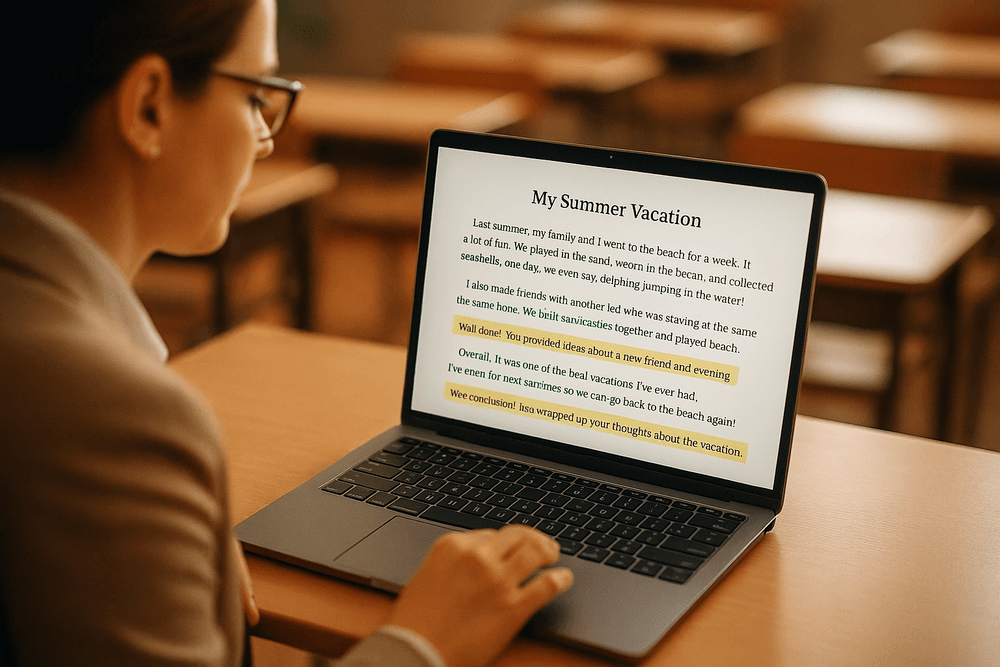
Second, and perhaps more importantly, an AI grading assistant revolutionizes student feedback. Instead of waiting for a grade, students can receive instant, actionable insights the moment they submit their work. The AI can provide line-by-line suggestions on grammar, clarity, structure, and evidence usage, turning every assignment into an immediate learning opportunity. This instant feedback loop empowers students to iterate and improve, fostering a deeper understanding and a more proactive approach to their own learning. It transforms grading from a final judgment into a dynamic, ongoing conversation.

The Top AI Grading Assistant Platforms for 2024 Reviewed
Navigating the crowded market for an ai grading assistant can be overwhelming. To cut through the noise, we’ve analyzed the leading platforms to help you find the perfect fit for your classroom. Whether you teach complex STEM subjects, writing-intensive courses, or need a tool that works directly within your LMS, this review covers the best options available today. Each platform offers a unique approach to streamlining your grading workflow and enhancing student feedback.
Gradescope: Best for STEM and Complex Assignments
Originally designed for the specific needs of science, technology, engineering, and math (STEM) courses, Gradescope excels where other tools falter. Its standout feature is AI-assisted grouping, which intelligently clusters similar handwritten, typed, or code-based answers. This allows educators to grade entire groups of identical responses at once, dramatically reducing repetitive work. Gradescope also supports dynamic rubrics, enabling you to adjust scoring criteria as you grade and apply changes retroactively. This flexibility makes it an indispensable ai grading assistant for subjects involving complex problem sets, diagrams, and programming assignments where answer variations are common.
Turnitin: For In-Depth Feedback and Plagiarism Detection
While universally known for its industry-leading plagiarism detection, Turnitin has evolved into a comprehensive feedback and assessment tool. With its acquisition of Gradescope and the development of its Feedback Studio, Turnitin leverages AI to do more than just check for originality. The platform now includes AI writing detection and is expanding its capabilities to provide instructors with AI-generated comments and feedback suggestions on written work. This powerful combination makes it the go-to ai grading assistant for humanities, social sciences, and any discipline that relies on essays and long-form writing. It streamlines the grading process while empowering educators to give more thorough and consistent feedback.
Bricksoft: AI-Powered Rubrics for K-12 and Higher Education
Bricksoft is carving out a niche by focusing on one of the most crucial elements of assessment: the rubric. This platform acts as an intelligent partner, using AI to help you build, refine, and apply rubrics with unparalleled consistency. The core of its technology analyzes student submissions against your predefined criteria, suggesting scores and generating relevant, constructive feedback for each rubric item. This not only ensures fairness and objectivity across an entire class but also saves countless hours. Designed with a clean interface, Bricksoft is accessible for both K-12 teachers and higher education faculty, making it the perfect ai grading assistant for educators who prioritize clear, criteria-based assessment.
Emerging Tools Integrated into Your LMS (Canvas, Moodle)
The most convenient ai grading assistant might already be at your fingertips. Learning Management Systems (LMS) like Canvas, Moodle, and Blackboard are increasingly embedding powerful AI grading features directly into their platforms. These integrated tools offer a seamless workflow, eliminating the need to export and import student data. Functions range from auto-grading multiple-choice and fill-in-the-blank questions to more advanced AI that can analyze short-answer responses and flag key concepts. Canvas, for example, is continuously rolling out new AI enhancements to its SpeedGrader, while the Moodle community actively develops plugins for AI-driven assessment. For educators seeking efficiency without adding another tool to their stack, exploring the native AI capabilities of your LMS is a fantastic starting point.
Essential Features to Look For in an AI Grading Assistant
Choosing the right AI grading assistant can transform your teaching workflow, but not all platforms are created equal. To truly leverage the power of artificial intelligence in your classroom, you need a tool equipped with a robust set of features designed to enhance, not just automate, the assessment process. As you evaluate your options, look for an ai grading assistant that delivers on these five essential capabilities.
Automated Rubric Alignment and Scoring
The cornerstone of any effective grading tool is its ability to score accurately and consistently. A premier ai grading assistant moves beyond simple keyword matching. It should intelligently analyze student submissions—from essays to short answers—and align the content with the specific criteria outlined in your rubric. This feature ensures every student's work is evaluated against the same standard, significantly reducing unintentional bias. By automating the most repetitive part of grading, it frees you up to focus on higher-level assessment and student engagement while maintaining rigorous academic standards.
Instant, Constructive Feedback Generation
The most significant pedagogical benefit of an ai grading assistant is its ability to close the feedback loop almost instantly. Waiting days or weeks for feedback diminishes its impact. Look for a tool that provides immediate, actionable, and personalized comments directly on student work. This feedback shouldn't be generic; the best systems can pinpoint specific areas for improvement, suggest concrete next steps, and explain why a certain aspect of the work meets or misses the mark. This transforms grading from a simple evaluation into a powerful, ongoing learning opportunity for every student.
Advanced Plagiarism and AI-Generated Text Detection
In today's digital landscape, maintaining academic integrity is more challenging than ever. Your chosen grading assistant must be equipped with sophisticated detection tools. This goes beyond traditional plagiarism checkers. A modern platform needs to identify subtle forms of text borrowing and, crucially, detect content that was likely generated by other AI models (like ChatGPT). This dual-detection capability is non-negotiable for upholding your institution's academic standards and teaching students the importance of original thought.
Student Performance Analytics and Insights
An AI grading assistant can be a powerful data analysis tool, offering insights that are difficult to gather manually. Look for a platform with a comprehensive analytics dashboard. This feature should aggregate performance data to reveal class-wide trends, common misconceptions on specific assignments, or learning objectives where students are consistently struggling. By visualizing this data, you can quickly identify areas where your instruction can be adapted or reinforced, enabling you to provide targeted support precisely where it’s needed most.
Seamless Learning Management System (LMS) Integration
Technology should simplify your workflow, not complicate it. The best AI grading assistant will integrate seamlessly with your existing Learning Management System (LMS), such as Canvas, Blackboard, Moodle, or Google Classroom. This integration ensures a frictionless experience for both you and your students. Assignments can be created, submitted, and graded within the familiar LMS environment, and grades can be automatically synced to your gradebook. This eliminates redundant data entry and keeps your digital classroom organized and efficient.
How to Successfully Implement an AI Grading Assistant in Your Classroom
Integrating an AI grading assistant into your workflow is more than just flipping a switch. A thoughtful implementation strategy ensures the technology enhances your teaching without compromising educational quality. By following these steps, you can harness the power of AI to save time, provide faster feedback, and maintain a fair, human-centered grading process.
Step 1: Choosing the Right Tool for Your Subject Matter
Not all AI grading tools are created equal. The most effective AI grading assistant for a STEM class focused on problem sets will differ significantly from one designed for grading humanities essays. Before committing to a platform, consider these factors:
- Assessment Type: Does your curriculum rely on multiple-choice questions, short answers, complex mathematical equations, or long-form essays? Look for a tool specifically designed to handle the primary assessment types you use.
- Subject Nuances: A good AI for literature should be able to analyze theme and argument structure, while a tool for coding should excel at syntax and logic checking. Vet the platform’s capabilities to ensure they align with your subject's specific demands.
- LMS Integration: To streamline your workflow, choose an AI grading assistant that integrates seamlessly with your school’s existing Learning Management System (LMS), such as Canvas, Blackboard, or Moodle.
Step 2: Training the AI for Maximum Accuracy and Fairness
An out-of-the-box AI model doesn’t know your specific standards. You need to train it. This calibration process is the single most important step for ensuring the tool is both accurate and fair.
- Provide Quality Examples: Begin by grading a sample set of assignments yourself. Feed these graded examples—along with your detailed rubrics—into the system.
- Use a Diverse Data Set: To mitigate bias, train the model on a wide range of student work, including excellent, average, and poor-quality submissions. This teaches the AI grading assistant the full spectrum of possible responses and helps it grade more equitably.
- Review and Refine: After the initial training, have the AI grade a new batch of assignments. Carefully review its suggestions, making corrections where needed. This iterative process of review and refinement fine-tunes the algorithm to your unique grading style.
Step 3: Setting Clear Expectations with Your Students
Transparency is essential for student buy-in. Students may be wary of being "graded by a robot," so it's crucial to communicate how the new tool will be used.
- Explain the "Why" and "How": Hold a brief class discussion or provide a handout explaining why you're using an AI grading assistant (e.g., to provide faster, more consistent feedback). Detail its role—is it providing a first-pass review, checking for grammar, or scoring specific rubric criteria?
- Clarify Your Role: Reassure students that you are still in control. Emphasize that you will review the AI’s suggestions, make the final grading decisions, and remain the go-to person for questions and in-depth feedback.
Best Practices for Maintaining the Human Element in Grading
An AI grading assistant should be a partner, not a replacement. Its greatest strength is handling repetitive, objective tasks, which frees you to focus on what matters most: providing meaningful, personalized feedback that fosters student growth.
- Be the Final Arbiter: Never accept an AI-generated grade without review. Always perform a final check to ensure the grade is fair and reflects the student's true understanding.
- Focus on Qualitative Feedback: Let the AI handle the basics like grammar, syntax, or correct formulas. Use the time you save to write personalized comments on higher-order thinking skills, creativity, argumentation, and unique insights—the areas where a human touch is irreplaceable.
- Use for Formative Assessment: AI tools are perfect for low-stakes, formative assignments. They provide the instant feedback students need to practice and improve, while you reserve your in-depth manual grading for major summative assessments like final papers and exams.
Real-World Impact: How an AI Grading Assistant Boosts Efficiency and Equity
The theoretical benefits of technology are one thing, but the real test is its impact in the classroom. For educators on the front lines, an ai grading assistant is not just a futuristic concept—it’s a practical solution that is reshaping workloads, student engagement, and educational fairness. Let’s explore how this technology delivers tangible results.
Case Study: How a University Professor Cut Grading Time in Half
Dr. Alisha Reynolds, a sociology professor at a large state university, faced a familiar challenge: grading 250 undergraduate essays three times a semester. Each cycle consumed over 40 hours, leading to burnout and a two-week delay in returning feedback to students. The quality of her comments suffered as grading fatigue set in.
Seeking a solution, she integrated an ai grading assistant into her workflow. She trained the AI on her specific rubric, focusing on criteria like thesis strength, evidence-based arguments, and structure. The tool performed the first pass, handling the objective, criteria-based scoring and highlighting common grammatical errors. This immediately cut her workload.
The result? Dr. Reynolds reduced her total grading time to under 20 hours per cycle. More importantly, the quality of her feedback improved. With the repetitive aspects automated, she could dedicate her energy to providing nuanced, high-level comments on students' critical thinking and analytical skills. “The AI grading assistant didn’t replace me,” she notes. “It became my partner, freeing me to be a better mentor and focus on the parts of teaching that truly matter.”
Improving Student Revision Habits with Immediate Feedback Loops
The traditional feedback cycle is often too slow to be effective. A student submits a paper, waits a week or more for a grade, and by the time they receive it, their focus has shifted to the next assignment. The motivation to learn from their mistakes is minimal.
An ai grading assistant shatters this outdated model by creating an immediate feedback loop. When students submit a draft, the tool can provide instant, formative feedback based on the instructor's rubric. It can flag:
- A weak thesis statement.
- Paragraphs lacking a clear topic sentence.
- Incorrect citation formatting.
- Grammatical and syntactical errors.
This instant feedback transforms the writing process from a single event into an iterative cycle. Students can review the AI’s suggestions, revise their work, and resubmit, all while the material is still fresh in their minds. This fosters a growth mindset and builds crucial self-editing skills, turning assessment into an active learning experience rather than a passive judgment.
Ensuring Consistent and Unbiased Grading Across Large Classes
In large courses, especially those with multiple teaching assistants (TAs), maintaining grading consistency is a monumental task. Grader fatigue, subjective interpretation, and unconscious bias can lead to significant variations in how papers are scored. A student’s grade can depend on whether their paper was graded at the beginning or the end of a long session.
An ai grading assistant provides the perfect solution for fairness and equity. The tool applies the exact same rubric and standards to every single submission, 24/7, without bias or fatigue. It evaluates the work solely on the established criteria, blind to a student’s name, past performance, or other external factors. This ensures that every student is assessed on a level playing field, where the quality of their work is the only metric that counts. For institutions, this creates a verifiable standard of fairness and consistency across entire departments.

Conclusion: Is an AI Grading Assistant the Future of Education?
The conversation around artificial intelligence in the classroom is no longer about a distant future; it's about the tools available right now. We've explored how these platforms function, what features to look for, and how they can be seamlessly integrated into your curriculum. But the central question remains: Is an AI grading assistant a fleeting trend or a foundational pillar of modern education?
When we look at the evidence, the potential is undeniable. These tools are not about replacing the invaluable human element of teaching but about augmenting it, allowing educators to reclaim their most precious resource: time.
Recap: The Top 3 Benefits for Overburdened Educators
Throughout this guide, we've seen how AI grading tools can revolutionize an educator's workflow. Let's revisit the three most impactful benefits:
- Massive Time Savings: The most immediate advantage is the significant reduction in time spent on repetitive grading. By automating the initial assessment of assignments, from multiple-choice quizzes to complex essays, an AI grading assistant frees you up to focus on what truly matters—designing engaging lessons, providing one-on-one student support, and fostering a dynamic learning environment.
- Instant & Consistent Feedback: Students thrive on immediate reinforcement. AI tools provide instant, objective feedback, allowing learners to understand their mistakes and correct their course while the material is still fresh in their minds. This consistency also helps eliminate unintentional grading bias, ensuring every student's work is evaluated against the same rubric.
- Actionable, Data-Driven Insights: A powerful AI grading assistant does more than just score papers. It acts as an analytical partner, identifying class-wide trends, pinpointing common misconceptions, and highlighting areas where students are struggling. This data empowers you to tailor your instruction and intervene precisely where you're needed most.
Addressing Ethical Concerns: Keeping Teachers in Control
Of course, the rise of AI in education brings valid questions about ethics, bias, and the role of the teacher. It's crucial to be clear: these tools are designed to be assistants, not replacements. The goal is not to automate teaching but to automate the administrative burdens that distract from it.
The most effective AI grading platforms are built with the educator firmly in the driver's seat. You set the rubric, you define the learning objectives, and you always have the final say. The AI provides a first pass, a detailed recommendation, but the nuanced, empathetic, and motivational feedback that inspires a student can only come from you. Think of it as a co-pilot—it handles the cruising altitude so you can focus on navigation and landing the lesson safely.
Your Next Step: How to Trial an AI Grading Assistant for Free
The best way to understand the transformative potential of an AI grading assistant is to experience it firsthand. Reading about the benefits is one thing; seeing hours returned to your week is another.
Fortunately, you don't need a budget or institutional approval to get started. Many of the leading platforms we've discussed offer robust free trials or freemium plans specifically for individual educators. Here’s how you can take the next step without any commitment:
- Choose a platform that offers a free trial and aligns with your subject matter.
- Start small. Select a single, low-stakes assignment to run through the system. This allows you to get comfortable with the interface and process.
- Compare the results. Grade the assignment yourself and compare your feedback and scores to the AI's suggestions. See where it excels and where your human touch is essential.
The future of education won't be one where AI replaces great teachers. It will be one where great teachers leverage powerful tools to become even better. By embracing an AI grading assistant, you’re not just saving time; you’re investing in a more sustainable, impactful, and personalized future for both you and your students.