
September 20, 2025
What Is an AI Grading Assistant and How Can It Revolutionize
What Is an AI Grading Assistant and How Can It Revolutionize Your Classroom?
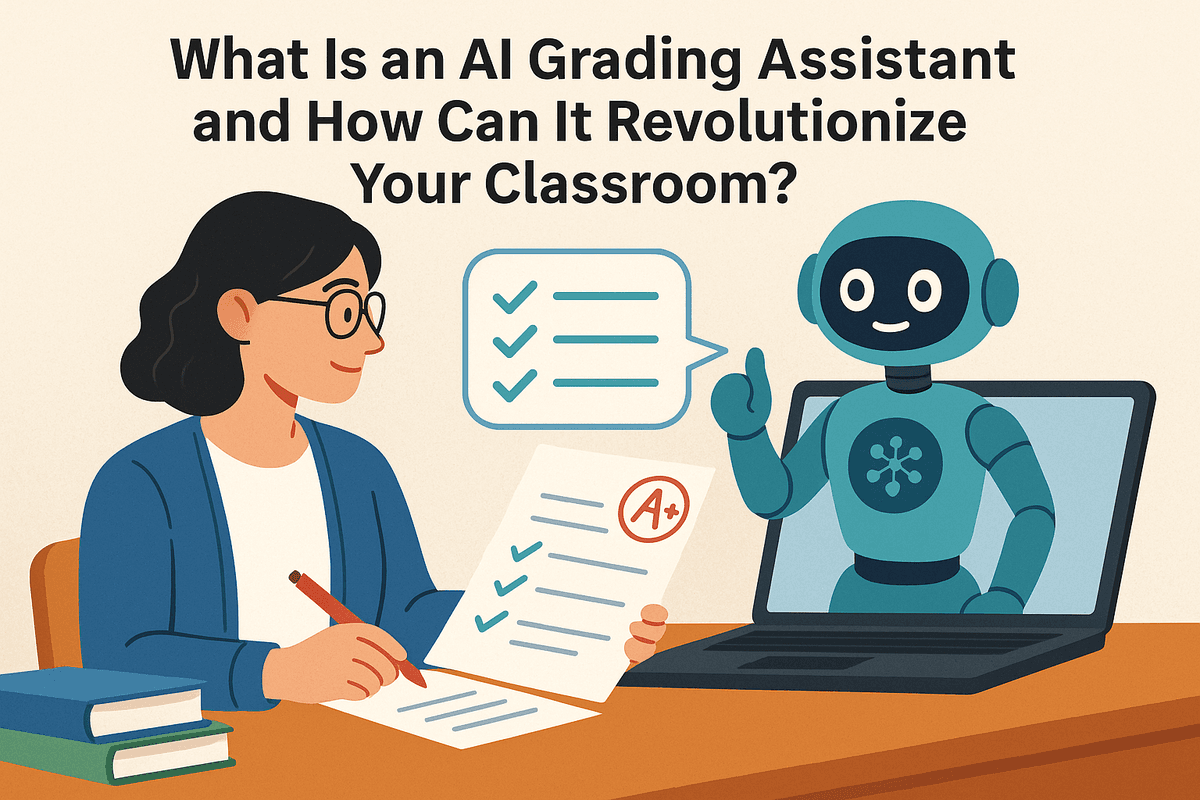
Every educator knows the feeling: the ever-present stack of assignments waiting for review. While grading is essential for tracking student progress, the sheer volume can be overwhelming, consuming countless hours that could be spent on lesson planning, student interaction, and professional development. This is where a powerful new technology steps in to transform the workload and elevate the learning experience: the AI grading assistant.
Moving Beyond Traditional Grading: The Challenge for Modern Educators
Traditional grading is a labor of love, but it’s also a significant source of educator burnout. The process is notoriously time-consuming, repetitive, and, despite our best efforts, prone to subjectivity. Grading fatigue can set in after the tenth essay, potentially leading to inconsistencies in feedback from one student to the next.
Furthermore, the modern classroom demands more than just a red mark and a letter grade. Effective teaching requires providing timely, specific, and actionable feedback that guides students toward improvement. For an educator with dozens or even hundreds of students, delivering this level of personalized feedback on every assignment is a monumental, if not impossible, task. The delay between submission and feedback often means students have already moved on to the next topic, making the comments less impactful.
Defining the AI Grading Assistant: Your New Teaching Partner
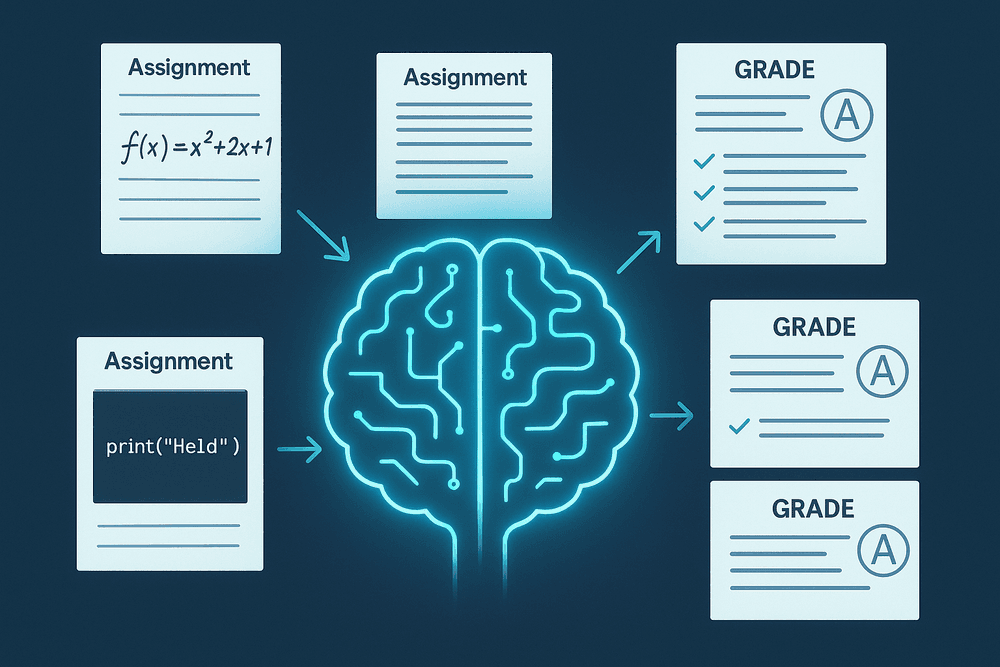
An AI grading assistant is a sophisticated software tool designed to automate the assessment of student work. Using advanced technologies like natural language processing (NLP) and machine learning, it analyzes submissions—from essays and short-answer questions to complex coding projects—and scores them based on a rubric you provide or help it create.
It's crucial to understand that this tool is not a replacement for the educator. Instead, think of it as a highly efficient teaching partner. The instructor remains in complete control, setting the grading criteria and reviewing the AI’s suggestions. The AI grading assistant handles the repetitive, time-intensive aspects of the process, freeing you to focus on the nuances of student work, address higher-order thinking skills, and engage more deeply with your class. It learns your grading style, ensuring its feedback aligns with your pedagogical approach.
How AI Is Changing the Landscape of Educational Assessments
The integration of an AI grading assistant does more than just save time; it fundamentally enhances the entire assessment cycle for both teachers and students.
- Unprecedented Speed and Efficiency: The most immediate benefit is reclaiming your time. An AI grading assistant can evaluate an entire class set of assignments in a fraction of the time it would take manually, turning days of grading into mere minutes.
- Enhanced Objectivity and Consistency: AI applies the established rubric with perfect consistency to every single paper, eliminating unintentional human bias. Every student is assessed against the exact same standards, ensuring a fairer and more equitable grading process.
- Immediate, Actionable Feedback: Students no longer have to wait days or weeks to see how they performed. AI tools can provide instant, granular feedback, highlighting specific areas of strength and suggesting concrete steps for improvement. This creates a powerful learning loop, allowing students to understand their mistakes and apply the feedback while the material is still fresh in their minds.
- Data-Driven Pedagogical Insights: These platforms can analyze class-wide performance data, revealing common trends and misconceptions. This empowers you to identify areas where the entire class may be struggling and adjust your teaching strategy in real-time to address those specific learning gaps.

The Core Benefits of Using an AI Grading Assistant
Integrating an AI grading assistant into your workflow isn't just about adopting new technology; it's about fundamentally transforming your approach to assessment and instruction. The benefits extend far beyond simply getting through a stack of papers faster. By leveraging artificial intelligence, educators can create a more efficient, equitable, and insightful learning environment for every student.
Reclaim Your Time by Automating Repetitive Grading Tasks
Every educator is familiar with the "grading mountain"—the endless pile of assignments, quizzes, and exams that consumes evenings and weekends. An AI grading assistant acts as your personal sherpa, expertly navigating the most repetitive and time-consuming slopes. It can instantly score objective questions like multiple-choice and fill-in-the-blanks, but modern platforms go much further, evaluating short-answer questions, essays, and even code submissions based on your pre-defined rubrics.
This automation frees you from tedious, low-impact work and returns your most valuable asset: time. Imagine reinvesting those hours into designing more engaging lesson plans, providing one-on-one support to struggling students, or pursuing your own professional development. By handling the grunt work, the AI empowers you to focus on the human side of teaching.
Deliver Fair and Consistent Feedback to Every Student
Maintaining perfect grading consistency is a monumental challenge. Whether you’re grading the first paper or the fiftieth, factors like fatigue or the sequence of submissions can subtly influence your judgment. An AI grading assistant eliminates this variable entirely. It applies the exact same criteria and rubric to every single submission, without bias or fatigue.
This unwavering consistency ensures that every student receives fair and impartial feedback based purely on the merit of their work. Students can trust that their grade reflects their understanding, not external factors. For educators managing multiple class sections, the tool guarantees that a "B" in your first period class means the same thing as a "B" in your last, creating a more standardized and trustworthy assessment process.
Gain Deeper Insights into Student Performance with AI Analytics
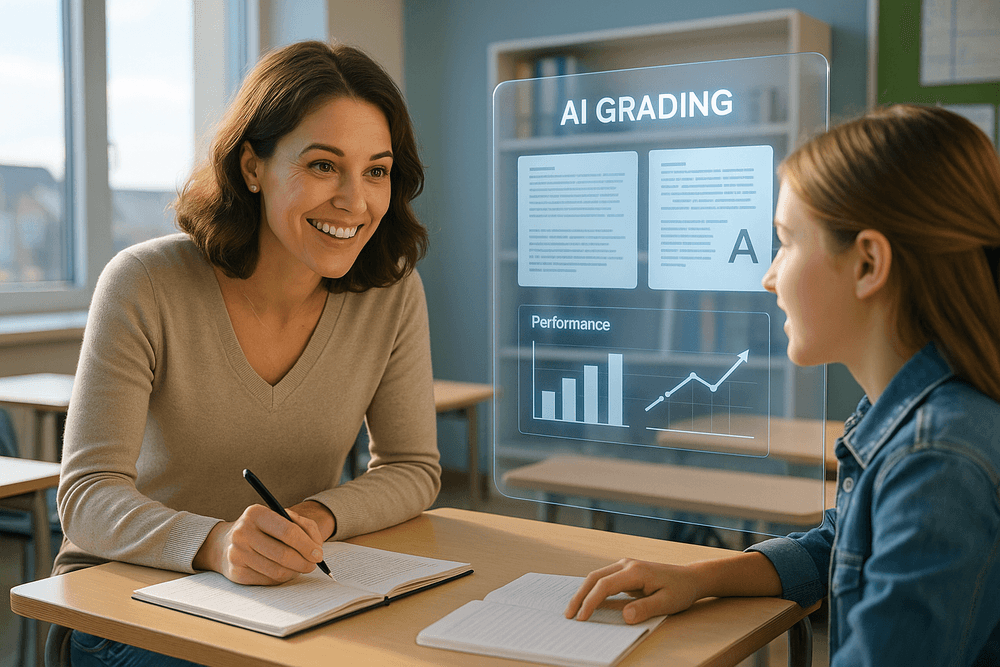
A powerful AI grading assistant does more than just assign a score; it aggregates and analyzes performance data to reveal actionable insights. Instead of just knowing the class average, you can instantly see which questions were most frequently missed, identify common misconceptions across the entire student body, and track individual progress over time.
These analytics transform grading from a summative task into a formative tool. If the data shows that 80% of your students struggled with a specific concept, you know precisely where to focus your next lesson. This data-driven approach allows you to tailor your instruction to address real-time learning gaps, making your teaching more targeted, effective, and responsive to your students' needs.
Reduce Grading Bias for More Equitable Assessments
Unconscious bias is a natural human element that can unintentionally affect the grading process. An AI, however, operates with complete objectivity. It doesn't know a student's name, their past performance, or their classroom participation. It evaluates work based solely on the content and how it aligns with the established rubric.
By anonymizing the assessment process, an AI grading assistant helps create a more equitable classroom. It levels the playing field, ensuring that every student’s work is judged on its own terms. This commitment to objective evaluation not only promotes fairness but also reinforces an academic environment where growth and mastery are the ultimate measures of success.
Choosing the Right AI Grading Assistant: Must-Have Features
The market is flooded with options, but not all AI grading tools are created equal. To find a solution that genuinely enhances your teaching and saves you time, you need to look beyond the hype and focus on core functionality. A truly effective ai grading assistant isn't just a gadget; it's a powerful partner in the educational process. As you evaluate your options, prioritize these four non-negotiable features to ensure you’re investing in a tool that will truly transform your workflow.
Support for Multiple Question Types
Your assessments aren't one-dimensional, so your grading tool shouldn't be either. While basic tools can handle multiple-choice questions (MCQs), a modern ai grading assistant must demonstrate versatility across a wide range of formats. Look for robust support for:
- Essays and Long-Form Answers: This is where AI truly shines. The ability to analyze nuanced arguments, check for coherence, and evaluate critical thinking in long-form writing is a game-changer for humanities, social sciences, and any subject requiring detailed explanations.
- Short-Answer Questions: For assessments that require concise, factual recall or brief analysis, the AI should be able to accurately parse and score responses based on keywords, concepts, and context.
- Multiple-Choice Questions: While simpler to grade, AI can still add value by providing analytics on question performance and common student errors, offering insights that go beyond a simple right/wrong tally.
A tool that masters all these types ensures you can use it consistently across your entire curriculum.
Customizable Rubrics and Grading Criteria
An AI grader should adapt to your pedagogy, not the other way around. The most critical feature for maintaining academic control is the ability to create and import your own detailed rubrics. A one-size-fits-all grading model will never align perfectly with your specific learning objectives. Your ideal ai grading assistant will allow you to define custom criteria, assign different weights to various components (e.g., 40% for analysis, 30% for evidence, 20% for clarity), and provide specific benchmarks for each performance level. This ensures the AI is grading according to your standards, providing feedback that is consistent, transparent, and meaningfully aligned with what you've taught in the classroom.
Plagiarism Detection and Originality Checking
Upholding academic integrity is non-negotiable. An ai grading assistant with a built-in plagiarism and originality checker is a massive efficiency booster. Instead of downloading submissions and uploading them to a separate service like Turnitin, an integrated system flags potential issues directly within your grading interface. This allows you to review originality reports alongside the AI-suggested grade and feedback, creating a seamless workflow for identifying unoriginal content. Advanced tools may even detect AI-generated text, giving you a more complete picture of a submission's authenticity.
Seamless Integration with Your Learning Management System (LMS)
To prevent administrative headaches, your chosen tool must fit perfectly into your existing digital ecosystem. A standalone platform that requires you to manually upload rosters and download grades creates unnecessary work and introduces the risk of error. Look for an ai grading assistant that offers deep, seamless integration with major Learning Management Systems (LMS) like Canvas, Blackboard, Moodle, and Google Classroom. Proper integration means you can sync your class roster, push assignments to students, and have grades and feedback automatically post back to your gradebook with a single click, keeping your workflow centralized and efficient.
Top AI Grading Assistant Tools on the Market Today
With a growing number of options available, selecting the right AI grading assistant can feel overwhelming. The best choice often depends on your specific subject matter, assignment types, and pedagogical goals. Whether you're teaching complex calculus, a writing-intensive history seminar, or a large-scale introductory course, there’s a tool designed to streamline your workflow. Here’s a breakdown of the leading platforms and a look at the free versus paid landscape.
Gradescope: The Standard for STEM and Beyond
Gradescope, a Turnitin company, has become a powerhouse in higher education, particularly in STEM fields, but its flexibility extends far beyond. It is purpose-built to handle a massive variety of assignment types, from paper-based exams and handwritten problem sets to digital homework and code submissions.
Its standout feature is AI-assisted grading. After you’ve graded a few submissions, Gradescope’s AI learns your rubric and automatically groups similar answers together. This allows you to grade one answer from a group and apply the same score and feedback to all identical or near-identical submissions with a single click. This dynamic rubric system ensures consistency across hundreds of assignments, drastically reducing the time spent on repetitive grading while maintaining high-quality, targeted feedback.
Turnitin: Best for Writing-Intensive Courses
While best known as the gold standard for originality checking, Turnitin has evolved into a comprehensive ai grading assistant for writing-intensive disciplines. Its core strength lies in analyzing text-based submissions for both academic integrity and writing quality.
Through its Feedback Studio, instructors can use features like the ETS e-rater® to provide automated grammatical and stylistic feedback, allowing students to see and correct errors before final submission. This shifts the focus of instructor feedback from simple proofreading to higher-order concerns like argumentation and critical analysis. The platform’s integration with Gradescope also means institutions with a Turnitin license often get the best of both worlds: unparalleled writing analysis and versatile STEM grading capabilities.
Kritik: Combining Peer Assessment with AI Assistance
Kritik offers a unique pedagogical approach by blending AI-powered assistance with a structured peer-to-peer assessment model. Instead of the AI grading the work directly, it facilitates and calibrates the peer-review process. Students submit their work, anonymously evaluate a set number of their peers' submissions using a rubric, and then assess the feedback they received.
The AI is the critical component that ensures fairness and quality. It provides each student with a “grading power” score based on how accurately their evaluations align with the instructor’s and their peers'. This gamified system incentivizes thoughtful, constructive feedback. For educators, Kritik is a powerful ai grading assistant that not only automates the evaluation process but also develops students' critical thinking and analytical skills.
Evaluating Free vs. Paid AI Grading Solutions
Free AI Grading Solutions
For educators on a tight budget or those with simpler grading needs, free tools can be a great starting point. Many Learning Management Systems (LMS) like Google Classroom and Canvas have built-in quizzing features with auto-grading for multiple-choice and fill-in-the-blank questions. However, these tools generally lack the sophisticated AI needed to analyze handwritten work, long-form essays, or complex problem sets, and offer limited support.
Paid AI Grading Assistant Platforms
Paid platforms like Gradescope, Turnitin, and Kritik represent a significant investment in your teaching workflow. The return on this investment comes from massive time savings, enhanced feedback consistency, and robust data analytics that can reveal class-wide learning gaps. These tools offer dedicated support, seamless LMS integration, and advanced AI that handles a much wider array of assignment types. The decision often comes down to institutional support, class size, and the complexity of your grading needs. For many, a dedicated paid ai grading assistant is a worthwhile expense for the value it provides to both the educator and the student.
Best Practices for Implementing an AI Grading Assistant
Adopting new technology in the classroom requires a thoughtful approach. An ai grading assistant is a powerful tool, but its success hinges on proper implementation. By following these best practices, you can seamlessly integrate AI into your workflow, build trust with stakeholders, and maximize the benefits for both you and your students.
Setting Clear Expectations with Students and Parents
Transparency is your most important asset when introducing an AI grading assistant. From the outset, communicate clearly with students and parents about what the tool is, how it will be used, and what its limitations are.
- Explain the "Why": Frame the AI as a tool to provide faster, more consistent feedback, allowing you to spend more quality time on personalized instruction and lesson planning.
- Define its Role: Specify which assignments the AI will assist with. For example, it might provide an initial score on essays, grade multiple-choice questions, or check for grammar and spelling on first drafts.
- Create a Policy: Include a brief statement in your syllabus or parent-teacher communications explaining the role of the ai grading assistant and reaffirming that you, the educator, have the final say on all grades. This proactive communication prevents confusion and builds trust.
Keeping a Human in the Loop: Reviewing and Refining AI Grades
The most effective way to use an AI grading tool is to treat it as a co-pilot, not an autopilot. The "assistant" in ai grading assistant is the key word. Your expertise, nuance, and pedagogical judgment are irreplaceable.
Always reserve the right to review, adjust, and override AI-generated scores. Plan for a quick spot-check of the AI's work, especially when first implementing the system. This process serves two crucial purposes: it ensures fairness and accuracy for your students, and it provides valuable feedback to the AI itself. By correcting its assessments, you are actively training the model to better understand your specific grading criteria and expectations, making it more accurate over time. The goal is augmentation, not abdication.
Navigating Ethical Considerations and Data Privacy
When you introduce any digital tool into your classroom, you take on the responsibility of protecting student data. Before committing to an ai grading assistant, do your due diligence.
- Prioritize Privacy Compliance: Ensure the platform complies with relevant data privacy regulations like FERPA, COPPA, and GDPR. Reputable providers will be transparent about their security protocols.
- Ask Critical Questions: Where is student data stored? Who has access to it? Is the data anonymized? How is it used to train the main algorithm? Choose a provider that prioritizes data encryption and institutional control over student information.
- Monitor for Bias: AI models learn from the data they are given. Be vigilant about monitoring for any potential bias in grading and ensure the tool is being applied equitably across all student demographics.
Training Your AI Model for Maximum Accuracy
An out-of-the-box ai grading assistant is a good start, but a customized one is a game-changer. The accuracy of your AI tool is directly proportional to the quality of the training you provide.
- Start with a Strong Rubric: The AI needs a clear, detailed, and objective rubric to learn from. This is the foundation of its grading logic.
- Provide Diverse Examples: Train the AI by feeding it a range of graded examples—not just A+ papers, but also average, below-average, and excellent work. This helps the model understand the full spectrum of performance and the nuances of your scoring.
- Iterate and Refine: The initial setup is just the beginning. Continuously correct and adjust the AI's grades. Each correction you make is a lesson that sharpens its accuracy for future assignments, turning it into a truly personalized and reliable grading partner.
The Future Is Here: Getting Started with Your AI Grading Assistant
The journey into AI-powered education doesn't have to be overwhelming. Embracing technology like an ai grading assistant is a practical, powerful step toward reclaiming your time and refocusing your energy on what truly matters: teaching. This isn't about replacing the essential human element of education; it's about augmenting your capabilities to create a more efficient, equitable, and impactful learning environment for your students.
Key Takeaways for Busy Educators: A Quick Recap
If you're short on time, here are the core benefits of integrating an ai grading assistant into your workflow:
- Massive Time Savings: Drastically reduce the hours spent on repetitive grading tasks. This tool handles the first pass, allowing you to dedicate your expertise to higher-level feedback and student interaction.
- Unparalleled Consistency: Eliminate unintentional bias and ensure every student's work is evaluated against the same criteria, every single time. An ai grading assistant provides objective, standardized feedback that promotes fairness.
- Actionable Student Insights: Move beyond individual grades to see the bigger picture. AI tools can analyze class-wide performance, identify common misconceptions, and highlight areas where students are struggling, enabling you to tailor your instruction more effectively.
- Renewed Focus on Teaching: By automating the administrative burden of grading, you free up invaluable time for lesson planning, developing creative assignments, and providing one-on-one support to the students who need it most.
Your Next Step: How to Choose the Right Tool for Your Classroom
Ready to take the plunge? Selecting the right ai grading assistant is crucial. Here are key factors to consider to ensure you find the perfect fit for your specific needs.
1. Analyze Your Assignment Types
What do you grade most often? Look for a tool specialized for your subject. Some platforms excel at grading long-form essays and written responses, while others are designed for math problems, coding assignments, or science reports. Make a list of your most common assessment types before you start your search.
2. Prioritize LMS Integration
For a seamless workflow, your chosen tool must integrate with your school's Learning Management System (LMS), whether it's Canvas, Blackboard, Moodle, or Google Classroom. This integration saves you from juggling multiple platforms and simplifies the process of syncing grades.
3. Evaluate Feedback Capabilities
A great ai grading assistant does more than just assign a score. Look for features like customizable rubrics, the ability to leave personalized comments, and AI-generated suggestions that are constructive and aligned with your learning objectives. Always request a demo or sign up for a free trial to test the quality of the feedback yourself.
The Evolving Role of AI in Education
Adopting an ai grading assistant is more than just a productivity hack; it's an entry point into the future of education. As AI technology continues to advance, its role in the classroom will expand beyond grading to create truly personalized learning experiences. We are moving toward a future where AI can help generate tailored lesson plans, act as an on-demand tutor for students, and use predictive analytics to identify at-risk learners before they fall behind.
By embracing these tools now, you are not only enhancing your own teaching but also preparing your students for a world where collaborating with artificial intelligence is the norm. You are becoming a pioneer in a pedagogical revolution, one that promises a more supportive, data-informed, and ultimately more human-centered approach to education.