
October 9, 2025
What Is an AI Ethics Framework and Why Is It Crucial for
What Is an AI Ethics Framework and Why Is It Crucial for Your Business?
As artificial intelligence moves from a niche technology to a core business function, the conversation is shifting from “Can we build it?” to “Should we build it, and how do we build it right?” At the heart of this question lies the AI ethics framework—a structured system of principles, guidelines, and processes that ensures your AI systems operate responsibly, fairly, and in alignment with human values.
Think of it as more than a legal checklist. While compliance with regulations like GDPR is essential, a true AI ethics framework goes further. It’s a proactive, operational blueprint for embedding ethics into every stage of the AI lifecycle, from data collection and model training to deployment and ongoing monitoring. It establishes clear accountability and guides your teams in navigating the complex gray areas of AI development, ensuring your technology serves both your business goals and the greater good.
The High Cost of Unethical AI
Ignoring AI ethics isn't just a philosophical misstep; it's a significant business risk with tangible consequences. In recent years, high-profile AI failures have served as cautionary tales. We’ve seen biased hiring algorithms that penalize female candidates, facial recognition systems that misidentify people of color, and opaque credit-scoring models that perpetuate systemic inequalities.
When an AI system goes wrong, the fallout is swift and severe:
- Brand Damage: Public trust, once lost, is incredibly difficult to regain. A single incident of biased or harmful AI can lead to a PR crisis, customer boycotts, and a permanently tarnished reputation.
- Financial Penalties: With regulations like the EU AI Act on the horizon, the financial cost of non-compliance is skyrocketing. Fines can reach millions of dollars, not to mention the potential for costly lawsuits from affected individuals.
- Operational Disruption: Discovering a fundamental ethical flaw after an AI system has been deployed can force you to halt operations, recall products, and invest heavily in redesigning the entire system from the ground up.
How a Strong AI Ethics Framework Drives Innovation and Trust
Implementing a robust AI ethics framework is not about stifling innovation—it’s about enabling it. By setting clear boundaries and goals, you empower your development teams to build better, safer, and more effective products. This commitment becomes a powerful competitive differentiator.
First, it builds unshakable customer trust. In an era of data-privacy concerns, consumers are increasingly drawn to brands they can rely on. Being transparent about your ethical principles and how your AI systems work shows respect for your customers and reassures them that their data and well-being are being protected.
Second, it fosters a culture of responsible innovation. An AI ethics framework encourages developers to ask critical questions about fairness, accountability, and transparency. This leads to more resilient and creative solutions that anticipate and mitigate potential harms. It also helps attract and retain top talent, as skilled professionals are increasingly seeking to work for companies that prioritize ethical impact. Ultimately, a well-designed AI ethics framework transforms a potential liability into a strategic asset, driving sustainable growth built on a foundation of trust.
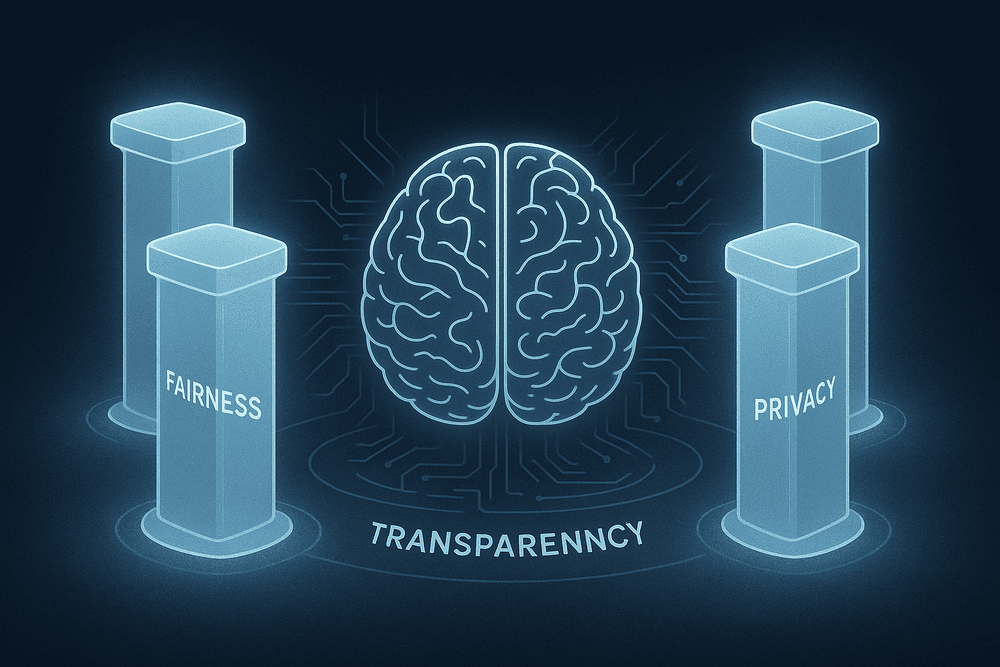
The Core Components of a Robust AI Ethics Framework
Building a responsible AI practice isn't an abstract exercise; it’s about constructing a concrete operational guide. A robust AI ethics framework is founded on four indispensable pillars that work in concert to ensure technology serves humanity equitably and safely. Neglecting any one of these components can expose your organization to significant reputational, legal, and financial risks. Let's break down each essential element.
Accountability: Establishing Clear Ownership for AI Systems
When an AI system makes a critical error, who is responsible? Accountability answers this question by moving beyond blame and establishing clear lines of ownership and governance. It means defining who has the authority to develop, deploy, and decommission AI models.
A strong accountability structure within your AI ethics framework includes:
- Designated Roles: Creating an AI ethics board or review committee comprised of diverse stakeholders from legal, technical, and business departments.
- Impact Assessments: Mandating regular assessments to proactively identify potential harms before a system goes live.
- Redress Mechanisms: Establishing clear channels for users and customers to appeal AI-driven decisions and receive a human review.
Accountability ensures that ethical considerations are embedded throughout the AI lifecycle, from initial concept to final deployment and beyond.
Fairness and Inclusivity: How to Mitigate Algorithmic Bias
Algorithmic bias occurs when an AI system produces systematically prejudiced outcomes, unfairly disadvantaging certain groups. This often stems from biased training data or flawed model assumptions. A commitment to fairness is crucial for building trust and serving a diverse customer base.
To mitigate bias, your framework must include proactive strategies:
- Data Scrutiny: Thoroughly auditing datasets for historical biases and ensuring they are representative of the populations they will affect.
- Fairness Metrics: Implementing technical tools and metrics (e.g., demographic parity, equalized odds) to test for and measure bias in model performance.
- Continuous Monitoring: Treating fairness not as a one-time check but as an ongoing process of monitoring and re-evaluation as the model interacts with real-world data.
Transparency and Explainability: Unpacking the 'Black Box' Problem
Many advanced AI models operate as "black boxes," where even their creators cannot fully articulate why a specific decision was made. This opacity erodes trust and makes it impossible to audit for fairness or errors. Your AI ethics framework must distinguish between and prioritize both transparency and explainability.
- Transparency refers to being open about where and how AI is used, the kind of data it’s trained on, and its known limitations.
- Explainability (XAI) is the technical ability to explain an AI model’s specific outputs. For example, why was a loan application denied? Techniques like LIME and SHAP are emerging to help interpret model behavior, making systems more auditable and trustworthy.
Security and Privacy: Safeguarding Data in AI Models
AI systems are both data-hungry and high-value targets. A breach can expose sensitive personal information, while malicious actors can manipulate model behavior through adversarial attacks. Therefore, security and privacy are foundational to any ethical AI deployment.
Key practices include:
- Data Minimization: Collecting and using only the data that is strictly necessary for the model to function.
- Privacy-Preserving Techniques: Employing methods like differential privacy or federated learning to train models without exposing raw, sensitive user data.
- Robust Cybersecurity: Implementing stringent security protocols to protect both the data and the AI model itself from unauthorized access and tampering.
How to Build a Custom AI Ethics Framework From Scratch
Off-the-shelf templates can offer a starting point, but a truly effective ai ethics framework is tailored to your organization's unique culture, industry, and risk profile. Building a custom framework ensures it becomes an integrated part of your operational DNA, not just a document on a shelf. This practical, four-step process will guide you in creating a framework that is both robust and actionable.
Step 1: Assemble a Cross-Functional AI Governance Committee
AI ethics is not solely an IT, legal, or data science problem—it's a business-wide strategic imperative. The first step in building a meaningful ai ethics framework is to establish a dedicated, cross-functional governance committee. This group will champion the initiative, oversee its development, and ensure its ongoing enforcement.
Your committee should include representatives from key departments to provide a 360-degree perspective:
- Legal and Compliance: To navigate regulatory landscapes and assess liability.
- Data Science and Engineering: To provide technical feasibility and implementation insights.
- Product Management: To align ethical principles with user experience and business goals.
- Business Leadership: To ensure executive buy-in and resource allocation.
- Human Resources: To address impacts on hiring, training, and workplace culture.
- Marketing and Communications: To manage public perception and transparently communicate your policies.
This committee is the living heart of your framework, responsible for its creation, evolution, and integration into the company’s core processes.
Step 2: Define Your Guiding Principles and Risk Tolerance
With your committee in place, the next step is to define the core values that will guide your AI development and deployment. These principles translate your company's mission into concrete, AI-specific commitments. Start by asking: "What does 'responsibility' or 'customer-first' mean in the context of an algorithm?"
Common principles include:
- Fairness and Equity: Actively identifying and mitigating harmful bias in data and models.
- Transparency and Explainability: Ensuring AI decisions can be understood and explained to relevant stakeholders.
- Accountability: Defining clear ownership for AI system outcomes and having processes for redress.
- Privacy and Security: Protecting user data and building secure, resilient systems.
- Human-in-the-Loop: Ensuring meaningful human oversight for high-stakes decisions.
Alongside these principles, you must define your organization's risk tolerance. An AI model recommending movies carries a different risk level than one used for medical diagnoses or loan applications. Categorize potential AI use cases by risk level (e.g., low, medium, high) to determine the required level of scrutiny and oversight for each.
Step 3: Implement AI Impact Assessments and Auditing Protocols
Principles are meaningless without processes to enforce them. To make your ai ethics framework operational, you must integrate assessments and audits directly into the AI lifecycle.
- AI Impact Assessments (AIIA): Before a project begins, teams should complete an AIIA. This structured review forces them to proactively consider potential ethical risks. The assessment should evaluate the data sources for bias, the model’s potential impact on different user groups, the worst-case failure scenarios, and the plan for mitigating identified risks.
- Regular Auditing Protocols: AI systems are not static; their performance can drift over time as new data is introduced. Establish a cadence for regular audits to monitor models in production. These audits should check for performance degradation, the emergence of bias, and ongoing compliance with your guiding principles.
Step 4: Create a Living Document for Continuous Improvement
The field of AI, along with its associated regulations and societal expectations, is evolving at a breakneck pace. Therefore, your ai ethics framework cannot be a one-and-done project. Treat it as a living document that is designed to adapt.
Establish clear mechanisms for continuous improvement:
- Feedback Loops: Create channels for employees, users, and external stakeholders to report concerns or incidents related to your AI systems.
- Incident Response Plan: Define a clear process for investigating ethical incidents, learning from them, and implementing corrective actions.
- Scheduled Reviews: Mandate that the AI Governance Committee formally reviews and updates the framework on a regular basis (e.g., annually or semi-annually) to incorporate new learnings, technologies, and legal requirements.

Real-World Examples of an AI Ethics Framework in Action
Theory can only take you so far. To truly understand the power and complexity of an AI ethics framework, we need to see how they function in the real world. Tech giants, operating at a massive scale, have been pioneers in this space, offering valuable blueprints for organizations of all sizes. By examining their approaches, we can distill practical lessons for building a responsible AI practice.
Google's AI Principles: Balancing Boldness and Responsibility
Google's approach is a high-profile example of a principles-based AI ethics framework. Published in 2018, their seven core principles guide their product development and research. These objectives focus on creating socially beneficial AI, avoiding unfair bias, ensuring safety and accountability, and upholding privacy.
What makes Google’s framework particularly instructive is what it explicitly forbids. Alongside their positive goals, they list four "red lines"—AI applications they will not pursue. These include technologies that cause overall harm, weapons, surveillance that violates international norms, and technologies that contravene principles of international law and human rights. This dual approach of defining both what to strive for and what to avoid creates clear guardrails for their developers. The framework is put into practice through a rigorous internal review process, involving diverse teams of ethicists, engineers, and policy experts who vet projects against these principles, ensuring that innovation doesn't come at the cost of responsibility.
Microsoft's Responsible AI Standard: A Model for Governance
Where Google focuses on high-level principles, Microsoft provides a masterclass in operationalizing AI ethics through governance. Their Responsible AI Standard is an internal set of rules that translates their six foundational principles—Fairness, Reliability & Safety, Privacy & Security, Inclusiveness, Transparency, and Accountability—into concrete engineering requirements.
This isn't just a document; it's a system woven into their development lifecycle. Teams are required to conduct AI impact assessments, document potential harms, and implement tools to measure and mitigate issues like bias. Microsoft supports this with a robust ecosystem, including:
- The AETHER Committee: An internal advisory board that counsels leadership on challenging AI issues.
- Specialized Toolkits: Open-source tools like InterpretML (for model transparency) and Fairlearn (for assessing and improving fairness) empower developers to build responsibly from the ground up.
Microsoft's model demonstrates that a successful AI ethics framework must be more than a poster on the wall; it requires dedicated roles, processes, and tools to make it a daily reality for engineering teams.
Lessons Learned from Successful Corporate AI Ethics Frameworks
Analyzing these leading examples reveals several universal truths for any organization looking to implement its own framework:
- Operationalization is Everything: Principles are the starting point, but they are ineffective without the mechanisms to enforce them. This includes mandatory reviews, impact assessments, dedicated teams, and developer training.
- Governance Provides Structure: Establishing clear lines of accountability, such as an AI ethics board or review committee, is crucial for handling complex edge cases and ensuring consistency.
- Public Commitment Drives Accountability: By publishing their principles, both Google and Microsoft create external accountability. This transparency builds trust with users and the public, holding the company to a higher standard.
- A Framework is a Living Document: The field of AI is constantly evolving, and so must the ethical guidelines that govern it. An effective AI ethics framework is not a one-time project but a commitment to continuous learning, iteration, and adaptation.
Common Challenges and Pitfalls in AI Ethics Implementation
Crafting a robust AI ethics framework is a critical first step, but the journey from paper to practice is filled with potential obstacles. Merely publishing a set of principles is not enough; true implementation requires navigating complex technical and organizational challenges. Overcoming these hurdles is what separates a symbolic gesture from a genuinely responsible AI program.
Closing the Gap Between High-Level Principles and Daily Practice
One of the most significant challenges is the "ethics evaporation" effect, where noble, high-level principles like "fairness," "accountability," and "transparency" lose their meaning when they reach the development teams on the ground. A data scientist building a predictive model needs more than a mandate to "be fair"; they need to know which fairness metrics to optimize for, what trade-offs are acceptable, and how to test for bias in their specific dataset.
The pitfall here is creating an AI ethics framework that is too abstract. To bridge this gap, your framework must be operationalized.
- Actionable Guidance: Translate principles into concrete checklists, technical standards, and design patterns.
- Role-Specific Training: Educate engineers, product managers, and legal teams on what ethical principles mean for their specific roles and daily tasks.
- Integrated Tooling: Embed ethical checks and balances directly into the MLOps lifecycle, making it easier to do the right thing.
Navigating Gray Areas: When Ethical Principles Conflict
What happens when adhering to one ethical principle compromises another? This is not a hypothetical question but a common reality in AI implementation. For instance:
- Accuracy vs. Fairness: A model optimized for maximum predictive accuracy might inadvertently perpetuate historical biases, making it less fair to certain demographic groups.
- Transparency vs. Security: Making a model completely transparent and explainable could expose proprietary algorithms or create vulnerabilities that malicious actors could exploit.
- Privacy vs. Utility: Using more comprehensive data can improve a model’s performance and utility, but it may come at the cost of individual user privacy.
A rigid AI ethics framework that fails to account for these trade-offs will be ineffective. The key is not to find a perfect answer but to have a defensible process for making a difficult choice. This often involves establishing a cross-functional AI ethics committee or review board that can deliberate on these conflicts, document the decision-making rationale, and assume responsibility for the outcome.
How to Ensure Your Framework Adapts to New AI Technologies
The AI landscape is in a constant state of flux. A framework designed for supervised learning models may be wholly inadequate for the challenges posed by large language models (LLMs) or autonomous systems. A static, "set-it-and-forget-it" approach to your AI ethics framework is a recipe for obsolescence and risk.
To remain relevant, your framework must be a living document. Build in mechanisms for evolution:
- Scheduled Reviews: Institute a formal process to review and update the framework on a regular basis (e.g., annually or biannually).
- Feedback Loops: Create channels for development teams to report new ethical challenges they encounter, feeding real-world learnings back into the framework.
- Continuous Learning: Stay informed about emerging AI technologies, new research in AI ethics, and evolving regulatory landscapes to proactively adapt your policies and guidelines.

Conclusion: Embedding Your AI Ethics Framework for a Responsible Future
The journey toward responsible AI is not about reaching a final destination; it’s about a continuous commitment to ethical innovation. An AI ethics framework is more than a corporate policy document—it is the operational compass that guides your organization through the complex, evolving landscape of artificial intelligence. It transforms abstract principles into concrete actions, ensuring that your technological advancements align with your core values and build lasting trust with customers, employees, and society. By moving from theory to practice, you’re not just mitigating risk; you’re seizing the opportunity to lead with integrity and shape a future where AI serves humanity’s best interests.
Your Quick-Start Checklist for Building an AI Ethics Framework
Getting started can feel daunting, but breaking the process into manageable steps makes it achievable. Use this checklist to begin building a robust and effective AI ethics framework for your organization.
- Assemble a Diverse Team: Bring together stakeholders from legal, technical, product, and business departments to ensure a holistic perspective.
- Define Your Core Principles: Identify and articulate the non-negotiable ethical values that will govern your AI development, such as fairness, transparency, accountability, and privacy.
- Conduct a Risk Assessment: Analyze your current and future AI systems to identify potential ethical, legal, and reputational risks.
- Draft the Framework Document: Create a clear, accessible document that outlines your principles, governance structures, and operational guidelines.
- Establish Governance and Accountability: Assign clear roles and responsibilities for overseeing the framework’s implementation and enforcement. Who is the final decision-maker?
- Plan for Training and Communication: Develop a strategy to educate all relevant employees on the framework and integrate its principles into their daily workflows.
- Implement a Feedback Loop: Create a mechanism for ongoing monitoring, reporting, and updating your framework as technology and regulations evolve.
Tools and Resources for Ongoing AI Governance
You don't have to navigate this path alone. A growing ecosystem of tools and resources can help you implement, monitor, and refine your AI ethics framework.
- Algorithmic Auditing & Bias Detection Tools: Platforms like IBM's AI Fairness 360 and Google's What-If Tool help data scientists and developers inspect models for hidden biases and improve fairness in outcomes.
- Regulatory and Governmental Guidance: Stay informed with resources like the NIST AI Risk Management Framework in the U.S. or the EU’s AI Act. These provide standards and best practices for trustworthy AI.
- Industry Consortiums: Organizations like the Partnership on AI offer a wealth of research, case studies, and best practices developed in collaboration with leading academic and corporate institutions.
- Explainable AI (XAI) Libraries: Open-source libraries such as LIME and SHAP provide developers with tools to build more transparent models, making it easier to understand and explain how an AI system arrived at a specific decision.
Take the First Step Toward Responsible AI Adoption Today
Building the perfect AI ethics framework from day one is an unrealistic goal. The most critical step is the first one. Begin by sparking the conversation within your leadership team. Use the checklist above to draft an initial plan. By proactively establishing ethical guardrails, you are doing more than managing compliance—you are building a foundation of trust that will become your most significant competitive advantage. Embrace this opportunity to lead, innovate responsibly, and build an organization that is ready for the future of AI.