
September 7, 2025
What is an AI Ethics Framework & Why is it Crucial for Your
What is an AI Ethics Framework & Why is it Crucial for Your Business?
As artificial intelligence moves from the theoretical to the core of daily operations, the question is no longer if you should use AI, but how. This is where a robust AI ethics framework becomes an indispensable business asset. It’s not a dusty policy document left on a shelf; it's a living, operational system designed to guide your organization’s development, deployment, and governance of AI technologies.
Think of it as your company's constitution for artificial intelligence. This framework establishes a clear set of principles, guidelines, and processes rooted in values like fairness, accountability, transparency, and privacy. It provides a structured approach for your teams to proactively identify, assess, and mitigate ethical risks before they escalate into crises. A comprehensive AI ethics framework empowers your developers and decision-makers to navigate complex moral dilemmas, ensuring that your AI systems are not only powerful but also principled.
Beyond Compliance: The Competitive Advantage of Responsible AI
Initially, many businesses view ethical guidelines as a matter of compliance—a necessary hurdle to clear to avoid fines and legal trouble. But this perspective misses the bigger picture. Implementing a strong AI ethics framework is a strategic move that delivers a significant competitive advantage.
- Builds Unbreakable Customer Trust: In an era of data breaches and algorithmic bias, trust is your most valuable currency. When customers know you are committed to responsible AI—that your systems are designed to be fair, transparent, and secure—they are more likely to choose your products, share their data, and become loyal brand advocates.
- Attracts and Retains Top Talent: The brightest minds in AI want to work for companies that align with their values. They are driven to build technology that makes a positive impact, not systems that perpetuate harm. A public commitment to ethical AI makes your organization a magnet for top-tier talent.
- Drives Superior Innovation: Ethical constraints are not limitations; they are catalysts for creativity. An AI ethics framework forces your teams to think more deeply about potential impacts, leading to more robust, resilient, and inclusive products that serve a wider market and uncover new opportunities.
The Real-World Costs of Ignoring AI Ethics
Failing to prioritize AI ethics is a high-stakes gamble with tangible consequences. The "move fast and break things" approach simply doesn't work when the things being broken are people’s livelihoods, opportunities, and trust. The costs of inaction are steep and multifaceted:
- Reputational Catastrophe: A single instance of a biased hiring algorithm, a discriminatory loan application model, or an invasive surveillance tool can create a public relations nightmare, erasing years of brand-building in an instant.
- Regulatory & Legal Penalties: Governments worldwide are enacting stricter regulations around AI, like the EU's AI Act. Non-compliance can result in crippling fines, legal battles, and forced suspension of operations.
- Financial & Operational Losses: Biased or flawed AI systems lead to poor decision-making, alienated customer segments, and costly product recalls. The financial fallout extends far beyond initial fines to include lost revenue and remediation expenses.
Ultimately, neglecting AI ethics isn't just a moral failure; it's a critical business failure. An AI ethics framework is your proactive investment in resilience, reputation, and long-term relevance in the age of intelligence.
The Pillars of a Strong AI Ethics Framework
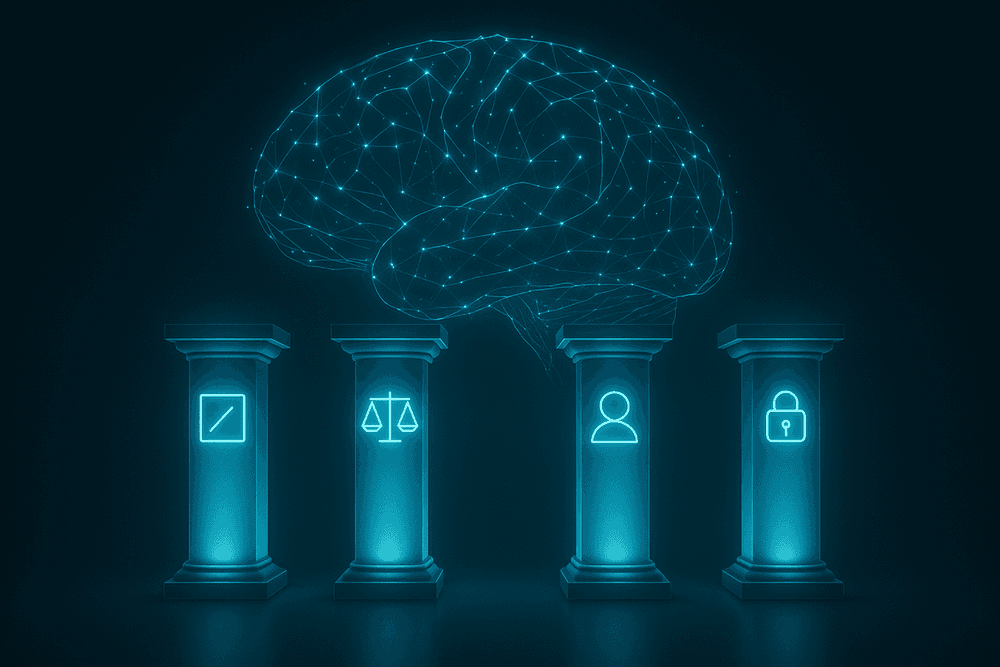
Building artificial intelligence that is truly beneficial to society requires more than just powerful algorithms and massive datasets. It demands a deliberate and structured approach to ethics. A robust ai ethics framework isn't a vague mission statement; it's a practical blueprint for responsible innovation built upon four essential pillars. These principles work in concert to guide development, deployment, and ongoing management, ensuring that technology serves humanity without causing unintentional harm. Let's explore the foundational columns that support any successful ethical AI initiative.
Principle 1: Transparency and Explainability (XAI)
At its core, this principle tackles the "black box" problem. If you can't understand why an AI system reached a particular conclusion, how can you trust it? Transparency means having clear insight into the data, algorithms, and models used in an AI system. Explainability goes a step further, focusing on the ability to describe an AI’s decision-making process in human-understandable terms. This is where Explainable AI (XAI) techniques become critical. They provide tools to interpret model behavior, debug errors, and verify that the system is operating as intended. For an ai ethics framework to be effective, stakeholders—from developers to end-users—must be able to scrutinize and comprehend the system's logic, building the trust necessary for widespread adoption.
Principle 2: Fairness and Bias Mitigation
AI models learn from data, and if that data reflects historical or societal biases, the AI will learn and often amplify those same prejudices. The principle of fairness is dedicated to proactively identifying and mitigating this algorithmic bias. It involves ensuring that an AI system does not produce systematically unfair outcomes or discriminate against specific individuals or groups, particularly protected populations. Implementing this pillar involves rigorous data analysis to uncover hidden biases, using diverse and representative datasets for training, and deploying fairness-aware algorithms. A commitment to fairness means continuously auditing systems to ensure they promote equity rather than perpetuate injustice.
Principle 3: Accountability and Governance
An AI system doesn't operate in a vacuum. The principle of accountability establishes clear lines of responsibility for its impact. Who is accountable when an AI makes a critical error? A comprehensive ai ethics framework defines roles, responsibilities, and oversight mechanisms throughout the AI lifecycle. This includes establishing internal review boards, creating impact assessment protocols, and ensuring meaningful human oversight is in place for high-stakes applications. Strong governance ensures that ethical principles are not just suggestions but are embedded into organizational processes, with clear procedures for redress and remediation when systems fail to meet established standards.
Principle 4: Security and Data Privacy
AI systems are often fueled by vast quantities of data, much of which can be sensitive. This final pillar addresses the dual responsibility of protecting that data from breaches and securing the AI model itself from malicious attacks. Data privacy involves adhering to regulations like GDPR and employing privacy-preserving techniques such as data anonymization and federated learning. Security extends to protecting the integrity of the model from threats like data poisoning (corrupting training data) or adversarial attacks (tricking the model into making incorrect predictions). A secure and private system is fundamental to maintaining user trust and ensuring the reliable, safe operation of AI technology.
How to Build and Implement Your AI Ethics Framework
Creating an effective AI ethics framework isn’t just a theoretical exercise; it’s a practical, strategic initiative that requires careful planning and company-wide commitment. Moving from abstract principles to concrete action is the key to responsible innovation. This four-step process provides a clear roadmap for building and operationalizing a framework that guides your AI development from start to finish.
Step 1: Assemble a Cross-Functional AI Ethics Committee
Ethical AI is a shared responsibility, not just a task for the tech team. The first step in building a robust AI ethics framework is to establish a dedicated, cross-functional committee or board. This group will serve as the central governance body for all things related to AI ethics.
Your committee should include diverse perspectives from across the organization:
- Technical Experts: Data scientists, AI/ML engineers, and cybersecurity specialists who understand the system's inner workings.
- Business Leaders: Product managers and executives who can align ethical goals with business objectives.
- Legal and Compliance: Lawyers and compliance officers to navigate regulatory landscapes and mitigate risk.
- Ethics and Social Impact: An ethicist, social scientist, or user advocate to champion human-centric values and consider societal impact.
- Domain Experts: Individuals who deeply understand the specific industry or area where the AI will be deployed.
This team’s mandate is to oversee the development, implementation, and continuous improvement of your AI ethics framework.
Step 2: Conduct an AI Risk and Impact Assessment
Before you can define your principles, you must understand your risks. An AI Risk and Impact Assessment is a proactive process to identify, analyze, and mitigate potential negative consequences of your AI systems. This isn’t a one-time audit but an ongoing practice integrated into your project lifecycle.
During the assessment, your team should investigate key areas:
- Data Bias: Is your training data representative? Could it perpetuate or amplify existing societal biases?
- Privacy Concerns: How is user data collected, stored, and used? Is it secure and anonymized where necessary?
- Fairness and Equity: Could the AI’s decisions disproportionately harm certain demographic groups?
- Accountability: Who is responsible if the AI system makes a mistake or causes harm? How can decisions be explained and challenged?
- Societal Impact: What are the broader, long-term effects of this AI on employment, social structures, or the environment?
The findings from this assessment will directly inform the principles you develop in the next step.
Step 3: Draft and Formalize Your Ethical Principles
With a clear understanding of your risks, your committee can now draft the core principles of your AI ethics framework. These principles should be more than just vague aspirations; they must be clear, actionable, and directly tied to your organization's values.
Common principles often include:
- Fairness: Actively work to mitigate bias and ensure equitable outcomes for all users.
- Transparency & Explainability: Strive to make AI systems and their decisions understandable to users and stakeholders.
- Human-in-the-Loop: Ensure meaningful human oversight and intervention, especially for high-stakes decisions.
- Privacy & Security: Commit to robust data protection and secure system design.
- Accountability & Governance: Establish clear lines of responsibility for AI systems and their impacts.
Once drafted, these principles must be formally adopted and championed by senior leadership. This document becomes the definitive guide for every team member involved in AI development.
Step 4: Integrate the Framework into the AI Development Lifecycle
A framework is only effective if it's put into practice. The final and most critical step is to embed your ethical principles into every stage of the AI development lifecycle. This operationalizes your commitment to responsible AI.
Integration can take many forms:
- Ideation: Require an initial ethics and risk screening for all new AI project proposals.
- Data Sourcing: Implement checklists to ensure data is ethically sourced, representative, and privacy-preserving.
- Model Development: Use tools and techniques to detect and mitigate bias during training and testing.
- Deployment: Establish "ethical go/no-go" decision gates before a model goes live.
- Monitoring: Continuously monitor live AI systems for performance drift, unintended consequences, and ethical compliance.
By weaving these practices into your daily workflows, your AI ethics framework transforms from a static document into a dynamic, living part of your organization's culture.

AI Ethics Frameworks in Action: Real-World Case Studies
Theoretical principles are crucial, but an ai ethics framework only proves its value when applied to complex, real-world challenges. By examining how organizations across different sectors navigate ethical dilemmas, we can uncover practical strategies and learn from both successes and failures. These case studies highlight how a structured approach to AI ethics moves from an abstract concept to a tangible business imperative.
Case Study: How Salesforce Built Its Trusted AI Framework
As a leader in CRM and enterprise software, Salesforce integrated AI into its products early on. Recognizing the potential risks, the company proactively developed its "Trusted AI" principles, a foundational component of its ai ethics framework. This framework is built on five core tenets: Responsibility, Accountability, Transparency, Empowerment, and Inclusivity.
Salesforce operationalizes these principles through its Office of Ethical and Humane Use. This team doesn't just create policies; it builds tools and processes for developers. For example, they utilize "Model Cards"—short documents providing information about a model's performance, intended use, and fairness considerations—to enhance transparency. They also conduct consequence scanning workshops to help product teams proactively identify potential harms. This case demonstrates how an effective ai ethics framework requires dedicated resources, practical tools, and a culture that embeds ethical thinking directly into the product development lifecycle.
Lessons from Healthcare: Ensuring Equity in Diagnostic AI
The stakes for ethical AI are arguably highest in healthcare, where an algorithm's decision can have life-or-death consequences. A significant challenge has been ensuring equity in diagnostic AI tools, which have shown a tendency to perform less accurately for underrepresented demographic groups. For instance, an AI model trained to detect skin cancer primarily on images of light-skinned individuals may fail to identify malignant lesions on darker skin, leading to dangerous health disparities.
An ai ethics framework in this context is non-negotiable. It mandates that training data be intentionally and rigorously diversified to reflect the patient population. It also requires continuous performance monitoring to check for accuracy gaps across different racial, ethnic, and gender groups post-deployment. Furthermore, it emphasizes the "human-in-the-loop" model, where AI provides support to clinicians rather than replacing their judgment. This ensures a layer of expert oversight, accountability, and a mechanism to catch algorithmic errors before they cause patient harm.
Avoiding Pitfalls: Bias in AI-Powered Recruiting Tools
The promise of using AI to streamline hiring is immense, but so is the potential for bias. Many early AI recruiting tools were trained on historical hiring data from specific companies. If that data reflected past discriminatory practices (e.g., favoring male candidates for technical roles), the AI would learn and amplify those very biases, systematically filtering out qualified candidates from underrepresented groups.
This is a classic example of where a robust ai ethics framework provides critical guardrails. Such a framework insists on regular, independent audits of recruiting algorithms to test for adverse impact against protected groups. It requires transparency in how the AI scores and ranks candidates, allowing for both internal review and candidate recourse. Companies now focus on using AI to identify skills and qualifications from résumés in a more objective way, rather than trying to predict "job success" based on flawed historical proxies. This shift—from predictive automation to augmented intelligence—is a direct result of applying ethical principles to avoid perpetuating societal inequities.
Overcoming Common Challenges in AI Ethics Implementation
Implementing an ethical AI strategy is more than drafting a set of principles; it's an ongoing commitment that involves navigating complex, real-world obstacles. While the journey is essential for building trust and ensuring responsible innovation, it’s rarely straightforward. Successfully operationalizing your AI ethics framework means proactively addressing three core challenges: the shifting regulatory environment, the inherent opacity of complex models, and the need for constant vigilance after deployment.
Navigating the Evolving Global Regulatory Landscape
The world of AI regulation is a dynamic and fragmented tapestry. Jurisdictions from the European Union (with its landmark AI Act) to the United States (with the NIST AI Risk Management Framework) are establishing rules that can significantly impact how AI is developed and deployed. Keeping up with these ever-changing, sometimes conflicting, global standards is a major hurdle.
How to Overcome It: Your AI ethics framework must be designed for agility. Instead of hard-coding rules for a single regulation, build it upon universally accepted principles like fairness, accountability, and transparency. These core tenets are the foundation of most emerging laws. Establish a dedicated cross-functional team, potentially led by an AI Ethics Officer, responsible for monitoring the global regulatory landscape. This team can translate new legal requirements into actionable updates for your framework, ensuring your organization remains compliant and ahead of the curve without needing to reinvent its ethical core for every new law.
Addressing the 'Black Box' Problem in Complex Models
Many of the most powerful AI models, particularly in deep learning, operate as "black boxes." Their internal decision-making processes are so complex that even their developers cannot fully explain why a specific input resulted in a particular output. This opacity poses a significant ethical risk. How can you hold a system accountable if you don’t understand its reasoning? How can you identify and correct a biased decision if you can’t trace its origin?
How to Overcome It: Embed the principle of explainability directly into your AI ethics framework. This involves:
- Adopting Explainable AI (XAI) Tools: Implement techniques like SHAP (SHapley Additive exPlanations) or LIME (Local Interpretable Model-agnostic Explanations) that provide insights into a model's predictions.
- Prioritizing Interpretability: For high-stakes applications like medical diagnostics or credit scoring, your framework should guide teams to favor simpler, more interpretable models over slightly more accurate but opaque ones. The ethical trade-off must be a conscious, documented decision.
- Mandating Documentation: Even if the model is a black box, the process around it shouldn't be. Document the data used, the assumptions made, and the performance metrics tracked to create a clear audit trail.
Ensuring Continuous Monitoring and Model Adaptation
Launching an AI model is the beginning, not the end. The world is not static; data patterns change, societal biases evolve, and user behavior shifts. A model that was fair and accurate at launch can experience "model drift," becoming biased or unreliable over time. Without continuous oversight, even the most ethically designed AI can cause unintended harm.
How to Overcome It: An effective AI ethics framework must treat ethics as a continuous operational practice, not a one-time pre-launch checklist. Integrate ethical monitoring into your MLOps (Machine Learning Operations) pipeline. This means setting up automated systems to track key metrics for fairness, bias, and performance degradation in real-time. Establish clear thresholds and alert mechanisms. When a model's performance drifts past an acceptable ethical or operational boundary, your framework should trigger a pre-defined protocol for review, retraining, or, if necessary, decommissioning the system. This proactive approach ensures your AI systems remain aligned with your ethical commitments long after they go live.
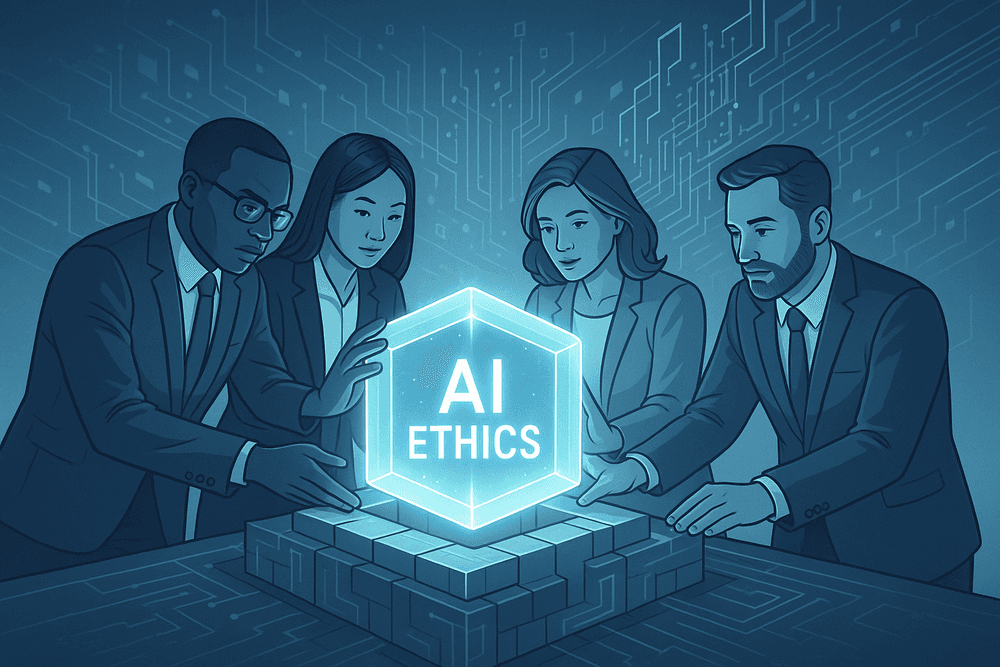
Conclusion: Future-Proofing Your Organization with an AI Ethics Framework
The journey into artificial intelligence is not just a technological race; it's a quest for responsible innovation. As we've explored, moving from abstract principles to concrete action is what separates leaders from laggards in the AI era. Implementing a robust AI ethics framework is no longer a "nice-to-have"—it is the foundational cornerstone of sustainable growth, customer trust, and long-term market relevance. This framework acts as your organization's constitution for AI, guiding every model, application, and decision toward outcomes that are fair, transparent, and aligned with human values. By embedding ethics into your development lifecycle, you don't just mitigate risk; you build a powerful competitive advantage.
Key Takeaways for Building a Culture of Responsible AI
An effective AI ethics framework is a living entity, nurtured by a proactive and engaged organizational culture. As you move forward, keep these core principles at the forefront of your strategy:
- Ethics is a Continuous Process: Responsible AI is not a one-time checklist. It requires ongoing monitoring, iterative improvement, and a commitment to adapting your framework as technology and societal expectations evolve.
- Culture Over Compliance: A document alone cannot create change. True success comes from embedding ethical considerations into the daily workflows, conversations, and performance metrics of your teams. It must become part of your company's DNA.
- Diversity is a Prerequisite for Fairness: Homogeneous teams are more likely to build biased systems. Actively cultivate diverse, cross-functional teams that include ethicists, social scientists, and legal experts alongside engineers to challenge assumptions and uncover blind spots.
- Transparency Builds Trust: Be prepared to explain how your AI systems work and the decisions they make. This commitment to transparency is crucial for earning and maintaining the trust of your customers, regulators, and the public.
Tools and Resources for Ongoing Learning
The field of AI ethics is dynamic. Staying informed is essential for keeping your framework relevant and effective. Here are several types of resources to integrate into your continuous learning strategy:
- Government & Academic Centers: Follow publications and guidelines from institutions like the NIST AI Risk Management Framework, Stanford's Institute for Human-Centered AI (HAI), and the AI Now Institute.
- Industry Consortiums: Participate in or learn from organizations like the Partnership on AI, which brings together industry leaders and non-profits to establish best practices.
- Open-Source Auditing Tools: Explore and utilize technical toolkits designed to detect and mitigate bias in machine learning models, such as IBM's AI Fairness 360 and Google's What-If Tool.
- Professional Courses and Certifications: Invest in training for your teams on topics like ethical AI design, governance, and responsible machine learning.
Take the Next Step in Your Ethical AI Journey
Knowledge is the first step, but action is what creates impact. Don't let the scale of the task lead to paralysis. Your journey to implementing a comprehensive AI ethics framework can begin today with three simple actions:
- Start the Conversation: Share this guide with key stakeholders in your organization—from the C-suite to product and engineering teams. Schedule a meeting to discuss why ethical AI is a strategic priority.
- Assemble a Cross-Functional Task Force: Create a dedicated team with representatives from legal, compliance, data science, engineering, and product management to champion the initiative.
- Draft Your V1.0 Framework: Begin outlining the core principles, governance structures, and review processes that align with your organization’s unique values and industry.
By taking these deliberate steps, you are not just writing a policy; you are future-proofing your organization, building deeper trust with your customers, and paving the way for innovation that benefits everyone.