
August 24, 2025
What is an AI Ethics Framework and Why is it Crucial?
What is an AI Ethics Framework and Why is it Crucial?
Imagine building a powerful engine without a steering wheel, brakes, or a dashboard. The raw power is there, but it's uncontrollable, unpredictable, and ultimately, dangerous. In the world of artificial intelligence, developing systems without ethical guardrails is just as risky. This is where an AI ethics framework comes in—it’s the essential control system for responsible innovation.
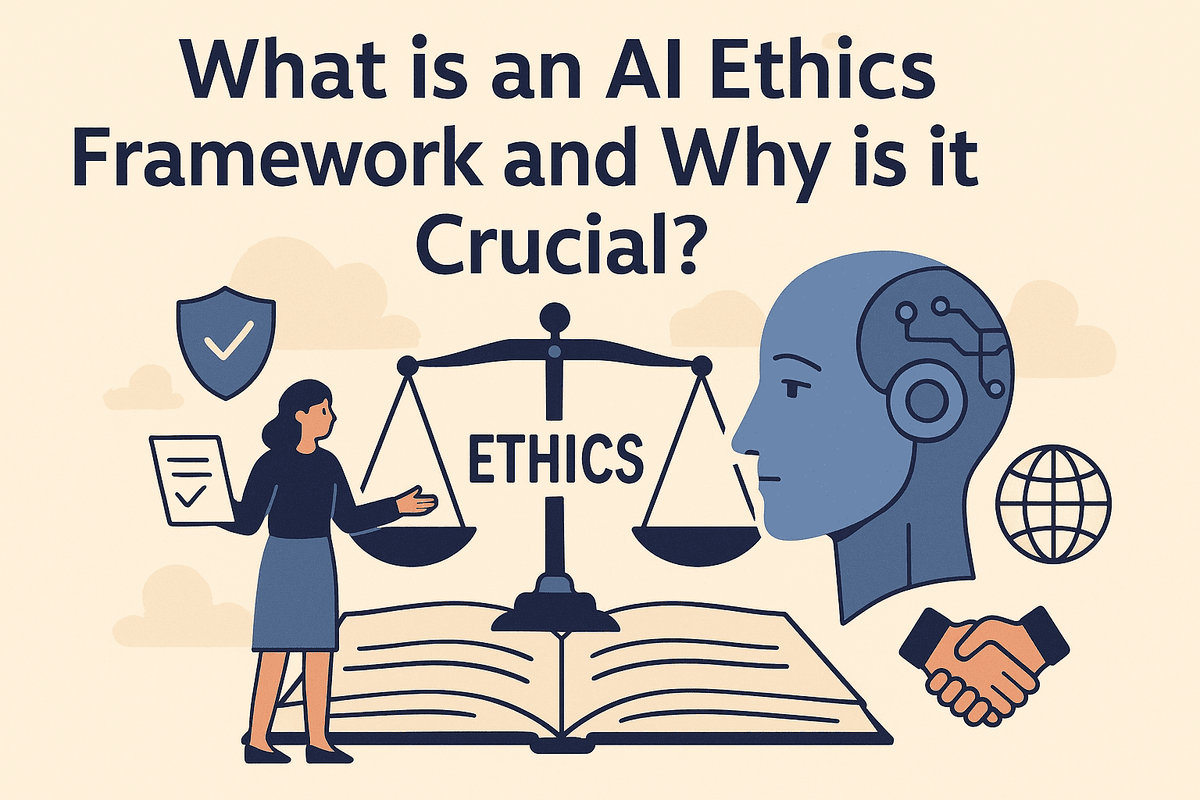
In simple terms, an AI ethics framework is a structured set of guidelines, principles, and governance processes that an organization formally adopts to ensure its AI systems are designed, developed, and deployed in a way that is fair, transparent, and aligned with human values. It’s not just a vague mission statement; it’s a practical blueprint that translates abstract ethical concepts like “fairness” and “accountability” into concrete actions and technical requirements for developers, data scientists, and business leaders.
The High-Stakes World of AI Without Guardrails
Developing AI without a formal ethical structure isn't just a misstep; it's a direct route to significant risk. When left unchecked, AI systems can amplify human biases at an unprecedented scale, leading to discriminatory outcomes in everything from hiring and loan applications to medical diagnoses. The consequences include:
- Pervasive Bias and Discrimination: An algorithm trained on historical data might learn to unfairly penalize certain demographics, perpetuating systemic inequalities under a veneer of technological neutrality.
- Erosion of Privacy: AI’s ability to process vast amounts of data can lead to invasive surveillance and the misuse of personal information, fundamentally eroding individual autonomy.
- The "Black Box" Problem: Many complex AI models are opaque, making it impossible to understand why they reached a specific conclusion. This lack of transparency makes it difficult to detect errors, challenge decisions, or assign accountability when things go wrong.
- Reputational and Financial Damage: An ethical failure can instantly destroy public trust, leading to customer backlash, regulatory fines, and lasting damage to a brand's reputation. Without an AI ethics framework, organizations are navigating these challenges blindfolded.
Beyond Compliance: How a Strong Framework Drives Innovation and Trust
While mitigating risk is a primary driver, the true power of a robust AI ethics framework lies in its ability to create value. It’s not about stifling progress with red tape; it's about channeling it in a more sustainable and successful direction.
A commitment to ethical AI is a powerful differentiator. In a crowded market, trust is the ultimate currency. When customers, partners, and employees know that you are building technology responsibly, they are more likely to engage with your products and champion your brand. This framework fosters a culture of critical thinking, pushing teams beyond asking "Can we build this?" to the more important question, "Should we build this, and how can we do it right?" This deeper consideration often leads to more thoughtful, robust, and human-centered products.
Ultimately, a well-implemented AI ethics framework transforms ethics from a compliance checkbox into a strategic advantage. It future-proofs the organization against evolving regulations, attracts top talent who want to do meaningful work, and builds a foundation of trust that is essential for long-term success in the age of AI.
Core Components of a Successful AI Ethics Framework
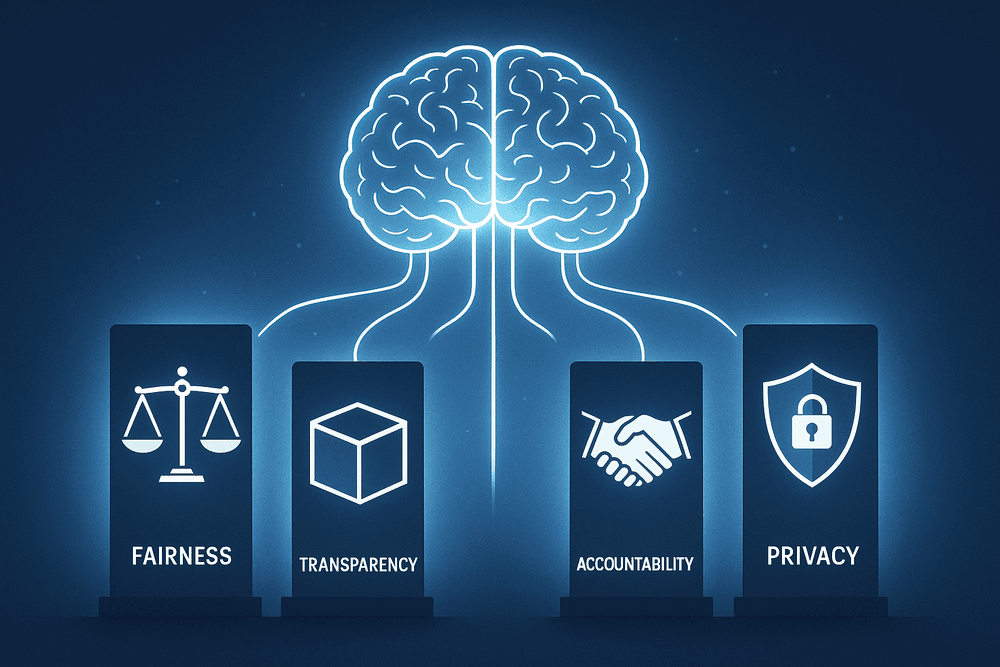
A truly effective AI ethics framework is more than a theoretical document; it's a practical blueprint for building responsible AI. It moves beyond abstract principles to establish actionable pillars that guide every stage of the AI lifecycle, from data collection to deployment and monitoring. These core components work in concert to build trust, ensure compliance, and embed ethical considerations directly into your technology.
Ensuring Fairness and Mitigating Algorithmic Bias
At its heart, AI learns from data. If that data reflects historical or societal biases, the AI system will not only replicate them but can also amplify them at an unprecedented scale. This can lead to discriminatory outcomes in critical areas like hiring, loan approvals, and criminal justice.
A robust AI ethics framework addresses this challenge head-on by mandating:
- Diverse and Representative Data: Actively seeking and using training data that accurately reflects the diversity of the population it will affect.
- Regular Bias Audits: Implementing processes to regularly test models for biased outcomes across different demographic groups.
- Fairness-Aware Algorithms: Employing techniques and tools designed to detect and correct for bias during the model development process.
Without a focus on fairness, even the most technologically advanced AI can cause significant harm and erode public trust.
Achieving Transparency and Explainability (XAI)
Many advanced AI models operate as "black boxes," making it difficult to understand how they arrive at a specific conclusion. This lack of clarity is a major obstacle to trust and accountability. Transparency and explainability (often called XAI) are crucial for demystifying these systems.
- Transparency refers to having insight into how a model is designed, trained, and deployed.
- Explainability is the ability to articulate why a model made a specific decision in a way that humans can understand.
An AI ethics framework must champion XAI, especially for high-stakes applications. This enables developers to debug models, helps regulators verify compliance, and gives end-users the confidence to trust and challenge an AI’s decisions.
Establishing Accountability and Clear Governance
When an AI system fails or causes harm, who is responsible? A successful AI ethics framework provides a clear answer by establishing strong governance and accountability structures. This isn't about assigning blame after the fact; it’s about creating a culture of responsibility from the outset.
Key governance elements include:
- AI Ethics Committees: Cross-functional teams responsible for reviewing and guiding AI projects.
- Defined Roles and Responsibilities: Clearly outlining who is accountable for the ethical implications of an AI system, from data scientists to product managers.
- Human Oversight: Ensuring that there is always a human in the loop for critical decisions, preventing full automation in sensitive contexts.
Accountability transforms ethical principles from suggestions into enforceable organizational policies.
Upholding Data Privacy and Security Standards
AI systems are data-hungry, often requiring vast amounts of personal and sensitive information to function effectively. Consequently, data privacy and security are not just IT concerns; they are fundamental ethical obligations. An AI ethics framework must integrate best practices for data handling, ensuring that the organization acts as a responsible steward of user data. This includes adhering to principles like data minimization (collecting only what is absolutely necessary), using anonymization techniques, and implementing state-of-the-art security to protect against breaches. This pillar ensures compliance with regulations like GDPR and builds foundational trust with customers.
Real-World Examples of AI Ethics Frameworks in Action
An AI ethics framework is only as good as its real-world application. Moving from abstract principles to concrete action is where the challenge lies, and leading organizations are tackling it in different ways. By examining the approaches of tech giants and governments, we can see how ethical considerations are being woven into the fabric of AI development and deployment.
Tech Giants on the Front Lines: Corporate AI Ethics Frameworks
For major technology companies, a public-facing AI ethics framework is now a crucial part of building user trust and guiding internal development. Two of the most influential examples come from Google and Microsoft.
Google's AI Principles
Google’s approach is a set of high-level, guiding commitments. Published in 2018, their principles declare that their AI applications will:
- Be socially beneficial.
- Avoid creating or reinforcing unfair bias.
- Be built and tested for safety.
- Be accountable to people.
- Incorporate privacy design principles.
Critically, Google also defined what it won't do with AI, drawing clear red lines against developing technologies for weaponry, illegal surveillance, or those that violate widely accepted principles of international law and human rights. This framework acts as a north star for project evaluation and corporate decision-making.
Microsoft's Responsible AI Standard
Microsoft has developed a more granular and operational ai ethics framework known as the Responsible AI Standard. This system is designed to translate high-level principles into tangible engineering practices. The standard is built around six core principles: Fairness, Reliability & Safety, Privacy & Security, Inclusiveness, Transparency, and Accountability. Microsoft has gone a step further by creating internal tools, checklists, and impact assessment templates that product teams must use throughout the AI system's lifecycle, from conception to deployment and beyond.
Governments Step In: Regulatory and Policy Frameworks
While corporations self-regulate, governments are establishing broader rules to protect citizens and ensure a level playing field. These frameworks often carry the force of law.
The EU AI Act
The European Union’s AI Act is a landmark piece of legislation that takes a risk-based approach. Instead of a one-size-fits-all rule, it categorizes AI systems into four tiers:
- Unacceptable Risk: Banned systems (e.g., social scoring by governments).
- High-Risk: Strictly regulated systems (e.g., AI in critical infrastructure, medical devices, or hiring).
- Limited Risk: Systems requiring transparency (e.g., chatbots must disclose they are AI).
- Minimal Risk: Unregulated applications (e.g., spam filters).
This Act represents a shift from voluntary principles to legal obligations, making it one of the most comprehensive regulatory AI ethics frameworks globally.
The NIST AI Risk Management Framework (RMF)
In the United States, the National Institute of Standards and Technology (NIST) has created a voluntary AI Risk Management Framework. The RMF is not a law but a detailed guide for organizations to "map, measure, and manage" AI risks. It provides a structured process to help organizations analyze the potential negative impacts of AI systems on individuals and society. Its goal is to cultivate a culture of risk management, enabling organizations to build more trustworthy and reliable AI in a flexible, adaptable manner.
Corporate vs. Governmental Approaches: Key Differences
The primary distinction lies in enforceability and scope. Corporate frameworks are internal guides based on company values, enforced by internal review boards. Their goal is to innovate responsibly and maintain brand reputation. Governmental frameworks, like the EU AI Act, are legally binding regulations that apply to an entire market, with significant penalties for non-compliance. Their primary goal is to protect citizens' fundamental rights. While corporate principles can adapt quickly to new technology, government regulations provide stability and universal standards, ensuring a baseline of ethical practice for everyone.

How to Build and Implement Your AI Ethics Framework: A Step-by-Step Guide
Moving from abstract principles to concrete action is the most critical challenge in AI ethics. A theoretical document is useless unless it’s actively embedded in your organization's culture and workflows. Building a robust AI ethics framework is not about creating a static checklist; it’s about developing a dynamic, operational guide for responsible innovation. Follow these four steps to build and implement a framework that drives real-world impact.
Step 1: Assemble a Diverse AI Ethics Review Board
Ethical blind spots are the biggest risk in AI development. A team composed solely of engineers and data scientists, no matter how well-intentioned, will inevitably miss social, cultural, and individual nuances. The first step in building a meaningful AI ethics framework is to establish a multidisciplinary review board or council.
This group should not be a gatekeeper but a collaborative guide. Its purpose is to stress-test ideas, identify potential harms, and champion ethical considerations throughout the company.
Who to include:
- Technical Experts: Data scientists, ML engineers, and software architects.
- Domain Experts: Legal and compliance officers, ethicists, and social scientists.
- Business & People Leaders: Product managers, user experience (UX) designers, and human resources representatives.
- External Voices: Representatives from affected communities, customer advocacy groups, or third-party auditors to provide an outside-in perspective.
Step 2: Define Your Organization's Ethical Principles and Values
Your AI ethics principles are the foundation of your entire framework. They must be authentic to your organization, reflecting its core mission, values, and the specific impact your technology has on the world. While you can draw inspiration from established principles like fairness, transparency, and accountability, simply copying them is not enough.
Tailor these values to your industry and context. A healthcare AI company’s framework will prioritize patient safety and data privacy differently than a marketing tech firm, which might focus more on transparency in advertising and preventing manipulative practices.
Hold workshops with your new review board and key stakeholders to translate broad values into actionable commitments. The output should be a clear, concise set of principles that an engineer, a marketer, and a CEO can all understand and apply to their daily work.
Step 3: Integrate the Framework into the Entire AI Development Lifecycle
An AI ethics framework fails the moment it becomes a document that only gets reviewed before a product launch. To be effective, ethics must be woven into every stage of the AI lifecycle, from initial concept to post-deployment monitoring.
- Ideation: Conduct "Ethical Risk Assessments" to proactively identify potential negative impacts on different user groups before development begins.
- Data Sourcing and Preparation: Implement strict data governance protocols. Scrutinize datasets for historical biases and use mitigation techniques to ensure they are as representative and fair as possible.
- Model Development: Mandate documentation for key modeling decisions. Use fairness and explainability toolkits to audit models for discriminatory outcomes and ensure their logic is interpretable.
- Testing and Deployment: Test for performance disparities across demographic groups, not just overall accuracy. Implement systems for human oversight and control.
- Monitoring: Continuously track model performance in the real world to detect performance drift, new biases, or unintended consequences.
Step 4: Create Mechanisms for Ongoing Monitoring and Public Feedback
AI systems and the societies they operate in are constantly evolving. Your AI ethics framework must be a living document, capable of adapting to new technologies, regulations, and social expectations. True accountability requires a continuous feedback loop.
First, establish internal processes for regular auditing of your AI systems against your stated principles. Define key performance indicators (KPIs) related to fairness, privacy, and transparency, and track them with the same rigor you track business metrics.
Second, create clear and accessible channels for the public to raise concerns, report issues, or appeal AI-driven decisions. This could be a dedicated contact form, an ombudsperson, or a public transparency report. Listening to external feedback is not just about risk management—it’s the most effective way to build lasting trust and ensure your technology serves humanity responsibly.
Overcoming Challenges in AI Ethics Framework Adoption
Establishing an ai ethics framework is a critical first step, but the journey from a document to a daily reality is fraught with challenges. Many organizations find their well-intentioned principles languishing on a server, disconnected from the teams building and deploying AI. Successfully operationalizing your framework requires a deliberate strategy to overcome three primary hurdles: translating principles into practice, navigating a complex regulatory environment, and future-proofing your approach against technological disruption.
From Principles to Practice: Bridging the Implementation Gap
The most significant challenge is moving from abstract ideals like "fairness" and "transparency" to concrete actions within the AI development lifecycle. A principle is only as valuable as its implementation. Without a clear path to application, an ai ethics framework risks becoming "ethics-washing"—a performative gesture with no real-world impact.
To bridge this gap, organizations must:
- Establish Cross-Functional Governance: Create a dedicated AI ethics board or committee with members from legal, engineering, product management, and business leadership. This group is responsible for translating principles into specific policies and reviewing high-risk AI projects.
- Integrate into Workflows: Embed ethical checkpoints directly into existing development processes like MLOps. This includes mandatory steps such as conducting AI Impact Assessments before a project begins, creating "Model Cards" to document a model's performance and limitations, and running regular algorithmic audits to detect and mitigate bias.
- Equip Teams with Tools: Provide developers and data scientists with practical tools for bias detection, explainability (XAI), and data privacy. Making responsible AI the path of least resistance is key to widespread adoption.
Navigating the Complex Web of Global AI Regulations
The global landscape for AI regulation is a patchwork of evolving laws and standards. From the EU's comprehensive AI Act to the NIST AI Risk Management Framework in the US, compliance is becoming increasingly complex. An ai ethics framework that ignores this reality is incomplete and exposes the organization to significant legal and reputational risk.
To navigate this complexity, your framework should be:
- Adaptable and Modular: Design your core principles to be universal, but allow for specific, jurisdiction-based controls and guidelines. This ensures you can adapt to local laws without overhauling your entire governance structure.
- A Tool for Compliance: Actively map the principles and controls within your ai ethics framework to the requirements of key regulations. This proactive approach not only ensures compliance but also demonstrates a commitment to responsible AI to regulators and customers.
- Informed by Continuous Monitoring: Designate a team or individual to monitor the global AI policy landscape. This horizon scanning allows you to anticipate changes and update your framework proactively, staying ahead of new compliance obligations.
Keeping Pace with AI's Evolution: The Generative AI Test
AI technology doesn't stand still. The explosive growth of Generative AI has introduced a new class of ethical challenges, from realistic deepfakes and large-scale misinformation to novel intellectual property concerns and biases embedded in massive foundational models. A static ai ethics framework designed for yesterday’s AI will quickly become obsolete.
To ensure your framework remains relevant and robust, treat it as a living document:
- Schedule Regular Reviews: The AI governance committee should review and update the framework at least annually, or more frequently in response to major technological breakthroughs.
- Incorporate "Red Teaming": Establish a process for actively stress-testing new AI models, especially generative ones, to identify potential harms and unforeseen failure modes before they are deployed.
- Foster a Learning Culture: Promote ongoing education and training on emerging AI ethics issues. When a new technology like Generative AI appears, your teams should be equipped with the knowledge to understand its unique risks and apply the principles of your framework accordingly.

The Future of Responsible AI: Your Next Steps
Embarking on the path of responsible AI is not a final destination but a continuous journey of learning, adaptation, and commitment. Moving from abstract principles to concrete action is the most critical step. With the foundations laid, let's explore how you can operationalize your ethical vision, equip your teams, and embed responsibility into the very DNA of your organization. This is where your AI ethics framework transforms from a document into a dynamic, living guide for innovation.
Key Takeaways for Building Your Framework
Crafting a robust AI ethics framework is a foundational act of corporate responsibility in the digital age. As you move forward, keep these core pillars in mind:
- Start with Your "Why": Your framework must be anchored in your organization's unique values and mission. It’s not about adopting a generic template but defining what responsible AI means for you and your stakeholders.
- Embrace Inclusivity: Ethical AI is a team sport. Ensure your development process includes diverse voices from across your organization—legal, HR, marketing, and product—as well as external perspectives.
- Principles as a North Star: Ground your framework in core principles like fairness, transparency, accountability, security, and privacy. These principles will guide decision-making when clear-cut answers aren't available.
- Operationalize Your Ideals: A framework is only effective if it's integrated into daily workflows. This means establishing clear governance structures, impact assessments, and review processes that translate principles into practice.
- Iterate and Evolve: The AI landscape is constantly changing. Your framework must be a living document, subject to regular review and updates in response to new technologies, regulations, and societal expectations.
Choosing the Right Tools and Resources
A framework alone is not enough; your teams need the right tools and support to implement it effectively. Supporting your ethical goals involves a strategic mix of technical and educational resources.
- Technical Toolkits: Invest in technologies that enable responsible AI. This includes model monitoring platforms to detect and mitigate bias, explainable AI (XAI) libraries to improve transparency, and data governance software to ensure privacy and security.
- Assessment Frameworks: You don’t have to reinvent the wheel. Leverage established resources like the NIST AI Risk Management Framework or industry-specific guidelines to pressure-test and refine your own AI ethics framework.
- Continuous Learning: Foster a culture of ethical curiosity. Provide access to ongoing training, workshops, and certifications on AI ethics. Encourage participation in industry conferences and forums to stay ahead of emerging best practices.
Championing a Culture of Responsible AI
Ultimately, the success of your AI ethics framework hinges on your company culture. It requires a collective shift in mindset, where ethical considerations are not an afterthought but a core component of the innovation process.
- Lead from the Top: Lasting cultural change starts with leadership. Executive buy-in is crucial. When leaders consistently communicate the importance of responsible AI and model ethical decision-making, it signals to the entire organization that this is a priority.
- Empower Ethics Champions: Identify and formally recognize individuals across different departments who are passionate about ethical AI. Equip them with the resources and authority to act as advocates, advisors, and educators within their teams.
- Integrate Ethics into the AI Lifecycle: Embed ethical checkpoints at every stage of development—from initial concept and data sourcing to model training, deployment, and post-launch monitoring. Create practical checklists, conduct pre-mortem analyses to anticipate potential harms, and establish clear escalation paths for ethical dilemmas.
- Incentivize Responsibility: Align your performance metrics and reward systems with your ethical principles. Recognize and celebrate teams that proactively identify and address ethical challenges or develop innovative, responsible AI solutions.