
October 16, 2025
What Is an AI Citation Generator and Why Is It a Game-
What Is an AI Citation Generator and Why Is It a Game-Changer?
Remember the late nights spent hunched over a style guide, trying to figure out whether to use a comma or a period after the author's name? The painstaking process of manually typing out every detail for your bibliography, cross-referencing in-text citations, and praying you didn’t miss a single rule is a universal academic headache. Those days are over. The AI citation generator has arrived, and it’s not just an incremental improvement—it’s a fundamental shift in how we approach academic and professional writing.
The End of Manual Referencing: A Quick Introduction
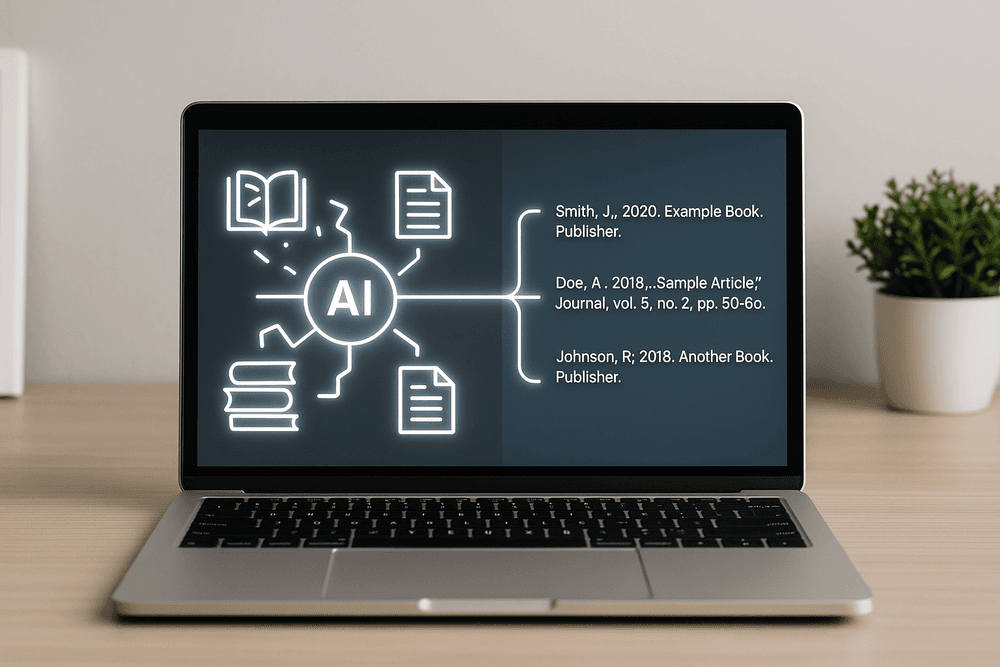
At its core, an AI citation generator is a sophisticated software tool that automates the creation of citations and bibliographies. Unlike older, simpler tools that acted like basic templates, modern AI-powered platforms do the heavy lifting for you. By simply providing a URL, a book's ISBN, or a journal article's DOI, the AI scours the web and academic databases to pull all the necessary metadata—authors, publication dates, titles, volume numbers, and more. It then instantly assembles this information into a perfectly formatted citation in the style of your choice, whether it's APA 7th Edition, MLA 9th, Chicago, or hundreds of others. This technology effectively marks the end of tedious, error-prone manual referencing.
How AI Is Revolutionizing Academic Integrity and Writing
The impact of an AI citation generator extends far beyond mere convenience. It is a powerful ally in upholding academic integrity. Unintentional plagiarism, often caused by incorrect or missing citations, is a serious academic offense. By making the citation process seamless and incredibly accurate, these tools drastically reduce the risk of such errors. They ensure every source is properly attributed, strengthening the credibility of your work.
Furthermore, by offloading the mechanical task of formatting, AI frees up invaluable cognitive resources. Instead of wrestling with punctuation rules, writers can focus their full attention on what truly matters: developing a strong thesis, analyzing data, and crafting a compelling argument. This shift allows for deeper critical thinking and a higher quality of writing, transforming a tedious chore into a streamlined part of the research process.
Understanding the Core Function of a Citation Generator
So, how does it work? An AI citation generator leverages advanced algorithms and machine learning models trained on millions of academic papers and style guide examples. When you input a source, the AI performs several key functions:
- Data Extraction: It intelligently identifies and extracts the essential bibliographic data from the source, discerning between an author's name and a publisher's, or a publication date and an access date.
- Style-Specific Formatting: The AI cross-references the extracted data with the precise rules of your chosen citation style. It knows when to italicize a journal title in APA, when to use "et al." for multiple authors in MLA, and how to format a footnote in Chicago style.
- Generation: It generates both the in-text citation (e.g., Smith, 2023) and the full reference list or bibliography entry, ensuring they are perfectly synchronized and formatted.
In essence, the tool acts as a tireless, expert research assistant, guaranteeing consistency and accuracy across your entire document, saving you hours of work and protecting your academic reputation.
The Unbeatable Benefits of Using an AI Citation Generator
Manually compiling a bibliography is one of the most tedious and error-prone parts of academic writing. It’s a final hurdle that can trip up even the most diligent students and researchers. An ai citation generator transforms this painstaking task into a seamless, efficient process, offering a suite of benefits that go far beyond simple convenience. By leveraging this powerful technology, you not only save time but also enhance the quality and integrity of your work.
Achieve Pinpoint Accuracy and Avoid Costly Errors
Every comma, period, and italicized word matters in academic citations. A single misplaced date or an incorrectly formatted author's name can lead to lost marks on an essay or a request for revision from a journal editor. The rules for each style are complex and filled with nuances, making human error almost inevitable.
This is where an ai citation generator excels. It eliminates the guesswork by drawing on massive, up-to-date databases and sophisticated algorithms to format every entry with pinpoint accuracy. It correctly handles everything from journal articles and books to more complex sources like online videos and conference proceedings. By automating the process, you avoid costly mistakes and ensure your bibliography meets the exacting standards of any academic institution or publication.
Save Hours of Tedious Work on Every Research Paper
Your time is your most valuable asset during the research process. Instead of spending hours poring over style manuals, cross-referencing rules, and manually typing out each entry, you could be refining your arguments or conducting further research. An ai citation generator gives you that time back.
The efficiency is staggering. Simply paste a URL, DOI, or ISBN, and the tool instantly fetches the necessary metadata and generates a perfectly formatted citation. Creating an entire reference list for a complex research paper can be reduced from a multi-hour ordeal to a matter of minutes. This reclaimed time allows you to focus on what truly matters: the quality of your research and writing.
Effortlessly Switch Between APA, MLA, Chicago, and More
Different disciplines, professors, and publications demand different citation styles. A paper for your psychology class might require APA 7th edition, while your literature review for an English course needs MLA 9th. Manually reformatting your entire bibliography to switch between these styles is a monumental task.
An ai citation generator acts as a universal translator for citation formats. With your sources saved in one place, you can switch the entire list from one style to another—be it APA, MLA, Chicago, Harvard, or thousands of others—with a single click. This flexibility is invaluable for students and professionals who work across various disciplines, ensuring their work is always compliant with the required format without any redundant effort.
Strengthen Your Credibility and Avoid Accidental Plagiarism
A well-formatted bibliography does more than just fulfill a requirement; it demonstrates your meticulousness and respect for intellectual property. It shows your reader that you’ve engaged deeply with the existing literature and are giving proper credit where it’s due. Using an ai citation generator ensures your reference list is professional, comprehensive, and clean.
More importantly, it serves as a crucial safeguard against accidental plagiarism. Forgetting to cite a source or citing it improperly can have serious academic and professional consequences. By making the citation process effortless and integrated into your workflow, these tools help you maintain a clear record of your sources, ensuring every idea is properly attributed. This strengthens your academic integrity and bolsters your credibility as a trustworthy researcher.
Reviewed: The Best AI Citation Generator Tools for Flawless Referencing
The digital landscape is flooded with tools promising perfect citations, but which AI citation generator truly delivers on that promise? To cut through the noise, we've tested the leading platforms to identify the best options for different needs. Whether you're a high school student finishing a term paper or a researcher compiling a complex literature review, the right tool can transform your workflow. Here’s our breakdown of the top contenders that stand out for their accuracy, features, and user experience.
Top Pick for Overall Ease of Use and Accuracy: CiteWiz AI
For the vast majority of users, CiteWiz AI strikes the perfect balance between power and simplicity. Its clean, intuitive interface makes generating citations a breeze, whether you're using a book's ISBN, a journal's DOI, or a website's URL. During our tests, CiteWiz consistently produced highly accurate citations in APA 7, MLA 9, and Chicago styles with minimal need for manual correction.
Its standout feature is the seamless browser extension, which allows you to capture source information with a single click while you research. CiteWiz also offers project management folders, making it easy to organize references for multiple assignments. While it may occasionally struggle with hyper-specific or non-traditional sources, it’s the most reliable and user-friendly AI citation generator for everyday academic and professional tasks.
Best Free AI Citation Generator for Students on a Budget: RefBot
If you need accurate citations without a subscription, RefBot is the undisputed champion. This ad-supported platform provides unlimited citations in the most common styles (APA, MLA, Chicago, Harvard) completely free of charge. The process is straightforward: paste a link, DOI, or title, and RefBot quickly retrieves the necessary metadata and formats the reference.
While it lacks the advanced project management and collaboration features of paid alternatives, it nails the core function of creating citations and bibliographies. For students working on standard essays and research papers, RefBot offers incredible value. It’s a powerful, no-frills tool that ensures your bibliography is correct without costing you a dime, making it the best free AI citation generator available today.
Most Powerful for Obscure or Complex Sources: ScholarCite Pro
When your research takes you off the beaten path, you need a tool built for academic rigor. ScholarCite Pro is designed for graduate students, academics, and professional researchers who handle a wide array of complex sources. It excels at parsing information from non-standard materials like government reports, archival documents, legal cases, and conference proceedings.
ScholarCite Pro supports an extensive library of over 9,000 citation styles, catering to niche journals and international standards. Its advanced features include tools for creating annotated bibliographies, sharing libraries with collaborators, and integrating directly with writing software like Scrivener and LaTeX. The learning curve is steeper and it comes with a premium subscription, but for serious research, its power and precision are unmatched.
Feature-by-Feature Comparison: Which Tool Fits Your Workflow?
| Feature | CiteWiz AI | RefBot | ScholarCite Pro |
| :--- | :--- | :--- | :--- |
| Best For | Undergraduates & Professionals | High School & Undergraduates | Graduate Students & Researchers |
| Pricing | Freemium / Subscription | Free (Ad-Supported) | Subscription |
| Ease of Use | Very High | High | Moderate |
| Core Accuracy | Excellent | Very Good | Excellent |
| Supported Styles | ~50 Major Styles | ~10 Core Styles | 9,000+ |
| Complex Sources | Good | Fair | Excellent |
| Key Feature | Browser Extension | Completely Free | Annotated Bibliography Tools |
How to Use an AI Citation Generator for Perfect Citations Every Time
An ai citation generator can transform the tedious task of creating a bibliography into a simple, efficient process. But to truly achieve perfect citations, it's crucial to use these powerful tools correctly. By following a systematic approach, you can ensure accuracy, maintain academic integrity, and save valuable time. This guide breaks down the process into three essential steps, followed by common pitfalls to avoid.
Step 1: Inputting Your Source (URL, DOI, or ISBN)
The magic of an ai citation generator begins with the data you provide. The tool uses unique identifiers to automatically locate and pull the necessary metadata for your source. The most common identifiers are:
- URL (Uniform Resource Locator): For websites, online articles, blog posts, and other web-based content. Simply copy the full address from your browser's navigation bar and paste it into the generator's search field.
- DOI (Digital Object Identifier): A unique alphanumeric string assigned to most modern academic journal articles, research papers, and some e-books. You can typically find the DOI at the top of the article's first page or on its database landing page. It's the most reliable way to cite scholarly work.
- ISBN (International Standard Book Number): A 10- or 13-digit number that uniquely identifies a book. It is usually found on the back cover near the barcode or on the copyright page inside the book.
Most advanced AI citation tools also allow you to search by title, author, or keywords if you don't have a direct identifier.
Step 2: Verifying the AI-Generated Output for Accuracy
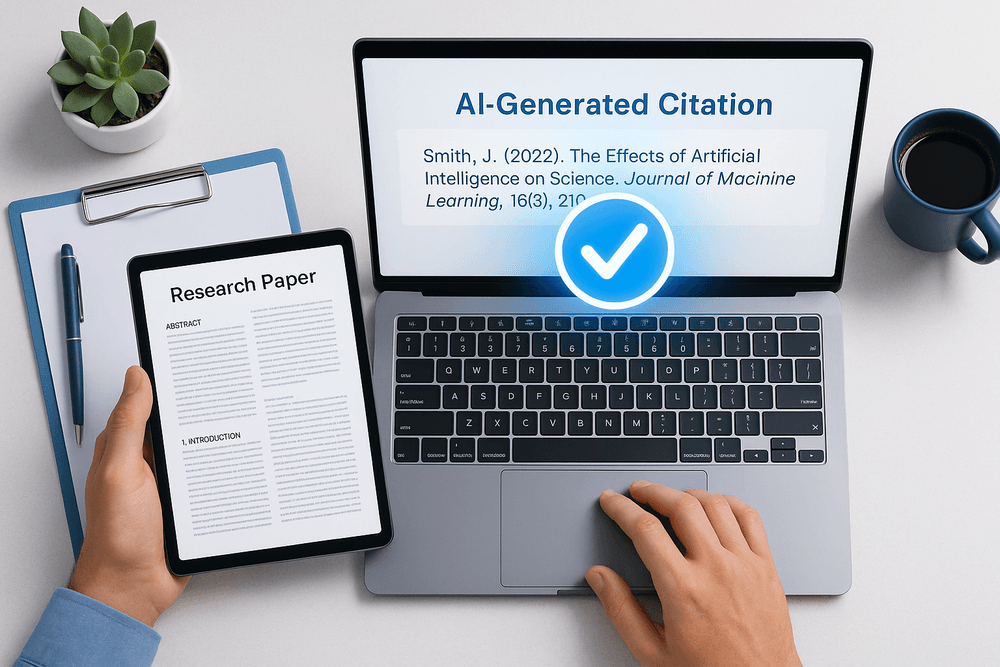
This is the most critical step in the process. While an ai citation generator is incredibly accurate, it is not infallible. It relies on the metadata available from the source, which can sometimes be incomplete or formatted incorrectly. Always treat the initial output as a high-quality draft that requires a quick human review.
Cross-reference the generated citation with your source, checking these key elements:
- Author(s): Are all author names spelled correctly and in the proper order?
- Title: Is the title of the article or book exact? Pay close attention to capitalization rules for your chosen style (e.g., sentence case for APA titles, title case for MLA).
- Publication Date: Is the year, and where applicable, the month and day, correct?
- Publisher/Journal Information: Is the name of the journal, publisher, volume number, and issue number accurate?
- Page Numbers/Location: Are the page ranges or other location identifiers (like paragraph numbers) correct?
Taking 30 seconds to verify this information prevents costly errors and ensures your work meets academic standards.
Step 3: Exporting and Integrating Citations into Your Document
Once you have verified the citation's accuracy, the final step is to add it to your paper. A quality ai citation generator offers several flexible options:
- Copy and Paste: The simplest method. Most tools have a "Copy" button that formats the citation perfectly, including hanging indents, which you can then paste directly into your bibliography or works cited page.
- Export to File: For managing multiple sources, you can often export your list as a file (e.g., BibTeX, RIS, or Word document) that can be imported into reference management software like Zotero or Mendeley.
- Direct Integration: Many generators offer browser extensions or add-ins for Microsoft Word and Google Docs. These tools allow you to build your bibliography directly within your document, making it easy to add, edit, and update citations as you write.
Common Pitfalls to Avoid When Using Automated Tools
- Blind Trust: Never assume the AI's output is 100% perfect. Always follow Step 2 and verify the details.
- Incorrect Source Type: The AI may occasionally misidentify a source, such as citing a blog post as a formal journal article. Confirm the source type is correct and adjust it if necessary.
- Ignoring Style Guide Nuances: While generators handle most rules, they may not perfectly format a very unusual source type (e.g., a live performance or a personal interview). Always have your style guide handy for complex cases.
- Incomplete Metadata: If a source's online metadata is missing (like a publication date), the generator can't invent it. You will need to locate the missing information and add it manually.
Beyond the Basics: Advanced Features of a Modern AI Citation Generator
While automatically formatting a reference list is a huge time-saver, it’s merely the starting point for today's sophisticated tools. A modern ai citation generator has evolved into a comprehensive research assistant, packed with advanced features that integrate deeply into your workflow. These capabilities go far beyond basic formatting to help you organize, write, and polish your work with unparalleled efficiency.
Creating Annotated Bibliographies in Seconds
An annotated bibliography is a powerful academic tool, requiring not just a citation but also a concise summary and analysis of each source. Traditionally, this is a painstaking process of reading, summarizing, and formatting. Advanced AI citation generators are changing the game. By leveraging generative AI, these tools can scan an article's abstract or even the full text to produce a well-written summary of its key arguments, methodology, and findings. With a few clicks, you can generate a complete annotated bibliography, giving you a high-level overview of your source material and saving countless hours of preliminary work.
Using Browser Extensions for One-Click Citing
Imagine you’re deep in a research session and stumble upon a perfect journal article, a critical news report, or an insightful online video. The friction of stopping, opening a new tab, and manually entering citation details can break your focus. This is where browser extensions come in. The best ai citation generator platforms offer extensions for Chrome, Firefox, and Safari that capture source information with a single click. The extension automatically parses the webpage, pulls all the necessary metadata—author, title, publication, date, DOI, URL—and adds it directly to your project library, perfectly formatted. This transforms source collection from a tedious chore into an instant, seamless part of your research process.
Seamless Integration with Zotero, Mendeley, and Word
A powerful tool doesn't force you to abandon your established habits; it enhances them. Recognizing that many researchers already rely on reference managers like Zotero, Mendeley, or EndNote, leading AI citation tools offer seamless integration. You can easily import your existing libraries or export new sources, ensuring all your research lives in harmony.
Even more crucial is the integration with word processors. Plugins for Microsoft Word and Google Docs allow you to insert in-text citations directly as you write. The tool automatically formats them and builds your bibliography at the end of the document. If you move a paragraph or delete a source, the ai citation generator automatically updates the numbering and the final reference list, eliminating the nightmare of manual cross-referencing.
Leveraging AI to Check for Citation Consistency
In a long paper with dozens or even hundreds of sources, ensuring consistency is one of the most difficult final hurdles. Is every in-text citation matched to an entry in the bibliography? Is every source in the bibliography cited in the text? Have you used "et al." correctly throughout? An AI-powered consistency checker is the ultimate solution. This feature scans your entire document, cross-referencing your in-text citations against your reference list to flag errors, omissions, and stylistic inconsistencies. It acts as a final, meticulous proofreader for your citations, ensuring your paper is not only well-researched but also professionally polished.

Conclusion: Choose the Right AI Citation Generator and Elevate Your Work
The days of wrestling with punctuation, publication dates, and the subtle differences between citation styles are officially behind us. As we've explored, manual citation is a time-consuming and error-prone process that pulls focus from what truly matters: your research and analysis. The digital age has delivered a powerful solution, and embracing a top-tier ai citation generator is no longer a luxury—it’s a fundamental step toward more efficient, accurate, and professional academic work.
By automating the tedious task of formatting bibliographies and in-text citations, you reclaim valuable hours. More importantly, you minimize the risk of accidental plagiarism and ensure your work adheres to the strict standards of your institution or publisher. An AI-powered tool isn't just about speed; it's about instilling confidence and credibility into every paper, report, and presentation you create. The right tool acts as your personal research assistant, tirelessly managing the details so you can concentrate on the big picture.
Your Final Checklist for Selecting the Best AI Citation Generator
Making the final decision can feel overwhelming with so many great options available. Use this checklist to cut through the noise and pinpoint the perfect ai citation generator for your specific needs.
- ✅ Comprehensive Style Support: Does the tool cover your required formats, whether it's APA 7, MLA 9, Chicago, Turabian, or another specialized style? Look for a platform with a vast and updated library.
- ✅ Accuracy and Reliability: How precise are the generated citations? The best tools pull metadata from reliable databases to reduce errors. Check if it allows for easy manual correction for any obscure sources.
- ✅ Intuitive User Experience: Is the interface clean and easy to navigate? You should be able to generate a citation from a URL, DOI, ISBN, or title with minimal clicks. A confusing platform defeats the purpose of saving time.
- ✅ Seamless Integrations: Does it offer browser extensions or add-ins for Google Docs and Microsoft Word? Direct integration into your writing workflow is a game-changer for efficiency.
- ✅ Versatile Source Handling: Can the generator handle a wide array of source types? Your research may include academic journals, books, websites, YouTube videos, podcasts, and more. Ensure your chosen tool is versatile enough to manage them all.
- ✅ Cost-Benefit Analysis: Does the free version offer sufficient functionality, or are the features of a premium plan (like cloud storage, collaboration tools, or advanced checking) worth the investment for your projects?
Start Citing Smarter, Not Harder, Today
The choice is clear. Moving forward, your goal should be to work smarter, not harder. By leveraging the power of an ai citation generator, you are making a strategic investment in your academic or professional career. You are choosing to dedicate your energy to critical thinking, compelling arguments, and groundbreaking research, leaving the meticulous task of citation formatting to a tool built for that exact purpose.
Don’t wait for the next big project to make the switch. Explore the options we've discussed, use the checklist to guide your decision, and commit to transforming your workflow today. Elevate your writing, ensure your credibility, and unlock a new level of academic productivity.