
August 5, 2025
What Is an AI Citation Generator and Why Do You Need One?
What Is an AI Citation Generator and Why Do You Need One?
Remember the tedious, hair-pulling frustration of manually creating a bibliography? Hunting for publication dates, wrestling with hanging indents, and triple-checking every comma and period according to a dense style guide. For students, researchers, and writers, this process has long been a necessary evil. But that era is rapidly coming to a close, thanks to the rise of the AI citation generator.
The End of Manual Formatting: A Quick Introduction
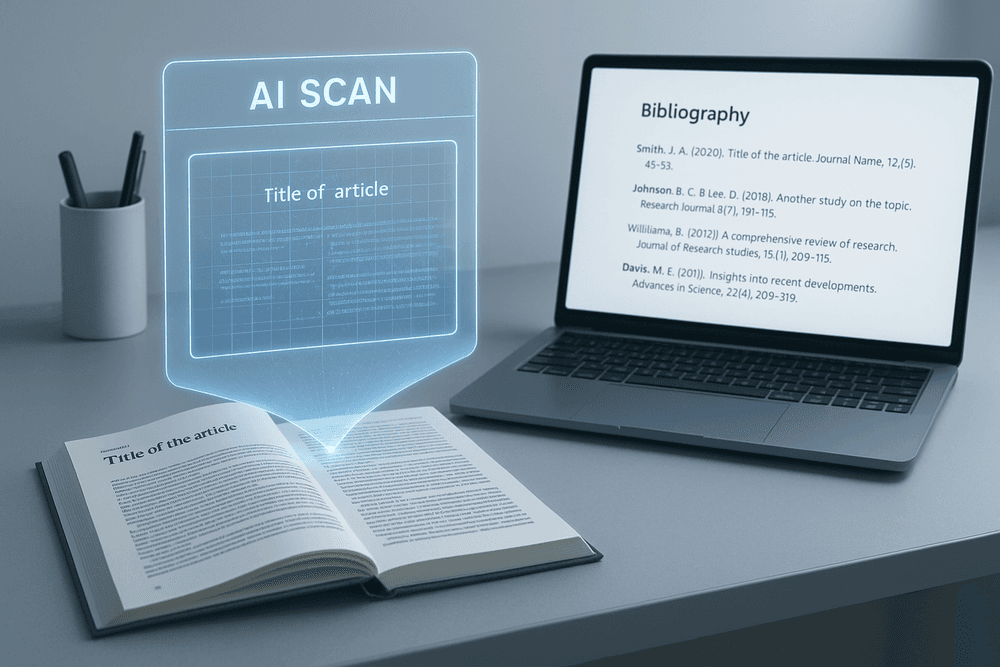
At its core, an AI citation generator is a sophisticated software tool that automates the creation of academic citations. Unlike older, basic citation machines that simply arranged the data you fed them, AI-powered tools are smarter. They use artificial intelligence and machine learning algorithms to scan sources—like a website URL, a book's ISBN, or a journal's DOI—and automatically extract the necessary information.
This intelligent tool then correctly formats the data into any style you require, whether it's APA 7th edition, MLA 9th, Chicago, or hundreds of others. It understands the subtle differences between citing a journal article versus a YouTube video and arranges every element perfectly, from the author's name to the access date, all in a matter of seconds.
How AI Citation Tools Are Revolutionizing Academic Research
The impact of a high-quality AI citation generator goes far beyond simple convenience; it’s a fundamental shift in the academic workflow. Here’s how these tools are changing the game:
- Massive Time Savings: Researchers and students can save countless hours previously spent on the meticulous task of formatting bibliographies and in-text citations. This recovered time can be reinvested where it truly matters: in critical thinking, analysis, and refining the core arguments of their work.
- Enhanced Accuracy: Manual citation is prone to human error. A misplaced comma or an incorrect publication year can not only look unprofessional but can also lead to point deductions or accusations of sloppy scholarship. AI minimizes these errors, ensuring consistency and adherence to strict formatting rules, which is crucial for maintaining academic integrity.
- Streamlined Workflow: Modern AI citation tools often integrate directly with word processors like Google Docs or Microsoft Word. They allow you to build your reference list as you write, inserting citations on the fly without ever leaving your document. This seamless integration keeps your focus sharp and your sources organized from the very beginning.
Key Differences: AI vs. Traditional Citation Methods
The contrast between using an AI citation generator and relying on traditional methods is stark. Manual citation is a static, labor-intensive process that demands deep familiarity with complex style manuals. Every source must be processed individually, and switching between citation styles (for example, from APA to MLA for a different class) requires a complete, time-consuming overhaul.
In contrast, an AI citation generator is dynamic and efficient. It acts as an intelligent assistant that does the heavy lifting. The AI handles the data retrieval and rule application, freeing you to focus on evaluation. Need to change your entire bibliography from Chicago to APA? A single click is often all it takes. This level of speed, accuracy, and flexibility was unimaginable with traditional methods, making AI-powered tools an indispensable asset for anyone serious about academic writing.
The Best AI Citation Generator Tools of 2024 Reviewed
Navigating the world of academic referencing can be daunting, but the right tool can transform the process from a tedious chore into a seamless task. Not all citation tools are built the same; some prioritize simplicity, while others offer a robust suite of features for professional researchers. We've tested the top contenders to find the best AI citation generator for every need, whether you're writing your first research paper or your dissertation.
CiteRight AI: Best for Overall Accuracy and Ease of Use
For those who value precision and a frictionless user experience, CiteRight AI stands out as the premier choice. Its strength lies in its sophisticated AI engine, which excels at parsing information from even the most complex sources, such as pre-print articles, digital journals, and obscure websites. This significantly reduces the risk of formatting errors that plague simpler tools, giving you confidence in your bibliography.
The interface is exceptionally clean and intuitive. You can generate a citation in seconds by simply pasting a URL, uploading a PDF, or entering a DOI. CiteRight AI's browser extension is a game-changer, allowing you to create citations with a single click as you conduct your research online.
- Key Features: Highest accuracy AI, intuitive drag-and-drop interface, powerful browser extension, supports all major styles.
- Best For: University students and professional researchers who need a reliable and fast AI citation generator and are willing to invest in a premium tool for guaranteed quality.
- Pricing: Subscription-based with a limited free trial.
QuickCite Free: The Top Free AI Citation Generator Option
If you're on a budget or only need to generate citations occasionally, QuickCite Free is the undisputed champion of free tools. It provides a straightforward, no-frills service that gets the job done without costing a dime. This tool effectively handles the most common source types—books, journal articles, and websites—and generates references in essential styles like APA 7, MLA 9, and Chicago.
While it’s an excellent AI citation generator for its price point (free!), users should be prepared to double-check the output. Its AI is less advanced than premium alternatives, meaning it may occasionally misinterpret data from web pages with unusual layouts. The platform is also ad-supported, but it remains a fantastic resource for high school students, undergraduates, and anyone needing a quick, one-off citation.
- Key Features: Completely free to use, simple interface, covers core citation styles (APA, MLA, Chicago).
- Best For: Students and casual users who need a fast, basic citation without a subscription.
- Pricing: Free (ad-supported).
ScholarScribe Pro: Ideal for Advanced Features and Multiple Styles
ScholarScribe Pro is built for the academic power user. It goes far beyond simple citation generation, functioning as a comprehensive research and bibliography management hub. Its biggest asset is its massive library of over 9,000 citation styles, including niche formats like IEEE, Vancouver, and Turabian, making it indispensable for graduate students and academics publishing in specialized journals.
The advanced features are where ScholarScribe Pro truly shines. It offers project-based organization, allowing you to manage multiple bibliographies at once. Its AI helps you create annotations, and its collaboration tools enable research teams to share and edit a central source library. With robust integrations for Microsoft Word and Google Docs, it embeds directly into your writing workflow.
- Key Features: Extensive style library, project management, collaboration tools, in-text citation assistance, and word processor integration.
- Best For: Graduate students, PhD candidates, and professional academics managing large-scale research projects.
- Pricing: Tiered subscription model based on features and user count.
Must-Have Features of a Powerful AI Citation Generator
Not all citation tools are created equal. While basic generators can put a source into a requested format, a truly powerful AI citation generator goes far beyond that, transforming from a simple utility into an indispensable research partner. When evaluating your options, look for a tool equipped with a suite of features designed to maximize accuracy, efficiency, and integration. These core capabilities separate the merely helpful from the absolutely essential, saving you hours of tedious work and protecting your academic credibility.
Automatic Style Formatting and Switching
At its core, the primary job of a citation tool is to eliminate the manual labor of formatting. A top-tier AI citation generator should have an extensive library of citation styles, covering not only the major ones like APA, MLA, and Chicago but also hundreds of others specific to various academic journals and fields (like IEEE, Turabian, or Vancouver).
The real power, however, lies in the ability to switch between these styles instantly. Imagine your professor changes the required format mid-semester, or you decide to submit your paper to a different journal with its own unique style guide. Instead of manually reformatting every single entry in your bibliography, a superior tool allows you to change the entire list with a single click. The AI handles all the complex rules—from comma placement and capitalization to the ordering of author names—ensuring every detail is perfect for the selected style.
Intelligent Source Scraping
The days of manually typing out author names, publication years, and article titles are over. A key feature of a modern AI citation generator is its ability to act as a data detective, automatically scraping and populating citation fields from a simple piece of information. You should be able to:
- Paste a URL: Drop in a link to a news article, a journal webpage, or an online report, and the tool will pull all available metadata.
- Use a DOI or ISBN: For academic articles and books, simply providing the Digital Object Identifier (DOI) or International Standard Book Number (ISBN) is enough for the AI to find and correctly cite the source.
- Upload a PDF: The most advanced tools allow you to upload a research paper's PDF directly. The AI then scans the document to extract the title, authors, journal, and other necessary information.
This intelligent scraping doesn't just save time; it dramatically reduces the risk of human error from typos or missed details.
Accuracy Verification and Error Highlighting
This is where the “intelligence” in AI truly shines. A basic tool might just take the data it finds at face value, but a powerful AI citation generator actively verifies it. It cross-references the scraped information with massive academic databases (like Crossref, PubMed, and others) to confirm its accuracy.
Furthermore, it provides a crucial layer of quality control by highlighting potential errors or missing information. For instance, it might flag a website source that lacks a publication date or an author, prompting you to find the missing piece of the puzzle. This feature acts as a safety net, helping you build a more robust and credible bibliography and preventing you from citing incomplete or questionable sources.
Seamless Integration with Word Processors
To achieve maximum workflow efficiency, a citation generator must integrate directly into the environment where you do your writing. Look for a tool that offers an add-on or plugin for word processors like Microsoft Word and Google Docs.
This integration allows you to find sources, generate both in-text citations and full reference list entries, and insert them into your document without ever leaving the page. As you write, the tool can automatically build and update your bibliography at the end of your paper. This eliminates the clumsy and error-prone process of copying and pasting between a browser tab and your document, keeping you focused on what truly matters: your writing.
How to Use an AI Citation Generator for Flawless References
Ready to harness the power of AI and say goodbye to tedious manual referencing? Using an ai citation generator is an incredibly straightforward process that saves you hours of work and eliminates the stress of formatting. By following a few simple steps, you can create accurate, perfectly styled citations for your bibliography or works cited page in seconds. This streamlined workflow allows you to focus on what truly matters—your research and writing—while the technology handles the complex rules of academic referencing.
Let’s break down the simple three-step process for getting flawless references every time.
Step 1: Input Your Source Information
The first step is telling the ai citation generator what source you need to cite. Modern tools make this incredibly easy by offering multiple input methods. The most common and efficient way is to provide a unique identifier.
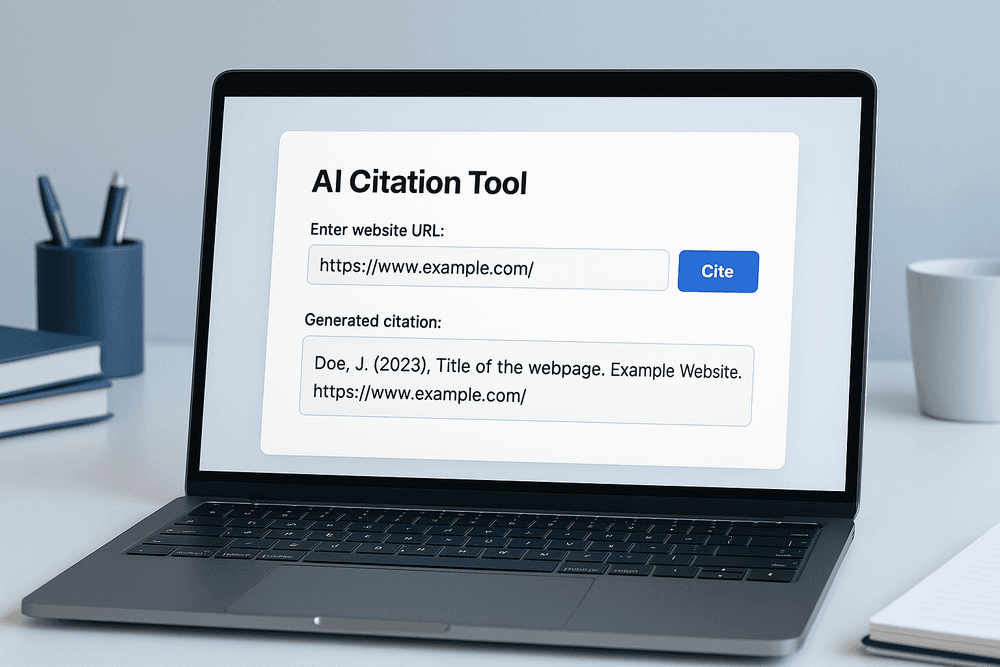
- For Websites and Online Articles: Simply copy and paste the URL into the search bar. The AI will scan the webpage to pull metadata like the author, title, publication date, and website name.
- For Books: Enter the book's title, author, or—for best results—its ISBN (International Standard Book Number). The tool will query vast databases to find the exact edition you used.
- For Academic Journals: Use the article's title or, even better, its DOI (Digital Object Identifier). A DOI is a permanent link that ensures the generator finds the precise article, even if its web address changes.
If the AI can't find your source automatically, or if you're citing something less common like a lecture or an interview, you can always use the manual entry form. Just fill in the fields for the author, title, publication year, and other relevant details, and the generator will format it for you.
Step 2: Select Your Required Citation Style
Once the ai citation generator has gathered your source’s information, your next task is to choose the correct citation style. This is arguably the most powerful feature of the tool. Instead of you needing to memorize the nuanced punctuation and formatting rules for dozens of styles, the AI handles it all with a single click.
Simply select your required format from a dropdown menu. The best generators offer a comprehensive list, including:
- APA (American Psychological Association): Common in social sciences, education, and psychology.
- MLA (Modern Language Association): Widely used in the humanities, such as literature and language studies.
- Chicago (Turabian) Style: Popular in history, fine arts, and some social sciences, with both author-date and notes-bibliography systems.
- Harvard, Vancouver, IEEE, and thousands of other specific styles required by various journals and institutions.
The tool will instantly reformat the citation according to the precise rules of your chosen style, from comma placement to the order of author names.
Step 3: Review and Export the Generated Citation
The AI has done the heavy lifting, but a final human review is essential for 100% accuracy. The ai citation generator will present the formatted reference for your review. Take a few seconds to scan it for any obvious errors or missing information. Does the author’s name look right? Is the title capitalized correctly according to the style guide? A good generator will often flag fields it couldn't find, prompting you to fill them in.
After your quick review, you can export the citation. Most tools allow you to copy and paste it directly into your document’s reference list. Many also offer features to build a complete bibliography as you work, which you can then download as a Word Doc or Google Doc, alphabetized and formatted perfectly.
Pro Tip: Always Double-Check the AI's Output
While an ai citation generator is a game-changer for speed and accuracy, it’s not infallible. It relies on the metadata it can find, and sometimes websites are poorly structured or databases have incomplete entries. Think of the AI as your brilliant but busy research assistant—it does 99% of the work, but you should always give it a final glance. Cross-reference the generated citation with your actual source to ensure the publication year, volume number, or author names are correct. This final, five-second check guarantees academic integrity and a flawless final paper.
Best Practices: Using Your AI Citation Generator Responsibly
An AI citation generator is an undeniable asset in modern academic work, saving countless hours and reducing the mental load of tedious formatting. However, like any powerful tool, it must be used with skill, awareness, and a commitment to academic integrity. Treating it as an infallible magic wand can lead to errors and oversights. To get the most out of your AI citation generator and uphold the highest academic standards, it's crucial to adopt a responsible workflow.
Understanding the Limitations of AI
The first step to responsible use is acknowledging that no AI is perfect. An AI citation generator operates by parsing data and applying formatting rules. While incredibly sophisticated, it can still make mistakes. Here are some common limitations to be aware of:
- Data Misinterpretation: The AI might struggle with unusual source layouts, sometimes confusing an author's name with a publisher or misidentifying a blog post as a formal journal article.
- Incomplete Information: If the source metadata on a webpage or in a PDF is incomplete, the AI can't invent the missing details. It might omit a publication year, volume number, or author, leading to an incomplete citation.
- "AI Hallucinations": In rare cases, if an AI model can't find a specific piece of data like a DOI (Digital Object Identifier), it might generate a plausible but entirely fake one.
- Style Guide Nuances: Citation styles like APA and MLA occasionally release minor updates. While developers work to keep their tools current, there might be a lag, leaving your citation slightly out of sync with the very latest edition.
The Importance of Verifying Primary Source Details
Because of these limitations, the single most important best practice is this: Always verify the output. You, the researcher, are ultimately responsible for the accuracy of your works cited or reference list. The AI citation generator is your assistant, not your replacement.
After generating a citation, cross-reference it with your actual source material. Use this simple verification checklist:
- Author(s): Are all authors listed, spelled correctly, and in the proper order?
- Title: Is the title of the article and the publication (journal, book, website) accurate? Is the capitalization correct for your required style (e.g., sentence case vs. title case)?
- Publication Date: Is the year, and where applicable, the month and day, correct?
- Publication Information: Are the journal volume/issue numbers, publisher name, or website name accurate?
- Locators: Are the page numbers, DOI, or URL correct and functional?
This final check transforms the tool from a potential liability into a reliable time-saver. You let the AI handle the heavy lifting of formatting, while you provide the essential human oversight and quality control.
Avoiding Over-Reliance and Maintaining Academic Integrity
Using an AI citation generator responsibly is a cornerstone of maintaining academic integrity. The tool is designed to format citations for sources you have actually consulted and understood. Citing a source you haven’t read is a serious academic misstep, and no tool can substitute for genuine engagement with research material.
Furthermore, avoid becoming completely dependent on the tool. It's still valuable to understand the basic logic behind the citation style you're using. Knowing why an author's name comes first or why a DOI is important helps you spot errors more quickly and makes you a more competent researcher. Use the AI citation generator to enhance your efficiency, not to replace your critical thinking and scholarly responsibility. Your integrity is your most valuable academic asset; use your tools in a way that protects it.
Conclusion: Let an AI Citation Generator Streamline Your Research
The days of wrestling with punctuation, publication dates, and the subtle differences between citation styles are drawing to a close. As we've explored, the modern academic landscape is being reshaped by powerful, intelligent tools designed to handle the tedious but critical task of citation. An AI citation generator is no longer a futuristic concept but a practical, indispensable asset for students, researchers, and writers. It’s an evolution in academic workflow, freeing up valuable mental energy for what truly matters: research, analysis, and critical thinking.
Recap: Making the Smart Choice for Your Needs
Throughout this guide, we've seen how an AI citation generator saves countless hours, dramatically reduces the risk of formatting errors, and demystifies the complexities of styles like APA, MLA, and Chicago. From websites and journal articles to more obscure sources, these tools provide a consistent and accurate framework for building a professional bibliography.
Remember, the best tool is the one that aligns with your specific requirements. Consider these key factors when making your choice:
- Supported Styles: Does it cover the citation formats required by your institution or field?
- Source Versatility: Can it handle a wide range of source types, from books and articles to videos and digital media?
- Integration: Does it offer browser extensions or word processor add-ons that fit seamlessly into your existing workflow?
- Accuracy and Verification: Does it pull clean metadata and make it easy for you to double-check the information?
By weighing these elements, you can select an AI citation generator that acts as a true partner in your academic journey.
The Future of AI in Academic Research
The current generation of citation tools is just the beginning. The future of AI in academia promises an even deeper level of integration and support. Imagine an AI assistant that not only formats your citations but also helps you discover relevant literature, identify thematic gaps in your research, and even provide summaries of key sources as you work.
We are moving toward a future where research platforms and writing software are imbued with AI that understands context. This AI will not only create a perfect reference list but will also act as a co-pilot, suggesting seminal works you may have missed or flagging sources that are outdated. The role of the AI citation generator will expand from a simple formatter to a comprehensive research associate, further empowering scholars to produce groundbreaking work.
Try an AI Citation Generator for Your Next Paper
There is no better way to understand the transformative power of this technology than to experience it firsthand. If you've been on the fence, we encourage you to take the leap. Start with a free version or a trial for your next essay, lab report, or research paper. Input your sources, select your style, and watch as a perfectly formatted reference list is generated in seconds.
While it’s always best practice to review the final output, you’ll quickly find that an AI citation generator provides a reliable and robust foundation. Adopting this tool isn't just about saving time or avoiding point deductions; it's about modernizing your scholarly process. Embrace the efficiency, enhance your accuracy, and dedicate your focus to the ideas that will shape your field. Your research deserves nothing less.