
September 3, 2025
What is an AI Audit Trail and Why is it Non-Negotiable?
What is an AI Audit Trail and Why is it Non-Negotiable?
As artificial intelligence moves from the lab to the core of our businesses, the "black box" problem is no longer a theoretical debate—it's a critical business risk. How can you prove your AI made a fair lending decision? How do you retrace the steps that led to a faulty diagnosis or a biased hiring recommendation? The answer lies in a comprehensive AI audit trail.
Forget simple server logs that just record API calls and errors. A true AI audit trail is a detailed, chronological, and immutable record of an AI system's entire lifecycle. It’s the definitive story of your model, capturing everything from the data it was trained on to the specific decisions it makes in real-time. Think of it less as a simple log and more as an aircraft's flight data recorder, providing the necessary context to understand not just what happened, but why.
Beyond Simple Logs: What a Robust AI Audit Trail Contains
A modern AI audit trail goes far beyond basic logging. It provides a multi-dimensional view of the system’s behavior, making it the bedrock of responsible AI governance. A complete trail should meticulously document:
- Data Lineage: The specific datasets and versions used for training, validation, and testing. This is crucial for tracing and mitigating bias.
- Model Versioning: Which version of the model was active when a specific decision was made, including its architecture and hyperparameters.
- Decision Inputs & Outputs: A clear record of the data fed into the model for a specific inference (e.g., a loan application) and the resulting output or score.
- Explainability Metrics: The key features or factors that influenced a particular outcome. For example, why was a loan application flagged as high-risk?
- Human Intervention: A log of any manual overrides, reviews, or adjustments made by human operators, creating a clear chain of accountability.
The Rising Stakes: Why Compliance and Transparency Demand It
In today's regulatory landscape, hoping for the best is not a strategy. With frameworks like the EU AI Act and industry-specific regulations taking shape, the ability to demonstrate compliance is non-negotiable. An AI audit trail is your primary evidence. When regulators come knocking, this trail is how you prove your system operates fairly, securely, and within legal boundaries.
Without a robust AI audit trail, transparency is just a buzzword. You cannot explain a model's decision if you haven't recorded the process. This lack of visibility exposes your organization to significant risks, including crippling fines, reputational damage, and a complete loss of operational control over your AI systems.
Building Trust with Users and Regulators
Ultimately, the most valuable asset an AI system can have is trust. An AI audit trail is the technical foundation upon which that trust is built.
- For Users: When customers know that a decision affecting them can be reviewed and explained, their confidence in your services grows. It transforms AI from an opaque, potentially biased authority into a transparent and accountable tool.
- For Regulators: Proactively maintaining a detailed audit trail demonstrates due diligence and a commitment to ethical AI. It shows you are in control of your technology, fostering a collaborative rather than adversarial relationship with oversight bodies.
In short, the AI audit trail is no longer a "nice-to-have" feature for technical debugging. It is a fundamental requirement for legal compliance, risk management, and building a sustainable, trustworthy AI-powered future.

The Core Components of an Effective AI Audit Trail
An AI system's decision-making process can often feel like a black box. To build trust, ensure compliance, and enable effective governance, you need to illuminate what happens inside that box. A robust ai audit trail is your flashlight, and it’s built upon several indispensable components that work together to create a complete, understandable, and verifiable record of your AI's activities.
Tracking Data Lineage: From Input to Decision
Every AI decision starts with data. A foundational component of your ai audit trail is the ability to trace the complete lineage of that data. This isn't just about recording the final input; it's about creating a detailed map of its entire journey.
Effective data lineage tracking logs:
- Data Source: Where did the original data come from? Was it a user submission, a sensor reading, or a third-party database?
- Transformations: What preprocessing steps were applied? This includes cleaning, normalization, feature engineering, and any aggregations.
- Feature Selection: Which specific data points and features were ultimately used by the model to arrive at its conclusion?
By meticulously documenting this path, you can validate the integrity of your inputs, identify potential sources of bias, and provide regulators with a clear explanation of how raw data influenced a specific automated decision. Without it, you’re missing the first chapter of your AI’s story.
Logging Model Versions and Parameters for Reproducibility
AI models are not static; they are constantly being retrained and updated. To audit a decision made six months ago, you can't use the model you have running today. This is where model versioning becomes critical for a meaningful ai audit trail.
True reproducibility requires logging a precise snapshot of the model environment at the time of the decision, including:
- Model Version ID: A unique identifier for the specific trained model artifact.
- Hyperparameters: The configuration settings used during the model’s training (e.g., learning rate, number of layers).
- Training Dataset: A reference or hash of the exact dataset used to train that version.
- Code and Dependencies: The version of the training script and key software libraries.
This level of detail ensures that you can, if required, perfectly reconstruct the past environment to replicate a result, investigate anomalies, or demonstrate operational integrity to auditors.
Recording User Interactions and System Outputs
The technical workings of the model are only part of the picture. An effective ai audit trail must also capture the full context of how the system is used in the real world. This involves logging every interaction and its corresponding result.
Key elements to record include:
- Timestamps: Precise, time-zoned logs for when every event occurred.
- User/System ID: Who or what initiated the request?
- The Query: The exact input or prompt provided to the system.
- The Output: The prediction, recommendation, or content generated by the AI.
- User Feedback: Any subsequent actions or feedback from the user (e.g., accepting a recommendation, flagging an error).
This comprehensive log of inputs and outputs provides an unassailable record of system performance, usage patterns, and potential points of failure, which is invaluable for debugging and compliance investigations.
Ensuring Immutability and Security of Log Data
Finally, an audit trail is worthless if it can be altered. The integrity of your ai audit trail hinges on the immutability and security of the log data itself. Once a record is written, it must be protected from tampering or unauthorized deletion.
Best practices for securing log data include:
- Write-Once Storage: Using systems where data, once written, cannot be changed.
- Cryptographic Hashing: Creating digital fingerprints of logs to detect any modifications.
- Strict Access Controls: Limiting who can view or manage log data to prevent unauthorized access.
- Regular Backups: Securing logs in a separate, secure location to protect against data loss.
By fortifying your logs, you ensure that your ai audit trail serves as a trusted and legally defensible source of truth for all system activities.
Best Practices for Implementing Your AI Audit Trail
Moving from theory to practice requires a strategic approach. A powerful ai audit trail is not merely a collection of log files; it's an integrated, automated, and scalable system that provides a clear, chronological record of your AI’s entire lifecycle. Implementing one effectively transforms it from a simple compliance checkbox into a strategic asset for transparency, debugging, and risk management. Here are the core best practices to follow.
Automate Log Collection Across the AI Lifecycle
Manual logging is a non-starter for complex AI systems. It's inconsistent, prone to human error, and simply cannot keep up with the speed and scale of modern MLOps. To build a trustworthy ai audit trail, automation is essential at every stage:
- Data & Development: Automatically log data sources, versioning, feature engineering steps, and preprocessing transformations.
- Training & Validation: Capture training parameters, code versions, evaluation metrics, and the specific dataset hash used to train each model version.
- Deployment & Inference: Record every deployment event, the production environment, API calls, inference inputs (or hashes for privacy), model outputs, and confidence scores.
- Monitoring & Feedback: Log post-deployment performance metrics, data drift alerts, user feedback, and the triggers for any retraining cycles.
By embedding automated logging directly into your CI/CD and MLOps pipelines, you ensure a complete, unassailable record from initial data ingestion to model retirement.
Standardize Formats for Easier Analysis and Reporting
An ai audit trail compiled from disparate, unstructured sources is nearly impossible to analyze efficiently. To unlock its value, you must enforce a standardized logging format across all services and components. Structured formats like JSON are ideal because they are both human-readable and easily parsed by machines.
Establish a clear, consistent schema for all log entries. Key fields to standardize include:
- Universal Timestamps: Use UTC to avoid any ambiguity across different time zones and systems.
- Consistent Event Taxonomy: Define a clear naming convention for events (e.g.,
model.train.start,api.inference.success). - Unique Identifiers: Assign unique IDs to every model, dataset version, user request, and session.
- Immutable Versioning: Clearly log the specific versions of models, code, and data involved in any action.
Standardization streamlines data aggregation, enabling rapid querying, faster incident response, and simplified dashboarding for compliance and operational reviews.
Integrate the AI Audit Trail with Your Compliance Framework
Your ai audit trail is a primary tool for demonstrating regulatory compliance. Instead of treating it as a separate technical task, integrate its design and outputs directly with your governance, risk, and compliance (GRC) framework.
- GDPR: Use your audit trail to document the lawful basis for data processing, track data lineage, and efficiently respond to Data Subject Access Requests (DSARs) by showing precisely how an individual's data was used.
- EU AI Act: For systems classified as high-risk, the AI Act mandates robust logging capabilities. Your audit trail is the mechanism to meet these requirements, providing regulators with the necessary evidence on data governance, system performance, and human oversight.
By mapping log events to specific regulatory articles, you build a compliance-native system that makes audits smoother and less resource-intensive.
Plan for Scalability and Long-Term Storage
Production AI models generate a massive volume of log data. A system that works for a single model in testing will quickly fail under the load of multiple models serving thousands of requests per minute. Planning for scale is critical.
- Embrace Cloud Storage: Utilize scalable and cost-effective solutions like Amazon S3, Azure Blob Storage, or Google Cloud Storage.
- Implement Data Tiering: Create a data retention policy based on regulatory and business needs. Use automated lifecycle policies to move older, less-frequently-accessed logs to cheaper archival "cold" storage, optimizing costs.
- Deploy an Efficient Query Engine: Storing data is only half the battle. You need a powerful platform like Elasticsearch, Splunk, or a dedicated data warehouse to index, search, and analyze petabytes of log data quickly when an incident occurs or an auditor asks.
Choosing the Right Tools for Your AI Audit Trail
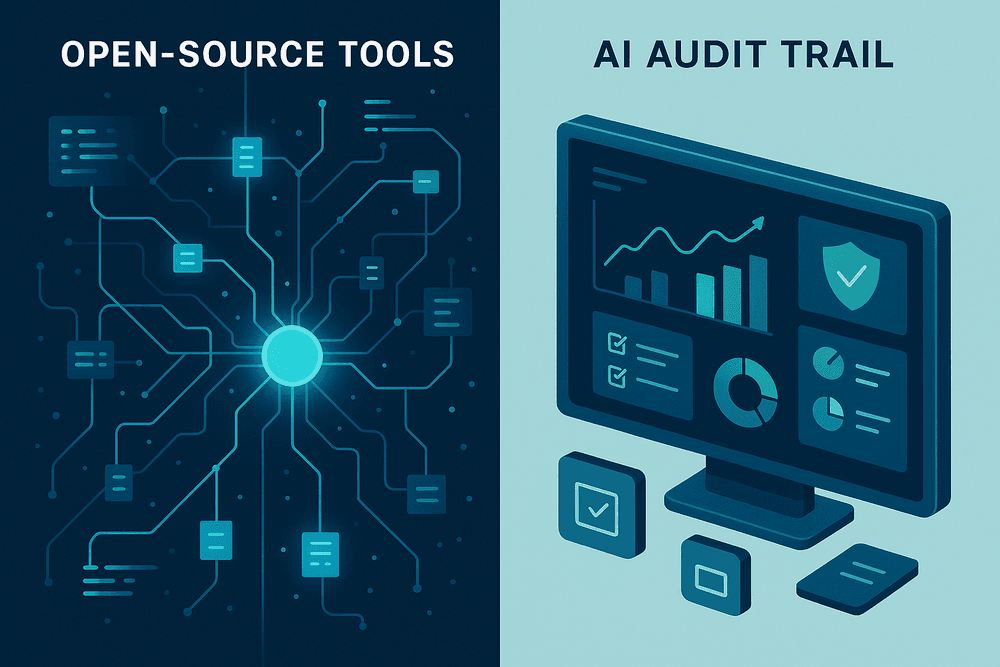
Selecting the right technology is foundational to creating a robust, reliable, and compliant AI audit trail. The market offers a wide array of options, from flexible open-source projects to comprehensive commercial platforms. Your choice will directly impact your team's efficiency, your system's scalability, and your ability to meet regulatory demands. This decision involves balancing cost, technical resources, and specific feature requirements.
Open-Source Solutions vs. Commercial MLOps Platforms
The first major decision point is whether to build your AI audit trail system using open-source components or invest in a commercial MLOps platform. Each path has distinct advantages and disadvantages.
Open-Source Tools (e.g., MLflow, DVC)
- Pros: Highly flexible and customizable, allowing you to tailor the solution precisely to your needs. They are cost-effective upfront and benefit from strong community support and rapid innovation.
- Cons: Require significant in-house technical expertise to implement, integrate, and maintain. Scaling and ensuring enterprise-grade security can become a complex engineering challenge. You are responsible for your own support and updates.
Commercial MLOps Platforms (e.g., Databricks, Amazon SageMaker, Weights & Biases)
- Pros: Offer end-to-end, turnkey solutions with dedicated customer support, built-in security features, and user-friendly interfaces designed for collaboration between technical and non-technical stakeholders. They often come with pre-built compliance and governance features.
- Cons: Can be expensive and may lead to vendor lock-in, making it difficult to migrate to other systems later. Customization might be more limited compared to open-source alternatives.
Ultimately, the right choice depends on your organization's scale, budget, regulatory exposure, and engineering capacity.
Key Features to Look For in an AI Audit Trail Tool
Regardless of your choice between open-source and commercial, any tool you consider for your AI audit trail must possess a core set of features to be effective.
- Immutability and Verifiability: The integrity of an audit trail is paramount. The tool must ensure that logs, once written, cannot be altered or deleted. Look for features like cryptographic hashing, version control, or write-once-read-many (WORM) storage capabilities.
- Automated Lineage Tracking: Manually logging every step is prone to error. A powerful tool will automatically capture the complete data and model lineage—tracking everything from the raw dataset version used for training, to the specific code commit, hyperparameters, and the resulting model artifact.
- Granularity and Context: Your logs must capture rich, contextual information. This includes not just the event itself, but also the user responsible, a precise timestamp, the model version, input data identifiers, and the resulting output or decision.
- Advanced Search and Visualization: A vast repository of logs is useless if you can't navigate it. Effective tools provide powerful query languages, indexed search, and intuitive dashboards that allow auditors and developers to quickly filter, analyze, and visualize the AI audit trail to pinpoint specific events.
- Role-Based Access Control (RBAC): Sensitive information will inevitably be part of your audit trail. Robust RBAC is essential to ensure that only authorized personnel can access or manage specific logs, protecting privacy and enhancing security.
Integrating Logging Frameworks into Your Existing Tech Stack
A tool is only effective if it fits seamlessly into your team's workflow. Prioritize solutions that offer straightforward integration with your existing infrastructure. Look for well-documented APIs and SDKs (Software Development Kits), especially for languages like Python, that allow developers to easily embed logging commands into their ML pipelines and applications. The tool should also have pre-built connectors for your cloud provider (AWS, GCP, Azure), data storage systems, and CI/CD tools to create a truly unified and automated AI audit trail.
The AI Audit Trail in Action: Real-World Use Cases
Theoretical discussions are valuable, but the true power of an AI audit trail becomes clear when applied to real-world, high-stakes scenarios. It’s the definitive record that turns ambiguity into evidence, enabling accountability, fairness, and security. Let’s explore how this crucial tool functions across different industries.
Debugging a Biased Algorithm in Financial Lending
Imagine a bank deploys a new AI model to automate loan approvals. Soon, they notice a statistically significant drop in approvals for applicants from specific neighborhoods, sparking concerns of algorithmic bias. Without a proper AI audit trail, identifying the root cause is a nightmare of guesswork.
With a detailed log, however, the process becomes a forensic investigation. Auditors can trace individual applications that were unfairly rejected. The AI audit trail reveals the exact input data used (income, credit score, location), the model version that processed it, and the specific features the algorithm weighed most heavily. They might discover the model was assigning a disproportionately negative weight to certain zip codes, a proxy for racial or economic bias. This concrete evidence allows developers to retrain the model with corrected data and demonstrate to regulators that they have proactively identified and fixed the issue.
Proving Compliance in Healthcare Diagnostic AI
In healthcare, an AI that analyzes MRI scans to detect tumors must be both accurate and compliant with strict regulations like HIPAA. Suppose a regulator questions whether the system is performing as validated or if patient data is being handled securely.
The AI audit trail provides the necessary proof. It contains an immutable record of every scan processed, including the timestamp, the specific model version used for the diagnosis, the resulting output, and which authorized personnel accessed the data. This log can be used to prove to bodies like the FDA that the AI's performance is consistent and reliable over time. Furthermore, it demonstrates HIPAA compliance by showing a clear, auditable history of data access, ensuring patient confidentiality was never compromised.
Tracing a Security Incident in an Autonomous System
Consider a fleet of autonomous warehouse robots. One day, a group of them suddenly deviates from its designated path, causing a collision and halting operations. Was it a software bug, a sensor malfunction, or a malicious cyberattack?
The AI audit trail acts as the system's "black box." Security analysts can immediately pull the logs from the affected robots. They can reconstruct the timeline of events, examining the stream of data from cameras and sensors, the commands received from the central server, and the internal decisions the AI made leading up to the incident. The trail might reveal a set of anomalous network packets received just moments before the deviation, pointing directly to an external breach. This allows the company to patch the vulnerability and secure the entire fleet.
Validating AI-Driven Hiring Decisions for Fairness
A large corporation uses an AI tool to screen thousands of resumes for a new engineering role. When challenged to prove its hiring process is fair and non-discriminatory, the company turns to its records. A vague explanation that "the AI chose the best candidates" is insufficient and legally risky.
A robust AI audit trail, however, provides a transparent defense. It logs why each candidate was scored the way they were, highlighting the skills, keywords, and experience metrics the model identified in each resume. This allows internal and external auditors to analyze the decision-making criteria across the entire applicant pool. They can verify that the AI did not unfairly penalize candidates based on gendered language or names associated with specific ethnicities, ensuring compliance with equal opportunity employment laws and building trust in their HR technology.

Conclusion: Future-Proofing Your AI with a Proactive Audit Strategy
The era of treating AI as a "black box" is over. As we've explored, building trust, ensuring compliance, and maintaining operational excellence hinges on one critical component: a comprehensive AI audit trail. This isn't a bureaucratic chore to be tackled after a system is deployed; it is a strategic imperative that underpins the entire AI lifecycle. By proactively documenting every step of your AI's journey—from data sourcing to model decision-making—you are not just meeting regulatory demands. You are building a resilient, transparent, and trustworthy AI framework that can adapt to future challenges and drive sustainable innovation. A robust AI audit trail is your organization's definitive record of diligence, accountability, and control.
Building a Resilient AI Audit Trail: Your Key Takeaways
To transform this understanding into action, focus on these core principles. They are the pillars of a successful and future-proof AI governance strategy.
- Embrace Proactivity Over Reactivity: The most effective AI audit trail is one that is designed into your system from the very beginning. Waiting for a regulatory inquiry, a model failure, or a security breach to think about logging is a recipe for disaster. Integrate auditing requirements into the initial design phase of any AI project.
- Prioritize Comprehensive Data Capture: A partial log is a partial defense. Your audit trail must be exhaustive, covering data lineage, preprocessing steps, model versions, training parameters, inference requests, final outputs, and the rationale behind automated decisions. This end-to-end visibility is non-negotiable for effective debugging and compliance.
- Leverage Automation and Specialized Tools: Manually logging AI activities is not scalable, reliable, or secure. Implementing automated logging solutions and MLOps platforms is essential. These tools ensure every critical event is captured consistently, timestamped accurately, and stored immutably, creating an AI audit trail that stands up to scrutiny.
- Make Accessibility and Clarity a Goal: An audit log is only valuable if it can be understood. Ensure your trail is structured, searchable, and accessible to relevant stakeholders, including auditors, data scientists, and compliance teams. The ability to quickly query and interpret the data is crucial during an incident or audit.
How to Start Your AI Auditing Journey Today
Getting started doesn't have to be overwhelming. You can begin laying the groundwork for a world-class auditing practice right now by following these three steps:
- Assemble a Cross-Functional Team: AI governance is a team sport. Bring together leaders from your legal, compliance, data science, and IT departments to define your auditing goals. This collaboration ensures your AI audit trail captures the necessary information to satisfy regulatory, technical, and business requirements.
- Define and Document Your Logging Policy: What needs to be tracked? Why? And for how long? Create a formal policy that outlines the specific events, data points, and metadata to be included in your audit logs. Align this policy with relevant regulations like the EU AI Act, GDPR, or industry-specific standards.
- Conduct a Pilot Project: Choose a single, manageable AI application to implement your new auditing strategy. Use this pilot to test your chosen tools, refine your logging policy, and demonstrate the value of a robust AI audit trail to the wider organization before scaling your efforts.
Your Blueprint for Success: Download Our Free Checklist
Ready to put these principles into practice? Don't leave your AI compliance to chance. Our free AI Audit Trail Checklist provides a step-by-step blueprint to help you design and implement a comprehensive auditing framework. This practical resource will guide you through the essential components, from defining requirements to selecting the right tools.
[Download Your Free AI Audit Trail Checklist Now]