
November 16, 2025
What is AI Trend Forecasting and Why Is It a Game-Changer?
What is AI Trend Forecasting and Why Is It a Game-Changer?
In a world saturated with data, the ability to predict the future is no longer a matter of intuition or guesswork; it's a science. AI trend forecasting is the application of artificial intelligence, machine learning (ML), and big data analytics to identify emerging patterns and predict future market and consumer behavior. It’s a quantum leap from looking in the rearview mirror to using a forward-facing radar, allowing businesses to anticipate shifts before they happen and make decisions with unprecedented confidence.
This advanced approach analyzes vast, complex datasets in real-time—from social media chatter and search engine queries to economic indicators and competitor activities—to provide a dynamic, data-driven glimpse of what’s to come.
Moving Beyond Traditional Forecasting Methods
For decades, businesses relied on traditional forecasting methods. These typically involved analyzing historical sales data, conducting market surveys, and leaning on the experience of industry experts. While valuable, these methods have significant limitations in today’s fast-paced digital economy:
- Reactive: They are often based on past events, making it difficult to anticipate sudden or disruptive changes.
- Slow: Manual data collection and analysis can take weeks or months, by which time the trend may have already peaked.
- Biased: Human interpretation is susceptible to cognitive biases and may overlook subtle but crucial patterns.
- Limited Scope: They struggle to process the sheer volume, velocity, and variety of unstructured data available today (e.g., videos, reviews, social posts).
AI trend forecasting shatters these limitations, transforming the process from a reactive, historical analysis into a proactive, predictive strategy.
How AI Analyzes Data to Predict What's Next
At its core, AI trend forecasting works by deploying sophisticated algorithms to sift through immense digital landscapes and find the signal in the noise. The process is multi-layered:
- Data Ingestion: AI systems gather data from countless sources, including social media platforms, news outlets, academic papers, e-commerce sites, and internal company data.
- Pattern Recognition: Using technologies like Natural Language Processing (NLP), AI understands the context, sentiment, and meaning within unstructured text and conversations. It identifies recurring themes, keywords, and emotional shifts.
- Predictive Modeling: Machine learning algorithms, such as time-series analysis and regression models, analyze these patterns to forecast their trajectory. The AI learns from historical data to understand how trends emerge, evolve, and fade, allowing it to predict the lifecycle of a new trend with increasing accuracy.
- Insight Generation: The system synthesizes its findings into actionable insights, often presented through intuitive dashboards that highlight key opportunities and potential risks.
This allows a business to see not just what is trending, but to understand the underlying drivers and predict how that trend will impact their specific industry.
The Core Business Value of Proactive Insights
The shift from reactive analysis to predictive insight is what makes AI trend forecasting a true game-changer. The value isn’t just in knowing what’s next; it’s in being able to act on that knowledge decisively. Businesses that leverage this technology gain a powerful competitive edge by:
- Optimizing Product Development: Launching products that meet future consumer demand, not past preferences.
- Sharpening Marketing Campaigns: Crafting messages that resonate with emerging cultural sentiments and consumer interests.
- Improving Inventory Management: Aligning stock levels with predicted demand to avoid costly overstock or stockouts.
- Mitigating Risk: Identifying potential PR crises, negative market shifts, or disruptive competitor moves early on.
Ultimately, AI trend forecasting empowers organizations to move from guessing to knowing, transforming strategic planning into a precise, data-backed discipline that drives growth and secures market leadership.
The Core Technologies Driving AI Trend Forecasting
At its core, AI trend forecasting isn't a single piece of technology but a powerful synergy of several advanced disciplines. It’s the combination of these components that allows businesses to move beyond simple historical analysis and into the realm of true predictive insight. By understanding the engine behind the curtain, you can better appreciate how AI transforms raw data into a strategic roadmap for the future. Let's break down the three pillars that make it all possible.
Machine Learning Models for Predictive Analytics
The heart of AI trend forecasting beats with machine learning (ML). These sophisticated algorithms are the workhorses that analyze historical data to identify patterns, learn from them, and make calculated predictions about future events. Unlike traditional statistical methods that rely on pre-set assumptions, ML models can adapt and refine their understanding as new data flows in, becoming more accurate over time.
For forecasting, technologies like time-series analysis models (e.g., ARIMA, Prophet) are used to predict future values based on past data points, making them ideal for sales or stock forecasting. Regression algorithms help uncover the relationships between different variables—for instance, how marketing spend and seasonality impact product demand. By processing vast datasets, these ML models build a complex, data-driven view of what's likely to happen next, providing the quantitative foundation for every trend forecast.
Natural Language Processing (NLP) for Sentiment Analysis
While numbers tell us what is happening, they often can't tell us why. This is where Natural Language Processing (NLP) comes in. NLP is a branch of AI that gives computers the ability to understand, interpret, and derive meaning from human language. In the context of AI trend forecasting, its most powerful application is sentiment analysis.
NLP algorithms can sift through millions of online conversations—from social media posts and customer reviews to news articles and forum discussions—to gauge public emotion and opinion. Is the buzz around a new product positive, negative, or neutral? Is a competitor’s new campaign generating excitement or backlash? By analyzing this unstructured text data, sentiment analysis adds a crucial layer of qualitative context. It helps you understand the human drivers behind emerging trends, turning a simple data spike into a rich, actionable narrative.
The Role of Big Data in Uncovering Hidden Patterns
Machine learning models are incredibly powerful, but they are also incredibly hungry for data. Big Data is the fuel that powers the entire AI trend forecasting engine. We’re not just talking about your internal sales figures; we’re talking about a massive, diverse ecosystem of information. This includes structured data (like transaction records and web traffic) and, more importantly, unstructured data (like videos, images, social media content, and weather reports).
A human analyst could never hope to process this volume and variety of information. AI, however, thrives on it. By analyzing these colossal datasets, AI can uncover subtle, non-obvious correlations and hidden patterns that would otherwise go unnoticed. It might discover a link between local weather patterns and the demand for a specific grocery item, or a correlation between a viral TikTok sound and a surge in e-commerce traffic. It is this ability to connect disparate dots across a vast data landscape that elevates AI trend forecasting from an educated guess to a strategic advantage.
Key Benefits of Integrating AI Trend Forecasting Into Your Strategy
In a market defined by rapid change, relying on historical data and human intuition alone is no longer enough to stay ahead. Integrating AI trend forecasting into your core strategy moves your business from a reactive stance to a proactive one, unlocking significant advantages across your entire operation. By leveraging artificial intelligence to analyze data at an unprecedented scale and speed, you can anticipate what’s next and act on it with confidence.
Achieve Higher Accuracy and Speed in Market Analysis
Traditional market analysis is often a slow, labor-intensive process prone to human bias and limited by the amount of data a team can realistically process. It can take weeks or even months to compile reports, by which time the insights may already be obsolete.
This is where AI trend forecasting fundamentally changes the game. AI algorithms can:
- Process Massive Datasets: Sift through billions of data points in near real-time, including unstructured data like social media posts, customer reviews, news articles, and search engine queries.
- Identify Complex Patterns: Uncover subtle correlations and non-linear patterns that are invisible to the human eye, connecting seemingly unrelated events to predict an emerging trend.
- Eliminate Human Bias: Base predictions on objective data analysis rather than preconceived notions or gut feelings, leading to more reliable and accurate forecasts.
By automating this complex analysis, businesses can shrink their research timelines from months to mere hours, all while increasing the confidence and accuracy of their strategic decisions.
Gain a Competitive Edge with Real-Time Trend Detection
The ability to identify a trend before it becomes mainstream is a powerful competitive advantage. AI trend forecasting acts as a 24/7 early warning system, constantly scanning the digital landscape for the faint signals that precede a major shift. While competitors are waiting for industry reports to confirm a trend, your organization can already be capitalizing on it.
This real-time capability allows you to:
- Be a First-Mover: Spot niche "micro-trends" as they emerge and introduce innovative products or services that meet a new demand before anyone else.
- Pivot with Agility: Quickly recognize when consumer interest is waning in a particular area, allowing you to shift resources away from declining trends and toward rising ones.
- Anticipate Competitor Moves: By monitoring the same data streams your competitors are likely influenced by, AI can help predict their next strategic actions.
Optimize Inventory, Marketing, and Financial Planning
The predictive power of AI trend forecasting has a direct and measurable impact on core business functions, transforming guesswork into data-driven precision.
- Inventory Management: By accurately forecasting demand for specific products, you can virtually eliminate costly overstocking and frustrating stockouts. AI helps you understand not just what will be popular but when and where, enabling a leaner, more efficient supply chain that responds directly to consumer behavior.
- Marketing Strategy: Move beyond generic campaigns and connect with your audience on a deeper level. AI insights reveal the topics, aesthetics, and values that are resonating with consumers right now. This allows your marketing team to create highly relevant and timely campaigns, allocate budget to the most effective channels, and tailor messaging for maximum impact.
- Financial Planning: Stronger forecasts lead to stronger financial models. With data-backed predictions for revenue and market growth, you can allocate capital more confidently, justify investments in new ventures, and manage financial risk by anticipating potential market volatility or shifts in consumer spending habits.
Real-World Use Cases: AI Trend Forecasting in Action
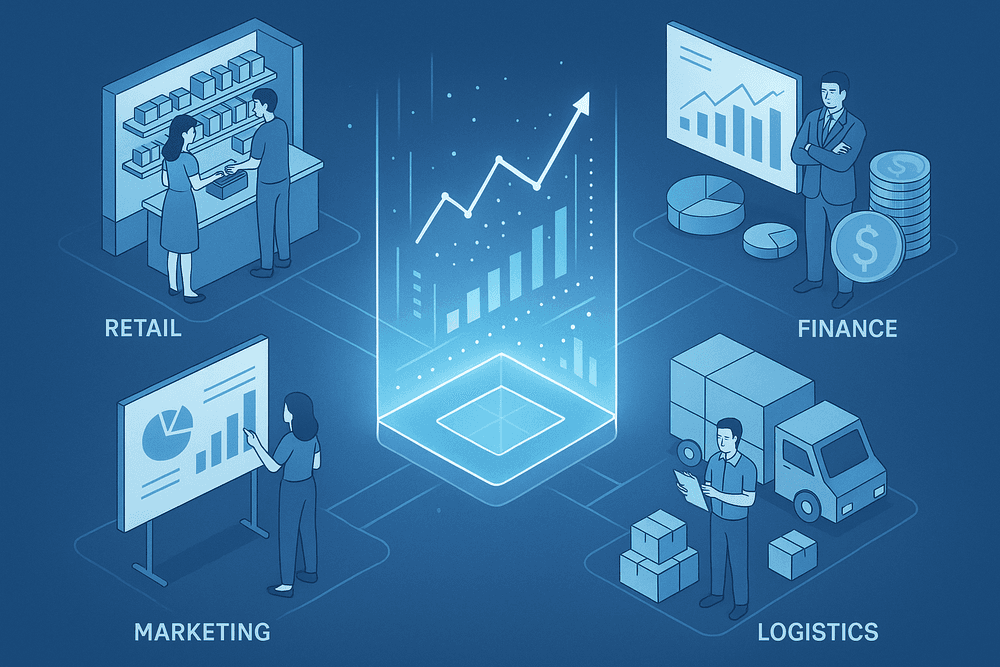
The theory behind AI-powered trend forecasting is compelling, but its true value shines in its practical application. Across diverse industries, businesses are moving beyond guesswork and reactive strategies, using AI to anticipate what's next and make proactive, data-driven decisions. Let's explore how AI trend forecasting is revolutionizing key sectors.
Predicting Consumer Behavior in Retail and E-commerce
In the fast-paced world of retail, staying ahead of consumer desire is the key to success. AI trend forecasting models analyze a massive array of data points—from social media mentions and influencer posts to search engine queries and online reviews—to identify emerging product trends before they hit the mainstream. For example, a fashion retailer can use AI to detect subtle shifts in color palettes, fabric preferences, or silhouette styles, allowing them to optimize inventory, design new collections, and launch marketing campaigns that land with maximum impact. This capability helps businesses avoid costly overstock of unpopular items and ensures they have the "it" product ready when demand peaks.
Anticipating Market Shifts in Finance and Investing
The financial markets are notoriously volatile, but AI trend forecasting is providing a new level of insight. Sophisticated algorithms can process global news, financial statements, social media sentiment, and macroeconomic indicators in real-time to identify patterns that might signal a market shift. Investment firms use these tools to anticipate stock price movements, predict currency fluctuations, and manage portfolio risk more effectively. By spotting emerging market opportunities or potential downturns earlier than human analysts could, financial institutions can optimize their trading strategies and protect their assets with greater precision.
Identifying Viral Topics for Content and Marketing Teams
For marketing and content creation teams, relevance is currency. AI trend forecasting acts as a powerful radar, scanning the digital landscape to pinpoint topics that are gaining traction. By analyzing keyword data, online forum discussions, and social media conversations, AI can predict which subjects are about to go viral. This allows a brand to create timely and resonant content—be it a blog post, a video, or a social media campaign—that captures audience interest at its peak. Instead of joining a conversation late, companies can now lead it, establishing themselves as thought leaders and significantly boosting engagement.
Streamlining Supply Chain and Logistics Management
An efficient supply chain is the backbone of many businesses. AI trend forecasting is crucial for optimizing demand planning and logistics. By analyzing historical sales data alongside external factors like weather patterns, upcoming holidays, and even local events, AI can predict surges or lulls in demand with remarkable accuracy. A beverage company, for instance, can anticipate a spike in demand for a particular drink based on a forecasted heatwave and adjust its production and distribution schedules accordingly. This foresight prevents stockouts, reduces carrying costs for excess inventory, and ensures products are in the right place at the right time, creating a more resilient and cost-effective supply chain.
Best Practices for Implementing AI Trend Forecasting
Adopting AI for trend forecasting is more than just plugging in a new piece of software; it's about building a robust, intelligent system that empowers your decision-making. To move from theoretical potential to tangible results, you need a strategic approach. By following these best practices, you can build an effective ai trend forecasting framework that delivers a true competitive advantage.
Choosing the Right AI-Powered Forecasting Tools
Not all AI platforms are created equal. The market is filled with options, from all-in-one enterprise suites to specialized niche tools. Selecting the right one is the foundational step for success.
- Assess Your Specific Needs: Do you need to forecast retail demand, financial market shifts, or social media sentiment? A tool excelling in one area may not be optimal for another. Define your primary objectives first.
- Evaluate Integration Capabilities: Your AI tool must seamlessly connect with your existing data ecosystem (e.g., CRM, ERP, and data warehouses). Poor integration creates data silos and manual work, defeating the purpose of automation.
- Prioritize Scalability and Flexibility: Your business will grow, and market dynamics will change. Choose a tool that can scale with your data volume and adapt its models as new information becomes available.
- Look for User-Friendly Interfaces: The most powerful insights are useless if your team can't access or understand them. An intuitive dashboard and clear data visualizations are crucial for widespread adoption and action.
Ensuring High-Quality Data for Reliable Predictions
The golden rule of artificial intelligence is "garbage in, garbage out." The accuracy of your ai trend forecasting model is entirely dependent on the quality of the data you feed it.
- Cleanse and Standardize: Before implementation, conduct a thorough data audit. This involves removing duplicates, correcting errors, handling missing values, and ensuring consistent formatting across all data sources.
- Aggregate Diverse Data Sources: The most powerful predictions come from a rich, multi-faceted dataset. Combine internal data (historical sales, customer behavior) with external sources (social media trends, economic indicators, competitor activity, weather patterns) to create a holistic view of the market.
- Ensure Data Relevance: Use data that is directly relevant to the trends you want to predict. While vast datasets are good, an overload of irrelevant information can introduce noise and confuse the model, leading to less accurate forecasts.
Integrating AI Insights with Human Expertise
The most successful implementations of ai trend forecasting don't replace human experts—they empower them. AI is brilliant at identifying complex patterns and correlations at a scale impossible for humans, but it lacks context, intuition, and strategic creativity.
Create a "human-in-the-loop" system where AI provides the data-driven predictions, and your team provides the strategic oversight. For example, an AI might predict a surge in demand for a specific product, but a human analyst can contextualize that insight by linking it to an upcoming cultural event or a viral marketing campaign, then shaping the appropriate inventory and marketing response. This collaboration turns raw data into actionable business intelligence.
Avoiding Common Pitfalls in Your Forecasting Model
As you build and deploy your model, be mindful of several common traps that can undermine its effectiveness.
- Overfitting: This occurs when a model learns the training data too well, including its noise and random fluctuations. As a result, it performs poorly when presented with new, real-world data. Regularly test your model against unseen data to ensure it can generalize effectively.
- Ignoring Inherent Bias: If your historical data contains biases (e.g., favoring a certain demographic), your AI model will learn and amplify them, leading to skewed and unfair predictions. Proactively identify and mitigate bias in your training datasets.
- Forgetting Model Maintenance: The market is not static. A model built today will become less accurate over time as consumer behaviors and external factors change. Implement a schedule for regularly retraining and updating your model with fresh data to maintain its predictive power.

The Future Is Predictive: Your Next Steps in AI Trend Forecasting
The ability to look around the corner and anticipate what's next is no longer a matter of intuition—it's a science, powered by data. As we've explored, AI trend forecasting is transforming how businesses strategize, innovate, and compete. But the technology isn't standing still. The predictive horizon is expanding, and staying ahead means preparing for what's coming. This section outlines the emerging innovations in predictive AI and provides a clear roadmap for integrating these powerful capabilities into your business.
Emerging Innovations in Predictive AI Technology
The field of AI is evolving at a breakneck pace, and the tools for AI trend forecasting are becoming more sophisticated. Keep an eye on these groundbreaking developments:
- Generative AI for Scenario Modeling: Beyond just predicting a single outcome, generative AI models can create multiple, highly detailed future scenarios. Imagine simulating how a new product might perform in a dozen different economic climates or how consumer behavior might shift in response to various marketing campaigns. This allows for more robust and resilient strategic planning.
- Causal AI: While traditional machine learning excels at identifying correlations, causal AI aims to understand the "why" behind the data. By uncovering the true cause-and-effect relationships driving trends, businesses can make more impactful interventions. Instead of just knowing that sales will dip, you’ll understand why and what levers to pull to change the outcome.
- Explainable AI (XAI): As forecasting models become more complex, the "black box" problem can be a barrier to trust and adoption. XAI techniques are making AI models more transparent, providing clear explanations for their predictions. This is crucial for gaining buy-in from stakeholders and for ensuring regulatory compliance.
How to Prepare Your Business for a Predictive Future
Transitioning to a data-driven, predictive model requires more than just new software. It demands a strategic shift in culture, skills, and infrastructure. Here’s how to get started:
- Fortify Your Data Foundation: High-quality AI trend forecasting relies on high-quality data. Begin by auditing your data sources. Ensure your data is clean, centralized, and accessible. Invest in a modern data infrastructure that can handle large volumes of structured and unstructured data, from sales figures to social media sentiment.
- Develop AI-Ready Talent: Your people are your greatest asset. Invest in upskilling your current teams in data literacy, analytics, and AI principles. Identify key roles, such as data scientists and AI specialists, that may need to be hired to lead your forecasting initiatives. Foster a culture of curiosity where data-driven insights are valued and acted upon.
- Start with a Pilot Project: You don’t need to overhaul your entire operation overnight. Identify a specific, high-impact business question that AI trend forecasting can help answer. This could be optimizing inventory for a key product line or predicting customer churn in a specific segment. A successful pilot project builds momentum, demonstrates ROI, and provides invaluable lessons for a wider rollout.
- Choose the Right Tools: Evaluate whether an off-the-shelf AI platform or a custom-built solution is right for you. Many excellent SaaS platforms offer powerful forecasting capabilities with a lower barrier to entry. Whatever path you choose, prioritize tools that are scalable, integrate with your existing systems, and align with your long-term strategic goals.
The journey into AI trend forecasting is a marathon, not a sprint. By laying the groundwork now—investing in your data, people, and technology—you position your organization not just to react to the future, but to actively shape it. The predictive age is here, and the businesses that embrace it will define the next era of industry leadership.