
August 18, 2025
What Is AI Text Analysis and Why Is It a Game-Changer?
What Is AI Text Analysis and Why Is It a Game-Changer?
At its core, AI text analysis is the process of teaching computers to understand, interpret, and derive meaningful insights from human language. Think about the massive volumes of text your business interacts with every day: customer emails, support tickets, social media comments, product reviews, and survey responses. This is unstructured data—a goldmine of information that, until recently, was incredibly difficult to mine at scale. AI text analysis provides the key to unlocking it, transforming messy, raw text into structured, actionable intelligence.
From Raw Data to Actionable Intelligence
Historically, businesses have been great at collecting data but struggled to make sense of it. Customer feedback sits in spreadsheets, and important comments are buried in thousands of social media mentions. This is where AI text analysis steps in to act as a tireless, brilliant analyst. It doesn't just count words; it comprehends meaning.
Using advanced technologies like Natural Language Processing (NLP) and machine learning, AI models can automatically:
- Identify topics and themes across thousands of documents.
- Detect the sentiment (positive, negative, or neutral) in a customer review.
- Extract key entities like names, places, and brands.
- Understand the intent behind a customer query (e.g., are they asking a question, making a complaint, or giving a compliment?).
This process turns a tidal wave of incomprehensible data into a clear dashboard of insights, allowing you to understand what people are saying, how they feel, and why—in real time.
The Evolution Beyond Simple Keyword Matching
Early forms of text analysis were limited to simple keyword matching and word clouds. These tools could tell you which words appeared most frequently but lacked any real understanding. They couldn't differentiate between "I love your fast service" and "Your service is not fast." Both contain the keyword "fast," but the context is completely different.
Modern AI text analysis represents a quantum leap forward. It moves beyond keywords to understand context, nuance, sarcasm, and relationships between words in a sentence. It can recognize that "unbelievably good" is high praise, while "unbelievably slow" is a major complaint. This sophisticated comprehension is what makes the insights generated so reliable and powerful. It’s the difference between merely listening to your customers and truly understanding them.
How AI Text Analysis Unlocks Business Value
So, why is this a game-changer? Because understanding text at scale directly translates to smarter business decisions and a significant competitive advantage. By implementing AI text analysis, organizations can:
- Elevate Customer Experience: Instantly analyze all customer feedback to identify common pain points, resolve issues faster, and proactively improve products and services based on what customers are actually asking for.
- Automate and Streamline Operations: Automatically categorize incoming support tickets, route inquiries to the correct department, and process documents like invoices or contracts, freeing up valuable human resources for more strategic tasks.
- Monitor Brand Health: Track brand mentions and sentiment across the web to manage your reputation, respond to PR crises before they escalate, and understand public perception.
- Drive Market Research: Analyze industry trends, competitor strategies, and customer reviews for competing products to uncover market gaps and opportunities for innovation.
Ultimately, AI text analysis bridges the critical gap between having data and using it effectively. It empowers businesses to make data-driven decisions based on the authentic voice of their customers, employees, and the market.
How Does AI Text Analysis Actually Work? Core Techniques Explained
Ever wonder what goes on "under the hood" of an AI text analysis platform? It’s not magic—it's a powerful combination of machine learning and natural language processing (NLP) techniques designed to understand language like a human, but at a massive scale. By breaking down complex text into manageable parts, these core methods turn unstructured data into structured, actionable insights.
Let's explore the four fundamental techniques that power modern text analytics.
Sentiment Analysis: Understanding Customer Emotion at Scale
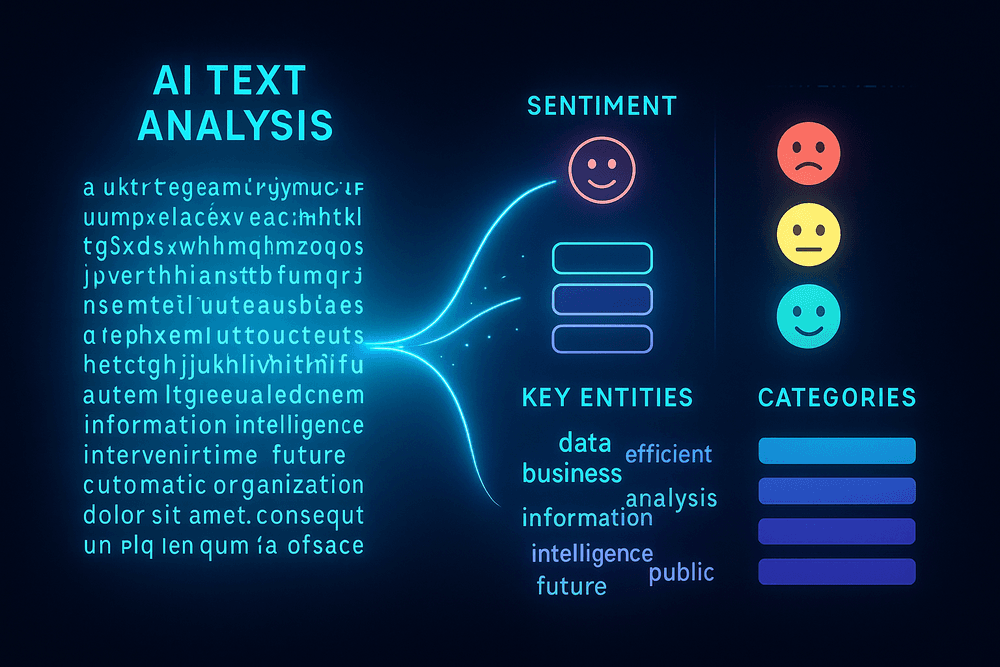
At its core, sentiment analysis gauges the emotional tone behind a piece of text. It automatically determines whether the underlying opinion is positive, negative, or neutral. More advanced models can even detect specific emotions like joy, anger, or frustration.
- How it Works: The AI is trained on vast datasets of text that have been pre-labeled with their sentiment. It learns to associate certain words, phrases, emojis, and even punctuation ("love," "amazing," vs. "horrible," "broken") with specific emotional polarities. It then applies this knowledge to new, unseen text, assigning a sentiment score.
- Business Application: Imagine instantly analyzing thousands of customer reviews, social media mentions, or support ticket responses. Sentiment analysis allows you to track brand health in real-time, identify areas of customer dissatisfaction, and pinpoint what your audience loves most about your products or services.
Entity Recognition (NER): Finding What Matters in Your Text
Unstructured text is full of critical information, but finding it can be like looking for a needle in a haystack. Named Entity Recognition (NER) is the technique that finds the needles. It identifies and categorizes key entities within the text into predefined categories.
- How it Works: NER models scan text to locate and classify specific pieces of information, such as:
- Names of people (e.g., "Elon Musk")
- Organizations (e.g., "Google")
- Locations (e.g., "New York City")
- Dates and times (e.g., "Q4 2023")
- Monetary values (e.g., "$1.2 million")
- Product names (e.g., "iPhone 15")
- Business Application: Automatically extract company names from news articles for market research, pull addresses from emails to update a CRM, or identify product mentions in competitor reports. NER brings structure to chaos, making data easy to query and analyze.
Topic Modeling: Discovering Hidden Themes in Unstructured Data
What if you have a massive volume of text—like thousands of open-ended survey responses—and you don’t know what themes to look for? Topic modeling is the perfect solution. It’s an unsupervised technique that automatically scans a collection of documents and groups words into abstract "topics" or clusters.
- How it Works: The algorithm identifies words that frequently co-occur across different documents and groups them together. For example, it might find that the words "login," "password," "reset," and "account" often appear together, creating a topic you could label "Account Access Issues."
- Business Application: Use topic modeling to discover the main pain points your customers are discussing in support tickets or to find emerging trends in industry reports without any manual reading. It reveals the "unknown unknowns" hidden in your data.
Text Classification: Automating How You Organize Information
While topic modeling discovers themes, text classification (or text categorization) sorts text into predefined categories. You tell the model what the categories are, and it learns how to assign new text to the correct bucket.
- How it Works: You first train a model using examples of text that have already been manually tagged. For instance, you would feed it hundreds of emails labeled as "Sales," "Support," or "Billing." The model learns the patterns and vocabulary associated with each category. Once trained, it can automatically classify new, incoming emails with high accuracy.
- Business Application: This technique is a workhorse for automation. It can instantly route support tickets to the right agent, sort user feedback into categories like "Bug Report" or "Feature Request," and organize vast document libraries for easy retrieval.
Top AI Text Analysis Tools: A Head-to-Head Comparison
Choosing the right platform for AI text analysis can feel daunting, with each major player offering a unique blend of features, power, and accessibility. The best tool for your business depends entirely on your technical resources, integration needs, and the complexity of your goals. Do you need a user-friendly interface to build custom models, or raw, scalable power for massive datasets? Here’s how the top contenders stack up.
MonkeyLearn: Best for User-Friendly Custom Models
MonkeyLearn carves out its niche by making powerful AI text analysis accessible to non-developers. Its standout feature is an intuitive, no-code graphical interface that allows users to build and train custom machine learning models with their own data. Imagine training a model to automatically tag customer support tickets by issue type or classify product reviews as "Pricing," "Usability," or "Feature Request"—all without writing a single line of code.
While it offers pre-built models for standard tasks like sentiment analysis and keyword extraction, its true value lies in custom classification and extraction. This makes it an ideal choice for business teams—from marketing to customer support—who want to quickly turn their specific unstructured text data into actionable insights. With easy integrations through Zapier and Google Sheets, MonkeyLearn empowers business analysts to build and deploy their own AI-powered workflows.
Google Cloud Natural Language API: Power and Scalability
When raw power and enterprise-grade performance are non-negotiable, the Google Cloud Natural Language API is a formidable choice. Backed by Google’s deep expertise in search and language understanding, this API delivers highly accurate and granular analysis. It excels at tasks like entity analysis (identifying people, places, and things), syntax analysis (understanding grammatical structure), and fine-grained sentiment analysis that can even assign sentiment scores to individual entities within a text.
This platform is built for developers and data scientists who need to integrate sophisticated AI text analysis into large-scale applications. Its ability to process massive volumes of text reliably and quickly makes it a go-to for analyzing social media firehoses, vast document archives, or real-time customer feedback streams. If your project demands robust, scalable, and detailed linguistic analysis, Google’s offering is a top-tier contender.
Amazon Comprehend: Seamless Integration for AWS Users
For businesses already operating within the Amazon Web Services (AWS) ecosystem, Amazon Comprehend is the path of least resistance. As a fully managed AWS service, it integrates seamlessly with other services like Amazon S3 for data storage and AWS Lambda for serverless processing. This tight integration dramatically simplifies the architecture and deployment of an AI text analysis pipeline.
Comprehend offers a comprehensive suite of features, including key phrase extraction, language detection, topic modeling, and personally identifiable information (PII) detection for compliance. Like its competitors, it also supports custom classification and entity recognition. Its primary advantage is convenience and operational efficiency for existing AWS customers, making it the logical choice for development teams looking to quickly add natural language processing capabilities to their existing cloud infrastructure.
OpenAI API: Cutting-Edge Capabilities for Complex Tasks
While other tools focus on analyzing text, the OpenAI API, powered by models like GPT-4, excels at understanding it with unprecedented nuance. This platform moves beyond simple classification and extraction into the realm of advanced reasoning, summarization, and generation. It can perform complex tasks like identifying the underlying intent in a convoluted customer email, summarizing a long report into three bullet points, or even generating creative marketing copy based on a set of product reviews.
The OpenAI API is the ultimate tool for developers and innovators looking to build next-generation applications. Its strength lies in handling ambiguity, context, and complex instructions that other APIs might struggle with. If your AI text analysis needs involve not just categorizing data but performing sophisticated semantic searches, building advanced chatbots, or powering complex question-answering systems, the cutting-edge capabilities of the OpenAI API are unparalleled.
Real-World Use Cases: Putting AI Text Analysis into Practice
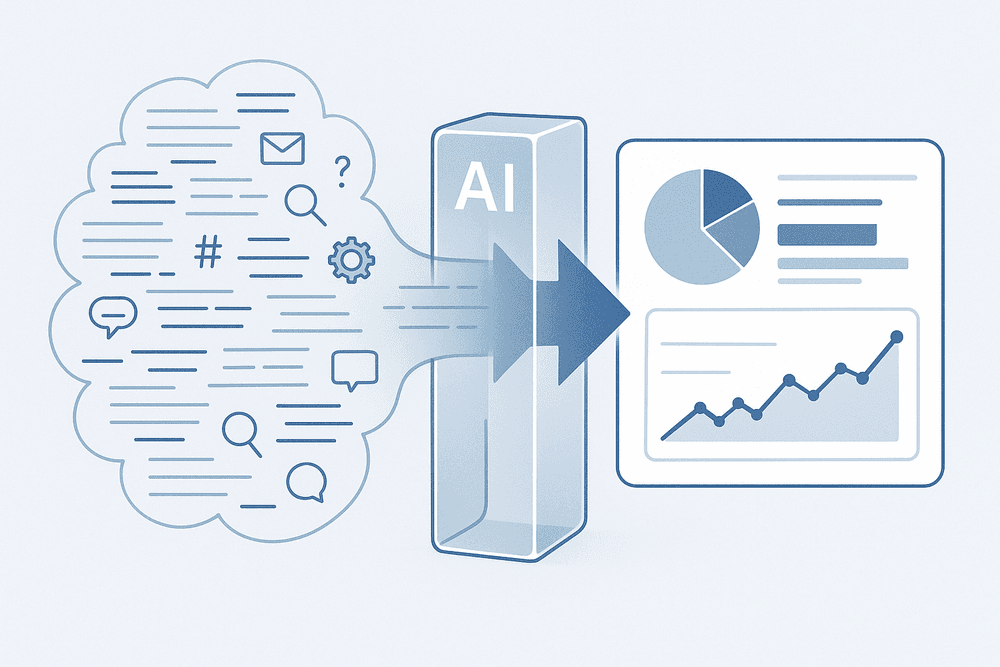
The theoretical power of AI is impressive, but its true value is realized when applied to solve tangible business problems. The ability of AI text analysis to convert vast seas of unstructured text into structured, actionable insights is a game-changer across industries. From understanding your customers on a deeper level to protecting your organization from risk, the applications are both diverse and transformative. Let's explore four key areas where businesses are successfully putting this technology into practice.
Revolutionize Your Customer Feedback Analysis
Your customers are constantly telling you what they think through reviews, support tickets, survey responses, and chatbot conversations. Manually sifting through this data is impossible at scale. This is where AI text analysis shines. By applying techniques like sentiment analysis, topic modeling, and keyword extraction, you can automatically:
- Gauge Customer Sentiment: Instantly understand the emotional tone behind feedback, categorizing it as positive, negative, or neutral.
- Identify Key Themes: Discover recurring issues or popular feature requests without reading every single comment. For example, an e-commerce company might find that "slow shipping" and "difficult returns" are major drivers of negative feedback.
- Prioritize Action: Pinpoint critical issues that are impacting the customer experience the most, allowing support and product teams to focus their efforts effectively.
Automate Social Media Monitoring and Brand Health Tracking
In today's digital world, your brand's reputation is being shaped in real-time on social media. Manually tracking mentions is a losing battle. AI text analysis provides the ultimate toolkit for automated social listening and brand health monitoring. It enables you to:
- Track Brand Mentions 24/7: Monitor platforms like Twitter, Facebook, and Reddit for mentions of your brand, products, or key executives.
- Analyze Public Perception: Use sentiment analysis to measure the overall feeling toward your brand and track how it changes over time, especially during marketing campaigns or product launches.
- Detect Crises Early: Identify spikes in negative sentiment or viral complaints instantly, giving your PR team a crucial head start to manage a potential crisis before it escalates.
Accelerate Market Research and Competitive Intelligence
Gaining a competitive edge requires a deep understanding of market trends, customer needs, and competitor strategies. Traditional market research is often slow and expensive. By deploying AI text analysis, you can accelerate this process significantly. You can automatically analyze:
- Competitor Communications: Scrutinize competitors' press releases, blog posts, and customer reviews to understand their positioning and product weaknesses.
- Industry Reports and News: Extract key trends, statistics, and predictions from thousands of documents in minutes, not weeks.
- Customer Forums: Analyze online communities like Reddit or industry forums to uncover unmet customer needs and identify gaps in the market your business can fill.
Enhance Fraud Detection and Compliance Monitoring
For industries like finance and insurance, risk management is paramount. AI text analysis is a powerful ally in identifying fraudulent activity and ensuring regulatory compliance. The technology can scan internal and external communications, such as emails, claims reports, and chat logs, to:
- Flag Suspicious Language: Identify patterns, keywords, or tones that are often associated with fraudulent insurance claims or financial crimes.
- Ensure Regulatory Adherence: Automatically monitor employee communications to ensure they comply with industry regulations (e.g., FINRA, HIPAA), flagging non-compliant language for review.
- Detect Internal Threats: Analyze internal text data to identify potential policy violations or security risks, helping to protect sensitive company information.
Best Practices for a Successful AI Text Analysis Strategy
Deploying AI text analysis is more than just plugging data into a tool; it's about building a strategic process that delivers tangible business value. Without a clear plan, even the most powerful technology can yield confusing or irrelevant results. By following a few core best practices, you can ensure your initiative transforms raw text into a strategic asset.
Start with Clear Business Objectives
Before you analyze a single word, you must define your "why." What specific business problem are you trying to solve? What decisions will the insights from your AI text analysis inform? Starting with a clear, measurable goal is the most critical step for success. Vague objectives like "understand our customers better" are a recipe for failure. Instead, frame your goals as actionable questions:
- To Reduce Churn: "What are the top three complaints mentioned in support tickets from customers who cancelled their subscriptions in the last quarter?"
- To Improve a Product: "Which feature requests appear most frequently in our online product reviews and app store feedback?"
- To Optimize Marketing: "What is the overall sentiment surrounding our latest marketing campaign on social media, and which themes are driving positive or negative reactions?"
A well-defined objective focuses your efforts, guides your choice of data and models, and makes it possible to measure the ROI of your analysis.
Ensure High-Quality Data for Accurate Insights
In the world of AI, the principle of "garbage in, garbage out" is absolute. The accuracy and reliability of your AI text analysis are entirely dependent on the quality of the data you feed it. High-quality data is:
- Relevant: The text must directly relate to the business objective you defined.
- Clean: The data needs pre-processing to remove noise. This involves correcting spelling errors, removing duplicates, handling slang or abbreviations, and filtering out irrelevant information (like email signatures).
- Sufficient: You need enough data to represent the full picture. Analyzing just 10 customer reviews won’t provide a statistically significant understanding of overall customer sentiment.
Investing time in data preparation and cleaning is non-negotiable. This foundational work prevents skewed results and ensures that the insights you generate are trustworthy and truly reflect reality.
Choose the Right AI Model for Your Goal
Not all AI text analysis models are created equal. The technique you use should align directly with your business objective. Using the wrong model is like using a hammer to turn a screw—it might work, but it won’t be effective. Here’s a simple guide:
- Sentiment Analysis: Use this to gauge emotion and opinion. It’s perfect for tracking brand perception, measuring customer satisfaction, or analyzing reactions to a campaign.
- Topic Modeling/Classification: When you need to understand what people are talking about, this is your go-to. It automatically categorizes text into key themes, ideal for sifting through thousands of survey responses or support tickets to find recurring issues.
- Named Entity Recognition (NER): Choose NER when you need to extract specific, structured information from unstructured text, such as names of people, organizations, locations, or product models.
- Intent Recognition: This is crucial for analyzing customer conversations. It helps you understand the user's goal (e.g., "book a flight," "check account balance," "request a refund").
Visualize Your Findings for Maximum Impact
Raw outputs from an AI text analysis tool—like spreadsheets of sentiment scores or lists of topics—are rarely compelling on their own. To drive action, you must translate these findings into a clear, understandable story. Data visualization is your most powerful storytelling tool.
Instead of presenting a table of numbers, use:
- Word Clouds: To quickly show the most frequent terms or topics.
- Bar Charts & Pie Charts: To illustrate sentiment distribution (e.g., 60% positive, 30% negative, 10% neutral).
- Trend Lines: To track sentiment or discussion volume over time, correlating it with specific events or campaigns.
- Interactive Dashboards: To allow stakeholders to explore the data themselves, filtering by date, product, or customer segment.
Effective visualization makes complex insights accessible to everyone in your organization, enabling faster, data-driven decision-making.

Conclusion: The Future of Data-Driven Decisions with AI Text Analysis
We've journeyed through the what, why, and how of AI text analysis, revealing its power to transform the 80% of your data that is unstructured text into a strategic goldmine. From customer reviews and support tickets to social media conversations, the voice of your market is louder and clearer than ever before. The question is no longer if you should listen, but how you can do it at scale. By leveraging techniques like sentiment analysis, topic modeling, and entity extraction, businesses are moving beyond guesswork and gut feelings to make truly data-driven decisions that enhance customer experience, optimize operations, and drive growth. The future isn't just about collecting data; it's about understanding it.
Your Quick-Start Guide to Implementation
Getting started with AI text analysis is more accessible than you might think. You don't need a team of data scientists for your first project. Follow these four simple steps to begin unlocking insights:
- Define Your Business Objective: Start with a clear question. Are you trying to understand the root cause of customer churn? Identify the most requested product features? Or gauge public sentiment around a new marketing campaign? A focused goal will guide your entire analysis.
- Gather Your Text Data: Identify your most valuable sources of unstructured data. This could be survey responses, online reviews, support chat logs, or social media mentions. Consolidate a relevant dataset to serve as your foundation.
- Select the Right Tool: As we've explored, there's a spectrum of tools available, from no-code platforms designed for business users to powerful APIs for developers. Choose a solution that matches your team's technical skills and start with a small, manageable pilot project.
- Analyze, Visualize, and Act: Run your data through the chosen tool. Look for patterns, trends, and outliers. The most crucial step is to translate these findings into actionable strategies. An insight is only valuable if it inspires a change that improves your business.
Emerging Trends to Watch in AI Text Analytics
The field of AI text analysis is evolving at a breakneck pace. As you integrate these tools into your workflow, keep an eye on the horizon for these game-changing trends:
- Multimodal AI: The future is about understanding context across different data types. AI will increasingly analyze text in conjunction with images, audio, and video to provide a holistic and more accurate picture of customer sentiment and intent.
- Explainable AI (XAI): As AI models become more complex, the demand for transparency is growing. XAI aims to demystify the "black box," providing clear explanations for why the AI reached a specific conclusion, which is critical for building trust and ensuring fairness.
- Real-Time, Proactive Insights: The shift from batch processing to real-time analysis is accelerating. Imagine automatically routing a negative customer tweet to a support agent in seconds or detecting a spike in frustration in live chat conversations to prevent churn before it happens.
Take the Next Step: Empower Your Team Today
The journey to mastering your unstructured data begins with a single step. The power of AI text analysis lies not in its technical complexity, but in its ability to give a voice to your customers, employees, and the market at large. By embracing this technology, you’re not just adopting a new tool; you’re fostering a culture of deep listening and intelligent action.
Don't let this valuable data sit dormant. Start a pilot project, empower a champion within your team, and begin uncovering the stories hidden in your text. The competitive edge of tomorrow will belong to those who can understand and act on the rich, human insights buried in their data today.