
September 27, 2025
What is AI Text Analysis and Why Does It Matter?
What is AI Text Analysis and Why Does It Matter?
We are drowning in a sea of words. Every day, customers leave reviews, clients send emails, users post on social media, and internal teams generate reports. Buried within this massive volume of text is a goldmine of invaluable insight. But how do you find it? Manually reading everything is impossible. This is where AI text analysis transforms the game.
Beyond the Buzzword: A Simple Definition
At its core, AI text analysis is the technology that teaches computers to read and understand human language. It’s a field of artificial intelligence that uses techniques like Natural Language Processing (NLP) and machine learning to automatically process text data, identify what it’s about, and extract specific, relevant information.
Think of it as a super-powered analyst that can read millions of documents in minutes. Instead of just searching for keywords, this technology comprehends:
- Sentiment: Is a customer review positive, negative, or neutral?
- Topics: What are the main themes people are discussing in support tickets?
- Intent: Is a user asking a question, making a complaint, or giving a compliment?
- Entities: Does a document mention specific people, products, or locations?
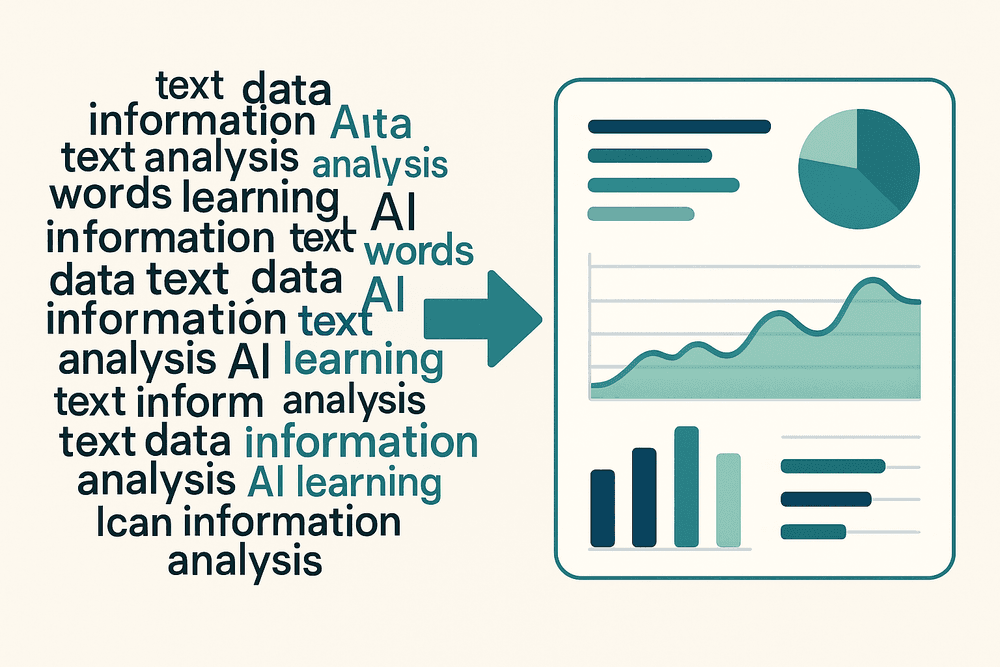
By interpreting context, nuance, and intent, AI text analysis turns messy, qualitative text into structured, quantitative data that businesses can easily analyze and act upon.
How AI is Revolutionizing How We Understand Text
For decades, the only way to understand text data was to have people read it. This approach was slow, expensive, inconsistent, and couldn't possibly keep up with the digital age. A single analyst might get through a few hundred survey responses in a day, but what about a few hundred thousand?
AI-powered text analysis represents a fundamental shift from manual labor to automated intelligence. The revolution lies in three key areas:
- Unmatched Speed and Scale: AI can analyze vast datasets—from a decade of emails to real-time social media feeds—almost instantly. This allows organizations to get a comprehensive, up-to-the-minute understanding of their landscape.
- Consistent Objectivity: Humans are prone to bias and fatigue. An AI model applies the same criteria and logic to every piece of text, ensuring a level of consistency and accuracy that is impossible to achieve manually.
- Deeper, Hidden Insights: Because AI can process so much data, it can identify subtle patterns, emerging trends, and unexpected correlations that a human would likely miss. It connects the dots across thousands of disparate comments to reveal the bigger picture.
The Core Problem: Taming Unstructured Data
The single biggest reason AI text analysis matters so much is the challenge of unstructured data. This is any information that doesn't have a predefined format or fit neatly into the rows and columns of a spreadsheet. It includes everything from legal contracts and research papers to customer support chats and online articles. In fact, experts estimate that over 80% of an organization's data is unstructured.
Without the right tools, this data is just noise—a massive, untapped asset. You know valuable information is in there, but you have no efficient way to get to it.
This is the core problem that AI text analysis is built to solve. It acts as the ultimate translator, imposing structure on the chaos. By automatically tagging, categorizing, and extracting information from text, it makes unstructured data searchable, measurable, and usable. Taming this data empowers businesses to finally listen to the voice of their customers, optimize their operations, and make smarter, evidence-based decisions.
Core Techniques Driving Modern AI Text Analysis
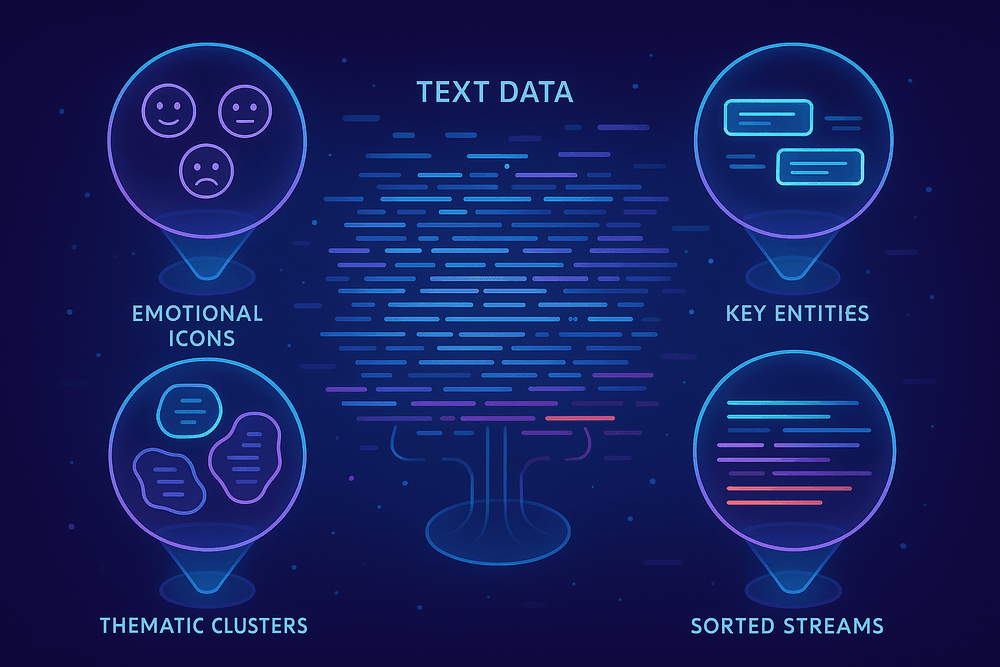
At its heart, AI text analysis isn't a single, monolithic technology. Instead, it’s a powerful suite of techniques, each designed to deconstruct and understand human language in a unique way. These methods work in concert to transform mountains of unstructured text into a structured, actionable resource. Let’s explore the four cornerstone techniques that enable machines to read, interpret, and derive meaning from your data.
Sentiment Analysis: Gauging Emotion in Text
Imagine being able to instantly know how thousands of customers feel about your latest product launch. That’s the power of sentiment analysis. This technique trains AI models to identify and extract emotional tones within the text, typically classifying them as positive, negative, or neutral. More advanced models can even detect nuanced emotions like joy, anger, or disappointment, and identify the specific aspects of a product or service being discussed (a feature known as aspect-based sentiment analysis). For any business focused on customer experience, sentiment analysis is a non-negotiable part of their AI text analysis toolkit, providing a real-time pulse on brand perception, customer satisfaction, and market trends by sifting through reviews, social media mentions, and support tickets.
Entity Recognition (NER): Identifying Key Information
Unstructured text is filled with crucial facts, but they are often buried. Named Entity Recognition (NER) is the AI-powered detective that finds and categorizes this key information. NER models scan text to identify and label "entities" such as names of people, organizations, locations, dates, monetary values, and more. For example, an NER tool could read a news article and automatically extract the companies involved, the executives mentioned, and the locations where events occurred. This technique is fundamental for structuring data, enabling businesses to automatically populate databases, streamline contract analysis by identifying key clauses and parties, and enhance content discovery by tagging documents with relevant entities.
Topic Modeling: Discovering Hidden Themes
What are your customers really talking about? While you might have some predefined categories, topic modeling helps you discover the themes you don't even know to look for. Unlike other techniques that require pre-labeled data, topic modeling is an unsupervised learning method that algorithmically scans a large collection of documents and groups words that frequently appear together to form abstract "topics." By analyzing thousands of open-ended survey responses or support conversations, this form of AI text analysis can reveal emerging issues, hidden customer needs, or popular feature requests, providing invaluable insights for strategic decision-making and product development.
Text Classification: Automating Content Categorization
If your organization deals with a high volume of incoming text, text classification is the engine of efficiency. This technique involves training an AI model to automatically assign predefined tags or categories to text. It’s the magic behind email spam filters, which classify messages as "spam" or "not spam." In a business context, it can be used to automatically route customer support tickets to the correct department (e.g., "Billing," "Technical Support"), sort news articles by subject (e.g., "Sports," "Technology"), or identify urgent communications that require immediate attention. By automating these sorting and routing tasks, text classification saves countless hours and ensures information gets to the right people, faster.
Putting AI Text Analysis to Work: Real-World Use Cases
The theoretical power of AI text analysis is impressive, but its true value emerges when applied to real-world business challenges. By transforming oceans of unstructured text into structured, actionable data, this technology is revolutionizing how organizations operate, strategize, and grow. Let’s explore four key areas where AI text analysis is making a significant impact today.
Transforming Customer Feedback into Actionable Insights
Your customers are constantly telling you what they think through reviews, support tickets, surveys, and chatbot conversations. Manually sifting through this feedback is an impossible task. AI text analysis automates this process, acting as a tireless listener. Using techniques like sentiment analysis, it can instantly gauge whether feedback is positive, negative, or neutral. Topic modeling can then automatically group comments into themes like "product defects," "slow shipping," or "excellent customer service." This allows you to move beyond anecdotal evidence and pinpoint the exact drivers of customer satisfaction and churn, enabling data-driven improvements to your products and services.
Enhancing Market Research and Competitive Analysis
In today's fast-paced market, staying ahead of the curve is critical. AI text analysis provides a powerful lens for understanding market trends and the competitive landscape. AI-powered tools can scan and interpret vast amounts of text from industry reports, news articles, competitor websites, and financial filings. By extracting key information—such as new product launches, pricing strategies, or shifts in marketing messaging—you gain a real-time competitive advantage. This sophisticated analysis helps you identify untapped market opportunities, anticipate competitor moves, and refine your own business strategy with confidence.
Streamlining Social Media Monitoring and Brand Reputation
Social media never sleeps, and a single viral post can redefine your brand’s reputation overnight. Manually tracking every mention, comment, and tag is unfeasible. This is where AI text analysis becomes indispensable for modern brand management. It continuously monitors social platforms, forums, and blogs to track brand mentions in real-time. By applying sentiment analysis, it can immediately flag negative conversations, allowing your team to address potential PR crises before they escalate. Furthermore, it helps you measure the public's perception of marketing campaigns, understand what resonates with your audience, and identify influential voices in your industry.
Automating Document Processing and Data Extraction
Businesses run on documents—contracts, invoices, legal forms, and reports. Extracting critical information from these files is traditionally a manual, error-prone, and time-consuming task. AI text analysis automates this workflow with incredible precision and speed. Using Named Entity Recognition (NER), AI models can read any document and automatically identify and extract key data points like names, dates, addresses, invoice numbers, and monetary values. This drastically reduces manual data entry, accelerates processes like invoice processing and contract review, and ensures higher data accuracy, freeing up your team to focus on more strategic work.

Choosing Your AI Text Analysis Toolkit
With a vast landscape of tools available, selecting the right platform is the critical next step in harnessing the power of ai text analysis. The perfect toolkit depends on your technical resources, business goals, and the scale of your data. Let's break down the key considerations to help you make an informed decision.
Comparing Top AI Text Analysis Platforms
The market offers a spectrum of solutions, each with its own strengths. You'll generally encounter three main categories:
- Major Cloud Providers: Platforms like Google Cloud Natural Language, Amazon Comprehend, and Microsoft Azure Cognitive Services for Language offer powerful, scalable, and robust APIs. They are excellent for companies already invested in these ecosystems and require high-performance processing for large-scale applications.
- Specialized SaaS Platforms: Companies like MonkeyLearn, Aylien, and Brandwatch focus specifically on providing user-friendly ai text analysis tools. They often feature no-code interfaces, pre-built models for common tasks (like social media sentiment), and excellent visualization dashboards, making them accessible to non-technical users.
- Open-Source Libraries: For teams with data science expertise, libraries such as SpaCy, NLTK, and transformers from Hugging Face provide unparalleled flexibility and control. This path requires significant technical skill but allows for building completely custom, state-of-the-art models from the ground up.
Key Features to Look For in an AI Analysis Tool
As you evaluate options, prioritize platforms that offer the following essential features:
- Customization and Accuracy: Out-of-the-box models are a great start, but the best tools allow you to train them with your own data. Custom classification and entity recognition ensure the model understands your specific industry jargon and context, dramatically improving accuracy.
- Scalability: Your chosen solution must grow with you. It should be able to process a thousand survey responses today and millions of customer reviews tomorrow without a drop in performance. Check for processing limits and pricing tiers.
- Comprehensive Analysis Techniques: Look beyond basic sentiment analysis. A robust toolkit should offer a suite of features, including keyword extraction, topic modeling, named entity recognition (NER), intent detection, and summarization to provide a holistic view of your text data.
- Easy Integration: An effective ai text analysis tool shouldn't be an island. Look for a strong API, webhooks, and pre-built integrations with platforms you already use, such as CRMs (Salesforce), data warehouses (Snowflake), or business intelligence tools (Tableau).
API vs. No-Code Solutions: What's Right for Your Business?
Your team's technical capability is a major deciding factor.
API-First Solutions
An Application Programming Interface (API) allows your developers to integrate ai text analysis capabilities directly into your own software and products.
- Best for: Businesses with an in-house development team looking to build custom applications, automate complex workflows, or embed text analytics into their own platform.
- Pros: Unmatched flexibility, full control over data processing, and seamless integration.
- Cons: Requires coding expertise and a longer implementation timeline.
No-Code/Low-Code Platforms
These tools provide a graphical user interface (GUI) that allows you to upload data, build analysis models, and connect to other apps with minimal or no coding.
- Best for: Marketing, customer service, and product teams who need to quickly analyze data from sources like surveys, reviews, or support tickets without relying on developers.
- Pros: Extremely fast to set up, intuitive to use, and often includes built-in data visualization.
- Cons: Less flexible than APIs and may have limitations on customization and scale.
Benefits and Challenges of AI Text Analysis
Harnessing the power of AI to understand text can transform your operations, but it’s essential to approach it with a clear understanding of both its incredible potential and its inherent limitations. By weighing the benefits against the challenges, you can build a strategy that maximizes your return on investment.
The Upside: Unlocking Productivity and Gaining a Competitive Edge
The most immediate benefit of AI text analysis is a massive leap in operational efficiency. Manually sifting through thousands of customer surveys, support emails, or social media comments is a slow, expensive, and error-prone process. AI automates this work, processing vast quantities of text in a fraction of the time it would take a human team. This automation frees up your employees to focus on higher-level strategic tasks instead of getting bogged down in data collection. The result is faster decision-making; you can identify a surge in negative customer feedback or spot an emerging market trend in real-time, not weeks later.
Beyond speed, AI text analysis provides a deeper, more nuanced understanding of your data, giving you a powerful competitive edge. AI algorithms can uncover hidden patterns, correlations, and sentiment drivers that a human analyst might easily miss. For example, you can:
- Analyze customer reviews to pinpoint specific product features that cause frustration or delight.
- Monitor brand mentions to understand public perception and manage your reputation proactively.
- Sift through internal documents to identify knowledge gaps or compliance risks.
These data-driven insights enable you to make smarter, more strategic decisions—from product development and marketing campaigns to customer service improvements—all based on a comprehensive understanding of what your text data is truly saying.
Navigating Common Hurdles: Accuracy, Bias, and Implementation
Despite its power, AI is not a magic bullet. One of the primary challenges is achieving high accuracy. Human language is filled with sarcasm, irony, idioms, and context-specific jargon that can confuse algorithms. An AI model trained on general news articles may struggle to understand the nuances of technical support logs or legal contracts. The performance of any AI text analysis system is directly dependent on the quality and relevance of its training data, often requiring customization and fine-tuning to perform reliably.
A more critical hurdle is the risk of algorithmic bias. AI models learn from the data they are given. If that data contains historical or societal biases, the model will learn and even amplify them. This can lead to skewed or unfair outcomes, such as a sentiment analysis tool that consistently misunderstands feedback from a particular demographic. Combating bias requires careful curation of diverse and representative training data and ongoing audits to ensure equitable performance.
Finally, implementation itself can be a challenge. Integrating an AI text analysis solution into your existing workflows requires technical expertise, a clear strategy, and investment. You need to choose the right tools, ensure data privacy and security, and train your team to interpret the results correctly. A poorly planned implementation can lead to low user adoption and a failure to realize the technology's full potential.
The Future is Written: Getting Started with AI Text Analysis
Diving into the world of AI text analysis can feel overwhelming, but the path to implementation is clearer than you might think. By taking a structured, step-by-step approach, you can begin extracting powerful insights from your data almost immediately. The key is to start with a clear goal and scale your efforts as you prove the value.
Your First Steps: How to Implement AI Text Analysis Today
Ready to transform your unstructured data into a strategic asset? You don't need a team of data scientists to get started. Follow this practical roadmap to begin your AI text analysis journey.
- Define a Specific Business Problem: Don't try to boil the ocean. Start with a focused question. Do you want to understand the primary drivers of customer complaints from support tickets? Or identify emerging trends from product reviews? A clear objective will guide your entire process.
- Identify and Gather Your Data: Pinpoint the source of text that holds the answers. This could be survey responses, social media comments, chatbot logs, or internal emails. Consolidate a representative sample of this data to use for your initial pilot project.
- Choose a User-Friendly Tool: In the beginning, opt for a no-code or low-code AI text analysis platform. Many services offer free trials and provide pre-trained models for common tasks like sentiment analysis and topic modeling. This allows you to see results quickly without a heavy technical investment.
- Run a Pilot Analysis: Upload your sample data and run the analysis. Focus on your initial business problem. For example, if you're analyzing support tickets, tag them by topic (e.g., "billing issue," "feature request") and sentiment (positive, negative, neutral).
- Evaluate and Iterate: Review the insights generated by the tool. Do they make sense? Do they reveal patterns you weren't aware of? Use these initial findings to refine your approach, perhaps by creating custom tags or focusing on a different data source. Once you’ve demonstrated value on a small scale, you can confidently expand your use of AI text analysis across the organization.
A Final Checklist for Choosing the Right Solution
As you move from a pilot project to a long-term solution, selecting the right platform is critical. Use this checklist to evaluate potential vendors and find the best fit for your business needs.
- Accuracy and Reliability: Does the provider offer transparent accuracy metrics? Can the models be customized to understand your specific industry jargon and brand names?
- Scalability: Can the platform process your data volume efficiently, both now and in the future? Check for API rate limits and processing speeds.
- Ease of Integration: Does it provide a well-documented API? Are there pre-built integrations with the software you already use, such as CRMs, helpdesks, or BI tools?
- Range of Features: Does the tool offer the specific capabilities you need? Look for core functions like sentiment analysis, topic extraction, entity recognition, and intent classification.
- User Experience: Is the dashboard intuitive for non-technical team members? Can you easily build visualizations and share reports?
- Security and Compliance: Does the platform adhere to essential data protection regulations like GDPR or HIPAA if required?
- Support and Documentation: Is there comprehensive documentation, tutorials, and responsive technical support available to guide you?