
October 28, 2025
What Is AI Task Automation and Why Should You Care?
What Is AI Task Automation and Why Should You Care?
Imagine your workday. How much time is spent on tasks that don't require your unique expertise? We’re talking about sorting through emails, scheduling meetings, manually entering data, or pulling the same weekly report. These small, repetitive actions are the silent productivity killers in any business. They create a drag on efficiency, drain employee morale, and, most importantly, steal time away from the strategic, creative work that truly drives growth.
For years, the solution was traditional automation. But now, there’s a much smarter way. This is where AI task automation enters the picture, and it’s a game-changer.
Beyond "If-Then": The AI Difference
To understand the power of AI in automation, it’s crucial to distinguish it from its predecessor: traditional, rule-based automation.
- Traditional Automation works on a simple "if this, then that" (IFTTT) logic. It follows a rigid, pre-programmed script. For example, if an email with the subject "Invoice" arrives, then move it to the "Finances" folder. It’s effective for predictable, unchanging tasks but breaks down the moment something deviates from the script. It can’t read context, understand nuance, or learn from experience.
- AI Task Automation, on the other hand, is like upgrading from a basic calculator to a super-powered personal assistant. It uses technologies like machine learning (ML) and natural language processing (NLP) to understand, interpret, and act on information with human-like intelligence. It doesn’t just follow rules; it recognizes patterns, makes predictions, and learns from new data to improve its performance over time. An AI system can read the content of an email, understand its sentiment and urgency, extract the relevant data (like an invoice amount and due date), and automatically update your accounting software—all without a rigid script.
The High Cost of Repetitive Work
Why does this difference matter so much? Because the cumulative effect of manual, repetitive work is staggering. It's not just a minor inconvenience; it's a significant drain on your most valuable resource: your team's time and cognitive energy.
Every hour an employee spends on a task that could be automated is an hour not spent on customer relationships, product innovation, or strategic planning. This "manual task tax" leads to burnout, reduces job satisfaction, and creates bottlenecks that slow down your entire operation. By tackling these productivity drains, AI task automation does more than just save a few minutes here and there. It fundamentally frees up your workforce to focus on high-impact activities that require human ingenuity and emotional intelligence.
A Smarter Way to Work
The future powered by AI task automation isn't about replacing humans; it's about augmenting them. Picture a workday where your AI assistant has already organized your inbox by priority, summarized key points from a long document ahead of your meeting, drafted initial responses to common customer inquiries, and flagged a potential sales opportunity based on recent communications.
This isn't science fiction—it's the new standard for efficiency. By offloading the robotic tasks to an intelligent system, you create an environment where people can do their best work. It’s a future where your team is more engaged, your processes are more streamlined, and your business is more agile and competitive. That’s why you should care.

Unlocking Key Benefits with AI Task Automation
Adopting AI task automation is more than just a technological upgrade; it's a strategic move that delivers tangible, transformative benefits to your entire organization. By intelligently delegating repetitive, rule-based processes to AI, you unlock new levels of efficiency and empower your team to focus on what truly matters. The advantages ripple across every department, fundamentally changing how work gets done for the better. Let's explore the core benefits that make this technology an indispensable tool for modern businesses.
Skyrocket Productivity by Eliminating Manual Drudgery
Consider the countless hours your team spends on manual, repetitive work: copying and pasting data between applications, processing invoices, updating customer records, or compiling standard reports. These tasks are not only time-consuming but also drain employee motivation. AI task automation acts as a tireless digital assistant, taking over this administrative burden. AI-powered bots can extract information from documents, sort and respond to emails, update databases in real-time, and execute multi-step workflows flawlessly. By removing these manual bottlenecks, you dramatically accelerate processes, allowing your team to accomplish more in less time and focus their energy on revenue-generating activities.
Enhance Accuracy and Reduce Costly Human Errors
To err is human, but in business, errors can be expensive. A simple typo in a data entry field can lead to incorrect invoicing, flawed analytics, or compliance issues. The risk of error increases with fatigue and the sheer volume of repetitive work. AI systems, however, operate with consistent precision. They follow programmed rules perfectly every time, 24/7, without getting distracted or tired. Implementing AI task automation for processes like data validation, financial reconciliation, and order processing drastically reduces the incidence of human error. This leads to higher-quality data, more reliable business intelligence, and a significant reduction in the costs associated with correcting mistakes.
Scale Your Business Operations Without Increasing Headcount
As your business grows, the volume of administrative tasks often grows exponentially. More customers mean more support tickets, more sales lead to more invoices, and more data requires more management. Traditionally, this growth would necessitate a proportional increase in headcount to handle the workload. AI provides a more efficient and scalable solution. An AI bot can process a thousand transactions as easily as it can process ten, handling fluctuating and peak workloads without delay. This allows you to scale your operational capacity on demand, ensuring you can grow your business and serve more customers without the linear increase in labor costs.
Free Up Your Team for Creative and Strategic Work
Perhaps the most powerful benefit of AI task automation is its ability to elevate the role of your human workforce. When employees are liberated from monotonous, low-value tasks, they have more time and cognitive bandwidth to devote to activities that require uniquely human skills: critical thinking, creativity, strategic planning, and complex problem-solving. Your team can focus on innovating new products, improving the customer experience, and analyzing market trends to drive the business forward. This not only fuels growth but also increases job satisfaction and employee engagement, transforming your workplace into a more dynamic and strategic environment.
Real-World Use Cases: AI Task Automation in Action
The concept of AI can feel abstract, but its impact becomes crystal clear when you see it at work. Across every industry and department, businesses are leveraging intelligent systems to handle repetitive, time-consuming processes, freeing up human talent for more strategic initiatives. Let's explore four powerful, real-world examples of how ai task automation is revolutionizing day-to-day operations and driving tangible results.
Revolutionizing Marketing with Automated Lead Nurturing
Gone are the days of generic email blasts and manual lead segmentation. Modern marketing relies on personalization at scale, a feat made possible by AI. Instead of manually creating complex drip campaigns, marketing teams now use ai task automation to analyze customer behavior in real-time. These systems track website visits, content downloads, and email engagement to build a dynamic profile for each lead. Based on this data, the AI can automatically trigger hyper-relevant emails, personalize website content, and score leads based on their likelihood to convert. This ensures that the right message reaches the right person at the perfect moment, dramatically improving conversion rates and nurturing relationships without constant human oversight.
Enhancing Customer Support with Intelligent Chatbots
A cornerstone of customer satisfaction is fast, effective support. However, human-led support teams often struggle with high volumes of repetitive inquiries, leading to long wait times and agent burnout. AI-powered chatbots provide a powerful solution. These intelligent bots use Natural Language Processing (NLP) to understand customer questions—no matter how they're phrased—and provide instant, accurate answers 24/7. They can resolve common issues, guide users through processes, and even handle account-specific queries by integrating with your CRM. When a problem is too complex, the chatbot seamlessly escalates the conversation to a human agent, providing them with the full chat history for a smooth transition. This application of ai task automation cuts operational costs while significantly boosting the customer experience.
Simplifying Finance with Automated Reporting and Analysis
The finance department is often buried in manual data entry, reconciliation, and report generation—tasks that are both tedious and prone to human error. AI task automation transforms this landscape by streamlining financial workflows. AI-powered tools can automatically extract data from invoices, receipts, and bank statements, eliminating the need for manual data entry. They can categorize transactions, reconcile accounts in real-time, and generate complex financial reports like P&L statements and cash flow analyses with a single click. Furthermore, AI can go beyond mere reporting by analyzing historical data to identify spending trends, forecast future revenue, and flag unusual transactions that could indicate fraud, allowing financial professionals to focus on high-value strategic planning.
Streamlining Operations with Automated Project Management
Managing complex projects with shifting deadlines, resource constraints, and intricate dependencies is a significant challenge. AI is stepping in to bring order to this chaos. Intelligent project management platforms use ai task automation to optimize workflows from start to finish. These systems can automatically assign tasks based on team member availability, skillset, and current workload. By analyzing progress data, they can predict potential bottlenecks and deadline risks before they become critical issues. AI can also automate administrative duties like sending deadline reminders, generating progress reports for stakeholders, and adjusting project timelines based on completed dependencies. This ensures projects run more smoothly, efficiently, and with greater predictability.
Top AI Task Automation Software & Platforms Compared
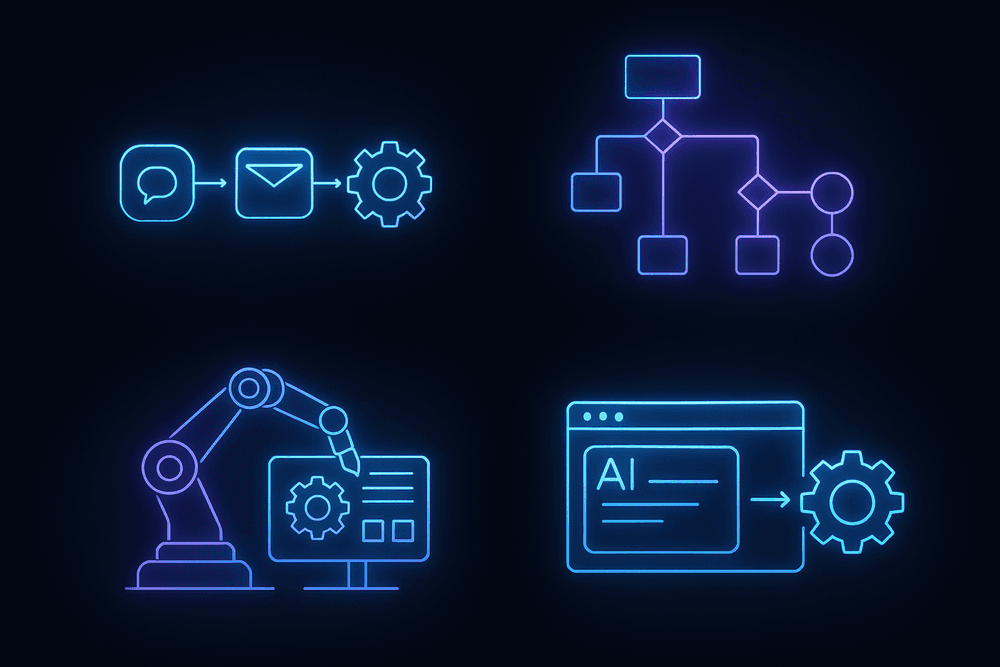
The world of AI task automation is vast, with tools designed for every need, from connecting two simple apps to orchestrating complex enterprise-wide operations. Choosing the right platform is crucial for success, as the best solution depends entirely on your specific goals, technical environment, and the scale of your processes. Below, we compare four leading solutions, each with a unique strength, to help you identify the perfect fit for your automation journey.
Zapier: Best for Connecting All Your Web Apps
Zapier is the undisputed champion of app integration, acting as the digital glue for the modern web. Operating on a simple "if this, then that" logic, it allows you to create automated workflows, called "Zaps," that connect over 6,000 web applications without writing a single line of code. When an event (a "trigger") happens in one app, Zapier automatically performs an "action" in another. For example, when a new lead fills out a form on your website (trigger), Zapier can automatically add them to your CRM, send a welcome email, and notify your sales team in Slack (actions). While traditionally rule-based, Zapier has increasingly integrated AI to help users build Zaps, format data, and even generate content within their workflows, making it a powerful and accessible entry point into AI task automation for individuals, small businesses, and teams.
Make (formerly Integromat): For Visual and Complex Workflow Design
If Zapier is the simple on-ramp, Make is the superhighway for complex automation. What sets Make apart is its powerful visual canvas where you build "Scenarios." Instead of a simple linear path, you can create intricate, multi-step workflows with branching logic, filters, and error handlers by dragging and dropping modules and connecting them. This visual approach provides unparalleled flexibility, allowing you to route data in complex ways that are difficult or impossible in simpler tools. It's ideal for power users, developers, and businesses that need to automate core operational processes with multiple dependencies. For anyone who finds themselves hitting the limits of simpler tools, Make offers a more robust and often more cost-effective solution for sophisticated AI task automation.
UiPath: The Enterprise Choice for Robotic Process Automation (RPA)
UiPath operates on a different level, focusing on enterprise-grade Robotic Process Automation (RPA). Unlike API-based tools that connect cloud applications, UiPath uses software "bots" to mimic human actions directly on a computer's graphical user interface (GUI). These bots can log into systems, open desktop applications, copy and paste data, fill out forms, and process documents—just like a person would, only faster and without errors. This makes it incredibly powerful for automating tasks in legacy systems that lack modern APIs. UiPath enhances its bots with a full suite of AI capabilities, including document understanding and process mining, to handle unstructured data and discover new automation opportunities. It’s the definitive AI task automation platform for large organizations seeking to automate high-volume, rule-based back-office work at scale.
Bardeen: A Browser-Based Agent for Automating Repetitive Clicks
Bardeen brings the power of automation directly into your web browser. As a Chrome extension, it excels at eliminating the tedious, repetitive tasks you perform online every day. Think of it as your personal digital assistant for browser-based work. You can create one-click "Playbooks" to scrape data from a webpage, enrich a list of contacts, transfer information between tabs, or save a LinkedIn profile directly to your project management tool. Bardeen's magic lies in its AI-powered builder, which can create custom automations from natural language descriptions of what you want to achieve. For sales professionals, recruiters, and anyone who spends their day in a browser, Bardeen provides an incredibly accessible and efficient form of AI task automation to reclaim hours of manual clicking and copy-pasting.
Best Practices for Implementing AI Task Automation
Jumping into the world of AI task automation can feel overwhelming, but a strategic approach ensures a smooth transition and maximum return on investment. It’s not just about adopting new technology; it’s about fundamentally rethinking how work gets done. By following these best practices, you can successfully integrate AI into your daily operations and unlock new levels of efficiency.
Identify the Best Tasks for Your First Automation Project
The key to a successful first foray into ai task automation is to start small and aim for a quick, measurable win. Look for the "low-hanging fruit"—tasks that are highly repetitive, rule-based, and time-consuming for your team.
Ideal candidates for initial automation include:
- Data Entry and Migration: Copying information from one system to another, such as updating a CRM with lead data from a web form.
- Report Generation: Compiling standard weekly or monthly performance reports from various data sources.
- Email Sorting and Responses: Categorizing incoming emails and sending standardized replies to frequently asked questions.
- Meeting Scheduling: Coordinating calendars to find and book meeting times without endless back-and-forth communication.
Choosing a task that is high-volume but low-complexity builds momentum and demonstrates the value of automation to your organization with minimal risk.
Choose the Right AI Tool for Your Business Needs
Not all AI tools are created equal. The market is filled with platforms ranging from simple, no-code workflow builders (like Zapier or Make) to sophisticated, enterprise-level AI systems. When selecting a tool, consider these factors:
- Integration: Does it connect seamlessly with the software you already use (e.g., your CRM, project management tool, email client)?
- Scalability: Can the tool grow with your business? Will it handle an increase in task volume as you expand your use of ai task automation?
- Ease of Use: Is the interface intuitive for your team, or does it require specialized technical skills to manage?
- Specific Functionality: Is the tool a generalist, or is it specialized for a specific function like customer support, marketing, or financial analysis? Match the tool to the task at hand.
Set Up and Test Your Automated Workflows for Success
Once you’ve chosen a task and a tool, it's time to build and test. Never launch a new automated workflow company-wide without rigorous testing.
- Map the Workflow: Clearly document every step of the manual process you are automating. This blueprint ensures you don’t miss critical details.
- Build a Pilot: Implement the automation on a small, controlled scale. For example, automate the process for just one team member or a specific type of customer inquiry.
- Test with Real Data: Run the workflow using real-world scenarios and data to identify potential failure points, exceptions, or errors.
- Gather Feedback: Ask the team members involved in the pilot for their feedback. Did the automation work as expected? Did it save them time?
- Refine and Iterate: Use the test results and feedback to fine-tune the workflow before a broader rollout.
Train Your Team to Work Seamlessly with AI Assistants
The final, and perhaps most critical, step is preparing your team. Successful ai task automation is as much about people as it is about technology. Address concerns head-on and frame AI as a collaborative partner that frees them from mundane work to focus on more strategic, creative, and high-value activities.
- Communicate the "Why": Explain the benefits of automation, focusing on how it will improve their work-life, reduce tedious tasks, and help the company achieve its goals.
- Provide Hands-On Training: Host workshops and provide clear, accessible documentation. Show your team exactly how the new tools and workflows operate.
- Appoint Champions: Identify enthusiastic team members who can act as go-to experts and advocates for the new AI systems.
- Establish New Processes: Define when and how employees should interact with the AI assistant and what their new, augmented roles look like.

Conclusion: The Future of Work and Your Next Step in AI Task Automation
We've journeyed through the landscape of artificial intelligence, and one thing is clear: AI task automation is no longer a futuristic concept—it's a present-day reality revolutionizing how we work. From eliminating mind-numbing data entry to streamlining complex marketing campaigns and supercharging customer support, its transformative power is undeniable. The core benefit isn't about replacing human ingenuity but liberating it. By delegating repetitive, rule-based processes to intelligent systems, you and your team are freed to focus on what truly matters: strategic thinking, creative problem-solving, and building meaningful relationships. Embracing AI task automation is a direct investment in your most valuable asset—human potential.
Start Your Automation Journey Today
The idea of implementing a new technology can feel overwhelming, but the first step into AI task automation is easier than you think. You don't need a massive budget or an overhaul of your entire infrastructure. You just need to start small.
Think of one task you do every single day or week that is predictable and time-consuming. Is it sorting emails? Copying data between spreadsheets? Generating a weekly report? That’s your perfect starting point. Many powerful AI task automation platforms offer free versions or trials specifically designed to help you get started. We encourage you to sign up for one today and build your first automated workflow. This simple, hands-on experience is the most effective way to demystify the technology and witness its immediate impact on your productivity.
Building a Long-Term AI Automation Strategy
While your first automation provides instant gratification, the true competitive advantage comes from developing a strategic, long-term approach. Moving from ad-hoc fixes to a cohesive strategy will unlock exponential gains in efficiency and innovation. Here’s how to build your roadmap:
- Audit and Identify: Systematically review your team's daily and weekly workflows. Identify bottlenecks, repetitive tasks, and processes prone to human error. These are your prime candidates for automation.
- Prioritize for Impact: You can't automate everything at once. Score potential automation opportunities based on factors like time saved, potential for error reduction, and overall business impact. Tackle the high-impact, low-effort "quick wins" first to build momentum.
- Choose the Right Tools: The AI software ecosystem is vast. Select tools that integrate seamlessly with your existing software stack (like your CRM, email, and project management apps) and match your team's technical comfort level.
- Involve and Upskill Your Team: Frame AI task automation as a digital assistant that empowers your team, not a threat that replaces them. Foster a culture of continuous improvement by providing training and encouraging employees to identify new automation opportunities themselves.
- Measure and Iterate: Your strategy should be a living document. Continuously monitor the performance of your automations. Track key metrics like hours saved, costs reduced, and project turnaround times. Use this data to refine existing workflows and inform future automation decisions.
The future of work is an intelligent, efficient, and collaborative partnership between humans and AI. Your journey begins not with a giant leap, but with a single, deliberate step. Take that step today and unlock a new era of productivity.