
November 4, 2025
What Is AI Reliability Engineering and Why Is It a Game-
What Is AI Reliability Engineering and Why Is It a Game-Changer?
In today’s hyper-connected world, system downtime isn’t just an inconvenience; it’s a direct hit to revenue, reputation, and customer trust. For decades, engineers have fought to keep systems running, but the methods have been largely reactive. AI reliability engineering represents a fundamental paradigm shift, transforming the practice from a defensive, break-fix model into a proactive, predictive, and ultimately, a more intelligent strategy for ensuring operational resilience. It’s not just about adding a new tool; it’s about rewiring the entire philosophy of how we maintain and manage complex systems.
The Evolution from Reactive to Predictive Maintenance
To understand the impact of AI, let's look at the journey of maintenance strategies:
- Reactive Maintenance ("If it breaks, fix it"): This is the most basic approach. Operations continue until a component fails, leading to unplanned downtime, expensive emergency repairs, and potential cascading failures. It’s costly, chaotic, and completely unpredictable.
- Preventive Maintenance ("Fix it on a schedule"): A significant step up, this strategy involves servicing equipment at regular intervals based on time or usage metrics. While it reduces unexpected failures, it's often inefficient. Parts are replaced whether they are worn out or not, leading to wasted resources and unnecessary maintenance-induced downtime.
- Predictive Maintenance ("Fix it right before it breaks"): This is where AI enters the picture. By analyzing real-time data from sensors, logs, and performance metrics, machine learning models can identify subtle patterns that precede a failure. This allows teams to intervene with surgical precision, performing maintenance only when necessary and just before a fault occurs. This intelligent approach is the cornerstone of AI reliability engineering.
Understanding the Core Concepts: AI, Machine Learning, and SRE
AI reliability engineering is a powerful fusion of several key disciplines. It’s crucial to understand how they fit together:
- Artificial Intelligence (AI): In this context, AI refers to the overarching system that can reason, learn, and act autonomously to improve reliability. It’s the "brain" that orchestrates the entire process, from data ingestion to recommending or even automating corrective actions.
- Machine Learning (ML): This is the engine that powers the AI. ML algorithms are trained on vast historical datasets to recognize what "normal" operation looks like. They can then perform powerful tasks like anomaly detection (flagging unusual behavior), failure pattern recognition, and predicting the Remaining Useful Life (RUL) of a component.
- Site Reliability Engineering (SRE): An operational discipline pioneered by Google, SRE treats operations as a software problem. It emphasizes automation, data-driven decision-making, and managing reliability through error budgets. AI reliability engineering supercharges SRE principles by providing the predictive insights needed to automate smarter, manage error budgets more effectively, and move from reactive problem-solving to proactive optimization.
The Business Case: How AI Reduces Downtime and Boosts ROI
Implementing an AI reliability engineering strategy is a strategic investment with a clear and compelling return. The benefits go far beyond just keeping the lights on; they translate directly to the bottom line.
- Drastically Reduced Unplanned Downtime: By predicting failures, organizations can shift from chaotic emergency repairs to scheduled, orderly maintenance. This means less disruption to customers and a massive reduction in the high costs associated with unexpected outages.
- Optimized Maintenance Costs: Say goodbye to wasteful, calendar-based servicing. AI ensures you only spend time and money on assets that actually need attention. This also leads to better management of spare parts inventory, cutting down on carrying costs.
- Increased Asset Lifespan and Efficiency: By understanding the true health of your systems, you can operate them more efficiently and extend their useful life. This maximizes the value of your capital investments and delays the need for costly replacements.
Ultimately, AI reliability engineering turns system maintenance from a necessary cost center into a strategic driver of business value, ensuring robust performance that fuels growth and innovation.
Core Applications of AI Reliability Engineering
The fusion of artificial intelligence with reliability engineering isn't just a theoretical concept; it's a practical revolution. By applying machine learning models to vast datasets, organizations are transforming their approach from reactive problem-solving to proactive system optimization. The core applications of AI reliability engineering are already delivering tangible results, enhancing stability, and driving operational efficiency across industries. These applications form the pillars of a more resilient and intelligent infrastructure.
Predictive Maintenance: Forecasting Failures Before They Occur
Predictive maintenance represents a paradigm shift from traditional, time-based maintenance schedules. Instead of servicing equipment on a fixed calendar, AI-powered systems predict when a component is likely to fail. Machine learning algorithms, such as Long Short-Term Memory (LSTM) networks and regression models, continuously analyze real-time data from sensors—monitoring variables like temperature, vibration, pressure, and acoustic signatures. By identifying subtle patterns and deviations that precede a fault, these systems can forecast failures with remarkable accuracy. This allows maintenance teams to intervene at the optimal moment, replacing parts just before they break. The result is a dramatic reduction in unplanned downtime, lower maintenance costs, and a significant extension of asset lifespan, making it a cornerstone of modern AI reliability engineering.
Real-Time Anomaly Detection to Prevent System Outages
In complex digital ecosystems, minor irregularities can quickly cascade into major system-wide outages. AI-driven anomaly detection acts as a vigilant, 24/7 watchtower. These systems first establish a baseline of "normal" operational behavior by learning from historical data streams, including server logs, network traffic, and application performance metrics (APM). Once this baseline is defined, the AI continuously monitors live data, using techniques like clustering or autoencoders to spot deviations in real time. An anomalous spike in API latency, an unusual memory consumption pattern, or a sudden drop in transaction success rates will trigger an immediate alert. This early warning enables Site Reliability Engineers (SREs) and operations teams to investigate and mitigate the issue before it impacts end-users, effectively preventing outages before they can even begin.
Automating Root Cause Analysis (RCA) with Machine Learning
When an incident does occur, identifying the root cause is often a time-consuming and manual process of sifting through mountains of logs and metrics from disparate systems. AI dramatically accelerates this process. Machine learning models, particularly those leveraging Natural Language Processing (NLP) and pattern recognition, can ingest and analyze terabytes of log data in seconds. By correlating events across different services, identifying causal relationships, and filtering out irrelevant noise, these AI tools can pinpoint the most probable source of the failure. This automated RCA provides engineers with a clear starting point for their investigation, drastically reducing the Mean Time to Resolution (MTTR) and freeing up valuable engineering talent to focus on building more resilient systems rather than just fixing broken ones.
Optimizing System Performance and Resource Allocation
Effective AI reliability engineering extends beyond failure prevention to continuous performance optimization. Modern systems, especially those in the cloud, require dynamic resource allocation to handle fluctuating workloads efficiently. AI and reinforcement learning models can analyze historical and real-time usage patterns to intelligently manage resources. For example, an AI system can predict traffic surges and proactively scale up server instances, or it can automatically tune database configurations for optimal query performance based on the type of workload. This ensures that the system delivers a consistent, high-quality user experience while simultaneously minimizing operational costs by avoiding over-provisioning. It's a proactive strategy that keeps systems running not just reliably, but at their absolute peak.
How to Implement an AI Reliability Engineering Strategy
Transitioning from traditional reliability practices to an AI-driven approach requires a strategic, phased implementation. A successful AI reliability engineering strategy isn't just about adopting new technology; it's about integrating intelligence into your core operations. By following a structured four-step process, you can build a robust framework that enhances system reliability, minimizes downtime, and delivers a clear return on investment.
Step 1: Collecting and Preparing High-Quality System Data
The foundation of any successful AI initiative is data—and a lot of it. The principle of "garbage in, garbage out" is especially true in this field. Your first step is to identify and consolidate relevant data sources. This includes real-time sensor data (temperature, pressure, vibration), operational logs, historical failure records, and maintenance work orders.
Once collected, this raw data is rarely ready for analysis. It needs to be meticulously prepared through a process of:
- Cleansing: Removing duplicates, correcting errors, and handling missing values.
- Normalization: Scaling data to a common range to prevent certain features from disproportionately influencing the model.
- Feature Engineering: Creating new, meaningful variables from existing data that can help the AI model identify patterns more effectively.
This preparation phase is critical. High-quality, well-structured data is the fuel that powers accurate predictions and makes your AI reliability engineering program effective.
Step 2: Selecting the Right AI Models and Algorithms
With clean data in hand, the next step is to choose the appropriate machine learning models for your specific reliability goals. There is no one-size-fits-all solution; the right model depends entirely on the problem you are trying to solve.
Common applications and their corresponding models include:
- Predictive Maintenance: For predicting a component's Remaining Useful Life (RUL), regression models are effective. For classifying whether a failure will occur within a specific timeframe, algorithms like Random Forest or Gradient Boosting are powerful choices. For complex time-series data, Long Short-Term Memory (LSTM) networks are often used.
- Anomaly Detection: To identify unusual operating behavior that may signal an impending fault, unsupervised models like Isolation Forests or clustering algorithms (e.g., DBSCAN) can automatically detect deviations from the norm.
- Root Cause Analysis: To understand the "why" behind failures, you can leverage causal inference models that help uncover the chain of events leading to a breakdown.
Start with simpler models to establish a baseline and gradually introduce more complexity as needed. The goal is actionable insight, not algorithmic complexity for its own sake.
Step 3: Integrating AI Insights into Your Existing Workflows
An AI model that generates alerts in a vacuum is useless. The true power of AI for reliability is unlocked when its insights are seamlessly integrated into your team's daily workflows. The objective is to make AI-driven recommendations actionable and easy to consume.
This involves connecting the AI system to your operational tools:
- CMMS Integration: Automatically generate a work order in your Computerized Maintenance Management System when the AI predicts a high probability of failure.
- Alerting Systems: Send detailed, context-rich notifications to the right engineers via their preferred communication channels (e.g., email, SMS, team chat).
- Dashboards: Visualize asset health scores, RUL predictions, and anomaly alerts in a central dashboard that provides engineers with a clear, at-a-glance overview of system status.
This integration transforms AI from a passive analytical tool into an active participant in your maintenance and reliability processes.
Step 4: Measuring Success with Reliability KPIs
To justify the investment and continuously improve your strategy, you must measure its impact. Tracking the right Key Performance Indicators (KPIs) will demonstrate the value of your AI reliability engineering program and highlight areas for optimization.
Key metrics to monitor before and after implementation include:
- Mean Time Between Failures (MTBF): This should increase as you proactively address issues before they cause breakdowns.
- Mean Time To Repair (MTTR): This should decrease as AI-driven diagnostics help technicians pinpoint problems faster.
- Overall Equipment Effectiveness (OEE): Improvements in availability and performance will lead to a higher OEE score.
- Maintenance Costs: Track the shift from expensive, unplanned reactive maintenance to more cost-effective, planned predictive maintenance.
- Model Accuracy: Continuously monitor the precision and recall of your AI models to ensure they remain effective over time.
By tying your AI initiatives to these core business and reliability metrics, you can build a powerful case for ongoing investment and expansion.
AI Reliability Engineering in Action: Real-World Use Cases
The theoretical benefits of AI in reliability are compelling, but its true value is demonstrated in practical application. Across diverse industries, AI reliability engineering is moving from a forward-thinking concept to an essential operational strategy. By integrating intelligent systems, companies are not just fixing problems faster—they are preventing them from ever occurring. Let's explore three powerful use cases where this transformation is already happening.
Case Study: Manufacturing - Preventing Assembly Line Downtime
The Challenge: In a high-volume manufacturing plant, every minute of unplanned downtime on an assembly line translates to thousands of dollars in lost production, wasted materials, and potential shipment delays. Traditional maintenance relies on scheduled servicing or reactive repairs after a breakdown, both of which are highly inefficient.
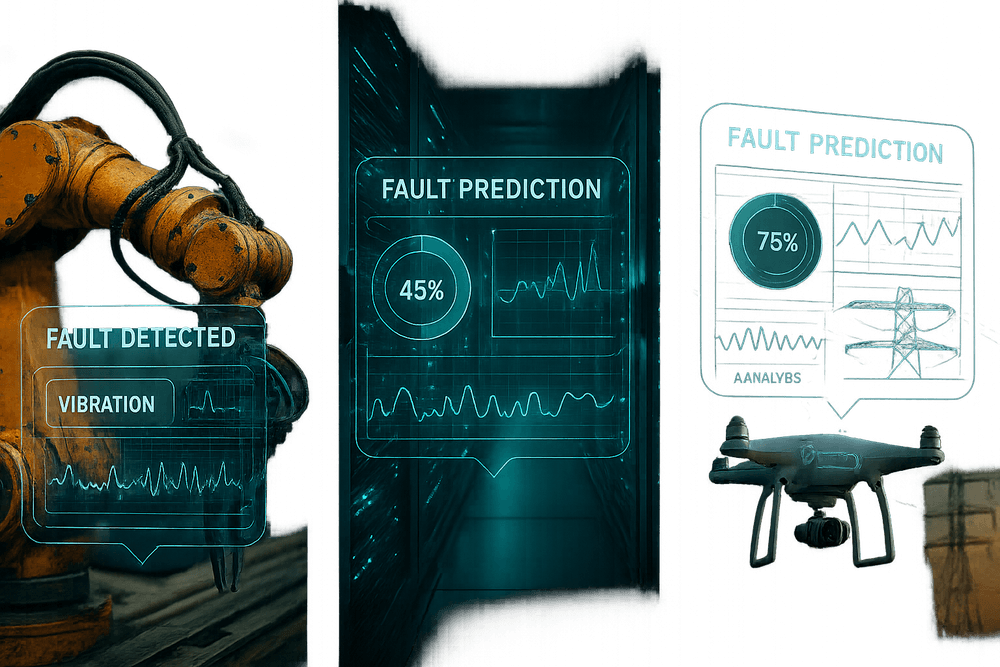
The AI Solution: A leading automotive manufacturer implemented an AI reliability engineering platform to monitor its critical robotic arms and conveyor systems. IoT sensors were installed to collect real-time data on vibration, temperature, and energy consumption. This data stream was fed into a machine learning model trained to understand the "healthy" operational signature of each machine. The AI continuously scans for subtle anomalies and patterns that are precursors to mechanical failure.
The Outcome: The system now flags specific components for maintenance days or even weeks before they are predicted to fail. Instead of a sudden, catastrophic halt, the plant schedules a brief, planned maintenance window to replace the at-risk part. This proactive approach has reduced unplanned downtime by over 30%, increased Overall Equipment Effectiveness (OEE) by 15%, and transitioned the maintenance team from a reactive "firefighting" mode to a strategic, data-driven one.
Case Study: Tech - Ensuring Uptime for Cloud Services
The Challenge: For a major Software-as-a-Service (SaaS) provider, uptime is the product. A service outage directly impacts customer trust and revenue. With a complex, microservices-based architecture running on thousands of virtual servers, manually identifying the root cause of a performance degradation issue is like finding a needle in a digital haystack.
The AI Solution: The company’s Site Reliability Engineering (SRE) team integrated an AIOps (AI for IT Operations) platform. This application of AI reliability engineering ingests millions of data points per minute—including application logs, server metrics, and network latency. Anomaly detection algorithms identify deviations from normal performance baselines, while correlation engines automatically link disparate events to pinpoint the likely root cause. If a specific code deployment correlates with a rising error rate in a particular region, the system can flag it instantly.
The Outcome: The Mean Time to Detection (MTTD) for critical incidents was reduced from hours to minutes. The AI system can automatically trigger predefined runbooks, such as rolling back a faulty deployment or rerouting traffic, creating a self-healing infrastructure. This allows the SRE team to focus on long-term reliability improvements rather than being consumed by constant incident response.
Case Study: Energy - Optimizing Power Grid Maintenance
The Challenge: An electric utility manages tens of thousands of miles of power lines and thousands of substations, much of which is aging infrastructure exposed to the elements. Physical inspections are slow, costly, and can be dangerous. Failures, like a failing transformer, can lead to widespread blackouts.
The AI Solution: The utility adopted a modern AI reliability engineering strategy combining drones, satellite imagery, and predictive analytics. Drones equipped with high-resolution cameras capture images of towers and lines, which are then analyzed by computer vision models to automatically detect rust, damaged insulators, or vegetation encroachment. Separately, machine learning models analyze sensor data, historical load patterns, and weather forecasts to predict which transformers are under the most stress and most likely to fail.
The Outcome: Maintenance is no longer based on a fixed calendar but on a dynamic, risk-based priority list generated by the AI. Crews are dispatched to fix specific, identified issues, making their work safer and more efficient. The utility has successfully prevented multiple potential blackouts by proactively replacing components flagged by the predictive models, improving grid stability and extending the life of its critical assets.
Navigating the Challenges and Future of AI in Reliability
While the potential of AI in reliability engineering is immense, the path to implementation is not without its obstacles. Successfully integrating these advanced technologies requires overcoming fundamental challenges and looking ahead to the next wave of innovation. By understanding the hurdles and the future horizon, organizations can build a robust strategy for a more resilient and autonomous future.
Overcoming Common Hurdles: Data Scarcity and Model Interpretability
Two significant challenges often emerge in AI reliability engineering projects: a lack of relevant data and the "black box" nature of complex models.
- Data Scarcity: Ironically, in our age of big data, high-quality failure data is often a rare commodity. While systems generate terabytes of operational data, documented instances of specific failures—complete with labeled root causes and contextual information—are scarce. This makes it difficult to train supervised machine learning models effectively. To combat this, engineers are turning to techniques like transfer learning, where models trained on one type of asset are adapted for another, and synthetic data generation, which uses simulations to create realistic failure scenarios for model training.
- Model Interpretability: For a reliability engineer, a prediction is useless without an explanation. Simply knowing a pump will fail in 72 hours isn't enough; they need to understand why. Many advanced AI models can act as "black boxes," making it difficult to trust their outputs. This is where Explainable AI (XAI) becomes critical. Techniques like SHAP (SHapley Additive exPlanations) and LIME (Local Interpretable Model-agnostic Explanations) help dissect model predictions, revealing which input features (e.g., vibration, temperature, pressure) most influenced the outcome. This transparency builds trust and empowers engineers to take precise, confident action.
The Rise of Digital Twins and AI-Powered Simulations
One of the most powerful catalysts for modern AI reliability engineering is the digital twin. A digital twin is a dynamic, virtual replica of a physical asset, system, or process, continuously updated with real-world sensor data.
When combined with AI, digital twins become powerful simulation environments. Instead of waiting for a real-world failure, engineers can use AI to run thousands of "what-if" scenarios on the virtual model. They can simulate the impact of extreme operating conditions, test the effectiveness of different maintenance strategies, and predict component degradation over time—all without any physical risk. This allows organizations to move from a reactive or even predictive stance to a truly proactive one, optimizing performance and reliability in a virtual sandbox before applying the learnings to the physical world.
What's Next? The Frontier of AI in Reliability
The evolution of AI continues to open new frontiers for creating ultra-reliable systems. Two of the most exciting developments are generative AI and the pursuit of self-healing systems.
Generative AI in System Design
Generative AI is poised to shift the role of AI from analysis to creation. In the near future, engineers will use generative models as collaborative partners during the design phase. An engineer could input a set of reliability requirements—such as a specific Mean Time Between Failures (MTBF) or a desired operational lifespan—and the AI could generate multiple optimal system architectures, suggest novel material compositions, or even write fault-tolerant software code to meet those targets. This embeds reliability into the very DNA of a system from its inception.
Self-Healing Systems
The ultimate goal of AI reliability engineering is the creation of self-healing systems. These are autonomous systems capable of detecting, diagnosing, and mitigating faults without human intervention. Imagine a software application that automatically reroutes traffic and re-provisions resources when it detects a failing server, or a wind turbine that adjusts its blade pitch to reduce stress on a wearing gearbox. This represents a paradigm shift from predicting failures to autonomously preventing them, ushering in an era of unprecedented operational resilience.

Conclusion: Your Next Steps in AI-Powered Reliability
The journey from traditional reliability practices to a future augmented by intelligence is not just an upgrade—it's a paradigm shift. We've explored how artificial intelligence is reshaping the landscape, turning reactive firefighting into proactive, predictive precision. The question is no longer if you should adopt AI in reliability engineering, but how and when. This conclusion serves as your launchpad, consolidating the key takeaways and providing a clear path forward to build more resilient, efficient, and intelligent systems.
A Quick Recap of Key Benefits
Embracing AI reliability engineering isn't just about implementing new technology; it's about unlocking transformative business value. Let's briefly revisit the core advantages:
- From Reactive to Predictive: Move beyond waiting for alarms. AI models analyze real-time data streams to predict component failures and system degradation before they impact users, drastically reducing unplanned downtime.
- Accelerated Root Cause Analysis: Instead of spending hours sifting through logs and metrics, AI algorithms can instantly correlate events across complex systems to pinpoint the root cause of an issue, slashing Mean Time to Resolution (MTTR).
- Intelligent Maintenance Automation: Optimize maintenance schedules based on predictive insights, not fixed calendars. This ensures resources are deployed where they're needed most, cutting costs and improving operational efficiency.
- Enhanced System Resilience: By identifying hidden dependencies and subtle performance anomalies, AI helps you engineer systems that are inherently more robust, self-healing, and capable of withstanding unexpected stress.
Building a Roadmap for Your Organization
Transitioning to an AI-driven approach requires a strategic plan. A successful implementation isn’t a single leap but a series of well-defined steps.
- Assess Data Maturity: AI is fueled by data. Begin by evaluating the quality, accessibility, and volume of your operational data (logs, metrics, traces). Identify gaps and establish a clear data governance strategy to ensure you have a solid foundation.
- Start with a High-Impact Pilot: Don’t try to boil the ocean. Select a single, well-understood system or a recurring, costly problem. A successful pilot project, such as predicting failure in a specific microservice, provides a powerful proof-of-concept and builds momentum.
- Foster Cross-Functional Collaboration: A successful AI reliability engineering initiative is a team sport. Break down silos between your Site Reliability Engineers (SREs), data scientists, and software developers. Create a shared language and common goals focused on improving system reliability.
- Invest in Skills and Tools: Equip your team with the necessary training and platforms. This may involve upskilling your current engineers in machine learning concepts or investing in AIOps platforms that democratize access to AI-powered insights.
How to Choose the Right Partner for Your AI Journey
You don’t have to go it alone. The right technology partner can significantly accelerate your progress. When evaluating potential partners, consider the following criteria:
- Domain-Specific Expertise: Look for a partner who understands the unique challenges of reliability engineering, not just generic AI. They should speak your language—from SLOs and error budgets to incident management.
- Explainability and Transparency: Avoid "black box" solutions. A trustworthy partner will offer explainable AI (XAI), providing clear reasoning behind its predictions and recommendations. This builds trust and allows your team to validate the AI’s output.
- Seamless Integration: The chosen solution must integrate smoothly with your existing toolchain, including monitoring platforms (like Prometheus or Datadog), incident response systems (like PagerDuty), and CI/CD pipelines.
- Scalability and Support: Your needs will evolve. Ensure the partner’s platform can scale with your organization and that they offer robust support and training to guarantee your long-term success.
The future of reliability is intelligent, automated, and proactive. By taking these deliberate next steps, you can begin your transformation today, building the resilient systems of tomorrow.