
November 13, 2025
What is AI Reliability Engineering and Why Does It Matter
What is AI Reliability Engineering and Why Does It Matter Now?
In today's complex, distributed digital landscape, traditional approaches to system reliability are reaching their breaking point. This is where AI Reliability Engineering emerges, not as a buzzword, but as a critical evolution of Site Reliability Engineering (SRE). At its core, AI Reliability Engineering is the strategic fusion of artificial intelligence and machine learning with the principles of SRE to create self-healing, predictive, and highly resilient systems. It’s about teaching machines to understand the normal, healthy state of a system so they can autonomously detect—and even prevent—the deviations that lead to downtime.
Instead of relying solely on human-defined dashboards and static alert thresholds, this new discipline leverages AI to analyze vast streams of telemetry data—logs, metrics, and traces—in real-time, uncovering the "unknown unknowns" that often precede a major incident.
From Reactive Firefighting to Predictive Prevention
For years, the reliability model has been largely reactive. An alert fires when a predefined threshold is breached, an on-call engineer is paged, and a frantic scramble to diagnose and resolve the issue begins. This firefighting approach, while necessary, is inherently inefficient and stressful. It treats symptoms after the damage has already started, leading to longer Mean Time to Resolution (MTTR) and a direct impact on the user experience.
AI Reliability Engineering fundamentally shifts this paradigm from reactive to predictive. By applying advanced algorithms, systems can now:
- Identify Precursor Patterns: Machine learning models can detect subtle, anomalous patterns across thousands of metrics that are invisible to the human eye, signaling a potential failure hours or even days in advance.
- Correlate Complex Signals: In a microservices architecture, a single user-facing issue can stem from a complex chain of events. AI excels at correlating disparate signals across the stack to pinpoint the true root cause automatically.
- Automate Triage and Remediation: Instead of just alerting a human, AI-driven platforms can perform initial triage, gather diagnostic data, or even trigger automated remediation runbooks for known issues, drastically reducing cognitive load on engineers.
The Business Impact of AI-Driven Uptime
The importance of this shift cannot be overstated. In the digital economy, uptime is synonymous with revenue and reputation. A single hour of downtime can cost a large enterprise millions of dollars, erode customer trust, and tarnish a brand's image. Reliability is no longer just an engineering concern; it's a board-level imperative.
By embracing AI Reliability Engineering, organizations can move beyond simply minimizing downtime. They can proactively optimize for peak performance and a flawless customer experience. The business impact is tangible: reduced operational costs from fewer P1 incidents, improved efficiency by freeing skilled engineers to focus on innovation instead of firefighting, and a powerful competitive advantage built on a foundation of unshakeable system resilience. In an era where system complexity is only accelerating, leveraging AI is no longer an option—it’s the essential next step in the practice of building and operating reliable software.
Core Applications of AI in Reliability Engineering
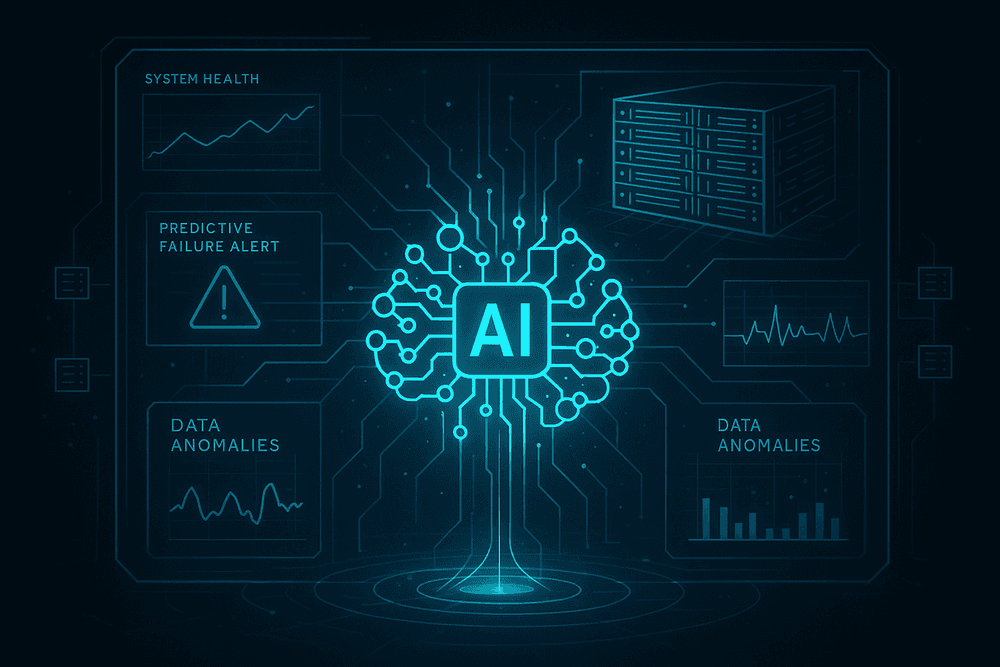
Artificial intelligence is not just a theoretical concept; it's a practical toolkit that transforms how we approach system stability. The fusion of AI reliability engineering principles with machine learning (ML) models allows organizations to shift from a reactive "break-fix" cycle to a proactive, predictive posture. By analyzing vast streams of telemetry data—logs, metrics, and traces—AI uncovers patterns invisible to the human eye, enabling engineers to address issues before they impact users. Let's explore the core applications making this revolution possible.
Predictive Maintenance: Getting Ahead of System Failures
Traditionally, maintenance falls into two camps: reactive (fix it when it breaks) or preventive (fix it on a schedule). Predictive maintenance offers a superior third way. By leveraging AI models, particularly time-series forecasting and regression analysis, systems can predict the remaining useful life (RUL) of a component.
These models are trained on historical performance data, environmental factors, and usage patterns. They learn to identify the subtle degradations that precede a catastrophic failure. For instance, an AI model can monitor the disk I/O, latency, and error rates of a server fleet to forecast which specific hard drive is likely to fail in the next 72 hours. This allows engineers to schedule a replacement during a low-traffic maintenance window, completely avoiding unplanned downtime and data loss.
Anomaly Detection: Using ML to Identify Silent Issues
Many critical system failures are preceded by subtle, unusual behavior that doesn't trigger traditional, threshold-based alerts. This is where AI-powered anomaly detection shines. Instead of relying on predefined rules (e.g., "alert when CPU > 90%"), machine learning algorithms like Isolation Forests or autoencoders learn a baseline of what constitutes "normal" system behavior.
When a new pattern emerges that deviates significantly from this learned normal—such as a slow memory leak in a microservice, a gradual increase in API error rates, or an unusual network traffic pattern—the system flags it as an anomaly. This capability is crucial for identifying "unknown unknowns" and silent, creeping issues that would otherwise go unnoticed until they escalate into a major incident.
Automated Root Cause Analysis for Faster Incident Resolution
During a system outage, the most stressful and time-consuming task is often the root cause analysis (RCA). Engineers must manually sift through mountains of logs and dashboards across dozens of services to piece together the sequence of events.
AI dramatically accelerates this process. By applying correlation algorithms and analyzing dependency graphs, AI platforms can instantly process telemetry from across the entire stack. They can pinpoint the exact deployment, configuration change, or upstream service failure that triggered the incident. Instead of a multi-hour investigation, engineers are presented with a probable root cause in minutes, complete with contextual data. This application is a cornerstone of effective AI reliability engineering, as it directly slashes Mean Time to Resolution (MTTR).
Intelligent Alerting: How to Reduce Monitoring Noise
Alert fatigue is a serious threat to any engineering team. A constant barrage of low-value, noisy, or duplicative alerts desensitizes engineers, causing them to miss the ones that truly matter. Intelligent alerting systems use AI to cut through this noise.
By learning from historical alert data and engineer interactions (e.g., which alerts are snoozed vs. acted upon), these systems can:
- Correlate and group alerts: Combine dozens of related symptom-based alerts into a single, actionable notification pointing to the root cause.
- Suppress noise: Automatically silence flapping alerts or known transient issues that resolve themselves.
- Prioritize dynamically: Escalate alerts that are statistically likely to have a high business impact based on the affected services and user activity.
This ensures that when an engineer is paged at 3 AM, it’s for a genuine, high-priority issue, restoring trust in the monitoring system.
Key Technologies Powering AI Reliability Engineering
At the heart of AI-driven reliability isn't a single magic algorithm, but a sophisticated toolkit of specialized technologies. Each plays a distinct role, transforming raw data into actionable insights and automated responses. Understanding these core components is crucial for implementing a successful AI reliability engineering strategy. Let's break down the key technologies that form the engine of next-generation system stability.
Machine Learning: The Foundation of Proactive Analysis
Before a system can heal itself, it must first learn to see. This is where classical Machine Learning (ML) models shine. Sifting through terabytes of system logs, metrics, and traces—data streams far too vast for human teams to monitor effectively—ML algorithms excel at pattern recognition and anomaly detection.
Models like clustering (e.g., k-means) can automatically group related error messages, revealing a widespread issue that might otherwise appear as isolated incidents. Classification algorithms can learn to distinguish between benign warnings and critical error precursors. By training on historical performance and incident data, these systems can move beyond simple threshold-based alerts. They learn the subtle, complex correlations that precede a failure, enabling engineers to predict potential outages and intervene proactively. This foundational layer of analysis is what elevates traditional monitoring into true AI reliability engineering.
Large Language Models (LLMs): Translating Chaos into Clarity
While ML models are masters of structured and semi-structured data, much of the crucial context surrounding an incident is trapped in unstructured text: Slack messages, Jira tickets, post-mortem documents, and engineer-written alerts. This is where Large Language Models (LLMs) provide a revolutionary leap in capability.
LLMs act as a powerful interpretation layer. They can parse natural language from disparate sources to build a coherent narrative of an ongoing incident. Imagine an LLM that reads through an entire incident Slack channel, summarizes the key hypotheses tested, identifies the engineers involved, and extracts the final root cause analysis. This dramatically accelerates the post-mortem process and makes institutional knowledge accessible. Furthermore, LLMs can translate cryptic error codes or stack traces into plain-English explanations, helping on-call engineers quickly grasp the nature of a problem without needing deep domain expertise, making incident response more efficient and less stressful.
Reinforcement Learning: The Path to Self-Healing Systems
If ML provides the senses and LLMs provide the understanding, Reinforcement Learning (RL) provides the autonomous hands. RL is the key to building truly self-healing systems. In this paradigm, an AI "agent" learns through trial and error to perform actions within a system to achieve a specific goal, like maximizing uptime or minimizing latency.
For example, an RL agent could learn the most effective way to respond to a sudden traffic spike. Should it scale up pods, reroute traffic to a different region, or enable a caching layer? By experimenting in a safe environment (or learning from past events), the agent develops a policy that is far more nuanced than a simple, hard-coded script. It can make dynamic decisions based on the current state of the entire system. From automatically adjusting database connection pools to orchestrating a failover sequence, RL represents the pinnacle of AI reliability engineering, transitioning systems from being merely observable to being genuinely autonomous and resilient.
Best Practices for Implementing AI Reliability Engineering
Adopting AI to enhance system reliability is a transformative step, but it’s not a simple plug-and-play solution. A strategic and thoughtful approach is essential for success. By following proven best practices, you can maximize the benefits of AI reliability engineering while minimizing risks and ensuring a smooth integration into your existing workflows.
Integrate, Don't Isolate: Connect AI to Your Observability Stack
Your AI is only as smart as the data it receives. The richest source of this data is your existing observability stack—your logs, metrics, and traces. Instead of treating AI as a separate, siloed tool, integrate it directly with your monitoring and observability platforms. This approach, often called AIOps, provides the necessary context for AI algorithms to work effectively.
A tight integration allows AI models to correlate disparate signals across your entire system. For example, an AI can link a sudden spike in CPU metrics with a specific error log and a distributed trace showing increased latency, instantly identifying the root cause of an issue that would take a human engineer hours to piece together. This unified view transforms your AI from a simple anomaly detector into a powerful, context-aware diagnostic engine.
Garbage In, Garbage Out: The Critical Role of High-Quality Data
The single most important factor in the success of any AI reliability engineering initiative is data quality. Inaccurate, incomplete, or irrelevant data will lead to flawed models, false positives, and a fundamental lack of trust in the system. To ensure your AI delivers accurate and actionable insights, focus on these data characteristics:
- Cleanliness: Implement processes to scrub data of errors, duplicates, and noise before it's fed into your models.
- Completeness: Ensure there are no significant gaps in your time-series data. Missing data can cause the AI to misinterpret normal behavior or miss critical failure signals.
- Relevance: Curate your data sources to focus on signals that are directly related to system health and performance. Feeding the AI irrelevant data will only confuse the model.
- Timeliness: For proactive and real-time reliability management, your AI needs access to fresh data with minimal delay.
A Step-by-Step Roadmap for Successful Adoption
Avoid a "big bang" approach. A phased, iterative rollout is the key to successfully implementing AI for reliability.
- Start Small and Define a Clear Use Case: Begin with a well-defined, high-impact problem. This could be predicting failures in a specific microservice, identifying anomalous API response times, or automating root cause analysis for a single application.
- Establish Baselines: Before you can detect anomalies, you must define "normal." Allow the AI model to learn the typical performance patterns and behaviors of your system over a sufficient period.
- Pilot and Validate: Deploy the AI model in a limited, non-critical environment. Continuously monitor its predictions and compare them against actual outcomes and the findings of your human experts. This validation phase is crucial for building trust.
- Iterate and Scale: Use the feedback and results from the pilot to refine the model's algorithms and thresholds. Once you’ve demonstrated value and reliability, you can gradually scale the solution to cover more services and systems.
Avoiding Common Pitfalls in AI Implementation
- The "Black Box" Problem: If your team doesn't understand why an AI makes a certain recommendation, they won't trust it. Prioritize AI solutions that offer explainability (XAI), providing clear reasoning behind their insights.
- Alert Fatigue: An untuned AI can quickly overwhelm your team with false positives. Fine-tune alerting thresholds carefully and integrate AI insights into workflows in a way that provides context, not just another noisy alert.
- Ignoring the Human Element: AI is a tool to augment, not replace, human expertise. Invest in training your engineers on how to interpret AI-driven insights and collaborate with the system effectively. Foster a culture where AI is viewed as a trusted partner in achieving reliability goals.
Real-World Use Cases of AI Reliability Engineering
Theory is one thing, but the true test of any new discipline is its performance in the real world. AI reliability engineering is no longer a futuristic concept; it's a critical operational strategy for industry leaders, safeguarding revenue and reputation by ensuring systems stay online and performant. From the cloud infrastructure that powers the internet to the factory floor, AI is the silent guardian against catastrophic failure.
How Major Cloud Providers Ensure Service Availability
For hyperscale cloud providers like Amazon Web Services (AWS), Google Cloud, and Microsoft Azure, reliability is the bedrock of their business. They manage millions of servers, network devices, and storage units, where even a minor outage can have a global impact.
This is where AI reliability engineering operates at its most impressive scale. These companies employ sophisticated AIOps platforms that:
- Predict Hardware Failures: AI models continuously analyze telemetry data from servers—monitoring temperature, disk I/O, and memory usage—to predict when a component like a hard drive or RAM module is likely to fail. This allows engineers to replace the hardware proactively during a scheduled maintenance window, preventing an unexpected outage.
- Automate Anomaly Detection: With millions of metrics streaming in every second, it’s impossible for humans to monitor everything. Machine learning algorithms establish a baseline of normal system behavior and instantly flag any deviation, alerting teams to potential issues long before they impact customers.
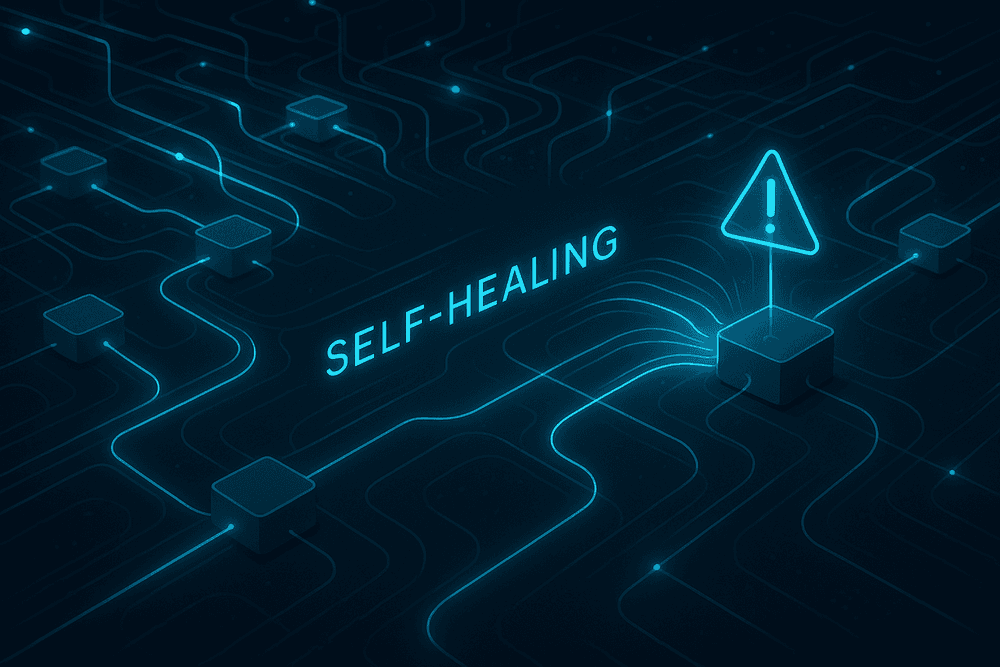
- Enable Self-Healing Infrastructure: When an anomaly is detected, AI-driven automation can kick in. For example, if a virtual machine becomes unresponsive, the system can automatically reroute traffic, reboot the instance, and log the event for root cause analysis without any human intervention.
AI in Manufacturing: Preventing Costly Factory Downtime
In the manufacturing sector, unplanned downtime is the enemy of profitability. A single failed piece of machinery on a production line can halt the entire operation, costing thousands of dollars per minute.
Forward-thinking manufacturers are implementing AI reliability engineering to transform their maintenance strategies from reactive to predictive.
- Predictive Maintenance: IoT sensors are fitted onto critical equipment like CNC machines, robotic arms, and conveyor systems. These sensors gather real-time data on vibration, temperature, and power consumption. AI models trained on this data can detect subtle patterns that precede a mechanical failure, alerting maintenance crews days or even weeks in advance.
- Optimized Maintenance Schedules: Instead of adhering to a rigid, time-based maintenance schedule (e.g., servicing a machine every 500 hours), AI can recommend maintenance based on actual usage and wear-and-tear. This prevents unnecessary servicing of healthy equipment and focuses resources where they are needed most.
Optimizing E-commerce Platform Reliability During Peak Traffic
For e-commerce giants, peak traffic events like Black Friday or a product launch are make-or-break moments. A slow-loading website or a crashed checkout process can lead to millions in lost sales and severe damage to brand reputation. AI is the key to weathering these digital storms.
- Intelligent Load Balancing and Auto-Scaling: AI systems analyze historical traffic data and real-time user activity to predict demand surges. They can automatically scale server resources up before the traffic spike hits, ensuring the platform remains fast and responsive. Once traffic subsides, the system scales resources back down to control costs.
- Real-Time Performance Monitoring: AI constantly monitors the user experience, detecting subtle issues like a slow-down in the payment gateway or an increase in API error rates. It can pinpoint the source of the bottleneck, allowing engineers to resolve the issue before a significant number of customers are affected. This proactive approach is a cornerstone of modern AI reliability engineering in customer-facing applications.
Conclusion: The Future of Autonomous and AI Reliability Engineering
We are at a pivotal moment in the evolution of system resilience. The principles of AI reliability engineering are no longer a futuristic concept but a present-day necessity for managing the immense complexity of modern distributed systems. As we've explored, leveraging AI moves teams beyond reactive firefighting to a proactive, predictive, and ultimately autonomous posture. The journey doesn't end here; it's an accelerating path toward systems that can anticipate, diagnose, and heal themselves with minimal human intervention.
Preparing for the Next Wave of AIOps Innovation
The future of AI reliability engineering is autonomous. The next wave of AIOps will transcend simple anomaly detection and automated alerting. We are heading towards truly self-healing infrastructures where AI agents perform root cause analysis, test potential fixes in sandboxed environments using digital twins, and deploy remediation automatically.
Expect to see advancements in:
- Causal AI: Moving beyond correlation to understand the true "why" behind system failures, dramatically reducing mean time to resolution (MTTR).
- Generative AI in Operations: AI will not only identify problems but also generate human-readable incident summaries, suggest detailed remediation steps, and even write corrective code or configuration scripts.
- Hyper-Automation: The integration of AI across the entire software development lifecycle, from predicting performance bottlenecks in pre-production to optimizing resource allocation in real-time.
How to Start Your AI Reliability Journey Today
Embracing this future doesn't require a massive, instantaneous overhaul. It begins with foundational, deliberate steps. Here’s a practical roadmap to get started:
- Master Your Observability Data: AI is fueled by data. Your first step is to ensure you have a robust observability practice. Consolidate your metrics, logs, and traces into a unified platform. Clean, well-structured data is the bedrock of any successful AI reliability engineering initiative.
- Identify a High-Impact, Low-Risk Use Case: Don't try to solve everything at once. Start by applying AI to a contained but meaningful problem. Good starting points include automating alert correlation to reduce notification fatigue, predicting disk or database capacity issues, or identifying seasonal performance degradation patterns.
- Foster a Culture of Experimentation: Encourage your SRE and DevOps teams to experiment. Create a safe environment to test new models and tools. Acknowledge that not every experiment will succeed, but every outcome provides valuable learning for refining your strategy.
- Upskill and Collaborate: Bridge the gap between operations and data science. Provide training for your engineers on the fundamentals of machine learning, and ensure your data scientists understand the unique challenges of production systems. Cross-functional collaboration is key to building effective AI-driven solutions.
Essential Tools and Resources for Your Team
Equipping your team with the right tools is crucial. The landscape is vast, but it can be broken down into a few key categories:
- Observability & AIOps Platforms: Solutions like Datadog, Dynatrace, New Relic, and Splunk offer increasingly sophisticated, built-in AIOps features for anomaly detection and event correlation.
- Open-Source ML Frameworks: For teams building custom solutions, libraries like TensorFlow, PyTorch, and Prophet provide powerful, flexible toolkits for developing predictive models.
- Specialized AIOps Tools: Platforms such as Moogsoft and BigPanda are purpose-built to ingest data from various sources and apply AI to streamline incident management.
- Learning Resources: Encourage continuous learning through courses on platforms like Coursera and A Cloud Guru, and stay engaged with the community through conferences like SREcon and industry publications.