
August 16, 2025
What Is AI Performance Monitoring (and Why It’s Business-
What Is AI Performance Monitoring (and Why It’s Business-Critical)?
Launching an AI model into production is like launching a ship into the ocean. You can run all the simulations you want in the harbor, but you only truly know its performance when it faces the unpredictable waves of the real world. AI performance monitoring is the continuous process of acting as the ship's captain, crew, and navigator—constantly checking the instruments, observing the environment, and making course corrections to ensure your model reaches its destination safely and effectively.
In simple terms, it’s the systematic tracking, analysis, and management of AI models once they are live, interacting with real-world data, and making decisions that impact your business. It’s not a one-time check but an ongoing discipline crucial for realizing the long-term value of your AI investment.
Beyond Accuracy: Defining the Full Scope of Model Health
When teams first think about monitoring, their minds often jump to a single metric: accuracy. While important, judging a model solely on its accuracy is like judging a car's health only by its top speed. It’s a vital piece of information, but it tells you nothing about the engine's oil pressure, tire integrity, or whether the brakes are about to fail.
Comprehensive ai performance monitoring provides a holistic, 360-degree view of model health by tracking a wider set of vital signs:
- Data and Concept Drift: This is the most common cause of model degradation. Data drift occurs when the input data in production (e.g., current user behavior) no longer resembles the data the model was trained on. Concept drift is when the relationship between inputs and outputs changes (e.g., the factors that define a "good" sales lead shift due to market changes).
- Operational Metrics: How is the model behaving as a piece of software? This includes latency (how fast it responds), throughput (how many requests it can handle), and system errors. A model that is 99% accurate but takes 10 seconds to return a prediction is often useless in a real-time application.
- Bias and Fairness: Is the model performing equitably across different user segments? Monitoring for bias is critical for avoiding ethical missteps, reputational damage, and regulatory penalties.
The High Cost of Silent AI Failures in Production
Unlike traditional software that often fails loudly with a crash or an error code, AI models fail silently. They don't stop working; they just start providing subtly incorrect, biased, or nonsensical outputs. This gradual decay can go unnoticed for weeks or months, all while silently eroding business value.
Consider the consequences:
- A product recommendation engine that starts suggesting irrelevant items due to a shift in trends, leading to a steady decline in conversion rates.
- A fraud detection model that fails to adapt to a new type of scam, causing a spike in financial losses.
- A dynamic pricing model that misinterprets new market data, leading to uncompetitive pricing and lost revenue.
Effective ai performance monitoring acts as your early warning system. It catches these silent failures before they can compound into catastrophic business problems, turning unknown risks into manageable events.
From Development to Deployment: The Shift in Monitoring Needs
The needs of monitoring change dramatically as a model moves from the controlled laboratory of development to the chaotic environment of production.
- In Development: Monitoring is static. You evaluate the model against a fixed, historical test dataset. The primary concerns are statistical metrics like F1-score, precision, and recall on a dataset you know and control.
- In Production: Monitoring must be dynamic and continuous. The data is a flowing river, not a placid lake. Your focus shifts from "How did the model perform on my test set?" to "How is the model performing on live, unseen data right now?"
This is where you must track data drift, model latency, and the direct impact on business KPIs. The goal is no longer just to validate a model but to ensure it continues to deliver real-world value day after day. This fundamental shift makes a dedicated ai performance monitoring strategy a non-negotiable component of any successful MLOps lifecycle.
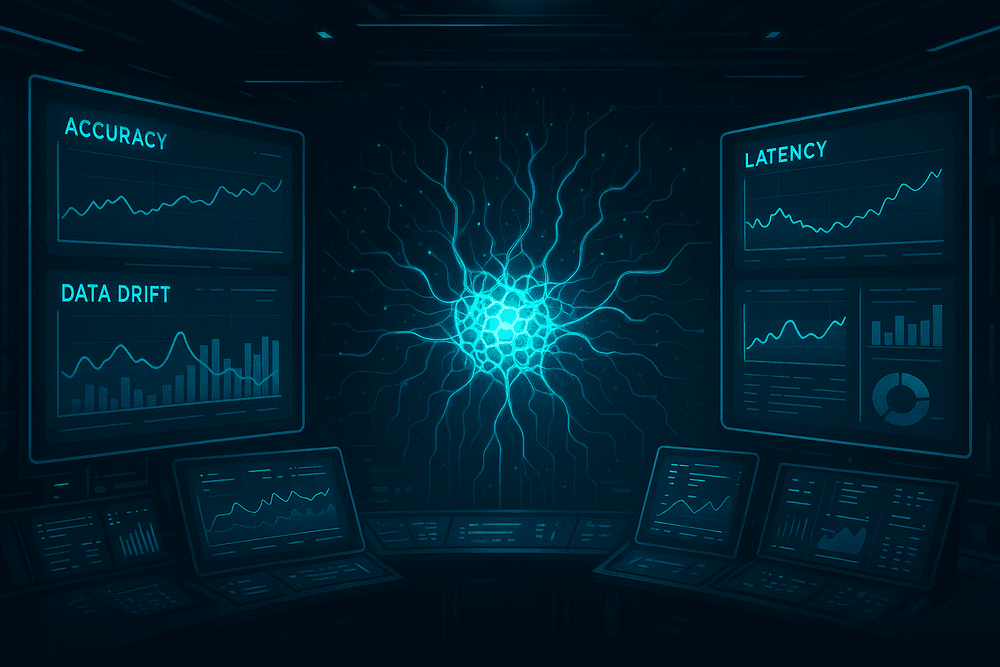
Essential Metrics for Robust AI Performance Monitoring
Once an AI model is deployed, its journey has just begun. Leaving it unmonitored is like flying a plane without an instrument panel—you're operating on hope, not data. A robust AI performance monitoring strategy relies on a dashboard of essential metrics that provide a complete picture of your model's health, from its operational stability to its real-world impact. These metrics fall into four critical categories.
Tracking Model Drift and Concept Drift in Real-Time
The world isn't static, and neither is your data. Drift is the silent killer of AI model performance, occurring when the production data deviates from the data the model was trained on.
- Model Drift (or Data Drift): This happens when the statistical properties of the input data change over time. Imagine a retail demand forecasting model trained on pre-2020 shopping data. As consumer habits shifted dramatically, the incoming data no longer matched the training data, causing the model's accuracy to degrade. Monitoring input data distributions is key to catching this early.
- Concept Drift: This is more subtle. Here, the relationship between the input data and the target variable changes. For example, the definition of a "spam" email evolves as attackers devise new phishing tactics. The features are the same (email content), but what constitutes the "spam" concept has changed. Continuous AI performance monitoring for concept drift involves tracking the model's prediction accuracy against ground truth and flagging performance dips that signal a need for retraining.
Measuring Operational Metrics: Latency, Throughput, and Uptime
An accurate model is useless if it's too slow or frequently unavailable. Operational metrics measure the health of the infrastructure serving your model and are vital for a positive user experience.
- Latency: This is the time it takes for your model to return a prediction after receiving an input request. For real-time applications like recommendation engines or fraud detection, high latency can render the system ineffective.
- Throughput: This metric measures the number of predictions your model can handle in a given timeframe (e.g., inferences per second). It's a critical indicator of your system's scalability and its ability to handle peak loads.
- Uptime: Also known as availability, this is the percentage of time your AI service is operational and ready to serve requests. This fundamental metric is a direct measure of reliability.
Evaluating Task-Specific Metrics: Accuracy, Precision, and F1-Score
These metrics evaluate how well your model is performing its intended task. The right choice depends entirely on your specific use case.
- Accuracy: The most straightforward metric, it measures the percentage of correct predictions out of all predictions made. However, it can be misleading for imbalanced datasets (e.g., a fraud model that is 99% accurate simply by predicting "not fraud" every time).
- Precision and Recall: These two metrics provide a more nuanced view. Precision answers: "Of all the positive predictions, how many were actually correct?" (minimizes false positives). Recall answers: "Of all the actual positive cases, how many did the model identify?" (minimizes false negatives). In medical diagnostics, high recall is crucial to avoid missing a disease.
- F1-Score: This is the harmonic mean of precision and recall, offering a single, balanced score. It's an excellent default metric for many classification problems where you need to balance the costs of false positives and false negatives.
Ensuring Ethical AI: Monitoring for Fairness, Bias, and Explainability
Effective AI performance monitoring extends beyond numbers to encompass ethical and compliance considerations. An AI that is technically accurate but systematically unfair can be a massive liability.
- Fairness and Bias: Models trained on historical data can inadvertently learn and amplify existing societal biases. Monitoring for fairness involves segmenting performance metrics across different demographic groups (e.g., age, gender, ethnicity) to ensure the model does not produce discriminatory outcomes.
- Explainability (XAI): This refers to the ability to understand and interpret a model's decisions. For high-stakes applications in finance or healthcare, being able to explain why a model denied a loan or recommended a treatment is critical for building trust, debugging, and meeting regulatory requirements like GDPR. Monitoring tools that integrate techniques like SHAP or LIME are becoming essential.
Comparing the Top AI Performance Monitoring Tools & Platforms
Navigating the landscape of AI performance monitoring tools can be daunting. The market is filled with options ranging from flexible open-source stacks to powerful, specialized MLOps platforms and integrated cloud services. The right choice depends on your team's expertise, budget, existing infrastructure, and specific monitoring needs. Let's break down the leading contenders to help you find the perfect fit.
Open-Source Solutions: When to Use Prometheus & Grafana
The combination of Prometheus (for data collection and alerting) and Grafana (for visualization and dashboards) is the go-to open-source stack for general-purpose monitoring.
- What They're Good For: This duo excels at monitoring system-level and infrastructure metrics. You can track CPU/GPU utilization, memory usage, request latency, and endpoint error rates. For teams with strong DevOps and engineering skills, it offers unparalleled flexibility and customization at zero licensing cost.
- The Catch: Prometheus and Grafana are not purpose-built for AI performance monitoring. Setting them up to track complex ML-specific metrics like data drift, concept drift, or prediction confidence requires significant custom development. You’ll need to build your own data pipelines, define metrics, and create visualizations from scratch.
- Best For: Teams with the in-house expertise to build and maintain a custom monitoring solution, or for those whose primary concern is the health of the underlying model-serving infrastructure rather than deep model-level insights.
Managed MLOps Platforms: Datadog, Fiddler AI, and Arize AI Compared
For teams seeking a ready-made, powerful solution, managed MLOps platforms offer specialized features for deep AI observability.
- Datadog: Known as a comprehensive observability platform, Datadog has extended its capabilities into MLOps. Its strength lies in providing a unified view across your entire tech stack—from infrastructure and logs to model performance metrics. If your organization already uses Datadog, adding AI performance monitoring can create a seamless, single-pane-of-glass experience.
- Fiddler AI: Fiddler carves out its niche with a strong focus on Explainable AI (XAI) and model fairness. While it provides robust performance monitoring, its standout feature is the ability to explain why a model made a specific decision. This is invaluable for regulated industries or applications where model transparency is non-negotiable.
- Arize AI: Arize is a leader in ML observability and is purpose-built for troubleshooting models in production. It excels at root-cause analysis, helping you quickly diagnose issues like data quality degradation, drift, and performance drops. Its powerful visualizations and automated monitors are designed to pinpoint problems before they impact users.
Cloud-Native Options: Leveraging AWS SageMaker and Google Vertex AI
If your ML workflow is heavily invested in a major cloud provider, their native monitoring tools are a convenient and powerful starting point.
- AWS SageMaker Model Monitor: Fully integrated into the AWS ecosystem, SageMaker Model Monitor automatically tracks deployed models for data drift, concept drift, and feature attribution drift. It provides built-in rules and visualizations, making it a straightforward choice for teams deploying models via SageMaker endpoints.
- Google Vertex AI Model Monitoring: Similar to its AWS counterpart, Vertex AI Model Monitoring helps you maintain high-quality models by detecting skew and drift between your training data and live prediction traffic. Its deep integration with the Google Cloud Platform makes it a natural fit for anyone building on Vertex AI.
- The Trade-off: While incredibly convenient, these tools can create vendor lock-in and may not offer the same depth of features or cross-platform compatibility as specialized third-party MLOps tools.
How to Choose the Right Monitoring Tool for Your Stack
Selecting the ideal tool requires evaluating your unique circumstances. Ask yourself these key questions:
- Team & Resources: Do we have the engineering bandwidth to manage an open-source stack, or do we need a managed solution?
- Primary Goal: Is our main focus on infrastructure health, model drift detection, explainability, or rapid troubleshooting?
- Existing Stack: Are we deeply integrated with a cloud platform like AWS or GCP, or do we use an observability tool like Datadog already?
- Scale & Criticality: How many models are we deploying, and how crucial is their performance to our business operations?
Ultimately, the best AI performance monitoring platform is the one that seamlessly integrates into your workflow, empowers your team with actionable insights, and helps you ensure your AI delivers consistent value.
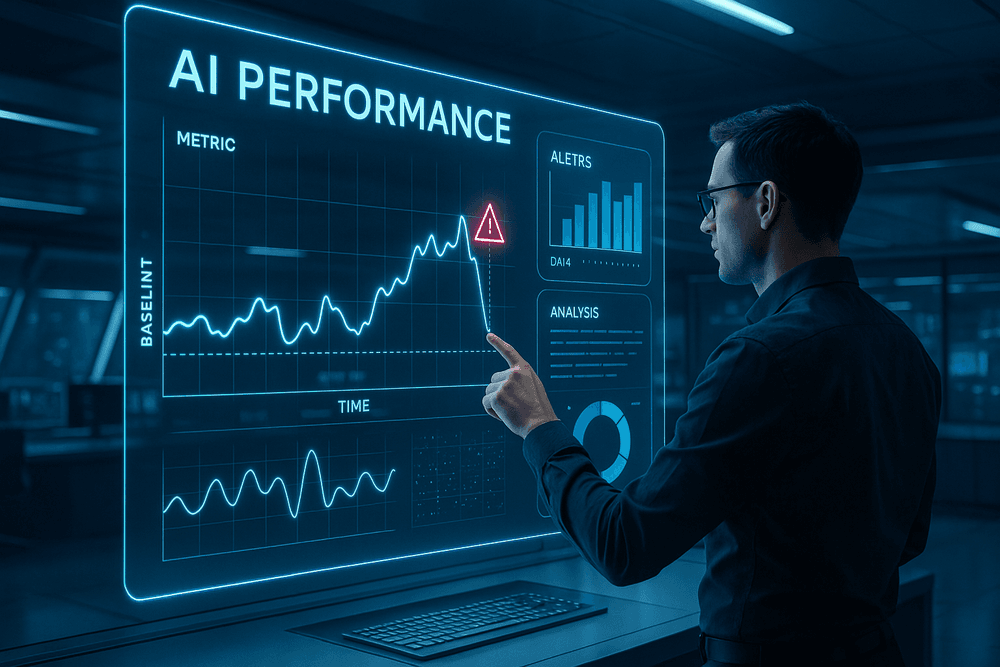
A Strategic Guide to Implementing AI Performance Monitoring
Transitioning an AI model from a controlled lab environment to the dynamic real world is a critical phase filled with potential pitfalls. A robust implementation strategy is essential for ensuring your model not only survives but thrives. The following steps provide a strategic roadmap for setting up a comprehensive AI performance monitoring framework.
Step 1: Establishing a Performance Baseline Before Deployment
You can't manage what you don't measure. Before your AI model ever sees a production environment, you must define what success looks like. This starts with establishing a robust performance baseline. By rigorously testing your model on a holdout validation dataset—a set of data it has never seen before—you create a benchmark for its expected behavior. Key metrics to baseline include not only model-specific ones like accuracy, precision, and F1-score but also operational metrics like inference latency and resource (CPU/GPU/memory) consumption. This pre-deployment baseline is the critical reference point for your entire AI performance monitoring framework. It acts as the "ground truth" against which you will compare real-world performance, allowing you to instantly identify degradation or unexpected behavior once the model is live.
Step 2: Setting Up Automated Alerting for Anomaly Detection
Once your model is in production, manually checking dashboards is inefficient and unsustainable. The key to proactive management is automated alerting. A sophisticated AI performance monitoring system should be configured to automatically notify the right teams when key metrics deviate significantly from your established baseline. These alerts aren't just for catastrophic failures; they should be tuned to detect subtle signs of trouble. For instance, you could set up alerts for a gradual drop in prediction confidence, a sudden spike in null values in input data (indicating a data pipeline issue), or a significant shift in the statistical properties of incoming data, known as data drift. The goal is to create a smart, sensitive system that flags anomalies before they impact end-users, transforming your team from reactive firefighters to proactive problem-solvers.
Step 3: Integrating Monitoring into Your CI/CD and MLOps Pipeline
AI performance monitoring should not be an afterthought; it must be woven into the fabric of your development and operations lifecycle. Integrating monitoring tools directly into your Continuous Integration/Continuous Deployment (CI/CD) and MLOps pipeline automates quality control and ensures consistency. When a new model version is committed, the pipeline should automatically trigger a process that deploys it to a staging environment, runs it against a benchmark dataset, and compares its performance to the current production model. If the new version fails to meet or exceed the established performance and operational thresholds, the deployment can be automatically halted. This practice, known as canary testing or shadow deployment, de-risks model updates and embeds a culture of performance-driven development from day one.
Step 4: Creating a Human-in-the-Loop Feedback System
While automation is powerful, human intelligence remains an invaluable asset. An effective AI performance monitoring strategy includes a human-in-the-loop (HITL) feedback system to handle the nuances that automated systems can miss. This involves creating a streamlined process for human experts to review predictions that the model flags as low-confidence or that an alerting system identifies as anomalous. These experts can then validate or correct the model's output, providing high-quality labeled data that is essential for retraining and fine-tuning. This feedback loop is particularly crucial for catching concept drift—where the real-world data patterns change over time—and addressing complex edge cases. By combining automated oversight with human expertise, you create a resilient, self-improving AI system that continuously adapts and maintains its performance over time.
AI Performance Monitoring in Action: Real-World Use Cases
Theory and metrics are essential, but the true value of AI performance monitoring shines when applied to real-world business challenges. By moving from a reactive "fix-it-when-it-breaks" approach to a proactive, data-driven strategy, organizations can protect revenue, mitigate risk, and ensure their AI initiatives deliver on their promises. Let's explore how three distinct industries leverage monitoring to solve critical problems.
E-commerce: Preventing Sales Loss from Degraded Recommendation Engines
For an e-commerce platform, a recommendation engine is a silent, top-performing salesperson. It drives engagement, increases average order value, and enhances the customer experience. But when its performance degrades, it becomes a silent revenue killer.
- The Challenge: Recommendation models are highly susceptible to data drift. Customer trends change, new products are added, and seasonal demands shift. A model trained on last season's data might start suggesting irrelevant winter coats in the middle of summer. This leads to user frustration, lower click-through rates, and abandoned carts.
- The Monitoring Solution: A robust AI performance monitoring system tracks the business impact of the model in real-time. It doesn't just look at abstract accuracy; it monitors key performance indicators (KPIs) like click-through rates on recommendations, conversion rates, and revenue per session. It also watches for statistical drift in user behavior data. When the system detects a sustained drop in conversions originating from recommended products, it triggers an alert. This signals to the MLOps team that the model no longer reflects current customer intent and needs to be retrained with fresh data.
- The Outcome: Instead of discovering a sales dip weeks later, the company can proactively retrain and redeploy its model, ensuring recommendations stay relevant and effective.
Fintech: Detecting Fraud with Real-Time Model Anomaly Alerts
In the high-stakes world of financial technology, fraud detection models are the first line of defense. The problem is that fraudsters are constantly innovating, creating new attack vectors that an existing model has never seen.
- The Challenge: Concept drift is a constant threat. A model trained to detect known fraud patterns can quickly become obsolete when a novel scheme emerges. This "zero-day" fraud can go undetected by the model, leading to significant financial losses before human analysts can catch on.
- The Monitoring Solution: Here, AI performance monitoring acts as a sophisticated early warning system. It focuses on monitoring the model's predictions and input data for anomalies. The system tracks the distribution of the model’s confidence scores. If it suddenly sees a spike in low-confidence predictions or a cluster of transactions with unusual feature patterns (e.g., a new combination of transaction amount, location, and time), it flags them. These anomalies suggest the model is encountering something it doesn't understand—a potential new fraud tactic.
- The Outcome: Security teams are alerted in real-time to investigate the suspicious activity. This allows them to catch new fraud schemes at their inception, update the model, and prevent widespread damage, protecting both the institution and its customers.
Healthcare: Ensuring Diagnostic AI Models Remain Accurate and Fair
When an AI model is used to help diagnose diseases from medical scans, its accuracy and reliability are non-negotiable. Lives are on the line, and performance degradation is not an option.
- The Challenge: A diagnostic AI's performance can be impacted by subtle shifts in the real world. A hospital might introduce a new MRI machine with slightly different image properties, or the patient demographic at a clinic could change. These changes can introduce data drift that degrades model accuracy or, more insidiously, introduces bias, making the model less accurate for certain populations.
- The Monitoring Solution: Continuous AI performance monitoring is critical for clinical AI. The system constantly validates the model’s predictions against ground truth data from pathologists. More importantly, it performs segmented analysis, monitoring fairness metrics to ensure the model’s accuracy is consistent across different age groups, genders, and ethnicities. If performance drops for a specific demographic or for images from a new scanner, the system immediately alerts the clinical and technical teams.
- The Outcome: This rigorous oversight ensures the diagnostic tool remains trustworthy, fair, and safe for all patients. It maintains clinical integrity and provides doctors with a reliable tool they can count on to aid in delivering the best possible care.
Conclusion: Future-Proof Your AI with Proactive Monitoring
The journey into AI doesn't end when a model is deployed; that’s precisely where the real work begins. Moving past a "set it and forget it" mindset is crucial for long-term success. Effective AI performance monitoring transforms your AI initiatives from a high-stakes gamble into a reliable, continuously improving business asset. It’s the essential bridge between a model's theoretical potential and its real-world value, ensuring it remains accurate, fair, and efficient long after launch. By adopting a proactive approach, you're not just fixing problems—you're preventing them, future-proofing your investment and building trust in your AI systems.
Your Quick-Start Checklist for AI Performance Monitoring
Embarking on a monitoring strategy can feel daunting. Use this checklist to lay a strong foundation for a comprehensive and actionable AI performance monitoring framework.
- Establish Your Baselines: Before you can detect deviation, you must define "normal." Document your model's key performance indicators (KPIs) at launch, including accuracy, precision, recall, latency, and resource consumption. This is your ground truth for all future comparisons.
- Monitor for Data and Concept Drift: Implement automated tools to track changes in your input data distributions (data drift) and shifts in the underlying relationships the model learned (concept drift). These are the earliest and most critical warning signs of performance degradation.
- Set Up Intelligent Alerting: Configure an alerting system that notifies the right teams when performance metrics breach predefined thresholds. To avoid alert fatigue, ensure your alerts are specific, contextual, and directly linked to potential business impact.
- Create Robust Feedback Loops: Build mechanisms to capture real-world outcomes and user feedback. This human-in-the-loop validation is invaluable for identifying subtle model failures, uncovering edge cases, and gathering high-quality data for retraining.
- Automate Health Checks and Reporting: Schedule regular, automated reports on model health, data integrity, and business impact. This keeps stakeholders informed and embeds AI performance monitoring into your core operational rhythm.
The Next Frontier: Predictive and Automated Model Maintenance
While current AI performance monitoring focuses on detecting issues as they arise, the future is predictive. The next generation of monitoring platforms won't just tell you that your model's performance has dropped; they will forecast a potential drop before it impacts your business. Imagine systems that identify subtle patterns in data drift that reliably precede a dip in accuracy, allowing you to intervene preemptively.
This evolution leads directly to automated model maintenance. Instead of a data scientist manually triggering a retraining pipeline after an alert, advanced MLOps systems will automatically initiate retraining on a fresh dataset, validate the new model, and even deploy it with minimal human intervention. This concept of "self-healing AI" is the ultimate goal: creating resilient, autonomous systems that adapt to a changing world, ensuring peak performance and freeing up your technical teams to focus on innovation.
Get Started with a Custom AI Monitoring Strategy
The most effective AI performance monitoring strategy is one that is tailored to your unique environment. The right metrics for a fraud detection model are different from those for a product recommendation engine. Start by auditing your current AI portfolio. For each model, ask: What is its core business purpose? What are the biggest risks of its failure? Use the answers to build a custom monitoring plan. Don't wait for a silent failure to erode customer trust or impact your bottom line. By implementing a proactive AI performance monitoring strategy today, you build a foundation for scalable, reliable, and trustworthy AI.