
July 26, 2025
What Is AI Performance Monitoring and Why Is It Your Safety
What Is AI Performance Monitoring and Why Is It Your Safety Net?
Imagine launching a state-of-the-art rocket into space without any instruments to track its trajectory, speed, or system health. You’d be flying blind, hoping for the best but expecting the worst. Deploying an AI model into a live production environment without a robust monitoring system is the digital equivalent. AI performance monitoring is the mission control for your artificial intelligence—the continuous, real-time process of tracking, analyzing, and evaluating how your model behaves once it leaves the controlled environment of the lab and faces the chaos of the real world.
It’s about answering critical questions long after the initial deployment: Is the model still making accurate predictions? Is it responding quickly enough? Has the data it's seeing changed in unexpected ways? Effective AI performance monitoring goes beyond simple server health checks; it dives deep into the statistical and operational integrity of the model itself, ensuring it delivers consistent value and doesn't become a hidden liability.
The High Stakes: What Happens When AI Models Go Unchecked?
A deployed AI model is not a static piece of code. It's a dynamic system interacting with an ever-changing environment. Without monitoring, you are exposed to silent failures that can erode trust, revenue, and customer satisfaction. The primary culprit is often model drift, which comes in two main forms:
- Concept Drift: The fundamental relationship between your model's inputs and the outcome it predicts changes. For example, a model predicting customer churn might become less accurate after a global event fundamentally alters consumer spending habits and loyalty. The old patterns no longer hold true.
- Data Drift: The statistical properties of the input data your model receives change over time. A facial recognition model trained on one set of camera resolutions may start failing when new, higher-resolution smartphone cameras become the norm, introducing data it wasn't prepared for.
When these drifts go unchecked, the consequences can be severe:
- Financial Losses: A dynamic pricing model might start underpricing products, or a fraud detection system could begin missing fraudulent transactions, leading to direct revenue loss.
- Poor User Experience: A recommendation engine that fails to adapt to new trends will offer irrelevant suggestions, frustrating users and driving them away.
- Operational Inefficiency: A predictive maintenance model that no longer accurately forecasts equipment failure can lead to unexpected downtime and costly repairs.
- Compliance and Ethical Risks: An unchecked model can slowly develop biases in its decision-making, leading to discriminatory outcomes in areas like loan applications or hiring, exposing the organization to legal and reputational damage.
From Proactive Prevention to Continuous Optimization
Viewing AI performance monitoring as merely a troubleshooting tool is missing half its value. It serves a dual purpose: it’s your defensive safety net and your engine for continuous improvement.
As a safety net, it provides proactive prevention. By tracking key metrics like accuracy, precision, latency, and prediction confidence, you can establish automated alerts that flag performance degradation before it impacts the business. This system catches subtle drifts and data quality issues early, allowing your team to intervene, investigate, and retrain the model before a minor issue becomes a major crisis.
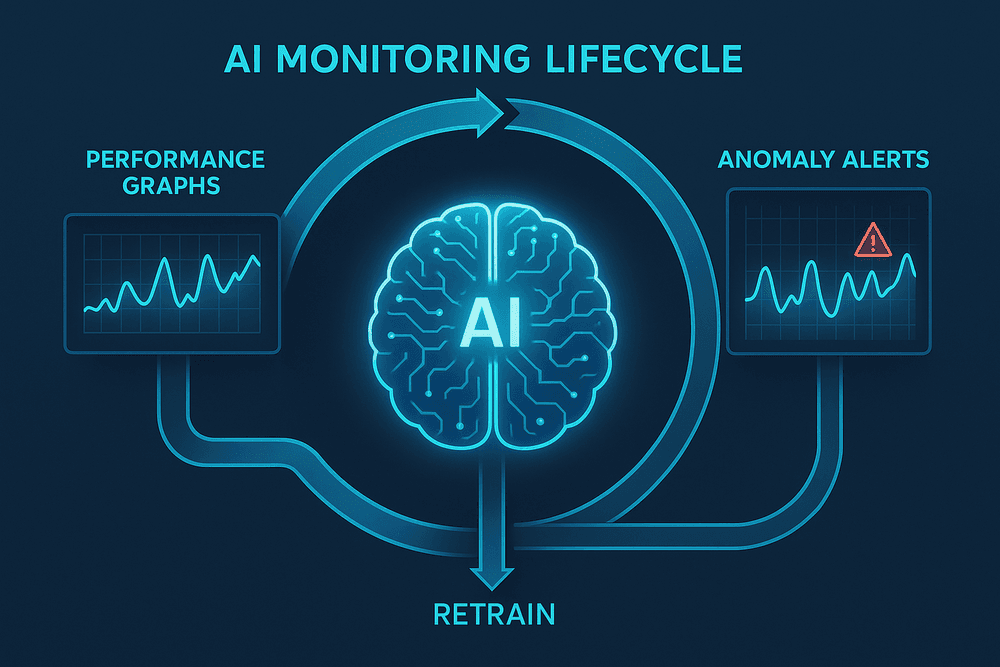
Beyond prevention, monitoring provides the data-driven feedback loop essential for continuous optimization. The insights gathered from a live model are invaluable. They reveal how users are interacting with your AI, highlight new data patterns, and pinpoint exactly when a model is becoming stale. This transforms AI performance monitoring from a defensive tactic into a strategic asset, powering an iterative cycle of Monitor -> Analyze -> Retrain -> Redeploy that ensures your AI systems don't just survive in the real world—they evolve and thrive.
The Core Metrics of AI Performance Monitoring You Must Track
Once your AI model is deployed, the real work begins. The dynamic nature of real-world data means a "set it and forget it" approach is a recipe for failure. Effective AI performance monitoring isn't just about checking if the system is online; it's about continuously measuring a core set of metrics that reveal the health, accuracy, and fairness of your model.
Tracking Model Drift and Concept Drift to Maintain Accuracy
Your model was trained on a snapshot of the world at a specific point in time. But the world changes, and so do the patterns in your data. This leads to two critical issues:
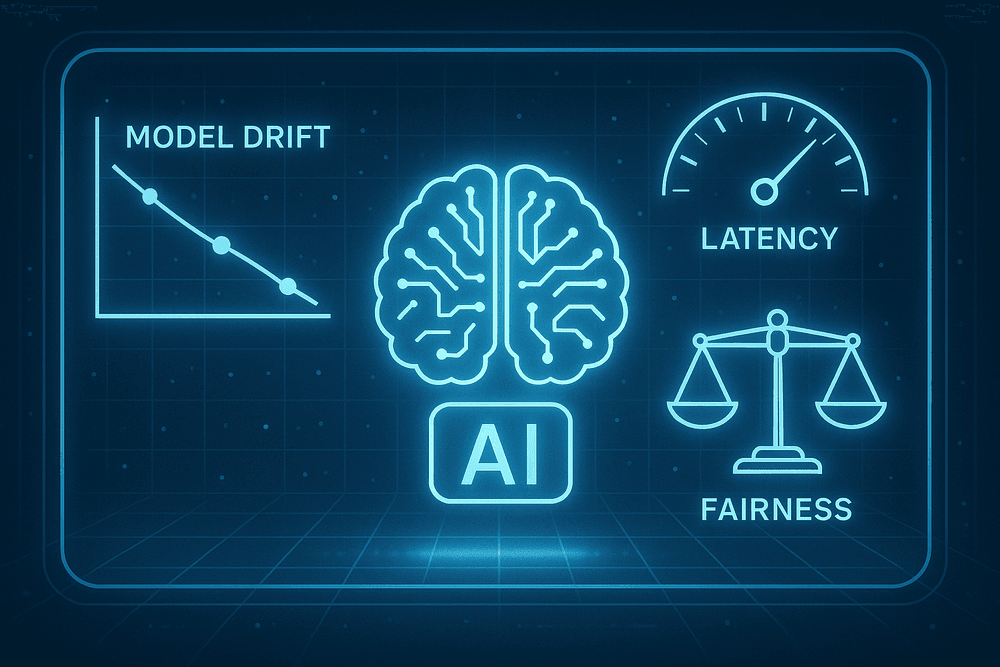
- Model Drift: Also known as model decay, this is the gradual degradation of your model's predictive power. The accuracy you celebrated during testing starts to decline because the statistical properties of the incoming data no longer match the data it was trained on.
- Concept Drift: This is a more profound change where the fundamental relationship between input variables and the target variable evolves. For example, a model predicting customer churn might become less accurate if a new competitor enters the market, completely changing the reasons why customers leave.
Monitoring for these drifts by comparing model predictions against ground truth (once it becomes available) is essential. A sudden or steady drop in accuracy is a red flag that your model needs to be retrained with fresh data to remain relevant.
Analyzing Data Drift: Is Your Input Data Changing?
Data drift is often a leading indicator of model drift. It occurs when the statistical properties of the live input data diverge from the training data, even if the underlying concepts remain the same. Imagine a credit risk model trained primarily on data from one economic climate suddenly facing data from a recession. The distribution of features like income, spending, and loan applications will shift dramatically.
A robust AI performance monitoring system tracks the distribution of each input feature. By using statistical tests like the Kolmogorov-Smirnov (K-S) test or Population Stability Index (PSI), you can automatically detect significant shifts in your data. Catching data drift early allows you to proactively investigate the cause and retrain your model before its performance degrades significantly.
Measuring Latency, Throughput, and Computational Costs
An accurate model that is too slow or expensive is impractical for most business applications. Operational metrics are just as crucial as accuracy metrics.
- Latency: The time it takes for the model to process a single request and return a prediction. For real-time applications like fraud detection or product recommendations, high latency can render the system useless.
- Throughput: The number of predictions the model can handle in a given timeframe (e.g., predictions per second). This is vital for high-volume systems to ensure they can scale with demand.
- Computational Costs: The amount of CPU, GPU, and memory resources your model consumes. Monitoring these costs helps manage your operational budget and optimize infrastructure for efficiency.
Balancing predictive accuracy with these operational constraints is a key challenge that a comprehensive AI performance monitoring framework helps solve.
Detecting and Mitigating Bias in AI Models
An AI model can inadvertently learn and amplify societal biases present in its training data. This can lead to unfair or discriminatory outcomes for certain demographic groups, posing significant ethical, reputational, and legal risks. Monitoring for bias isn't an optional extra; it's a core responsibility.
This involves tracking fairness metrics across different population segments (e.g., defined by race, gender, or age). Metrics like demographic parity (ensuring the model's positive outcome rate is similar across groups) and equal opportunity (ensuring the true positive rate is similar) can reveal hidden biases. When bias is detected, mitigation may involve re-sampling data, adjusting model thresholds, or applying advanced fairness algorithms.
Comparing the Best Tools for AI Performance Monitoring
Choosing the right tool for AI performance monitoring can feel overwhelming. The landscape is split between flexible open-source solutions and powerful, specialized managed platforms. Your choice depends on your team’s expertise, budget, and the specific monitoring depth your models require. Let's break down the leading options to help you decide.
Open-Source vs. Managed Platforms: A Head-to-Head Comparison
The first major decision is whether to build your monitoring stack with open-source tools or buy into a managed service.
- Open-Source Solutions (e.g., Prometheus, Grafana, Evidently AI): These tools offer unparalleled flexibility and control. You can customize every dashboard, alert, and integration to fit your exact needs. The primary benefit is cost-effectiveness, as there are no licensing fees. However, this path requires significant engineering resources for initial setup, ongoing maintenance, and scaling. It’s a great fit for teams with strong DevOps capabilities who want to build a bespoke AI performance monitoring system from the ground up.
- Managed Platforms (e.g., Arize AI, Fiddler, WhyLabs): These are purpose-built, commercial tools designed to provide deep ML observability out of the box. They offer user-friendly interfaces, automated drift detection, model explainability features, and dedicated customer support. While they come with a subscription cost, they drastically reduce the engineering overhead, allowing your ML team to focus on building and improving models instead of managing infrastructure.
Deep Dive: Evaluating Datadog for AI Observability
Many teams already use Datadog for application performance monitoring (APM), making it a natural contender. Datadog has extended its powerful observability platform to include features for monitoring machine learning models.
Strengths: Datadog’s key advantage is its unified approach. You can view model latency, error rates, and resource usage right alongside your application logs, infrastructure metrics, and user experience data. This holistic view is invaluable for debugging issues where the root cause might be in the application code or the underlying infrastructure, not the model itself.
Ideal Use Cases: Datadog is an excellent choice for organizations that are already invested in its ecosystem and prioritize a single pane of glass for all their monitoring needs. It provides a solid foundation for AI performance monitoring by connecting model behavior to the broader system’s health.
Exploring Arize AI: Strengths and Ideal Use Cases
Where Datadog offers breadth, Arize AI delivers specialized depth. Arize is a market leader purpose-built for ML observability and AI performance monitoring.
Strengths: Arize excels at diagnosing complex, model-specific problems. Its platform is finely tuned to automatically detect and surface issues like data drift, concept drift, and performance degradation across specific data segments. It offers powerful tools for root-cause analysis, model validation, and comparing production models against challenger models. Its focus on unstructured data (text and images) and large language models (LLMs) also sets it apart.
Ideal Use Cases: Arize is the go-to solution for teams whose business relies heavily on the performance of critical AI models. If you need to move beyond basic metrics and understand why your model’s predictions are changing, Arize provides the deep diagnostic tools necessary for high-stakes environments.
When to Use Tools like Grafana and Prometheus
Prometheus and Grafana are the dynamic duo of the open-source monitoring world.
- Prometheus is a time-series database that scrapes and stores metrics. For AI systems, it's perfect for collecting operational data: API request latency, prediction throughput, CPU/GPU utilization, and memory consumption.
- Grafana is the visualization layer. It connects to Prometheus (and other data sources) to create real-time dashboards and alerts, turning raw numbers into actionable insights.
When to Use Them: This combination is ideal for teams that need a highly customizable and cost-effective way to monitor the operational health of their AI services. It’s a foundational layer for any AI performance monitoring strategy. However, to track more complex ML-specific issues like feature drift or prediction distribution changes, you will need to build custom logic or integrate another specialized tool like Evidently AI on top of this stack.
Best Practices for Implementing a Robust AI Performance Monitoring Strategy
Moving from a theoretical model to a value-driving production AI requires a deliberate and robust strategy. It’s not enough to simply deploy your model and hope for the best. A proactive AI performance monitoring framework is the bedrock of reliable and effective artificial intelligence. By implementing the following best practices, you can ensure your models remain accurate, fair, and efficient long after their initial launch.
Setting Up Automated Alerting for Anomaly Detection
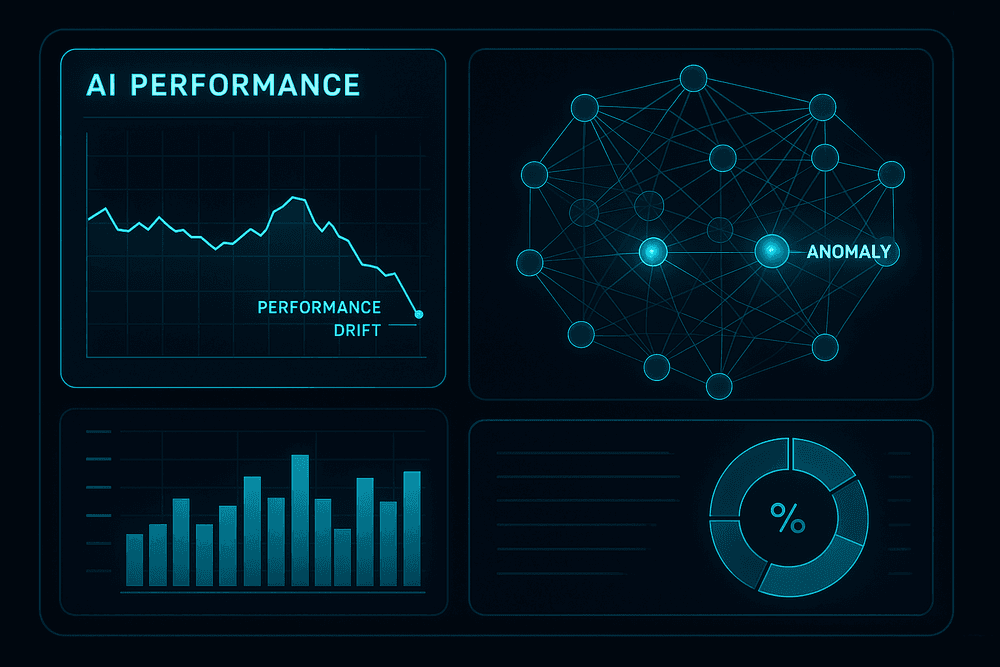
Waiting for users to report strange model behavior is a reactive strategy that erodes trust and can lead to significant business impact. The cornerstone of modern AI performance monitoring is proactive, automated alerting. Instead of manually combing through dashboards, you should configure your monitoring system to automatically notify the right teams when key metrics deviate from expected norms.
Set up alerts for critical issues like:
- Data Drift: When the statistical properties of input data change significantly.
- Concept Drift: When the relationship between input data and the target variable changes.
- Performance Degradation: When metrics like accuracy, precision, or F1-score dip below an acceptable threshold.
- Latency Spikes: When the model's response time suddenly increases, affecting user experience.
By defining these thresholds, your MLOps and data science teams can immediately investigate anomalies, transforming your monitoring from a passive reporting tool into an active defense system.
Establishing a Performance Baseline Before Full Deployment
How do you know if your model is underperforming if you haven't defined what "good performance" looks like? Establishing a comprehensive performance baseline is a non-negotiable step before a full production rollout. During the final testing, staging, or canary deployment phase, you must meticulously record your model's key performance indicators (KPIs) on a representative dataset.
This baseline should be a multi-faceted snapshot, including not just model accuracy but also operational metrics like inference latency, throughput, and resource consumption (CPU/GPU/memory usage). This benchmark becomes the "ground truth" for your ongoing AI performance monitoring. Every future data point is compared against this baseline, making it instantly clear when performance begins to degrade and a closer look is warranted.
Integrating Monitoring into Your MLOps Lifecycle Seamlessly
AI performance monitoring should not be a separate, siloed activity tacked on at the end of the deployment process. To achieve true operational excellence, monitoring must be woven into the very fabric of your MLOps lifecycle. This means integrating your monitoring tools and processes directly into your CI/CD (Continuous Integration/Continuous Deployment) pipelines.
When a new model version is deployed, the pipeline should automatically configure the necessary monitoring dashboards, alerts, and logging for it. This "monitoring-as-code" approach ensures consistency, reduces manual error, and makes your monitoring strategy scalable. By treating monitoring as an integral part of deployment, you create a system where every model is born observable, empowering teams with immediate insights from the moment it goes live.
Creating a Feedback Loop for Model Retraining
The ultimate goal of AI performance monitoring is not just to identify problems but to trigger solutions. The most mature monitoring strategies create a closed-loop system where insights directly feed back into model improvement. When your monitoring system detects significant performance degradation, such as severe concept drift, it should do more than just send an alert—it should initiate an action.
This feedback loop can trigger a workflow that flags the problematic real-world data for review and annotation. Once labeled, this new data can be used to automatically kick off a retraining pipeline. This creates a virtuous cycle: the model performs, monitoring observes, degradation triggers retraining, and an improved model is deployed. This automated feedback loop ensures your AI systems can adapt to a changing world, maintaining their performance and business value over time.
AI Performance Monitoring in Action: Real-World Use Cases
Theoretical concepts come to life when applied to tangible problems. The true value of AI performance monitoring is most evident in how it safeguards business outcomes and, in some cases, human well-being across various industries. By tracking model health in real-time, organizations can move from a reactive to a proactive stance, catching issues before they escalate. Let's explore how this practice is making a critical difference in e-commerce, finance, and healthcare.
E-commerce: Keeping Recommendation Engines Relevant and Profitable
For online retailers, personalization is profit. AI-powered recommendation engines are the primary drivers of this personalization, suggesting products that increase cart size and customer loyalty. However, their effectiveness is fleeting. Consumer trends shift, seasonal items go in and out of style, and viral products can emerge overnight. A model trained on last month's data can quickly become stale, recommending irrelevant items and frustrating users.
This is where AI performance monitoring steps in. By continuously tracking key metrics, e-commerce platforms can ensure their engines remain sharp.
- Concept Drift: Teams monitor for shifts in user behavior. For instance, a sudden interest in outdoor gear as summer approaches is a concept drift that a monitoring system can flag, triggering a model retrain.
- Prediction Quality: Key business metrics like click-through rate (CTR) and conversion rate on recommended products are tracked as direct indicators of model performance. A gradual dip in these metrics signals that the model's relevance is fading.
- Data Drift: The system also watches for changes in the product catalog itself. If a new brand or category is added, the model needs to understand how to incorporate it, and monitoring ensures this happens effectively.
By implementing a robust AI performance monitoring strategy, online retailers can maintain a highly personalized shopping experience, directly protecting their revenue and customer satisfaction.
Finance: Ensuring Fraud Detection Models Remain Effective
In the financial sector, AI models are the frontline defense against sophisticated fraud. These systems analyze thousands of transactions per second to spot anomalous patterns indicative of criminal activity. The challenge? Fraudsters are constantly innovating, developing new techniques to bypass security. A fraud detection model that performs perfectly today could be obsolete tomorrow.
The stakes are incredibly high, making continuous AI performance monitoring a non-negotiable part of risk management.
- Model Drift: Monitoring systems are tuned to detect new, unseen fraud patterns. When a novel type of attack emerges, it creates significant data and concept drift, which a monitoring tool can immediately flag for investigation by security analysts.
- False Positives/Negatives: The balance here is crucial. Monitoring tracks the rate of false positives (legitimate transactions incorrectly flagged as fraud), which frustrate customers, and false negatives (actual fraud that gets missed), which result in financial loss. A sudden spike in either metric prompts an immediate model review.
- Latency: In finance, speed matters. A monitoring system ensures the model’s response time doesn’t degrade, as delays can impact customer experience and transaction processing systems.
Through diligent AI performance monitoring, financial institutions can adapt to evolving threats in real-time, minimizing losses and maintaining the trust of their clients.
Healthcare: Monitoring AI-Powered Diagnostic Tools for Patient Safety
AI is revolutionizing healthcare, particularly in medical imaging analysis where models help radiologists detect diseases like cancer from X-rays and CT scans. In this context, model performance isn't just about profit—it's about patient safety. A subtle degradation in a model's accuracy could lead to a missed diagnosis or a false alarm, with severe consequences.
Therefore, rigorous AI performance monitoring is an ethical and regulatory imperative.
- Data Integrity and Drift: Hospitals use different imaging machines, and new equipment is introduced regularly. Monitoring systems check for drift caused by variations in image resolution, contrast, or artifacts from new hardware, which could confuse the model.
- Diagnostic Accuracy: Model accuracy, sensitivity, and specificity are continuously validated against ground-truth data, often confirmed by expert clinicians. Any performance decay triggers an alert, pausing the model’s use until it can be retrained and re-validated.
- Fairness and Bias: A critical monitoring task is ensuring the model performs equitably across diverse patient demographics (e.g., age, sex, ethnicity). The system checks for performance gaps between subgroups to prevent biased outcomes that could compromise care for certain populations.
In this high-stakes field, AI performance monitoring provides the necessary guardrails to ensure that AI-driven diagnostic tools are safe, reliable, and trustworthy assistants for medical professionals.
Conclusion: The Future of AI Performance Monitoring and Your Next Steps
The journey from a promising AI model in a lab to a reliable, value-generating asset in production is paved with continuous vigilance. As we've explored, deploying an AI system is not the finish line; it’s the starting gun for a race against performance degradation. Effective AI performance monitoring is the discipline that keeps your models running at their peak, ensuring they remain accurate, fair, and efficient in a constantly changing world. It’s the critical link that transforms a fragile algorithm into a resilient, enterprise-grade solution.
Recap: Key Takeaways for a Resilient AI Ecosystem
A robust AI strategy is built on a foundation of proactive observation. The core principle is simple: you cannot manage what you do not measure. Throughout this guide, we've identified the essential pillars of a successful monitoring framework:
- Drift is Inevitable: Both model drift (concept drift) and data drift are natural consequences of a dynamic environment. A comprehensive AI performance monitoring plan anticipates and detects these shifts before they impact business outcomes.
- Metrics Matter: Beyond simple accuracy, a mature monitoring strategy tracks a spectrum of metrics, including latency, throughput, prediction confidence, and data quality. The right KPIs are those tied directly to your business objectives.
- Automation is Key: Manually checking model performance is unsustainable. The goal is to build an automated system with intelligent alerting that notifies the right teams when key thresholds are breached, enabling rapid intervention.
Getting Started: Your First Steps in AI Monitoring Today
Embarking on your AI performance monitoring journey doesn't have to be overwhelming. You can begin making a significant impact by taking a few focused, strategic steps.
- Define Your Baseline: Before you can detect anomalies, you must understand what "normal" looks like. Profile your model's performance on a validation dataset to establish a clear baseline for accuracy, latency, and data distribution. This becomes your gold standard.
- Select Your Initial Toolset: Start small. Implement a basic logging system to capture model inputs and outputs. Explore open-source libraries like Evidently AI or WhyLogs for data drift and model quality checks. As your needs mature, you can evaluate more comprehensive MLOps platforms.
- Monitor a Single Critical Metric: Choose one high-impact metric to track first, such as prediction drift or a key data feature's distribution. Set up a simple dashboard and a basic alert. This initial win will build momentum and demonstrate immediate value to stakeholders.
The Rise of Explainable AI (XAI) in Performance Monitoring
Looking ahead, the future of AI performance monitoring is becoming inextricably linked with Explainable AI (XAI). Traditional monitoring tells you what is happening—your model's accuracy is dropping. XAI tells you why—for instance, a sudden shift in the importance of a specific feature is causing skewed predictions. This evolution moves us from simple "black box" monitoring to true AI observability.
Integrating XAI techniques, such as SHAP (SHapley Additive exPlanations) or LIME (Local Interpretable Model-agnostic Explanations), into monitoring dashboards provides deeper diagnostic power. It allows data scientists to not only see a drift alert but also instantly understand which data segments or features are driving the change. This accelerates debugging, builds trust with business leaders, and is becoming essential for regulatory compliance. As AI systems become more complex and integral to our operations, the ability to explain their behavior will be the defining characteristic of a world-class AI performance monitoring strategy.