
November 14, 2025
What Is AI Performance Monitoring (and Why Is It Non-
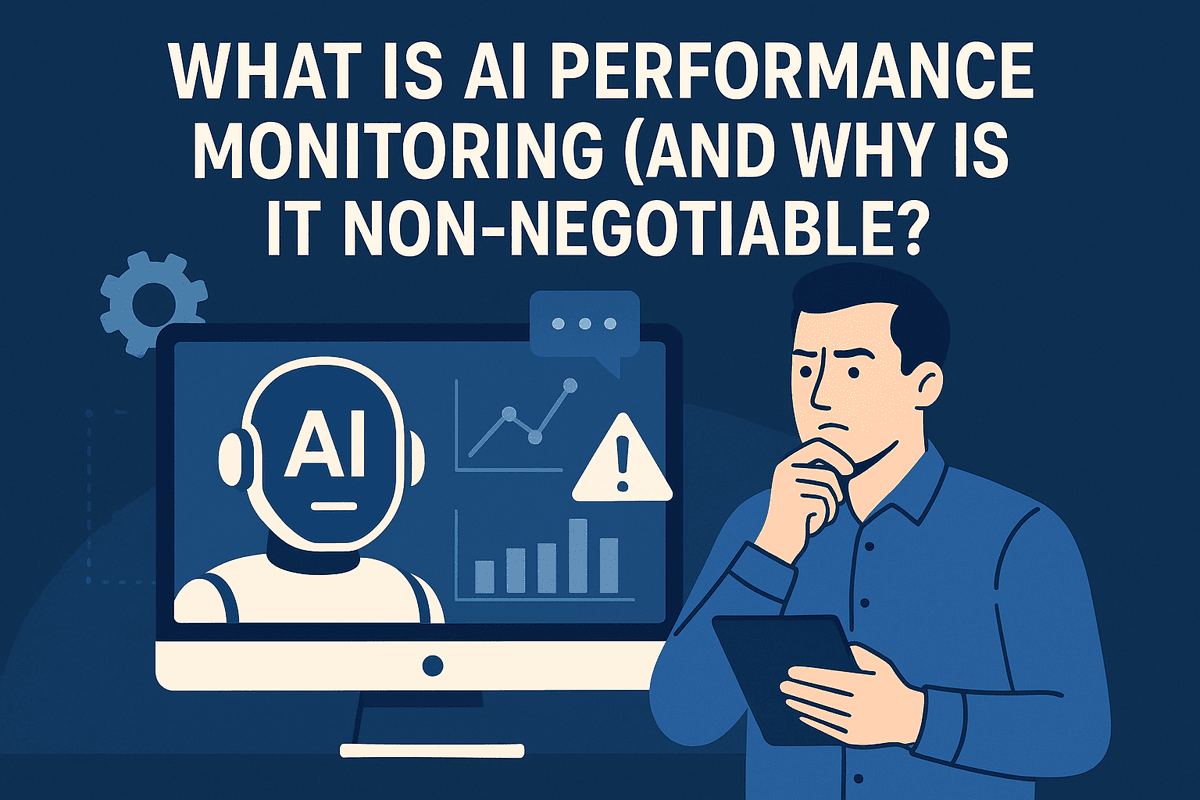
What Is AI Performance Monitoring (and Why Is It Non-Negotiable)?
Launching a machine learning model is not the finish line; it’s the starting block. AI performance monitoring is the continuous, systematic process of tracking, analyzing, and managing the operational and predictive health of AI and machine learning models in a live production environment. It’s the critical post-deployment phase that ensures your intelligent systems deliver consistent, reliable, and fair results long after they’ve left the lab.
Without it, even the most sophisticated model is a ticking time bomb, silently degrading and potentially causing significant harm to your business.
Beyond Accuracy: The Hidden Dangers of Unmonitored AI
Initial model accuracy is a snapshot in time, not a guarantee of future success. The real world is dynamic, and once a model encounters live data, it faces numerous threats that can cripple its performance. This degradation is often silent and invisible without a dedicated AI performance monitoring strategy.
The most common culprit is model drift. This occurs in two forms:
- Data Drift: The statistical properties of the input data change over time. For example, a fraud detection model trained on pre-pandemic transaction data may fail as consumer spending habits shift dramatically.
- Concept Drift: The relationship between the input data and the target variable changes. A product recommendation engine might see its effectiveness decline as user preferences and market trends evolve.
Beyond drift, unmonitored models are vulnerable to data quality issues, unexpected data formats, algorithmic bias that can lead to unfair outcomes, and security vulnerabilities. The consequences are severe: flawed business decisions, poor customer experiences, regulatory fines, and lasting damage to your brand’s reputation.
Defining the Core Pillars of AI Performance Monitoring
A comprehensive monitoring framework is built on several key pillars that provide a 360-degree view of your model's health. Effective AI performance monitoring isn't just about one metric; it’s about a holistic system.
- Model Performance: This goes beyond simple accuracy. It involves tracking a suite of relevant metrics in real-time, such as precision, recall, F1-score, and AUC for classification models, or MAE and RMSE for regression models. It also includes tracking prediction latency and throughput to ensure the model responds quickly enough for its application.
- Data Drift & Integrity: This pillar focuses on the input data itself. The system should automatically detect changes in data distribution, identify missing values, and flag schema shifts or data type mismatches that could cause the model to fail or produce nonsensical outputs.
- Operational Health: An AI model is part of a larger software system. Monitoring operational health means tracking system-level metrics like CPU/GPU usage, memory consumption, and API uptime to ensure the infrastructure supporting the model is stable and scalable.
- Fairness & Bias: A critical and increasingly important pillar is monitoring for ethical concerns. This involves segmenting predictions across different demographics (e.g., age, gender, geography) to ensure the model isn't performing differently or unfairly for specific groups, thereby mitigating ethical and compliance risks.
The Business Case: How Monitoring Drives ROI and Mitigates Risk
Implementing robust AI performance monitoring is not a cost center—it’s a crucial investment that directly protects and enhances your return on investment (ROI). By ensuring models perform as expected, you prevent revenue loss caused by inaccurate predictions, from failed marketing campaigns to poor inventory management. It provides the insights needed to know precisely when a model needs to be retrained, optimizing resource allocation and maintaining a competitive edge.
From a risk perspective, monitoring is your first line of defense. It provides an early warning system for performance degradation, allowing teams to intervene before minor issues escalate into major crises. This proactive approach is essential for maintaining regulatory compliance, avoiding costly legal battles related to bias, and safeguarding the trust you’ve built with your customers. In today’s data-driven world, neglecting AI performance monitoring isn't just a technical oversight; it's a strategic business failure.
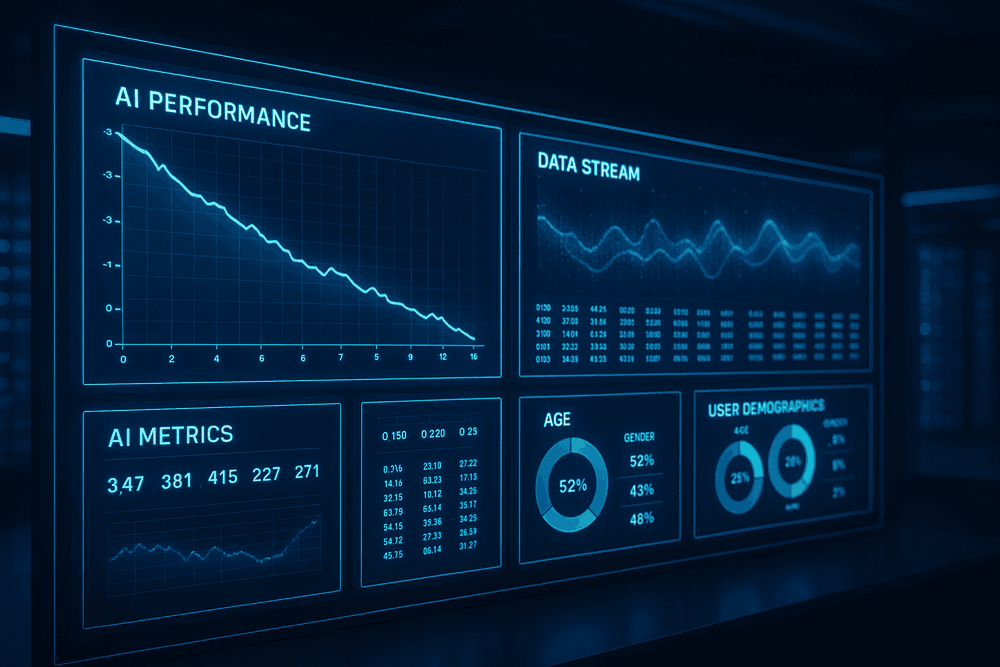
Key Metrics for Robust AI Performance Monitoring
Once your AI model is deployed, the real work begins. Effective AI performance monitoring isn't just about checking if the system is online; it's about continuously evaluating its effectiveness, reliability, and fairness through a specific set of metrics. A model that performs brilliantly in a lab can fail silently in the real world if not watched closely. Let's break down the essential areas you need to track to ensure your AI delivers sustained value.
Tracking Model Drift: Is Your AI's Performance Decaying?
Model drift, also known as concept drift, is the silent killer of AI systems. It occurs when the statistical properties of the target variable change over time, causing your model's predictive power to degrade. What worked perfectly at launch may become less accurate as user behavior, market trends, or the environment evolves. For example, a fraud detection model trained before a new payment technology was introduced might miss novel fraudulent patterns.
To catch this decay early, you must continuously track core model evaluation metrics against your established baselines from training.
- For Classification Models: Monitor accuracy, precision, recall, F1-score, and AUC-ROC. A gradual dip in these scores is a clear red flag.
- For Regression Models: Keep an eye on Mean Absolute Error (MAE), Mean Squared Error (MSE), and R-squared.
Proactive tracking of these metrics is the foundation of any successful AI performance monitoring strategy, signaling when it's time to retrain your model.
Detecting Data Drift and Skew in Production
While model drift focuses on the output, data drift focuses on the input. Data drift happens when the data being fed into your model in production starts to look different from the data it was trained on. This could mean changes in the distribution of a feature (e.g., the average age of users changes), an increase in null values, or the appearance of new categories.
Data skew is a related issue, representing a mismatch between your training environment and the live production environment from day one. Both issues violate the core assumption that your production data will resemble your training data, leading to unpredictable and poor performance. Monitoring involves using statistical tests (like the Kolmogorov-Smirnov test) and visualizing data distributions to spot significant changes before they corrupt model outcomes.
Operational Health: Monitoring Latency, Throughput, and Errors
An accurate model is useless if it's slow, unavailable, or constantly crashing. Operational metrics are crucial for ensuring a positive user experience and a reliable system. This side of AI performance monitoring focuses on the infrastructure supporting your model.
- Latency: How long does it take for the model to return a prediction after receiving a request? High latency can frustrate users and make real-time applications unviable.
- Throughput: How many requests can the system handle per second or minute? This helps with capacity planning and identifying performance bottlenecks.
- Error Rates: This tracks system-level failures, such as server errors (5xx codes), timeouts, or malformed requests, distinct from the model's prediction errors. High error rates point to instability in your deployment infrastructure.
Ensuring Fairness and Uncovering Hidden Bias
Technical accuracy isn't enough. A critical component of modern AI performance monitoring is the continuous evaluation of fairness and bias. AI models trained on historical data can unintentionally learn and amplify existing societal biases related to race, gender, age, or other protected attributes.
Monitoring for fairness involves segmenting your model's performance across different demographic groups. Are the error rates significantly higher for one group than another? Key metrics like demographic parity (ensuring predictions are independent of a sensitive attribute) and equalized odds help quantify these disparities. Uncovering and mitigating bias is essential for building trust, meeting regulatory requirements, and ensuring your AI operates ethically.
The Top AI Performance Monitoring Tools on the Market
Once you’ve defined your metrics, the next step is selecting the right tool to track them. The landscape for AI performance monitoring solutions is rapidly evolving, with options ranging from all-in-one enterprise platforms to highly specialized, model-centric tools. Understanding the key players and their unique strengths will help you build a robust MLOps stack that prevents model decay and ensures ROI.
Enterprise-Grade Monitoring: Datadog and New Relic
For organizations already invested in a mature DevOps ecosystem, established Application Performance Monitoring (APM) leaders like Datadog and New Relic are a natural starting point. These platforms have extended their powerful infrastructure and application monitoring capabilities to encompass ML models.
- Datadog: Offers integrations and dashboards specifically for ML workflows, allowing you to monitor model resource consumption (CPU/GPU), inference latency, and error rates alongside the rest of your application stack. This provides a unified view, making it easier to correlate a dip in model performance with an underlying infrastructure issue.
- New Relic: Similarly, New Relic provides tools to instrument your ML applications, giving you visibility into transaction traces and endpoint performance. It's an excellent choice if your primary concern is how the model impacts overall application health and user experience.
The main advantage here is consolidation. However, these APM tools often lack the deep, model-specific analytics—like granular data drift detection, bias analysis, or feature-level explainability—that specialized platforms provide.
Specialized ML Observability Platforms: Fiddler AI vs. Arize AI
When you need to go beyond infrastructure metrics and dive deep into model behavior, specialized ML observability platforms are essential. Fiddler AI and Arize AI are two of the most prominent players in this space.
- Fiddler AI: Positions itself as an "ML Model Intelligence" platform, with a strong emphasis on explainability (XAI) and model governance. It excels at answering the "why" behind a model's predictions, making it invaluable for high-stakes or regulated industries like finance and healthcare. Fiddler’s robust fairness and bias detection capabilities help ensure your models are performing responsibly.
- Arize AI: Focuses on real-time performance troubleshooting and root-cause analysis. Arize makes it incredibly easy to pinpoint which data segments, features, or model versions are causing performance degradation. Its intuitive dashboards are designed for ML practitioners to quickly diagnose and resolve issues like data quality problems and prediction drift in production.
Open-Source Solutions: When to Use Evidently AI or WhyLabs
For teams that prefer a customizable, code-first approach, open-source tools offer powerful and flexible solutions for AI performance monitoring.
- Evidently AI: An excellent choice for generating detailed, interactive reports on model performance, data drift, and target drift. It integrates seamlessly into Jupyter notebooks and CI/CD pipelines, making it ideal for model validation, testing, and periodic monitoring.
- WhyLabs: Built around the
whylogsopen-source standard, WhyLabs is designed for lightweight and scalable data profiling. It captures statistical summaries of your data streams, making it efficient for monitoring massive datasets without transmitting raw data. It’s perfect for teams needing to monitor data health across complex data pipelines.
Choosing the Right Tool for Your MLOps Stack
The right tool ultimately depends on your team’s maturity, existing infrastructure, and specific needs.
- Start with your APM: If you already use Datadog or New Relic, leverage their ML monitoring features first.
- Add a specialist for deep insights: Augment your APM with a platform like Arize for real-time troubleshooting or Fiddler for governance and explainability.
- Embrace open-source for flexibility: Use Evidently AI or WhyLabs for custom pipeline integrations and cost-effective monitoring.
Often, the most effective strategy involves a combination of these tools, creating a comprehensive AI performance monitoring solution that covers everything from GPU utilization to model fairness.
Best Practices for Implementing Your AI Performance Monitoring Strategy
Moving from theory to practice requires a structured approach. A robust AI performance monitoring strategy isn't just about collecting data; it's about creating an automated, responsive, and integrated system that maintains model health and business value. Here’s how to implement the core best practices that separate high-performing AI teams from the rest.
Establish an Effective Performance Baseline
You can't know if your model is drifting if you don't know where it started. Establishing a performance baseline is the critical first step. This baseline is your "ground truth"—a snapshot of how your model is expected to perform under normal conditions.
- How to Create It: Your baseline should be established using a combination of offline evaluation metrics from your holdout test set (e.g., precision, recall, F1-score) and its initial performance during the first few days or weeks in a stable production environment. Capture metrics like prediction latency, throughput, and data drift statistics during this period.
- Why It's Crucial: This benchmark becomes the standard against which all future AI performance monitoring data is compared. Without a clear baseline, distinguishing between normal fluctuations and a genuine performance degradation issue becomes nearly impossible.
Set Up Automated Alerts for Anomaly Detection
Passive monitoring is not enough. To be effective, your system must proactively notify you when things go wrong. Setting up automated alerts is key to transforming your AI performance monitoring from a reactive report to a proactive defense mechanism.
Define clear thresholds for your key metrics. For example, you might set an alert if:
- Model accuracy drops by more than 5% from the baseline.
- The latency for 95% of predictions exceeds 500ms.
- Data drift (e.g., changes in the statistical properties of input features) surpasses a predefined value.
Integrate these alerts with your team's existing workflows, sending notifications to channels like Slack, PagerDuty, or email. This ensures the right ML engineers and data scientists are notified immediately, enabling them to investigate and resolve issues before they impact users.
Create a Human-in-the-Loop Feedback System for Retraining
AI models are not static; they require continuous improvement. A human-in-the-loop (HITL) system provides the high-quality, labeled data needed for effective retraining. This process closes the loop between monitoring and model improvement.
Your monitoring system should flag ambiguous or low-confidence predictions, as well as instances identified as anomalies. These specific cases are then routed to human experts for review and correct labeling. This curated feedback is far more valuable than randomly sampled data. The newly labeled data can be collected and added to your training set, allowing you to periodically retrain the model on a richer, more relevant dataset that addresses its specific weaknesses in production.
Integrate Monitoring Seamlessly into Your CI/CD Pipeline
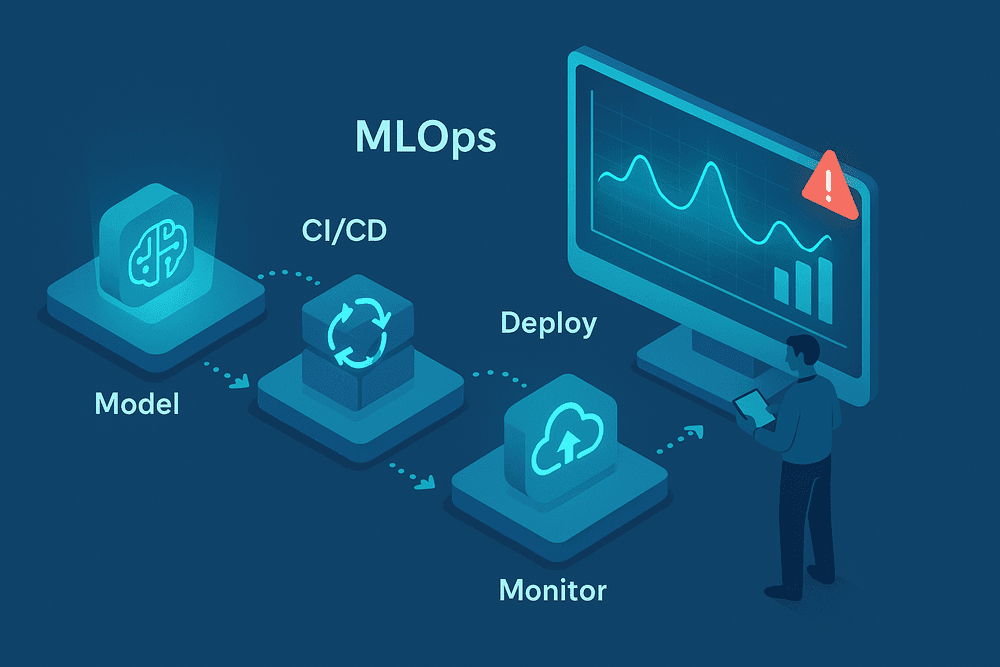
Finally, for true MLOps maturity, AI performance monitoring must be an integral part of your Continuous Integration/Continuous Deployment (CI/CD) pipeline. It shouldn't be a manual step performed after deployment.
When a new model version is ready to be deployed, your CI/CD pipeline should automatically:
- Deploy the model to a staging or canary environment.
- Run automated tests to check for bugs and performance regressions.
- Provision monitoring resources, such as setting up new dashboards, logs, and alert configurations for the new model version.
By automating this process, you ensure that every model pushed to production is monitored consistently and correctly from the moment it goes live. This prevents "unmonitored" models from slipping through the cracks and embeds reliability directly into your development lifecycle.
AI Performance Monitoring in Action: Real-World Use Cases
The principles of AI performance monitoring are powerful in theory, but their true value shines when applied to real-world challenges. From safeguarding finances to personalizing shopping and improving patient outcomes, proactive monitoring is the critical link between a deployed model and sustained business value. Let's explore how different industries leverage ai performance monitoring to turn their AI investments into reliable, high-performing assets.
Case Study: How FinTechs Prevent Fraud with Real-Time Monitoring
For financial technology companies, the battle against fraud is a high-stakes, real-time race. Fraudsters continuously evolve their tactics, creating a classic case of data drift where new, unseen patterns emerge daily. A fraud detection model trained on last month's data can quickly become obsolete, leading to missed fraudulent transactions and significant financial losses.
This is where continuous ai performance monitoring becomes a non-negotiable. FinTechs implement sophisticated monitoring systems to:
- Track Model Predictions: They monitor key metrics like precision and recall in real-time. A sudden drop in precision might mean the model is incorrectly flagging too many legitimate transactions (false positives), frustrating customers. A dip in recall signals that real fraudulent activities are slipping through the cracks.
- Detect Data Drift: Monitoring systems watch for shifts in input data distributions. Are transactions suddenly coming from a new geographic region? Is there a spike in a specific type of low-value transaction? These alerts trigger investigations and potential model retraining.
- Automate Alerts: Teams receive instant notifications when performance metrics breach predefined thresholds, enabling them to react before a minor issue becomes a major security incident.
By actively monitoring their models, FinTechs can adapt to new fraud patterns on the fly, ensuring their AI defenses remain robust and effective.
E-commerce: Combating Concept Drift in Recommendation Engines
In the dynamic world of e-commerce, customer preferences change with the seasons, trends, and even viral social media posts. This phenomenon, known as concept drift, can render a product recommendation engine useless. A model that perfectly understood user behavior in the winter may fail completely during the summer if it keeps recommending sweaters and boots.
Effective ai performance monitoring is crucial for keeping recommendation engines relevant and profitable. E-commerce platforms track:
- Business Impact Metrics: The ultimate measure of a recommendation engine's success is its impact on the bottom line. Monitoring systems track click-through rates (CTR), conversion rates, and average order value (AOV) specifically for recommended items. A steady decline in these metrics is a clear signal that the model is no longer aligned with customer intent.
- Recommendation Diversity: Is the model stuck in a rut, recommending the same handful of popular items to everyone? Monitoring the distribution and freshness of recommendations ensures the engine is effectively surfacing new inventory and long-tail products.
This vigilant oversight allows retailers to identify when a model needs to be retrained with new interaction data, ensuring recommendations stay fresh, engaging, and drive sales.
Healthcare: Ensuring Diagnostic AI Models Remain Accurate and Fair
In healthcare, the stakes for AI model performance are incredibly high, directly impacting patient health and safety. An AI model that assists in diagnosing diseases from medical scans must be exceptionally accurate, reliable, and, crucially, fair.
The role of ai performance monitoring in this sector is uniquely rigorous, focusing on:
- Clinical Accuracy: Models are constantly benchmarked against ground-truth data, such as diagnoses from expert clinicians. Key metrics like sensitivity (the ability to correctly identify patients with a disease) and specificity (the ability to correctly identify healthy patients) are tracked obsessively. Any degradation could have severe clinical consequences.
- Fairness and Bias: A diagnostic model must perform equally well across all demographic groups. A core function of ai performance monitoring in healthcare is to segment performance by age, gender, and ethnicity. This helps uncover and mitigate hidden biases, ensuring the AI provides equitable benefits to all patient populations.
- Operational Drift: A hospital might update its MRI machines or imaging protocols. This can introduce subtle changes in the input data that cause a model's performance to decline. Monitoring for this operational data drift is essential to maintaining diagnostic accuracy over time.
Conclusion: Future-Proofing Your Systems with Proactive AI Monitoring
We've journeyed through the critical components of keeping your AI systems healthy, reliable, and effective. The days of "deploy and forget" are over. In today's dynamic digital environment, proactive AI performance monitoring is not a luxury but a foundational pillar for success. It’s the essential practice that transforms a promising model into a dependable, value-generating asset. By embracing a culture of continuous observation and improvement, you safeguard your investments, protect your brand reputation, and ensure your AI continues to deliver on its promise.
Your Quick-Start Checklist for AI Performance Monitoring
Ready to move from theory to practice? Use this checklist to build a robust monitoring framework for any new or existing AI model.
- ✅ Define Your North Star Metrics: Before deploying, clearly identify the key performance indicators (KPIs) that align with business outcomes. This includes model-specific metrics (e.g., accuracy, precision, F1-score) and operational metrics (e.g., latency, throughput, error rate).
- ✅ Establish a Performance Baseline: Run the model on a validation dataset to establish its expected performance under normal conditions. This baseline is your reference point for detecting future degradation.
- ✅ Implement Drift Detection: Set up automated checks for both data drift (changes in input data distribution) and concept drift (changes in the relationship between inputs and outputs). These are the earliest indicators of performance issues.
- ✅ Choose the Right Tools: Evaluate and select an AI performance monitoring platform or a combination of open-source tools (like Prometheus and Grafana) that fit your team’s expertise, scale, and budget.
- ✅ Configure Smart Alerts: Don't drown in data. Set up intelligent, actionable alerts that notify the right teams when key metrics breach predefined thresholds.
- ✅ Create a Retraining Feedback Loop: Your monitoring system should trigger a process for model retraining when significant performance degradation is confirmed. Automate this pipeline where possible.
The Evolving Landscape: What's Next in AI Observability?
The field of AI performance monitoring is rapidly advancing. Staying ahead of the curve means keeping an eye on these emerging trends:
- Explainable AI (XAI): Monitoring is moving beyond what is happening to why. Future tools will offer deeper insights into model decision-making, making it easier to diagnose issues like bias or unexpected predictions.
- LLM and Generative AI Observability: The rise of Large Language Models introduces new monitoring challenges, such as tracking token usage, response quality, toxicity, and "hallucinations." Specialized solutions are emerging to provide observability for these complex systems.
- Bias and Fairness Auditing: Ethical AI is paramount. Monitoring platforms are increasingly incorporating features to continuously audit models for demographic bias and fairness, ensuring they perform equitably across all user segments.
Take Control of Your AI: Getting Started Today
The journey to comprehensive AI observability begins with a single step. You don't need a perfect, all-encompassing system from day one. The most important action is to start now. Pick one critical model in production and begin instrumenting it. Track its core metrics, set up a simple alert, and observe.
By implementing a solid AI performance monitoring strategy, you are not just fixing problems—you are building a more resilient, trustworthy, and intelligent system. You are future-proofing your operations, empowering your teams with data-driven insights, and unlocking the full, sustainable potential of your artificial intelligence initiatives. Take control of your AI's lifecycle and turn proactive monitoring into your greatest competitive advantage.