August 19, 2025
What Is AI Performance Monitoring and Why Is It Mission-
What Is AI Performance Monitoring and Why Is It Mission-Critical?
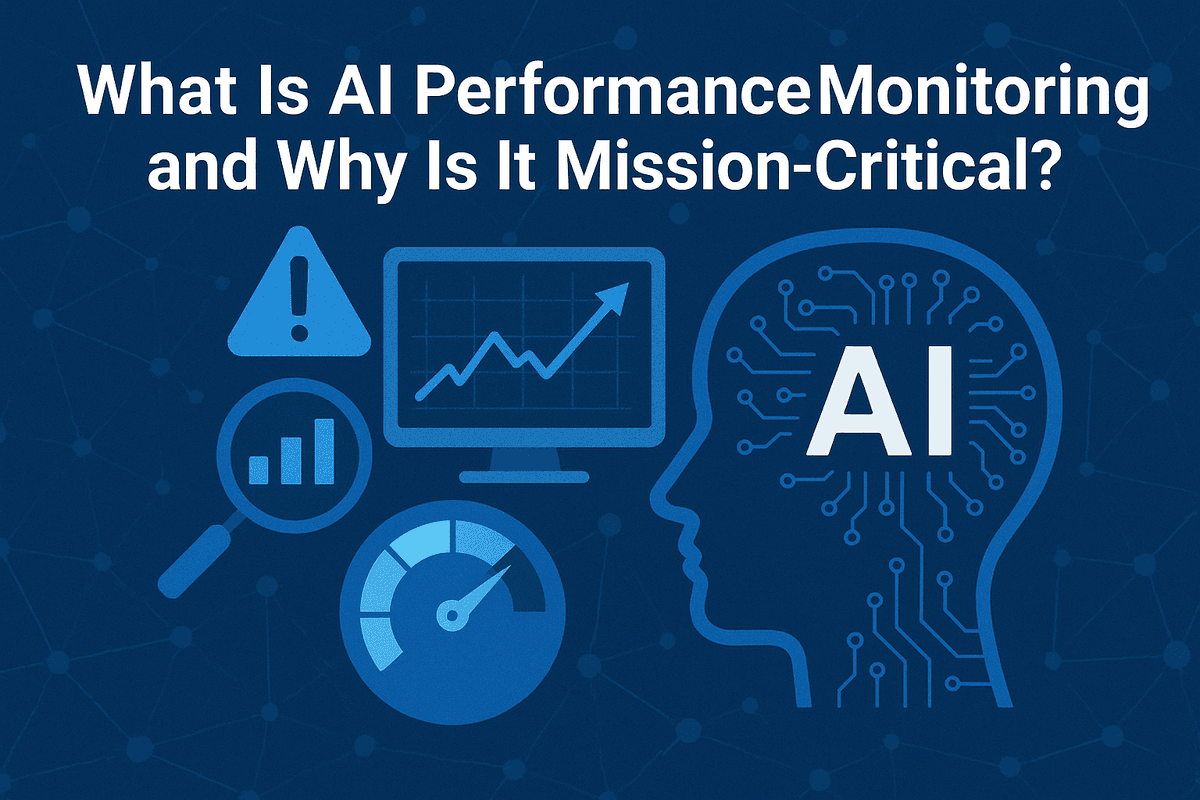
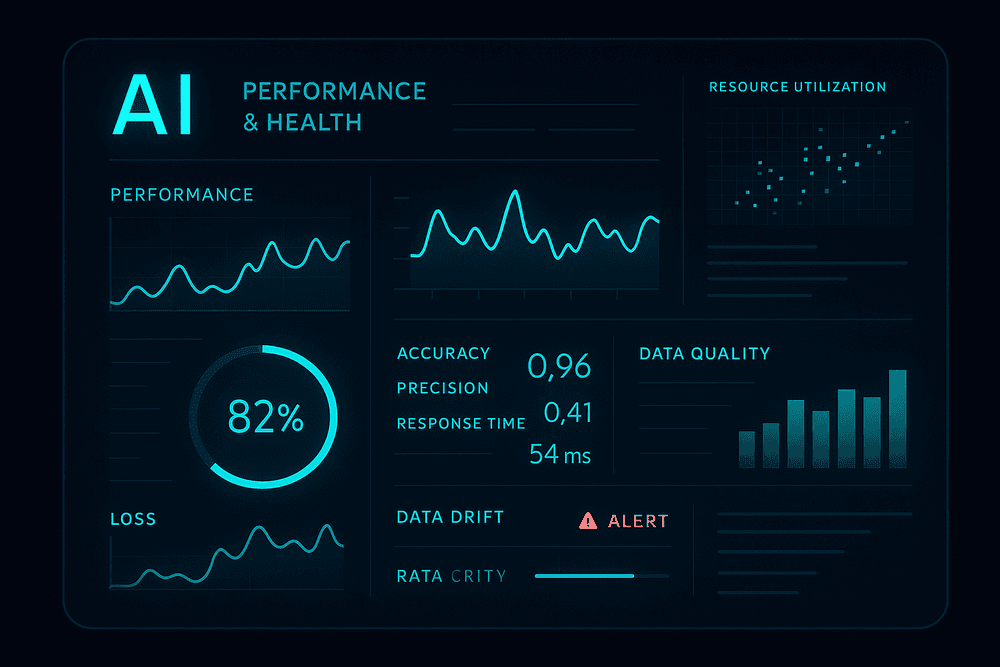
Launching an AI model without a plan to watch it is like sending a rocket into space and turning off the mission control dashboard. It might work for a while, but you have no way of knowing when—or why—it will veer off course. AI performance monitoring is that mission control. It's the continuous, real-time process of tracking, analyzing, and managing your AI models once they are live and interacting with the real world.
Unlike traditional software that behaves predictably, AI models are dynamic systems whose performance can degrade silently. A model that scored 99% accuracy in the lab can fail spectacularly in production. This is why a robust AI performance monitoring strategy isn't a "nice-to-have"; it's a fundamental requirement for any business relying on artificial intelligence.
Beyond Accuracy: The Hidden Dangers of Unmonitored AI
Relying solely on pre-deployment accuracy metrics is a dangerous oversimplification. The real world is messy and constantly changing, and an unmonitored model is a ticking time bomb. The hidden dangers include:
- Silent Failures & Model Decay: Your model won't throw an error code when its predictions become irrelevant. It will just keep making confident but wrong decisions. This "model decay" happens due to data drift (when input data changes, like new customer demographics) and concept drift (when the relationship between inputs and outputs changes, like a shift in consumer buying habits).
- Bias Amplification: A model might perform well on average but exhibit significant bias against certain user segments. Without monitoring, this bias can go undetected, leading to unfair outcomes, damaged brand reputation, and serious compliance risks.
- Operational Bottlenecks: Poor model performance isn't just about bad predictions. High latency, excessive computational cost, or system crashes can cripple user experience and negate the model's value.
- Eroding Trust and Revenue: Ultimately, every incorrect prediction or slow response chips away at user trust. For a recommendation engine, this means lost sales. For a fraud detection system, it means financial loss. The cost of inaction is direct and tangible.
The Core Pillars of a Monitoring Strategy
Effective AI performance monitoring goes far beyond just one metric. A comprehensive strategy is built on three core pillars that provide a holistic view of your model's health and impact:
- Model Performance: This is the most direct pillar, tracking the quality of the model's predictions over time. It involves monitoring classic machine learning metrics like accuracy, precision, and recall, but more importantly, it connects them to key business KPIs. Are your model's predictions actually driving the desired business outcomes?
- Data Health & Integrity: Garbage in, garbage out. This pillar focuses on monitoring the input data your model receives. It involves detecting data drift, identifying missing values, flagging schema changes, and catching data quality issues before they corrupt your model's predictions.
- Operational Health: An accurate model is useless if it's too slow or unavailable. This pillar covers the technical infrastructure, monitoring metrics like prediction latency, throughput, uptime, and resource utilization (CPU/memory) to ensure the AI system is stable, scalable, and cost-effective.
The Business Impact of Proactive AI Performance Monitoring
Implementing a proactive AI performance monitoring framework transforms AI from a high-risk investment into a reliable, strategic asset. The business impact is immediate and far-reaching:
- Maximize ROI: Ensure your AI systems consistently deliver the value they were designed for, protecting your investment and driving predictable growth.
- Mitigate Risk: Catch performance degradation and data drift early, before they escalate into major financial losses, customer churn, or a PR crisis.
- Build Stakeholder Trust: Provide clear, data-backed evidence that your AI systems are performing reliably, fairly, and effectively.
- Foster Continuous Improvement: Use monitoring insights to understand exactly when and why your model is failing, enabling you to retrain and redeploy smarter, more resilient models over time.
Key Metrics for Comprehensive AI Performance Monitoring
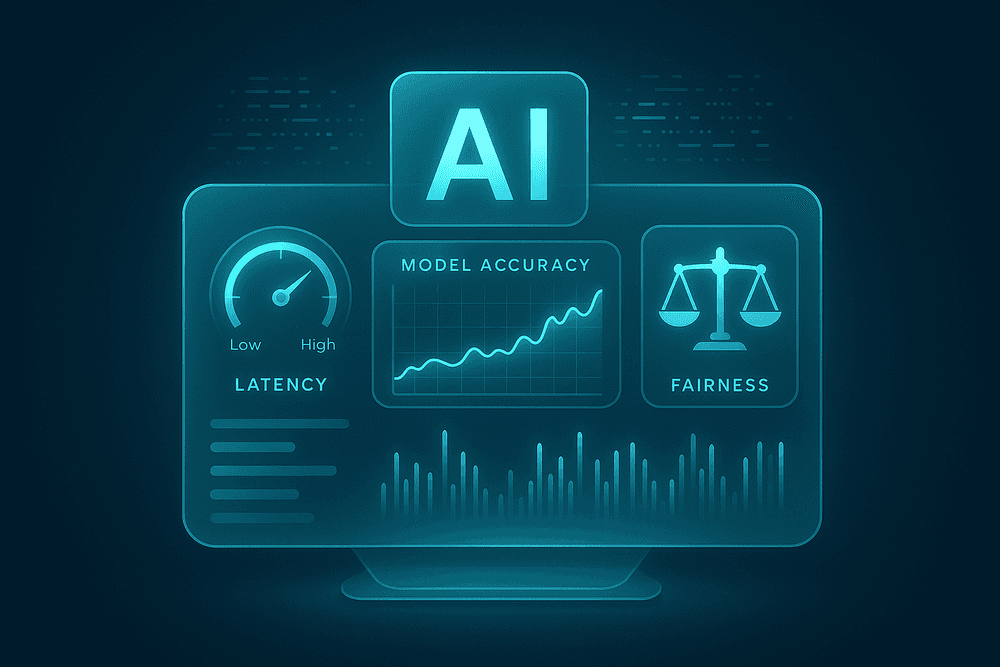
Effective AI performance monitoring goes far beyond a single accuracy score. In production, an AI model is a dynamic system interacting with a constantly changing world. To truly understand its health and value, you need a multi-faceted view that encompasses performance, operational efficiency, data integrity, and responsible deployment. Focusing on this comprehensive set of metrics ensures your AI remains a reliable and valuable asset, not a hidden liability.
Tracking Model Drift and Prediction Accuracy Over Time
A model's accuracy is not a "set it and forget it" value. The moment it's deployed, its predictive power begins to degrade in a process known as model drift or concept drift. This happens when the statistical relationships between input variables and the target variable change in the real world.
Your AI performance monitoring strategy must continuously track core accuracy metrics against a baseline or ground truth.
- For Classification Models: Monitor metrics like Precision, Recall, F1-Score, and AUC-ROC. Are you correctly identifying positive cases without raising too many false alarms?
- For Regression Models: Keep a close eye on Mean Absolute Error (MAE), Root Mean Square Error (RMSE), and R-squared. How far off are your numerical predictions on average?
Tracking these metrics on a timeline allows you to pinpoint the exact moment performance begins to decline, enabling proactive retraining before it impacts business outcomes.
Measuring Latency, Throughput, and Computational Costs
An accurate model that is too slow or expensive can be just as problematic as an inaccurate one. Operational metrics are critical for evaluating the real-world viability and scalability of your AI system.
- Latency: This is the time it takes for the model to return a single prediction after receiving an input. For user-facing applications like recommendation engines or fraud detection, low latency is crucial for a positive user experience.
- Throughput: This measures how many predictions the model can handle in a given period (e.g., predictions per second). High throughput is essential for systems that need to process large volumes of data in real-time.
- Computational Costs: Monitor the CPU, GPU, and memory resources consumed by your model. Effective AI performance monitoring helps you optimize this consumption, directly impacting your cloud computing bill and overall ROI.
Evaluating Data Drift and Input Integrity
Models are only as good as the data they are fed. Data drift occurs when the statistical properties of the live input data diverge from the data the model was trained on. This is a silent killer of performance because the model itself hasn't changed, but the world it operates in has.
Your monitoring toolkit should watch for:
- Statistical Drifts: Use measures like the Population Stability Index (PSI) or Kolmogorov-Smirnov (K-S) test to detect shifts in the distribution of key features.
- Schema Changes: Flag any unexpected changes in the input data, such as new categories in a feature, missing columns, or altered data types.
- Data Integrity Issues: Track the prevalence of null values, outliers, or out-of-range inputs that could lead to erroneous predictions.
Ensuring Fairness, Explainability, and Bias Detection
A technically proficient model can still be a business risk if it is unfair, opaque, or biased. Responsible AI performance monitoring includes tracking metrics related to ethics and trust.
- Fairness: Does your model perform equally well across different user segments (e.g., by age, geography, or other demographic factors)? Monitor fairness metrics like demographic parity and equalized odds to ensure equitable outcomes and mitigate compliance risks.
- Explainability (XAI): While not a single metric, you can monitor the outputs of explainability tools like SHAP or LIME. Drastic changes in feature importance for predictions can signal an underlying issue with the model's logic.
- Bias Detection: Continuously analyze model predictions to identify and quantify systemic biases. For example, does a loan approval model disproportionately favor one group over another, even when all other factors are equal? Proactive monitoring helps you catch and correct these harmful patterns.
Comparing the Top AI Performance Monitoring Tools on the Market
Choosing the right tool is critical for establishing a robust AI performance monitoring strategy. The market offers a range of solutions, from flexible open-source libraries to powerful managed platforms, each catering to different needs, team sizes, and technical expertise. Let's break down the landscape to help you find the perfect fit.
Open-Source vs. Managed Platforms: Which is Right for You?
Your first major decision is between building on an open-source foundation or investing in a managed, software-as-a-service (SaaS) platform.
- Open-Source Tools (e.g., Evidently AI, WhyLabs/whylogs): These libraries offer maximum flexibility and control. They are ideal for teams with strong engineering resources who want to build a completely custom monitoring stack integrated deeply into their existing infrastructure. The primary benefits are zero licensing cost and infinite customizability. However, this path requires significant internal effort for setup, maintenance, scaling, and building user-friendly dashboards.
- Managed Platforms (e.g., Arize, Fiddler, Arthur): These solutions provide a fast, scalable, and user-friendly path to comprehensive AI performance monitoring. They offer out-of-the-box dashboards, automated alerting, collaborative features, and dedicated support. While they come with a subscription cost, they dramatically reduce the engineering overhead, allowing your team to focus on deriving insights and improving models rather than maintaining monitoring infrastructure.
In-Depth Review: Arize AI for Real-Time Troubleshooting
Arize AI has established itself as a leader in the ML observability space, particularly for teams that need granular, real-time troubleshooting capabilities. Its platform excels at helping engineers quickly diagnose and resolve production issues.
Arize’s core strength lies in its ability to pinpoint the root cause of model degradation. By automatically surfacing problematic data slices, detecting data and concept drift, and monitoring data quality, it provides the context needed to understand why a model’s performance has changed. For example, if a model’s accuracy suddenly drops, Arize can help you trace the issue back to a specific feature, a problematic cohort of users, or an upstream data pipeline failure. This makes it an indispensable tool for high-stakes applications where immediate issue resolution is paramount.
Feature Deep Dive: Fiddler AI for Explainability and Analytics
While many tools focus on operational metrics, Fiddler AI differentiates itself with a strong emphasis on explainability (XAI) and connecting model behavior to business outcomes. Fiddler’s platform is designed to build trust and transparency around your AI systems, making it a favorite among organizations in regulated industries like finance and healthcare.
Its standout features include powerful model explainability techniques (like SHAP) to understand individual predictions and robust fairness analysis to audit models for bias. Furthermore, Fiddler allows you to create custom business analytics and KPIs, directly linking model performance metrics like precision and recall to tangible business results like customer lifetime value or fraud detection rates. This makes Fiddler an excellent choice for teams needing to justify their model’s decisions and demonstrate its business impact to stakeholders.
Exploring Datadog, New Relic, and Other Integrated Solutions
For organizations already heavily invested in broad application performance monitoring (APM) ecosystems, tools like Datadog and New Relic are increasingly adding AI performance monitoring features. The primary advantage here is consolidation—you can monitor your model’s performance alongside your application logs, infrastructure metrics, and user experience data in a single unified platform.
These integrated solutions offer a convenient starting point, providing basic monitoring for prediction latency, error rates, and throughput. However, they often lack the specialized depth of dedicated ML observability platforms. Advanced features like granular drift detection across specific data segments, sophisticated explainability, or fairness auditing are typically less mature. This makes them a solid choice for initial monitoring, but teams with complex models will likely need to supplement them with a specialized tool as their needs evolve.
Best Practices for Implementing Your AI Performance Monitoring Framework
Putting an AI model into production is just the beginning. To extract long-term value and avoid silent failures, you need a robust implementation strategy. An effective ai performance monitoring framework isn't just about having the right tools; it’s about integrating smart, proactive processes into your entire machine learning lifecycle. These best practices will help you build a system that is resilient, responsive, and continuously improving.
Establish Baseline Performance Benchmarks
You can't know if your model is underperforming if you haven't defined what "performing" looks like. Establishing baseline benchmarks is the critical first step. Before deploying, rigorously evaluate your model on a holdout test set to determine its expected performance on key business and statistical metrics.
- Key Metrics to Baseline: Include technical metrics like accuracy, precision, recall, and F1-score, as well as operational metrics such as prediction latency and throughput.
- Set a "Gold Standard": Your baseline isn’t just a single number; it's a performance profile. For example, "95% accuracy with an average latency of 200ms."
- Document Everything: Store these benchmarks in your model registry alongside the model version. This historical context is invaluable for comparing future model iterations and diagnosing degradation over time.
Without these initial benchmarks, your entire ai performance monitoring effort will be reactive and lack a clear standard for success.
Set Up Automated Alerts for Anomaly and Drift Detection
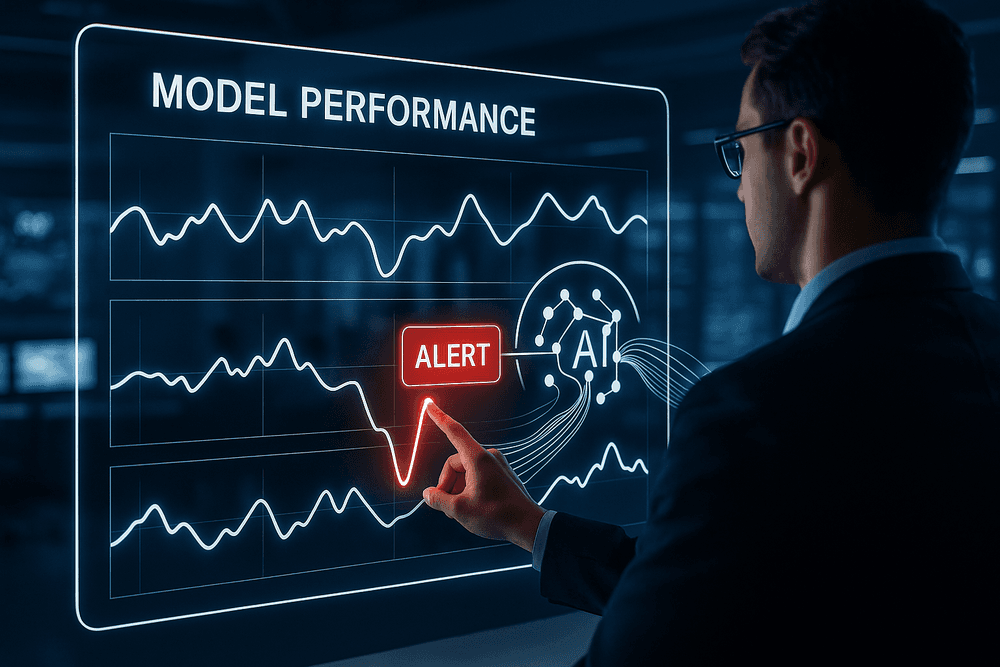
Relying on manual checks to monitor model health is inefficient and unsustainable. The core of a modern monitoring framework is automated alerting that notifies your team before a small issue becomes a major business problem. Configure your system to trigger alerts when performance deviates significantly from your established baselines.
- Threshold-Based Alerts: Set sensible thresholds for key metrics. For instance, trigger a warning if accuracy drops by 2% and a critical alert if it drops by 5%.
- Detecting Drift: Monitor for gradual performance decay (concept drift) and shifts in input data distributions (data drift). Statistical tests like the Kolmogorov-Smirnov (K-S) test can be automated to detect these changes.
- Anomaly Detection: Implement algorithms to catch sudden, unexpected spikes or drops in error rates or prediction latency, which could indicate a system outage or a bug.
Integrate Monitoring Seamlessly into Your MLOps Pipeline
AI performance monitoring should not be a siloed activity. To achieve true operational excellence, integrate it directly into your MLOps pipeline. This creates a powerful, automated feedback loop where insights from production directly inform the development and deployment cycle.
A well-integrated system can:
- Automatically link performance metrics back to specific model versions and training datasets.
- Use monitoring alerts as triggers to automatically initiate model retraining pipelines.
- Incorporate A/B testing frameworks where monitoring data is used to declare a winning model, streamlining the champion-challenger process.
This tight integration transforms monitoring from a passive dashboard into an active, intelligent component of your AI infrastructure.
Create a Human-in-the-Loop Feedback System for Retraining
While automation is crucial, human expertise remains essential for handling ambiguity and ensuring data quality. A human-in-the-loop (HITL) system leverages this expertise to create a virtuous cycle of improvement.
Here’s how it works:
- Your monitoring system flags low-confidence predictions or data points where the model's behavior has drifted significantly.
- These specific cases are routed to a queue for human subject-matter experts to review, validate, and correct.
- This newly verified and labeled data is fed back into your training datasets.
This process ensures that your model is retrained on high-quality data that directly addresses its specific weaknesses identified in production, making each retraining cycle more targeted and effective.
AI Performance Monitoring in Action: Real-World Use Cases
Theoretical knowledge is valuable, but seeing how AI performance monitoring solves tangible business problems is where its importance truly clicks. The right monitoring strategy is not just a technical backstop; it's a core component of business success, risk management, and innovation. Let's explore how different industries leverage these practices in high-stakes environments.
Case Study: How FinTech Companies Prevent Fraud Model Decay
In the fast-paced world of financial technology, fraud detection models are a critical line of defense. However, they face a constant threat: model decay. Fraudsters are relentlessly creative, continuously developing new schemes to bypass existing security measures. What worked last month might be obsolete today. This rapid evolution of malicious behavior causes concept drift, where the statistical properties of the data the model was trained on no longer match the live data it's processing.
This is where continuous AI performance monitoring becomes essential. FinTech companies implement sophisticated monitoring systems that track key performance indicators in real-time.
- Drift Detection: Monitors track the distribution of input features like transaction amounts, locations, and frequencies. A sudden spike in unusual, small-value international transactions, for instance, could trigger an alert for data drift.
- Accuracy Tracking: The system constantly compares the model's fraud predictions against confirmed fraudulent activities. A dip in precision or recall signals that the model is failing to catch new fraud patterns.
By catching this decay early, data science teams can trigger automated retraining pipelines or flag the model for manual review, ensuring the fraud detection system remains effective and adaptive.
Use Case: Optimizing Recommendation Engines in E-Commerce
For e-commerce giants, a recommendation engine is a powerful revenue driver. Its goal is to present customers with products they are highly likely to purchase. However, consumer tastes, seasonal trends, and inventory change constantly. A recommendation model that isn't monitored can quickly become stale, suggesting winter coats in July or promoting products that are out of stock, leading to poor user experience and lost sales.
Effective AI performance monitoring provides the necessary oversight. Teams track metrics that directly reflect business impact and model relevance:
- Click-Through Rate (CTR): A declining CTR on recommended items is a clear indicator that the suggestions are no longer resonating with users.
- Conversion Rate: This tracks how many recommendations lead to an actual purchase. Monitoring this metric helps quantify the model's direct contribution to revenue.
- Item Coverage: This metric ensures the engine isn't repeatedly suggesting the same few popular items, promoting discovery across the broader product catalog.
By monitoring these KPIs, e-commerce platforms can identify when a model's performance is degrading and intervene—whether by retraining it on fresh user interaction data or A/B testing a new algorithm.
Application: Ensuring Reliability and Safety in Healthcare AI
Nowhere are the stakes of AI performance higher than in healthcare. AI models used for tasks like diagnosing diseases from medical scans or predicting patient outcomes must be exceptionally reliable, fair, and safe. A subtle drop in accuracy isn't just a business problem; it could have serious consequences for patient health.
Robust AI performance monitoring is non-negotiable in this domain. It focuses on ensuring clinical validity and equity.
- Subpopulation Performance: A model might have high overall accuracy but perform poorly for a specific demographic due to underrepresentation in the training data. Monitoring systems continuously segment performance across age, gender, and ethnicity to detect and mitigate such biases.
- Data Integrity and Drift: The introduction of a new MRI machine or a change in imaging protocols at a hospital can introduce data drift, causing a diagnostic model to fail. AI monitoring tools detect these shifts in input data distributions, alerting clinical staff that the model's predictions may be unreliable until it's recalibrated or retrained on data from the new source.
This vigilant oversight ensures that healthcare AI systems remain trustworthy tools that support clinicians and deliver equitable care.
Conclusion: Future-Proof Your Strategy with Proactive AI Monitoring
You've invested heavily in developing and deploying your AI models. But launching them is just the beginning. The real challenge—and the key to long-term success—lies in what happens next. Without a robust strategy for AI performance monitoring, even the most sophisticated models can degrade, delivering inaccurate results, introducing bias, and eroding business value. Moving from a reactive "fix-it-when-it-breaks" approach to a proactive, continuous monitoring culture is the single most important step you can take to safeguard your AI investments and ensure they consistently deliver on their promise.
This isn't just about technical maintenance; it's about strategic advantage. Proactive monitoring transforms your AI from a black box into a transparent, reliable, and continuously improving asset.
Your Quick-Start Checklist for AI Performance Monitoring
Ready to implement a powerful monitoring framework? Use this checklist to ensure you've covered the essential pillars of effective AI performance monitoring.
- ✅ Define Business-Centric KPIs: Don't just track model accuracy. Connect technical metrics like precision, recall, and F1-score directly to business outcomes, such as customer conversion rates, fraud detection efficiency, or operational cost savings.
- ✅ Establish Solid Baselines: Before you can detect a problem, you must define what "normal" looks like. Document your model's performance on a validation dataset to create a benchmark for all future production monitoring.
- ✅ Automate Drift Detection: Manually checking for data, concept, and prediction drift is unsustainable. Implement automated systems to continuously monitor for these silent model killers and alert you to significant shifts in real-time.
- ✅ Implement an Explainability Layer: When performance dips, you need to know why. Integrate explainability tools (like SHAP or LIME) into your monitoring stack to understand the drivers behind specific model predictions.
- ✅ Create a Feedback and Retraining Loop: Your monitoring system should be the starting point for model improvement. Build a clear process for using insights from production data to trigger model retraining, validation, and redeployment.
Emerging Trends in AI Observability and Governance
The field of AI performance monitoring is rapidly evolving. Staying ahead of these trends will not only improve your models but also prepare your organization for the future of AI regulation and complexity.
- Unified AI Observability: The next frontier moves beyond isolated metrics. It involves creating a single pane of glass that combines performance data, data quality logs, model traces, and explainability insights. This holistic view accelerates root cause analysis and deepens understanding of your entire AI system.
- Governance and Compliance: With regulations like the EU AI Act on the horizon, monitoring for fairness, bias, and transparency is becoming non-negotiable. Modern AI performance monitoring platforms are incorporating these ethical dimensions, enabling you to generate compliance reports and prove your models are operating responsibly.
- LLM and Generative AI Monitoring: Large Language Models (LLMs) present unique challenges, including hallucination detection, toxicity scoring, sentiment analysis, and cost monitoring (token usage). Specialized monitoring techniques are emerging to ensure these powerful models are both effective and safe in production.
Take the Next Step: Book a Consultation Today
Understanding the principles of AI performance monitoring is the first step. Implementing a solution that scales with your business and provides actionable insights is the next. Stop letting model degradation silently undermine your ROI. It's time to build a resilient, transparent, and high-performing AI strategy.
Ready to see how a dedicated AI observability platform can transform your operations?
[Schedule a personalized demo with our experts today and future-proof your AI strategy.]()