
August 3, 2025
What Is AI Performance Monitoring and Why Is It Critical?
What Is AI Performance Monitoring and Why Is It Critical?
Launching an AI model into production without a plan for oversight is like sending a rocket into space and cutting communication with mission control. It might have started on the right path, but you have no way of knowing if it’s still on course, functioning correctly, or heading for disaster. This is the essence of AI performance monitoring: a continuous, systematic process of tracking, analyzing, and managing the performance of AI systems and machine learning models once they are live and interacting with the real world.
It’s a crucial discipline that moves beyond the one-time success of training and validation, ensuring your AI delivers sustained, reliable value over its entire lifecycle.
The 'Black Box' Problem: Why Post-Deployment Oversight is Non-Negotiable
Many sophisticated AI models, particularly deep learning networks, operate as "black boxes." We know what data goes in and what predictions come out, but the internal logic behind their decisions can be incredibly complex and opaque. While a model may demonstrate high accuracy in a controlled, historical training environment, the real world is messy, dynamic, and constantly changing.
This is where post-deployment oversight becomes non-negotiable. Without it, you are blind to critical issues like:
- Model Drift: The statistical properties of the live data your model receives begin to differ from the data it was trained on, causing performance to degrade over time.
- Data Drift: The input data itself changes. For example, a new product category is introduced, or user behavior shifts due to external events, making the model's original assumptions obsolete.
- Concept Drift: The relationship between input variables and the target variable changes. For instance, in a fraud detection model, the very definition and patterns of fraudulent activity can evolve.
Effective AI performance monitoring is the only way to pierce through the black box and gain the visibility needed to detect these issues before they negatively impact your business.
From Model Accuracy to Business Impact: The Goals of AI Monitoring
The ultimate purpose of AI performance monitoring isn't just to keep tabs on technical metrics; it's to protect and maximize the business value the AI was built to create. The goals extend from the server room to the boardroom.
Key objectives include:
- Maintaining Technical Performance: Tracking core ML metrics like accuracy, precision, recall, and F1-score to ensure the model’s predictions remain correct and reliable.
- Ensuring Operational Health: Monitoring system-level metrics such as latency (response time), throughput, and error rates to guarantee the AI is responsive and available.
- Detecting Data Integrity Issues: Identifying anomalies, outliers, and schema changes in incoming data that could corrupt the model's performance.
- Connecting to Business KPIs: Translating model performance into tangible business outcomes. For a recommendation engine, this means tracking click-through rates and conversions. For a predictive maintenance model, it’s about measuring reductions in downtime and costs.
- Managing Risk and Compliance: Ensuring the model operates fairly, without bias, and within regulatory guidelines, providing an audit trail for its decisions.
Key Signs Your AI System Needs Performance Monitoring
If you’re not actively monitoring your AI, problems are likely already brewing under the surface. Here are clear warning signs that you need a robust AI performance monitoring strategy immediately:
- Declining Business Metrics: The primary KPI your model was designed to improve (e.g., customer retention, sales, fraud prevention) is flat or decreasing.
- Increased User Complaints: Customers or internal users report bizarre, irrelevant, or consistently wrong outputs from the AI system.
- Unexpected Model Behavior: The model starts producing predictions that defy business logic or common sense.
- Silent Failures: The system isn’t crashing or throwing errors, but its predictive value has quietly eroded, leading to poor decisions being made at scale.
- Shifts in the Operating Environment: Your business has launched new products, entered new markets, or experienced a significant change in user demographics since the model was last trained.
Core Pillars of AI Performance Monitoring: Key Metrics to Track
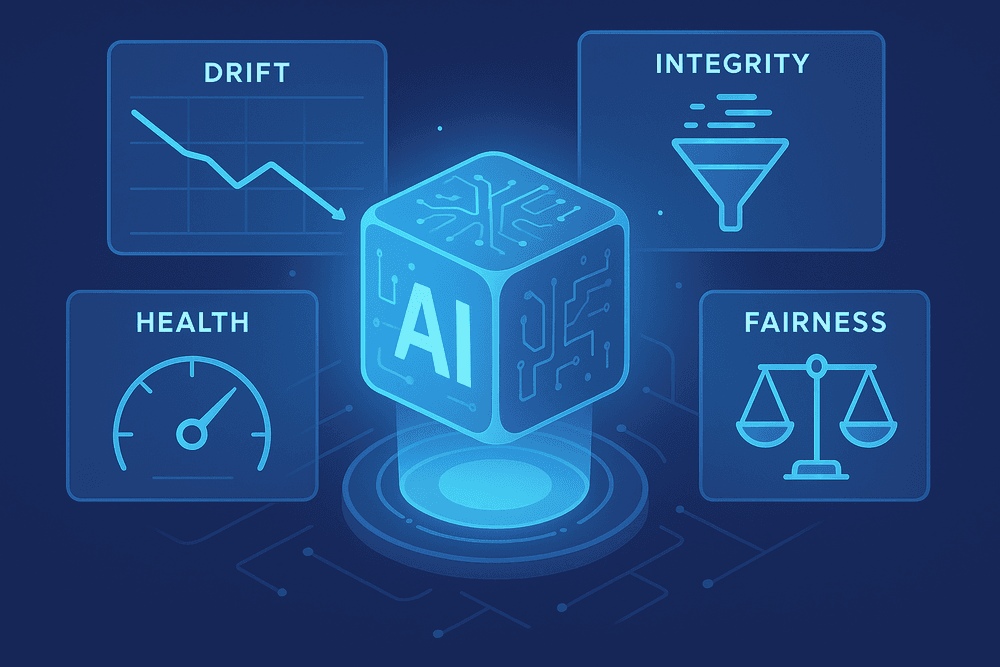
Effective AI performance monitoring is a multi-faceted discipline built on four essential pillars. To truly understand how your model behaves in the wild, you must look beyond a simple accuracy score and track a holistic set of metrics that cover everything from the data pipeline to the end-user experience. These pillars ensure your AI system remains accurate, reliable, efficient, and fair over its entire lifecycle.
Tracking Model Drift and Concept Drift Over Time
Your model was trained on a snapshot of the past, but it operates in the ever-changing present. This inevitable divergence is known as drift, and it's a primary reason for performance degradation.
- Model Drift (or Model Decay): This occurs when the statistical relationships between your model’s input features and the target variable change. For example, a model predicting customer churn might become less accurate as new marketing strategies alter customer behavior patterns. Its predictive power erodes even if the inputs look similar.
- Concept Drift: This is a more fundamental shift where the very definition of the target variable changes. In fraud detection, for instance, criminals constantly develop new techniques, changing what "fraudulent activity" looks like.
To combat drift, you must continuously monitor key performance indicators (KPIs) like accuracy, precision, F1-score, and recall against the baseline established during training. Also, track the distribution of both your input data (feature drift) and your model’s predictions to catch subtle shifts before they impact business outcomes.
Ensuring Data Integrity and Quality for Reliable Inputs
The principle of "garbage in, garbage out" has never been more relevant than in production AI systems. Faulty data is a leading cause of model failure, making data integrity a cornerstone of AI performance monitoring. Your monitoring strategy must validate the health of your data pipeline at every stage.
Key data quality metrics to track include:
- Schema Adherence: Detect unexpected changes, such as missing or new data columns.
- Data Type Mismatches: Ensure numerical data hasn't been replaced with text, and vice-versa.
- Null and Missing Values: A sudden spike in null values can cripple a model’s predictive ability.
- Value Ranges and Outliers: Monitor for data that falls outside expected ranges, which could indicate sensor errors or data entry issues.
Analyzing Operational Health: Latency, Throughput, and Uptime
An accurate model is useless if it’s too slow or frequently unavailable. The operational health of your AI system is critical for user trust and scalability. This pillar connects your model directly to its infrastructure performance.
- Latency: The time it takes for your model to return a prediction after receiving a request. High latency can ruin the user experience in real-time applications like recommendation engines or chatbots.
- Throughput: The number of predictions the system can serve per second or minute. This metric is crucial for understanding how well your system scales under load.
- Uptime and Availability: The percentage of time your AI service is operational and accessible. This is a fundamental measure of reliability.
- Resource Utilization: Monitor CPU, GPU, and memory usage to optimize costs and prevent system overloads.
Fairness and Bias: Monitoring Ethical AI Performance
AI models can inadvertently learn and amplify societal biases present in their training data. This can lead to unfair outcomes, damage brand reputation, and create significant legal risks. A mature AI performance monitoring framework must include dedicated checks for fairness and bias.
This involves segmenting your model's performance across different demographic groups (e.g., based on age, gender, or location) to ensure equitable outcomes. Key metrics include:
- Disparate Impact: Compares the rate of favorable outcomes across different groups.
- Equal Opportunity Difference: Checks that the model’s true positive rate is consistent across groups.
By proactively monitoring for bias, you build trust with your users and ensure your AI systems operate responsibly and ethically.
Evaluating the Top AI Performance Monitoring Tools & Platforms
Choosing the right tool is a critical step in operationalizing your machine learning models. The market is filled with excellent options, but they fall into two main camps: open-source solutions and managed platforms. Understanding their differences and aligning them with your specific needs is the key to successful AI performance monitoring.
Open-Source vs. Managed Solutions: A Head-to-Head Comparison
The first decision your team will face is whether to build on an open-source foundation or buy into a managed service. Each path has distinct trade-offs.
- Open-Source Tools (e.g., Evidently AI, NannyML): These libraries provide the fundamental building blocks for monitoring.
- Pros: They are free to use, highly customizable, and offer complete control over your data and infrastructure. You can tailor them precisely to your workflows and integrate them deeply into proprietary systems.
- Cons: The "free" price tag doesn't account for the significant engineering resources required for setup, configuration, and ongoing maintenance. You are responsible for scaling, reliability, and building out features like user-friendly dashboards and alerting systems.
- Managed Solutions (e.g., Datadog, WhyLabs, Arize AI): These are commercial SaaS platforms that offer a comprehensive, out-of-the-box AI performance monitoring experience.
- Pros: They are designed for rapid deployment, often requiring only a few lines of code to get started. They come with dedicated support, guaranteed uptime, and a polished user interface with advanced features for visualization, alerting, and root-cause analysis.
- Cons: They operate on a subscription model, which represents an ongoing cost. While flexible, they may offer less granular customization than an open-source tool you build yourself.
Deep Dive: Features of Leading Tools
While many platforms exist, a few leaders exemplify different approaches to solving the AI performance monitoring challenge.
- Datadog: For teams seeking a unified observability platform, Datadog extends its renowned application performance monitoring (APM) capabilities to machine learning. Its key strength is integrating model metrics—like inference latency and error rates—directly alongside infrastructure health, logs, and application traces. This provides a single pane of glass for DevOps and MLOps teams to see how model performance impacts the entire system.
- WhyLabs: WhyLabs positions itself as an AI observability platform with a strong focus on data health. It excels at detecting silent model failures caused by issues like data drift, data quality degradation, and concept drift. Its lightweight and privacy-preserving architecture, built around the WhyLogs data logging standard, makes it easy to monitor models without moving raw data, making it ideal for teams prioritizing data integrity and security.
- Arize AI: Arize is a purpose-built ML observability platform designed for deep troubleshooting and root-cause analysis. It goes beyond simple metrics to help teams understand why a model’s performance is changing. With powerful features for performance tracing, drift analysis, and model explainability, Arize empowers ML engineers to quickly diagnose and resolve issues, compare models across environments, and improve performance over time.
How to Choose the Right Monitoring Tool for Your Tech Stack
The "best" tool is the one that fits your unique context. To make the right choice, ask your team these critical questions:
- What is your scale and budget? A small project might start effectively with an open-source tool. A large-scale, business-critical deployment will likely benefit from the reliability, scalability, and support of a managed enterprise solution.
- What is your team’s expertise? Do you have dedicated MLOps engineers who can manage and scale an open-source solution? If not, the ease of use and dedicated support from a managed platform will provide a faster time-to-value.
- What are your primary monitoring needs? If your main concern is detecting data drift, a tool like WhyLabs is a strong contender. If you need to troubleshoot complex prediction issues, Arize's analytical depth is invaluable. If you want to see model metrics alongside your backend service KPIs, Datadog is a natural fit.
- How does it integrate with your stack? Ensure the tool seamlessly connects with your existing infrastructure, including cloud providers (AWS, GCP, Azure), data sources (Snowflake, S3), and ML frameworks (PyTorch, TensorFlow, Scikit-learn). A smooth integration is non-negotiable for effective AI performance monitoring.
A Strategic Blueprint for Effective AI Performance Monitoring
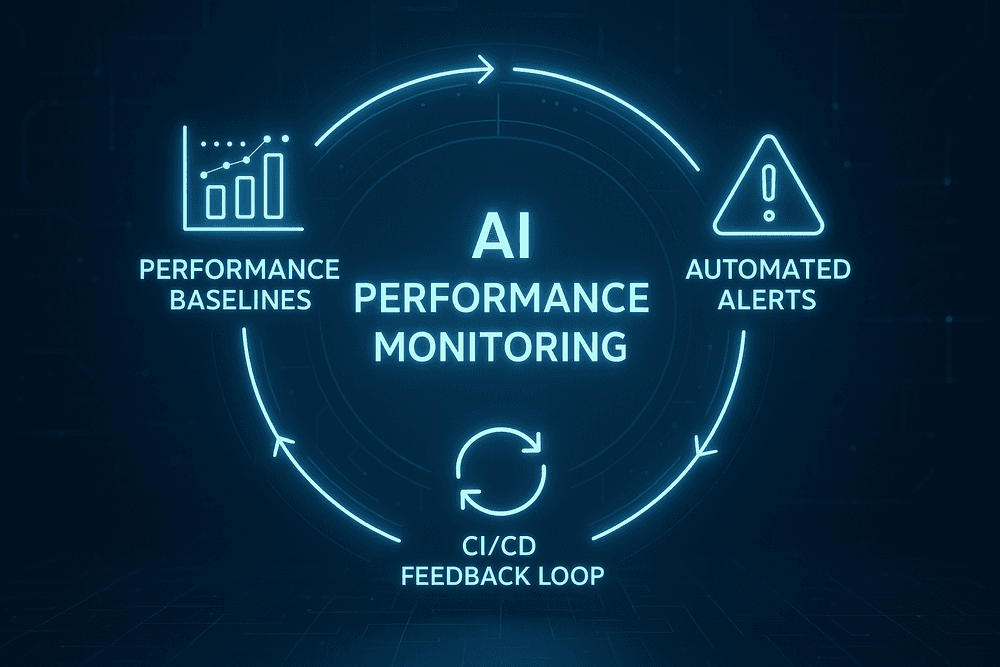
Moving from theory to practice requires a clear, actionable plan. A reactive approach to AI issues leads to firefighting, lost revenue, and eroded user trust. A proactive strategy, however, transforms AI performance monitoring from a defensive chore into a competitive advantage. This four-step blueprint provides a structured framework for implementing a robust monitoring system that ensures your models remain valuable assets long after deployment.
Step 1: Establishing a Performance Baseline Before Launch
Before your AI model ever sees live production data, you must define what “good” looks like. This is your performance baseline—a golden record of how the model performs under ideal, controlled conditions. This initial evaluation, typically conducted on a held-out test or validation dataset, must capture a range of metrics:
- Predictive Power: Accuracy, precision, recall, F1-score, or AUC-ROC, depending on your use case.
- Operational Health: Inference latency, throughput, and resource consumption (CPU, GPU, memory).
- Data Profile: The statistical distribution of the features the model was trained on.
This baseline becomes the immutable benchmark against which all future performance is measured. Without it, detecting subtle degradation or data drift is impossible. Effective AI performance monitoring is fundamentally about comparing the present to this well-defined past.
Step 2: Configuring Automated Alerts for Anomaly Detection
In a live environment, manual checks are too slow and unreliable to catch critical issues in time. The core of a modern AI performance monitoring strategy is automated alerting. Your system should be configured to proactively notify stakeholders when key indicators deviate from the norm. Critical alerts to configure include:
- Data Drift Alerts: Triggered when the statistical properties of incoming production data (e.g., mean, variance, null values) shift significantly from the training data profile.
- Concept Drift Alerts: Fired when the relationship between input features and the target variable changes, causing a drop in model accuracy even if the input data distribution seems stable.
- Performance Threshold Alerts: Activated when core metrics like accuracy or F1-score fall below the predefined baseline thresholds.
- System Health Alerts: Set to monitor for operational issues like spikes in latency, high error rates, or excessive resource usage.
Integrating these alerts with communication platforms like Slack, Microsoft Teams, or PagerDuty ensures the right teams are notified instantly.
Step 3: Integrating Monitoring into Your CI/CD and MLOps Pipeline
AI performance monitoring should not be an afterthought bolted on post-deployment. To build a truly resilient system, monitoring must be woven into the fabric of your MLOps pipeline. This integration treats model performance as a critical quality gate, just like unit tests in traditional software development.
By embedding monitoring checks directly into your Continuous Integration/Continuous Deployment (CI/CD) workflow, you can automatically validate new model candidates against the current production champion. Use strategies like shadow deployments, where the new model processes live traffic in the background without serving results, to gather real-world performance data in a safe environment. This MLOps-centric approach ensures that only models proven to be stable and effective on live data are promoted, preventing performance regressions before they ever impact a user.
Step 4: Creating Feedback Loops for Model Retraining
The ultimate goal of monitoring is not just to identify problems but to trigger solutions. A mature monitoring system closes the loop by feeding its insights directly back into the model development lifecycle. This creates a powerful, semi-automated system for continuous improvement.
When your monitoring platform detects significant performance degradation or drift, it should initiate a feedback loop. This workflow can automatically flag the problematic data segment for review and relabeling. Once a new, enriched dataset is available, the system can trigger an automated retraining pipeline. The newly trained model is then evaluated within the CI/CD pipeline, and its performance is compared against the degraded production model. This closed-loop process—Detect, Flag, Retrain, and Redeploy—transforms your AI performance monitoring into an active, self-healing system that adapts to a changing world.
AI Performance Monitoring in Action: Real-World Use Cases
The theoretical importance of tracking model health is clear, but the true value of AI performance monitoring comes to life in its real-world applications. Across industries, proactive monitoring is the critical link between a deployed model and sustained, reliable performance. Let's explore how different sectors leverage these strategies to protect revenue, ensure accuracy, and even save lives.
Success Story: How an E-commerce Giant Prevents Revenue Loss with Drift Detection
A leading online retailer’s recommendation engine is its golden goose, responsible for a significant portion of its sales. The AI model, trained on historical user behavior, suggests products that customers are most likely to buy. However, customer tastes are not static; they shift with seasons, trends, and promotions.
The Challenge: In the weeks leading up to the summer, the model, trained heavily on winter data, continued to recommend sweaters and boots. Unseen by the team, click-through rates and add-to-cart metrics began to dip. This phenomenon, known as concept drift, was causing a silent leakage of revenue as user engagement dropped.
The Solution: The company implemented a comprehensive AI performance monitoring platform. The system was configured to track not just high-level business KPIs but also the statistical distribution of the model's predictions and input data. It immediately flagged a growing discrepancy between the items being recommended and the items users were actually viewing and purchasing.
The Outcome: An automated alert notified the MLOps team of the performance degradation. They quickly triggered a retraining pipeline using fresh, seasonal data. The updated model was deployed within hours, reversing the negative trend. This proactive drift detection system transformed a potential quarterly revenue miss into a routine operational task, safeguarding millions in sales.
Case Study: Maintaining Accuracy in a Financial Fraud Detection Model
For a major financial institution, an AI-powered fraud detection system is the first line of defense against financial crime. The model must analyze thousands of transactions per second to block fraudulent activity without inconveniencing legitimate customers.
The Challenge: Fraudsters constantly devise new schemes. A novel type of phishing attack created a new data pattern the model had never encountered. As a result, false negatives (missed fraudulent transactions) began to creep up, leading to direct financial losses. Simultaneously, the model's uncertainty about these new patterns caused a spike in false positives, where legitimate transactions were incorrectly declined, infuriating customers.
The Solution: The institution’s AI performance monitoring strategy focused heavily on data drift and outlier detection. The system continuously monitored the statistical properties of incoming transaction data, flagging anomalies in real-time. It detected a sudden surge in transactions with unusual merchant codes and small, rapid-fire amounts—hallmarks of the new fraud scheme.
The Outcome: Instead of waiting for customer complaints or loss reports, the security team was alerted instantly. They used the flagged data to analyze the new fraud vector, label a new dataset, and retrain the model. This agile response, powered by meticulous AI performance monitoring, allows the bank to stay one step ahead of criminals, protecting both its assets and customer trust.
Application: Ensuring Reliability in Healthcare Diagnostic AI
In a cutting-edge hospital, an AI model assists radiologists by analyzing MRI scans to identify early signs of neurological disorders. Here, the accuracy and reliability of the model are non-negotiable.
The Challenge: The hospital introduced a new line of MRI machines from a different manufacturer. While the images appeared similar to the human eye, they had subtle differences in resolution and contrast. This data drift caused the AI model, trained on data from the older machines, to become less reliable in its predictions, posing a significant risk to patient diagnosis.
The Solution: A rigorous AI performance monitoring framework was a mandatory component of the AI’s deployment. This system regularly compared the model’s outputs against diagnoses confirmed by senior radiologists (the ground truth). It also monitored the statistical distribution of the input data, flagging the shift in image properties from the new machines.
The Outcome: The system alerted the clinical AI team to a drop in the model's confidence scores correlated with scans from the new equipment. This enabled them to isolate the issue, collect and label a set of images from the new machines, and fine-tune the model. This ensures the diagnostic tool remains a safe, effective, and trustworthy assistant, upholding the highest standards of patient care.
Conclusion: Future-Proofing Your Systems with Proactive AI Monitoring
The era of deploying artificial intelligence and simply hoping for the best is over. As we've explored, AI models are not static assets; they are dynamic systems that interact with an ever-changing world. Without a robust framework for AI performance monitoring, even the most sophisticated model can degrade, delivering inaccurate results, eroding user trust, and ultimately undermining your return on investment. The journey doesn't end at deployment—it begins there. Embracing this new reality is the first step toward building resilient, reliable, and truly intelligent systems that deliver sustained value.
The Shift from Reactive Fixes to Proactive Optimization
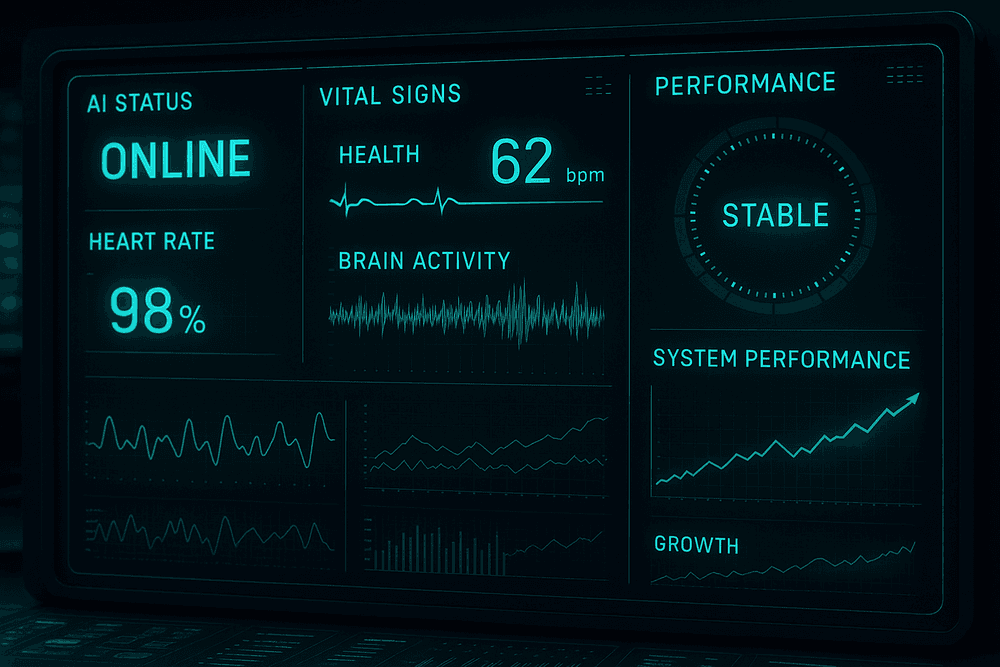
For too long, organizations have treated AI issues reactively. A model fails, a customer complains, or a KPI plummets, and a frantic scramble begins to diagnose and fix the problem. This fire-fighting approach is costly, inefficient, and damaging to your reputation. Proactive AI performance monitoring fundamentally changes this paradigm. It’s about creating a nervous system for your AI, one that constantly senses and reports on its health.
By continuously tracking model drift, data integrity, and operational metrics, you move from crisis management to strategic optimization. Instead of asking "What broke?", you begin to ask "How can we make this better?". This proactive stance allows you to anticipate degradation before it impacts users, identify opportunities for model retraining with fresh data, and ensure your AI systems are not just functioning but thriving. It's the critical difference between an AI solution that survives and one that provides a lasting competitive advantage.
Building Your AI Performance Monitoring Strategy Today
Implementing a comprehensive AI performance monitoring strategy is not an insurmountable task, but it requires deliberate action. It begins with establishing a clear baseline of performance post-deployment and defining the key metrics that matter most to your business objectives—from technical indicators like prediction latency and accuracy to business-level KPIs.
Your strategy should include:
- Automated Alerting: Set up intelligent thresholds for critical metrics like concept drift, data schema changes, and outlier detection. Your team should be notified of anomalies automatically, not after a manual review.
- Integrated Tooling: Select and integrate monitoring tools that provide a unified view of your entire MLOps pipeline. The right platform will offer dashboards, root cause analysis features, and clear visualizations that make complex data understandable.
- Clear Governance and Processes: Define who is responsible for monitoring, what the escalation path for an issue looks like, and how often models are reviewed. A solid process ensures that insights from monitoring lead to concrete actions, such as retraining, data cleansing, or model rollback.
Next Steps: Resources for Advanced Learning and Implementation
Embarking on your AI performance monitoring journey is a powerful step toward operational excellence. To help you move from theory to practice, here are some resources to guide your next steps:
- Explore Open-Source Tools: Investigate powerful open-source libraries like Evidently AI, NannyML, or a combination of Prometheus and Grafana for building a custom monitoring stack.
- Review Vendor Whitepapers: Leading MLOps and cloud platforms (e.g., Datadog, Arize AI, Fiddler AI) provide in-depth whitepapers and case studies on implementing effective monitoring at scale.
- Join a Community: Engage with MLOps communities on platforms like Slack, Discord, or LinkedIn to ask questions, share challenges, and learn from practitioners who have navigated these waters.
Ultimately, investing in AI performance monitoring is an investment in the future of your business. It's the foundation upon which you can build, scale, and trust your AI initiatives, ensuring they remain powerful assets for years to come.