September 22, 2025
What Is AI Performance Monitoring and Why Is It Critical?
What Is AI Performance Monitoring and Why Is It Critical?
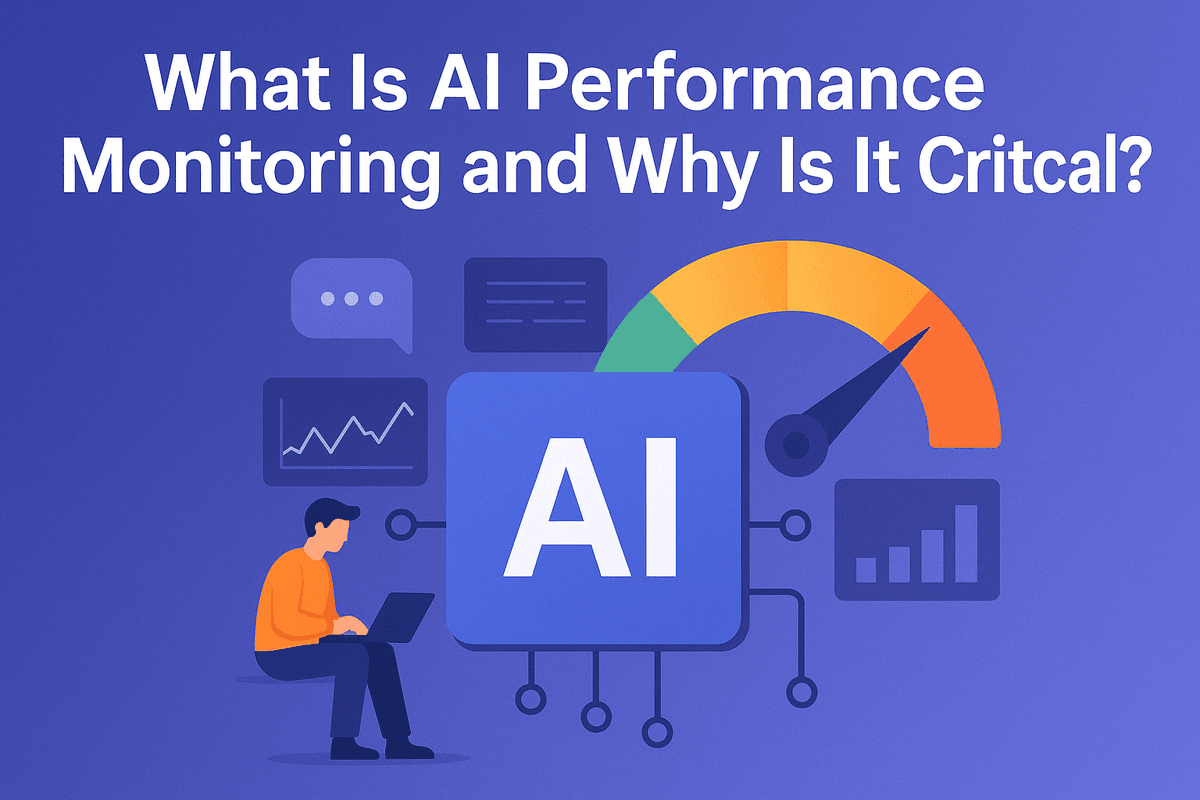
Deploying an AI model is not the finish line; it’s the starting gun. Once your model is live, it begins interacting with a dynamic, ever-changing world. AI performance monitoring is the continuous, systematic process of tracking, analyzing, and managing your AI model's performance in this real-world environment. It’s the crucial practice that ensures your intelligent system not only works at launch but continues to deliver accurate, efficient, and valuable results over its entire lifecycle. Without it, you’re flying blind, risking everything from financial loss to brand damage.
From 'Did it work?' to 'Is it still working?': The MLOps Shift
In the early days of machine learning, the primary focus was on training and validation. The critical question was, "Did the model work on our test dataset?" If it passed, it was deployed, and the job was considered done. This approach is dangerously outdated. The modern discipline of MLOps (Machine Learning Operations) recognizes that AI models are not static assets. They are dynamic systems that can, and will, degrade over time.
This has fundamentally shifted the central question from "Did it work?" to "Is it still working?". This ongoing query is the heart of AI performance monitoring. It acknowledges that real-world data evolves—customer behaviors change, market trends shift, and new patterns emerge. An effective monitoring strategy provides the tools to answer this question continuously, creating a feedback loop that sustains the model’s health and relevance long after its initial deployment.
The Hidden Costs of AI Model Degradation
When a model's performance silently degrades, the consequences can be severe and often go unnoticed until significant damage is done. This decay, often called "model drift," happens when the live data the model processes no longer resembles the data it was trained on. The hidden costs are substantial:
- Eroding Business Value: A demand forecasting model that becomes less accurate can lead to costly overstocking or missed sales opportunities. A recommendation engine that provides irrelevant suggestions can drive customers away. These subtle failures directly chip away at your bottom line.
- Reputational Damage: Inaccurate AI can quickly undermine customer trust. Imagine a fraud detection system that incorrectly flags legitimate transactions, frustrating loyal customers, or a customer service chatbot that provides nonsensical answers. This erodes brand credibility.
- Compliance and Ethical Risks: In regulated industries like finance and healthcare, a degrading model can lead to biased or unfair outcomes, creating serious legal and ethical liabilities.
- Wasted Investment: The significant time, data, and resources invested in developing a sophisticated AI model are squandered if its performance isn't maintained in production.
How Proactive Monitoring Protects Your ROI
Effective AI performance monitoring is the ultimate insurance policy for your AI investment. By moving from a reactive to a proactive stance, you can catch issues before they impact your business and ensure your models continue to generate value.
Proactive monitoring protects your ROI in several key ways. It provides early detection of performance dips, data drift, and concept drift, giving your team the signal to intervene before users are affected. By tracking key metrics like accuracy, latency, and throughput, you gain clear, data-driven insights that inform when a model needs to be retrained or replaced. This prevents the "silent failure" scenario and ensures the model remains aligned with current business realities. Ultimately, robust AI performance monitoring transforms your AI from a one-time project into a reliable, evolving business asset that consistently delivers on its promised return.
Key Metrics for Robust AI Performance Monitoring
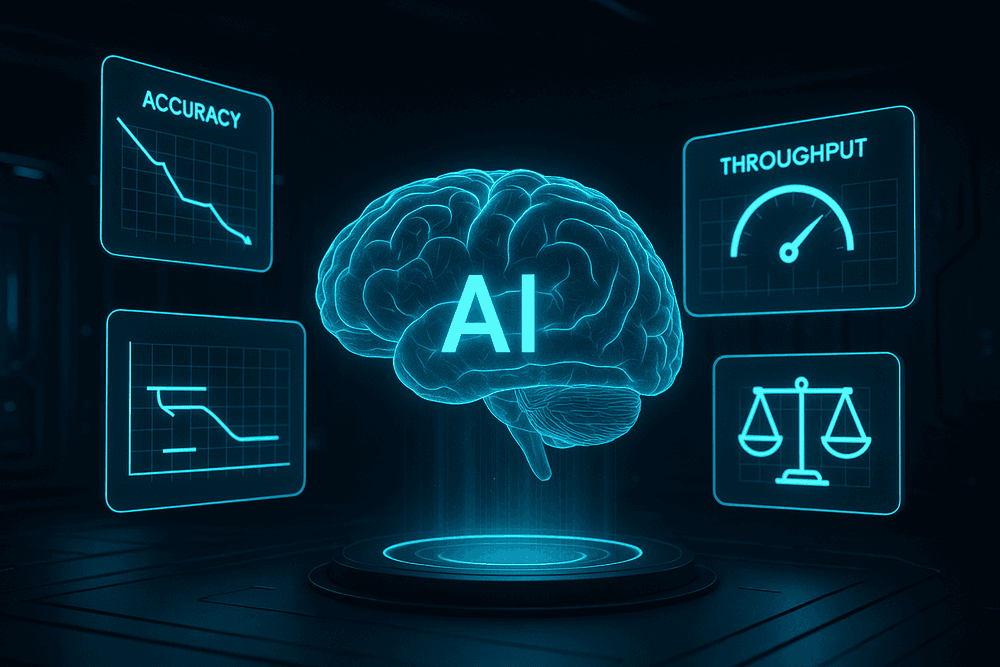
Effective AI performance monitoring isn't just about checking if your model's accuracy is holding steady. It’s a multi-faceted discipline that requires tracking a diverse set of metrics to ensure your system is not only accurate but also efficient, reliable, and fair. Once a model is deployed, it enters a dynamic environment where data, user behavior, and business needs are constantly evolving. Here are the essential metrics you need to watch to maintain a healthy and high-performing AI system.
Tracking Model Drift: Is Your AI Becoming Obsolete?
One of the most significant threats to a deployed AI model is model drift. This occurs when the statistical properties of the real-world data change over time, causing the model's predictions to become less accurate because it was trained on outdated patterns. Think of it as the model’s knowledge becoming obsolete.
There are two main types of drift:
- Concept Drift: The relationship between input variables and the target variable changes. For example, a model predicting customer churn might degrade because the very reasons customers leave (e.g., new competitor pricing, a shift in product features) have changed.
- Data Drift: The distribution of the input data itself changes, even if the underlying concepts remain the same. A loan approval model might see a drift in the average income of applicants due to macroeconomic shifts.
A core component of AI performance monitoring is to continuously compare the distribution of live production data against the training data to catch these drifts early, allowing you to retrain or recalibrate the model before its performance severely impacts business outcomes.
Measuring Latency and Throughput for Real-Time Efficiency
A correct prediction delivered too slowly is often useless. Operational metrics are critical, especially for customer-facing applications.
- Latency measures the time it takes for the model to process a single request and return a prediction. For a real-time recommendation engine or a chatbot, high latency leads to a poor user experience and abandonment.
- Throughput measures how many predictions the system can handle within a specific timeframe (e.g., predictions per second). Low throughput can create bottlenecks, causing system-wide slowdowns during peak traffic.
Monitoring these metrics helps you optimize infrastructure, ensure scalability, and guarantee that your AI system meets the performance demands of your application.
Monitoring Data Quality and Integrity Issues
The age-old principle of "garbage in, garbage out" is amplified in AI systems. A model can only be as good as the data it receives. Your AI performance monitoring strategy must include rigorous checks on the input data pipeline. Key issues to monitor include:
- Sudden increases in null or missing values.
- Changes in data schema or format (e.g., a field changing from integer to string).
- Outliers or values that fall outside expected ranges.
- Shifts in the categorical or numerical distributions of input features.
By setting up alerts for these data integrity anomalies, you can prevent corrupted data from polluting your model's predictions and investigate pipeline issues before they cause significant damage.
Analyzing Fairness, Bias, and Explainability (XAI)
Beyond technical performance, it's crucial to monitor the ethical and social impact of your AI. An unmonitored model can inadvertently perpetuate or even amplify societal biases present in its training data.
- Fairness and Bias: This involves measuring whether your model's performance is consistent across different demographic groups (e.g., race, gender, age). Metrics like demographic parity and equal opportunity difference help quantify and flag potential biases in outcomes, such as loan approvals or hiring recommendations.
- Explainability (XAI): This refers to the ability to understand and interpret a model's decisions. Monitoring explainability involves using techniques like SHAP (SHapley Additive exPlanations) to ensure predictions are not only accurate but also transparent. This is vital for debugging, building user trust, and complying with regulations that require a "right to explanation."
The Ultimate Toolkit for AI Performance Monitoring
Choosing the right tools is the critical next step in operationalizing your AI performance monitoring strategy. The market is filled with options, from highly flexible open-source frameworks to feature-rich managed platforms. Your choice will depend on your team’s expertise, budget, and scalability needs. Let’s break down the landscape.
Open-Source vs. Managed Platforms: A Head-to-Head Comparison
The first major decision is whether to build on open-source software or invest in a managed, software-as-a-service (SaaS) platform. Each path offers distinct advantages.
- Open-Source Solutions (e.g., Evidently AI, Prometheus with Grafana): These tools provide maximum flexibility and control. You can customize every aspect of your monitoring pipeline, from data ingestion to visualization dashboards. They are cost-effective to start, with no licensing fees, and benefit from strong community support. However, this freedom comes at the cost of significant engineering effort for setup, maintenance, and scaling. This route is ideal for teams with deep MLOps expertise who require a bespoke AI performance monitoring system.
- Managed Platforms (e.g., Arize, WhyLabs, Datadog): These commercial solutions offer a turnkey experience. They are designed for rapid implementation, with user-friendly interfaces, pre-built dashboards, and dedicated customer support. Managed platforms excel at providing sophisticated features like automated drift detection, model explainability, and root cause analysis out-of-the-box. The trade-off is the subscription cost and potential vendor lock-in, but the speed to value is often a compelling reason for teams focused on accelerating their AI initiatives.
Evaluating Top Contenders: Datadog, Arize, and WhyLabs
Several key players lead the market for managed AI performance monitoring. While not an exhaustive list, these three represent different approaches to the problem:
- Datadog: A giant in the broader application and infrastructure observability space, Datadog has extended its capabilities to MLOps. Its strength lies in providing a unified view, allowing you to correlate model performance with underlying system health (like CPU usage or network latency). It's an excellent choice for organizations already embedded in the Datadog ecosystem.
- Arize AI: As a purpose-built ML observability platform, Arize offers deep functionality specifically for monitoring models. It excels at complex drift detection, performance slicing to uncover hidden issues in specific cohorts, and providing tools for root cause analysis and explainability. It’s built from the ground up for the unique challenges of production AI.
- WhyLabs: This platform takes a data-centric approach, emphasizing the continuous monitoring of your data's health to prevent model degradation. By integrating its lightweight data logging library (WhyLogs), it enables monitoring across the entire ML lifecycle, from development to production, helping teams catch data quality issues before they impact performance.
Essential Features to Look for in a Monitoring Solution
When evaluating any tool, prioritize features that provide actionable insights. Your ideal solution for AI performance monitoring should include:
- Automated Drift Detection: The ability to track both data drift (changes in input distributions) and concept drift (changes in the relationship between inputs and outputs).
- Performance Metrics Tracking: Real-time monitoring of operational metrics (latency, throughput) and model quality metrics (accuracy, F1-score, custom business KPIs).
- Data Quality and Integrity Checks: Alerts for anomalies like null values, schema changes, or statistical outliers that can break your model.
- Alerting and Root Cause Analysis: Customizable, multi-channel alerting (Slack, PagerDuty) and dashboards that help you quickly diagnose the source of a problem.
- Explainability and Bias Detection: Tools to interpret why a model made a specific prediction and to audit for fairness and ethical compliance.
Integrating Monitoring into Your Existing MLOps Stack
An effective AI performance monitoring tool does not operate in a vacuum. It must integrate seamlessly into your existing MLOps pipeline to create a cohesive, automated workflow. Look for solutions that offer robust APIs and pre-built integrations with:
- Model Serving Platforms: (e.g., KServe, Seldon Core, SageMaker Endpoints) to automatically capture inference data.
- Data Warehouses: (e.g., Snowflake, BigQuery, Redshift) to compare production data against training or validation sets.
- CI/CD and Orchestration Tools: (e.g., Jenkins, Kubeflow, Airflow) to programmatically register and configure monitoring for newly deployed models.
- Communication Hubs: (e.g., Slack, Microsoft Teams) to ensure alerts reach the right on-call engineers and data scientists immediately.
Best Practices for Implementing Your AI Monitoring Strategy
An effective AI performance monitoring strategy isn't just about collecting data; it's about turning that data into actionable insights. Moving from theory to practice requires a structured approach. Here are the essential best practices to build a robust and responsive monitoring framework for your AI systems.
Establishing a Performance Baseline: What Does 'Good' Look Like?
Before you can detect a problem, you must define what normal operation looks like. A performance baseline is your model's "ground truth," a benchmark against which all future performance is measured. Without it, you’re flying blind.
- How to Create a Baseline: Your baseline should be established using a combination of offline evaluation metrics (from your test dataset) and initial real-world performance data. Consider running the model in "shadow mode"—where it makes predictions on live data without acting on them—for a period to gather a realistic performance sample before a full rollout.
- Key Baseline Metrics: Your baseline should include both model-specific metrics (e.g., accuracy, precision, F1-score) and operational metrics (e.g., prediction latency, throughput, CPU/GPU utilization).
- Context is King: "Good" is highly dependent on your use case. A 90% accuracy rate might be excellent for a product recommendation engine but dangerously inadequate for a medical diagnostic tool. Define and document acceptable performance ranges for your specific application.
Configuring Automated Alerts for Anomaly Detection
Manually checking a dashboard 24/7 isn't a scalable solution. A cornerstone of effective AI performance monitoring is an automated alerting system that notifies the right people when key metrics deviate from the established baseline.
- Set Intelligent Thresholds: Configure alerts to trigger when performance drops below a certain threshold (e.g., accuracy falls by 5%) or when operational metrics spike (e.g., latency increases by 50%).
- Monitor for Drift: Set up alerts specifically for data and concept drift. Statistical tests can run automatically to detect when the distribution of incoming production data no longer matches the training data, a leading indicator of performance degradation.
- Avoid Alert Fatigue: Be strategic with your alerts. If everything is an emergency, nothing is. Start with critical alerts and refine the thresholds over time to ensure that notifications are both timely and meaningful. Integrate alerts into your team's existing workflows, such as Slack, Microsoft Teams, or PagerDuty.
Creating a Human-in-the-Loop Feedback System
Automation is powerful, but human expertise is irreplaceable. A human-in-the-loop (HITL) system integrates human feedback directly into your monitoring and retraining pipeline, creating a powerful cycle of continuous improvement.
This system works by flagging uncertain or anomalous predictions for review by a subject-matter expert. For example, a fraud detection model might flag a transaction with a 60% confidence score for manual review. The human analyst then provides the "ground truth"—confirming whether it was fraudulent or not. This verified data is invaluable, serving as a high-quality, curated dataset for future model retraining, helping the AI learn from its most challenging cases.
A Step-by-Step Guide to Your First Monitoring Dashboard
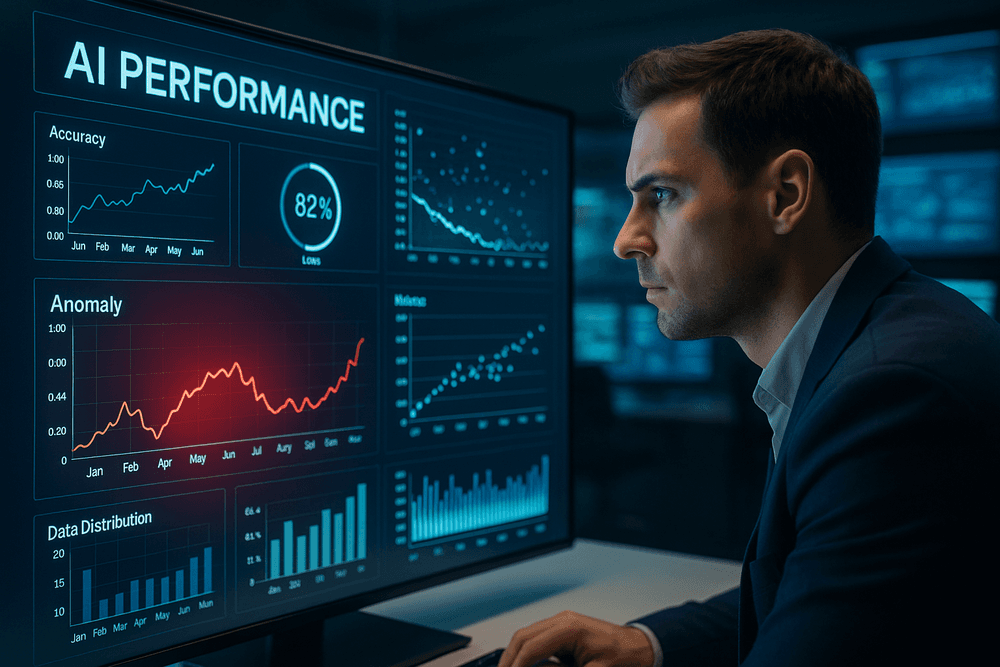
Your dashboard is the command center for your AI performance monitoring efforts. It visualizes key metrics, making it easy to assess model health at a glance.
- Define KPIs and Audience: First, determine who will use the dashboard (ML engineers, product managers, business stakeholders) and what they need to know. An engineer may need granular latency data, while a product manager might care more about the model's impact on user engagement.
- Choose Your Tools: Select a visualization tool that fits your stack. Options range from open-source platforms like Grafana to APM (Application Performance Management) tools like Datadog or specialized MLOps monitoring platforms.
- Design the Layout: Structure your dashboard logically. A common layout includes a high-level summary at the top (e.g., overall model health, key business KPI), followed by sections for predictive performance, data drift, and operational metrics.
- Connect Data Sources: Pipe the necessary data—such as model predictions, ground truth labels, and system logs—from your AI application into your dashboarding tool.
- Iterate and Refine: Your first dashboard won't be perfect. Treat it as a living product. Gather feedback from users and continuously refine it to ensure it provides clear, actionable insights into your model's performance.
AI Performance Monitoring in Action: Real-World Use Cases
Theory and metrics are crucial, but the true value of AI performance monitoring shines when applied to real-world business challenges. By moving from a reactive to a proactive stance, organizations can protect revenue, mitigate risk, and ensure their AI systems deliver on their promises. Let's explore how different industries leverage monitoring to maintain peak model performance.
E-commerce: Tackling Concept Drift in Recommendation Engines
In the fast-paced world of e-commerce, a recommendation engine is a powerful revenue driver. However, its effectiveness is perishable. The model that perfectly captured customer preferences during the holiday season will likely underperform in the spring. This is a classic case of concept drift, where the relationship between input data and the target variable changes over time due to new trends, seasonal shifts, or evolving user behavior.
AI performance monitoring provides the necessary defense. By continuously tracking key business metrics like click-through rates (CTR), conversion rates, and average order value tied to recommendations, teams can spot performance degradation instantly. An effective monitoring system also analyzes data distribution, alerting teams when the types of products being viewed or purchased shift significantly. When a drift alert is triggered, it's a clear signal to retrain the model with fresh data, ensuring recommendations remain relevant, personalized, and profitable.
Fintech: Ensuring Peak Accuracy in Fraud Detection Models
For financial institutions, a fraud detection model is a critical line of defense. The stakes are incredibly high; even a fractional drop in accuracy can result in millions of dollars in losses and erode customer trust. Fraudsters are constantly innovating, meaning new, unseen attack patterns can emerge at any moment, rendering a static model obsolete.
This is where real-time AI performance monitoring becomes non-negotiable. These systems go beyond simple accuracy checks to track precision and recall, ensuring the model isn't just catching fraud but also avoiding false positives that block legitimate transactions. Crucially, monitoring tools look for data drift by identifying anomalies in transaction data—sudden spikes in transactions from a new region or unusual spending patterns. When the system flags such anomalies, it prompts an immediate investigation and potential model retraining, allowing the institution to stay one step ahead of criminals and protect its assets and customers.
Healthcare: Maintaining Reliability in AI-Powered Diagnostics
In healthcare, AI models that assist in diagnostics—like identifying tumors in medical scans or predicting patient risk—must be impeccably reliable. A model’s performance can subtly degrade due to factors like the introduction of new imaging equipment, updated scanning protocols, or demographic shifts in the patient population. In this context, performance degradation isn't just a business problem; it's a patient safety issue.
A robust AI performance monitoring framework is essential for maintaining clinical trust and regulatory compliance. It involves tracking the model's predictions against a "ground truth" established by human experts, such as pathologists. The system also monitors for data drift in the input images, such as changes in resolution, brightness, or contrast. If the model's confidence scores dip or its predictions start diverging from expert diagnoses, the monitoring system raises an immediate alert. This ensures that the AI tool remains a reliable, life-saving asset for clinicians, reinforcing its value in modern medicine.
Conclusion: Future-Proofing Your AI with Smart Monitoring
The journey of an AI model doesn’t end at deployment; it begins. In a dynamic world where data, user behavior, and business needs are constantly in flux, treating AI as a "set-it-and-forget-it" technology is a recipe for failure. The critical bridge between a promising algorithm and a reliable, high-value business asset is a robust AI performance monitoring strategy. It’s the essential practice that ensures your models perform as intended, adapt to new realities, and continue to deliver on their promise long after they leave the lab. By moving from a reactive to a proactive stance, you can transform your AI initiatives from a source of uncertainty into a pillar of resilience and innovation.
Key Takeaways for a Resilient AI Ecosystem
Throughout this guide, we've established that effective AI performance monitoring is not merely a technical task but a core business function. The key to a resilient AI ecosystem lies in continuous observation. Remember these core principles:
- Drift is inevitable: Concept drift and data drift will happen. Proactive monitoring is your only defense against the silent degradation of model accuracy.
- Metrics must be holistic: Go beyond simple accuracy. A comprehensive view requires tracking operational metrics like latency and throughput, data integrity metrics like drift scores, and ethical metrics like fairness and bias.
- Context is king: An anomaly in latency is just a number until it’s tied to a poor user experience. Effective monitoring connects model behavior directly to business KPIs, providing the context needed to prioritize action.
Ultimately, a strong monitoring framework builds trust—trust from your technical teams that the system is stable, trust from stakeholders that the AI is delivering value, and trust from your customers that they can rely on your services.
The Future of AI Observability and Proactive Control
The field of AI performance monitoring is rapidly evolving into the more sophisticated discipline of AI observability. While monitoring tells you when a system is failing, observability gives you the tools to ask why. The future lies in creating systems that don't just send an alert when a model's accuracy drops but can pinpoint the root cause—be it a shift in a specific data feature, an upstream data pipeline issue, or a change in user demographics.
We are moving toward a paradigm of proactive control, where automated systems can:
- Predict performance degradation before it impacts business outcomes.
- Trigger automated retraining pipelines with validated data slices.
- Perform root cause analysis to provide engineers with actionable insights, not just alarms.
This shift empowers organizations to manage their AI systems with greater precision and efficiency, enabling them to scale their AI investments confidently.
Ready to Start? Your First Steps in AI Performance Monitoring
Embarking on your monitoring journey can feel daunting, but you can start making an immediate impact by taking a few focused steps.
- Define Your North Star Metrics: Before writing a single line of code, clearly define what success means for your model. Connect technical metrics like F1-score or latency directly to a business KPI, such as customer conversion rate or fraud detection savings.
- Choose the Right Toolkit: Evaluate the landscape of tools, from open-source libraries like Evidently AI to comprehensive MLOps platforms. Select a solution that integrates with your existing tech stack and can scale with your needs.
- Start with One Critical Model: Don’t try to boil the ocean. Select your most business-critical model and implement a pilot monitoring program. Establish a baseline for its performance, set up initial alerts for key metrics, and use it as a learning ground.
- Establish a Clear Feedback Loop: An alert is useless without a response plan. Document who is responsible for investigating an issue, what the process for retraining is, and how you will validate the fix before redeployment. This closes the loop from insight to action.
By embedding AI performance monitoring into your development lifecycle, you are not just managing models; you are building an intelligent, adaptive, and future-proof AI foundation for your entire organization.