
August 30, 2025
What is AI Knowledge Management and Why is it a Game-Changer
What is AI Knowledge Management and Why is it a Game-Changer?
For decades, organizations have wrestled with a paradox: they collect vast amounts of data, yet wisdom remains elusive. Employees spend countless hours searching for information they know exists, trapped in a maze of disconnected drives, outdated wikis, and siloed chat histories. Traditional knowledge management systems acted as passive digital filing cabinets—useful if you knew exactly what you were looking for, but frustratingly inert otherwise. Today, that paradigm is being completely upended by AI knowledge management, a technology poised to transform organizational intelligence.
The Evolution from Static Databases to a Dynamic 'Second Brain'
Think of old-school knowledge management as a library. To find a specific piece of information, you had to know the author, the title, or the exact subject heading. It was a static, "pull" system that placed the entire burden of discovery on the user.
AI knowledge management, in contrast, functions like a dynamic, collective "second brain" for your entire organization. It doesn't just store information; it understands, connects, and contextualizes it. Instead of you pulling data from a repository, this intelligent system proactively pushes relevant insights to you, often before you even realize you need them. It learns from every interaction, becoming smarter and more attuned to the needs of your team over time. This shift from a passive archive to an active intelligence partner is the core of its revolutionary power.
Defining AI Knowledge Management: More Than Just a Search Bar
So, what is AI knowledge management? At its core, it is the application of artificial intelligence technologies—primarily Natural Language Processing (NLP), Machine Learning (ML), and generative AI—to the processes of capturing, sharing, discovering, and using an organization's collective knowledge.
This goes far beyond a supercharged search bar. A search bar matches keywords; an AI-powered system understands intent and context.
- Natural Language Processing (NLP): Allows the system to understand human language, whether in a support ticket, a Slack message, or a 50-page report. You can ask complex questions like, "What was our customer feedback on Product X's UI in Q3?" and it will find the answer, not just documents with those keywords.
- Machine Learning (ML): Enables the platform to learn from user behavior, identify expert knowledge holders within the company, and predict what information will be most relevant to a specific project or task.
- Generative AI: Can synthesize information from multiple sources to provide concise summaries, draft reports, or answer complex queries directly, saving you from having to read through numerous documents yourself.
Why Now? The Tipping Point for Business Intelligence
The concept of intelligent knowledge retrieval isn't new, but we've reached a critical tipping point. Three major forces are converging to make AI knowledge management not just a possibility, but a business necessity.
First, the sheer volume of unstructured data (in emails, chats, documents, and call transcripts) has become impossible for humans to manage manually. Second, AI models, especially Large Language Models (LLMs), have achieved a level of sophistication and accessibility that makes them commercially viable and incredibly powerful. Finally, the rise of remote and hybrid work has fragmented company knowledge, creating an urgent need for a centralized, intelligent hub to maintain cohesion and efficiency. Businesses can no longer afford the "knowledge gap"—the time wasted searching for information is time lost to innovation and competition.
Core Benefits of Integrating AI into Your Knowledge Management Strategy
Adopting an AI knowledge management strategy isn't just about upgrading your tech stack; it's about fundamentally transforming how your organization creates, shares, and leverages its most valuable asset: collective intelligence. By moving beyond static repositories and manual processes, you unlock a suite of powerful benefits that drive efficiency, innovation, and a smarter workforce.
Automate Content Curation and Eliminate Information Silos
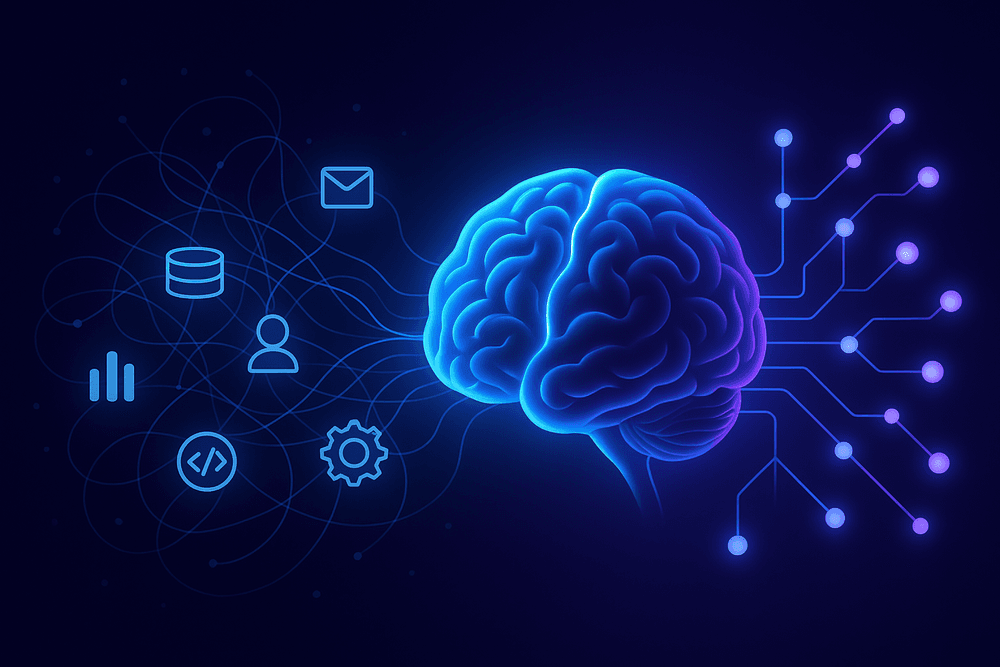
In most organizations, crucial information is scattered across countless platforms—Slack, email threads, Google Drive, Confluence, and more. This creates information silos, making it nearly impossible for employees to find what they need. Manual tagging and categorization are tedious and often inconsistent.
This is where an AI knowledge management platform transforms the process. AI-powered tools automatically ingest, analyze, and tag content from all your disparate sources. Using Natural Language Processing (NLP), the system can understand the context of a document, a conversation, or a ticket and apply relevant metadata without human intervention. This breaks down silos by creating a unified, interconnected web of knowledge, ensuring that valuable insights are never lost in a forgotten channel again.
Unlock Deeper Insights with Semantic Search and Natural Language Queries
Traditional keyword search is fundamentally limited. It finds documents that contain your exact search term, but it doesn't understand your intent. If you search for "customer churn report," you might miss a vital presentation titled "Client Retention Analysis."
AI introduces semantic search, a far more intelligent approach. Instead of matching keywords, semantic search understands the meaning and context behind your query. You can ask questions in plain, conversational language, such as, "What were our main marketing takeaways from the Q4 product launch?" The AI comprehends the intent behind the query and retrieves the most relevant information, even if it uses different terminology. This allows employees to find precise insights faster, without having to guess the right keywords.
Empower Teams with Instant, Context-Aware Answers
Finding the right document is only half the battle; employees still have to read through it to find the specific answer they need. AI accelerates this final step by providing direct, synthesized answers.
Instead of just linking to a 20-page PDF, an AI-powered system can pinpoint the exact paragraph or data point that answers a user's question and present it directly. Many modern platforms integrate with tools like Slack or Microsoft Teams, allowing employees to ask a question and receive an instant, verified answer from the company's knowledge base, complete with source citations. This immediate access to context-aware information dramatically reduces friction and boosts team productivity.
Proactively Identify and Bridge Your Organization's Knowledge Gaps
What knowledge is your organization missing? Traditionally, this question is almost impossible to answer. With AI knowledge management, you gain a powerful diagnostic tool. The system can analyze search patterns, identifying frequently asked questions that return no results or have low engagement.
This data provides a clear roadmap of your organization's knowledge gaps. It tells you precisely what information your teams need but cannot find. This allows knowledge managers and subject matter experts to proactively create and validate content that fills these crucial gaps, continuously strengthening the collective knowledge base and ensuring employees are equipped with the information they need to succeed.
Top AI Knowledge Management Tools & Platforms Compared
Choosing the right AI knowledge management platform is a critical decision. The market is filled with powerful options, but the best choice depends entirely on your specific use case, existing tech stack, and strategic goals. We’ll break down the leading contenders for internal and external knowledge, key features to look for, and how to measure the return on your investment.
For Internal Wikis: Guru vs. Confluence AI
Your internal wiki is the brain of your organization. AI is making that brain faster and smarter.
Guru: The Proactive Knowledge Assistant
Guru was built from the ground up as an AI-native platform. Its core strength lies in delivering trusted knowledge proactively within your existing workflows. Instead of you searching for information, Guru suggests it to you in tools like Slack, Microsoft Teams, and your CRM.
- Best for: Fast-moving sales, support, and success teams who need verified, bite-sized information instantly without switching tabs.
- Key AI Feature: AI-powered suggestions that surface relevant "Cards" based on the context of a conversation or a support ticket. It also uses AI to identify duplicate content and suggest experts to answer questions.
Confluence AI: The Enhanced Collaboration Hub
Atlassian’s Confluence is the established leader for structured documentation and project collaboration. Confluence AI is its powerful new layer, focusing on enhancing content creation and discovery within that familiar ecosystem.
- Best for: Organizations already invested in the Atlassian suite (Jira, Trello) that need to improve the creation, summarization, and searchability of long-form documentation, meeting notes, and project plans.
- Key AI Feature: Generative AI for drafting content, changing tone, and summarizing lengthy pages. Its enhanced search can now understand natural language questions to pinpoint answers deep within complex documents.
For Customer Support: Zendesk AI vs. Intercom's Fin
For customer-facing teams, an AI knowledge management tool directly impacts satisfaction and efficiency.
Zendesk AI: The Agent's Super-Powered Assistant
Zendesk AI is deeply integrated into its full-service customer support platform. It acts as an intelligent layer that assists human agents, automates tedious tasks, and powers self-service options.
- Best for: Companies with established support teams using the Zendesk ecosystem who want to boost agent efficiency and improve the quality of their help center.
- Key AI Feature: Intelligent Triage automatically categorizes and routes tickets. AI-powered suggestions provide agents with relevant macros and knowledge base articles to resolve issues faster.
Intercom’s Fin: The Conversational AI Problem-Solver
Fin is Intercom’s custom-built AI chatbot, designed to resolve customer issues from start to finish. It goes beyond simple FAQ bots by holding natural, sophisticated conversations, understanding complex queries, and drawing answers directly from your knowledge base.
- Best for: Businesses looking to automate a significant portion of their frontline support conversations with a highly capable, human-like AI agent.
- Key AI Feature: True conversational resolution. Fin can ask clarifying questions and provide precise, trustworthy answers based only on your support content, minimizing hallucinations and incorrect responses.
Key Features to Demand in Your Next AI KM Solution
When evaluating any platform, ensure it checks these boxes:
- Semantic Search: It must understand user intent and context, not just keywords.
- Generative AI for Content: The ability to draft, summarize, and reformat knowledge is a massive time-saver for content creators.
- Knowledge Verification Workflow: The system should have a process for subject matter experts to verify information, ensuring accuracy and building trust.
- Actionable Analytics: You need insight into what knowledge is being used, search queries that yield no results (content gaps), and which articles are most effective.
- Seamless Integrations: The platform must connect effortlessly with the tools your team already uses every day.
Evaluating ROI: How to Choose the Right Platform for Your Budget
The true cost of an AI knowledge management tool isn't its price tag; it's the value it delivers. To calculate your potential ROI, focus on these metrics:
- Time Saved Searching: Calculate hours saved per employee per week from not having to hunt for information.
- Ticket Deflection Rate: For support tools, measure the percentage of customer queries resolved by AI without human intervention.
- Faster Employee Onboarding: Track the time it takes for new hires to become fully productive. A strong knowledge base drastically shortens this ramp-up period.
- Reduced Errors: Quantify the cost of mistakes made due to inaccurate or outdated information.
The right platform isn't the cheapest one—it's the one that moves these key performance indicators in the right direction.
Real-World Use Cases: AI Knowledge Management in Action
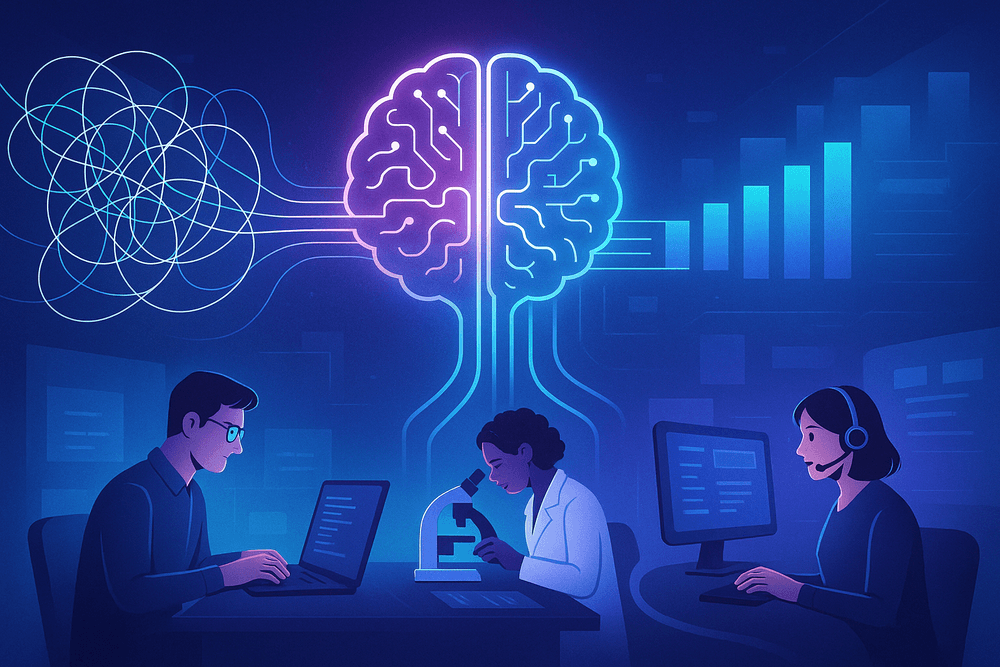
Theory is one thing, but the true value of a technology is revealed through its practical application. The adoption of AI knowledge management is already delivering transformative results across various industries by turning chaotic data streams into strategic assets. Here’s how leading organizations are leveraging AI to work smarter, faster, and more innovatively.
Case Study 1: How a Tech Giant Cut Onboarding Time by 40%
The Challenge: A multinational technology firm faced a common but costly problem: a slow and inefficient onboarding process. New hires were overwhelmed by vast, fragmented knowledge bases—spread across internal wikis, code repositories, and chat histories. They spent weeks trying to find answers to basic process and technical questions, heavily relying on the time of senior engineers and mentors.
The Solution: The company implemented a centralized AI knowledge management platform. This system integrated with all their internal data sources and used a large language model (LLM) to create a single, searchable source of truth. New hires could now use a natural language search bar to ask complex questions like, "What is the security protocol for accessing the production database?" or "Where is the documentation for the payments API?"
The Results: The AI provided instant, context-aware answers, complete with links to source documents and code snippets. This self-service model drastically reduced the new hires' dependency on senior staff. The company reported a 40% reduction in the average time-to-productivity for new engineers, allowing them to contribute to projects significantly faster and freeing up valuable senior talent to focus on innovation.
Case Study 2: Reducing Customer Support Tickets with a Proactive AI Help Center
The Challenge: A rapidly growing B2B SaaS company was struggling with a high volume of customer support tickets. Their support team was stretched thin answering repetitive questions about product features, billing, and troubleshooting. Their static, hard-to-navigate FAQ page was failing to deflect a meaningful number of inquiries.
The Solution: They revamped their customer support strategy by deploying a proactive AI knowledge management tool. The platform analyzed thousands of historical support tickets to identify the most common customer issues. It then powered an intelligent help center and an in-app chatbot that could understand user intent. The system could proactively suggest relevant help articles based on the user's activity within the application.
The Results: Within three months, the company saw a 30% decrease in inbound support tickets. Customers were able to find answers instantly without ever needing to contact a human agent. This not only lowered support costs but also dramatically improved the customer experience by providing immediate resolutions, boosting satisfaction and retention.
Case Study 3: Accelerating Pharmaceutical R&D with Intelligent Document Analysis
The Challenge: In the pharmaceutical industry, progress hinges on the ability to analyze enormous volumes of complex, unstructured data, including clinical trial results, academic papers, and patent filings. Manually sifting through this information to find relevant insights is a monumental task that slows down the entire drug discovery pipeline.
The Solution: A major pharmaceutical firm integrated an advanced AI knowledge management solution designed for scientific research. Leveraging sophisticated Natural Language Processing (NLP), the system could read, understand, and categorize millions of pages of biomedical text. It could extract key data points, identify relationships between compounds and diseases, and recognize patterns across disparate studies.
The Results: Researchers could now perform powerful semantic searches, asking the system to "summarize all clinical trials related to GLP-1 agonists for treating neurodegenerative diseases." The AI synthesized information in minutes that would have previously taken a team of researchers weeks to compile. This acceleration of the research phase is helping the company identify promising drug candidates faster, shortening the path from lab to market.
Best Practices for Implementing AI Knowledge Management
Deploying an AI-powered system is more than a technical upgrade; it's a strategic business transformation. To ensure a smooth and successful rollout, it’s essential to follow a structured approach that prioritizes data quality, user adoption, and measurable results. These best practices will guide you from a small-scale test to a fully integrated and effective ai knowledge management platform.
Start Small: How to Launch a Successful Pilot Program
Jumping headfirst into a company-wide implementation is a recipe for failure. A successful ai knowledge management initiative begins with a focused pilot program. This allows you to test the technology, gather crucial feedback, and demonstrate value in a controlled environment before scaling.
- Isolate a High-Impact Use Case: Don't try to solve every problem at once. Target a specific pain point with a clear potential for improvement, such as reducing the time customer support agents spend searching for answers or streamlining the onboarding process for new hires.
- Select a Pilot Group: Choose a small, representative team that is open to new technology. Their experience and feedback will be invaluable for refining the system and building a case for a broader rollout.
- Set Clear Goals: Define what success looks like for the pilot. Is it a 15% reduction in average ticket resolution time? Or a 20% increase in self-service article usage? Measurable goals are essential for proving ROI.
The 'Garbage In, Garbage Out' Rule: Ensuring Data Quality for AI
The most powerful AI algorithm is useless if it's fed poor-quality information. The timeless principle of 'Garbage In, Garbage Out' (GIGO) is more critical than ever in ai knowledge management. If your knowledge base is filled with outdated, inaccurate, or contradictory documents, your AI will only amplify the confusion, delivering unreliable answers and eroding user trust from day one.
Before implementation, prioritize data hygiene. Conduct a thorough knowledge audit to identify and archive obsolete content, merge duplicate entries, and tag information with relevant metadata. Establish clear data governance policies that define who is responsible for creating, reviewing, and updating information. This foundational work ensures your AI has a clean, structured, and reliable dataset to learn from, enabling it to deliver the accurate and context-aware insights your team needs.
Driving Adoption: Training Your Team to Trust the AI
Even the most advanced technology will fail if your team doesn't use it. Overcoming skepticism is crucial for realizing the value of your ai knowledge management system. The key is to build trust by focusing on the human element and proving the tool’s value in their daily work.
- Focus on the 'Why': Your training shouldn't just be a technical walkthrough. Communicate the vision. Explain how the AI will eliminate tedious searches, provide instant answers, and free up their time for more strategic tasks.
- Create Champions: Identify enthusiastic users from your pilot program to act as internal advocates. Peer-to-peer success stories are far more powerful than top-down mandates.
- Establish a Feedback Loop: Show your team their voice matters. Create a simple channel for them to report issues, ask questions, and suggest improvements. Acting on this feedback proves the system is evolving to meet their needs.
Measuring Success: Critical KPIs for Your AI Knowledge Management System
How do you know if your investment is paying off? You must track the right Key Performance Indicators (KPIs). Measuring success goes beyond simple usage statistics; it’s about connecting the platform's performance to tangible business outcomes that resonate with leadership.
Start by tracking a mix of metrics across different categories:
- Efficiency Metrics:
- Time to Information: A decrease in the average time employees spend searching for answers.
- First-Contact Resolution: An increase in the rate at which support agents solve issues on the first try.
- Adoption Metrics:
- Daily/Monthly Active Users: Consistent engagement from across the organization.
- Search Success Rate: The percentage of queries that return a relevant, helpful result.
- Effectiveness Metrics:
- User Satisfaction Scores: Simple "Was this helpful?" ratings on AI-generated answers.
- Reduction in Onboarding Time: Evidence that new hires are becoming fully productive faster.

The Future is Here: Your Next Steps in AI Knowledge Management
We've explored how AI is revolutionizing knowledge management today, but the true paradigm shift is just on the horizon. The journey doesn't end with implementing a smart search bar. The future of AI knowledge management is about transforming your organization’s collective intelligence from a static library into a dynamic, predictive engine for growth. Moving forward means evolving from simply answering questions to anticipating needs and shaping outcomes. Preparing for this next wave isn't a far-off strategic exercise; it's an immediate, actionable priority.
From Reactive Answers to Proactive, Predictive Insights
For years, the goal of knowledge management was to provide the right answer when asked. This is the reactive model: an employee has a query, they search for it, and the system delivers a relevant document. While incredibly valuable, this is only the first stage of AI’s potential. The next evolution is already underway, defined by two key capabilities:
- Proactive Assistance: Imagine a system that doesn't wait to be asked. A support agent opens a complex ticket, and the AI instantly surfaces the three most relevant troubleshooting guides and a list of internal experts on that specific issue. A project manager starts a new client brief, and the system proactively pushes templates, past project retrospectives from similar clients, and key risk assessments. This is proactive knowledge delivery—providing vital information at the exact moment of need, without the user even having to formulate a query.
- Predictive Intelligence: This is where AI knowledge management becomes a strategic asset. By analyzing patterns across all organizational data—support tickets, sales calls, project notes, and internal communications—the AI can predict future challenges and opportunities. It can identify emerging customer complaints before they escalate, forecast knowledge gaps in your team before a new product launch, or even suggest new service offerings based on recurring client questions. It turns your knowledge base into a crystal ball for making smarter business decisions.
How to Prepare Your Organization for the Next Wave of AI
Transitioning to a predictive knowledge ecosystem requires a strategic approach. You can lay the groundwork for this advanced capability today by focusing on the fundamentals.
- Strengthen Your Knowledge Foundation: Predictive AI is only as good as the data it learns from. Before anything else, focus on creating a "single source of truth." Break down information silos, standardize documentation processes, and ensure your core knowledge is clean, organized, and accessible. This foundational work is the most critical investment you can make in your future AI knowledge management strategy.
- Cultivate a Culture of Contribution: Technology is the vehicle, but your team is the fuel. Foster an environment where documenting processes, sharing insights, and updating information is a valued and routine part of everyone's job. Reward knowledge sharing and create simple, frictionless ways for employees to contribute. A vibrant, human-powered knowledge culture is essential for the AI to learn and thrive.
- Align with Strategic Business Goals: Don’t adopt AI for its own sake. Pinpoint the key business outcomes you want to achieve. Do you need to accelerate employee onboarding? Reduce time-to-resolution for customer issues? Increase sales win rates? By tying your AI initiatives to concrete metrics, you ensure the technology delivers measurable ROI.
Take the First Step Today
The path to a proactive, intelligent organization begins with a single step. Whether you are just starting to explore the possibilities or are ready to see a solution in action, we have a resource for you.
See it Live: Book a Personalized Demo Curious how an AI-powered platform can transform your scattered information into a predictive asset? Schedule a no-obligation demo with our specialists. We’ll walk you through real-world use cases and tailor a presentation to your organization's unique challenges.
Learn More: Download Our Free Guide Ready to build a strategic roadmap? Download our comprehensive guide, The Ultimate Playbook for AI-Powered Knowledge Management. This free resource is packed with actionable frameworks, expert insights, and best practices to help you lead your organization into the future of work.