
August 24, 2025
What Is AI Customer Support and Why Does It Matter Now?
What Is AI Customer Support and Why Does It Matter Now?
Forget the sci-fi fantasies of sentient robots. In the real world, AI customer support is the practical application of smart technologies—like machine learning (ML), natural language processing (NLP), and automation—to streamline, enhance, and even predict customer service needs. It's not about replacing the human touch; it's about amplifying it.
At its core, AI customer support works by analyzing vast amounts of data to understand patterns, interpret customer intent, and provide fast, accurate responses. This can take many forms, from an intelligent chatbot that instantly answers common questions on your website to a sophisticated system that assists a human agent by suggesting the perfect response during a live chat. The goal is simple: to resolve customer issues more efficiently and effectively, creating a better experience for everyone involved.
The Tipping Point: A Revolution in Customer Expectations
For decades, the rules of customer service were straightforward: be available during business hours and try to solve problems within a few days. That rulebook is now obsolete. We've hit a tipping point, driven by a new generation of consumers who expect instant, personalized, and effortless interactions.
This is precisely why AI customer support matters more than ever. It’s the only way for businesses to meet these sky-high expectations at scale. Here’s how AI is changing the game:
- 24/7/365 Availability: Your customers don't operate on a 9-to-5 schedule, and now your support doesn't have to either. AI-powered tools can provide instant assistance around the clock, resolving issues and answering questions anytime, anywhere.
- Radical Personalization: AI can analyze a customer's history, past purchases, and previous support tickets in milliseconds. This allows it to offer tailored solutions and recommendations, making the customer feel understood rather than like just another ticket number.
- Proactive Problem-Solving: The best support is the kind a customer never has to ask for. AI can identify potential issues—like a payment failure or a shipping delay—and proactively reach out to the customer with a solution before they even realize there's a problem.
Are You Ready for the Future of Support?
The shift toward AI-driven service isn't just a trend; it's a fundamental restructuring of the relationship between a business and its customers. Companies still relying exclusively on manual email queues and long phone hold times are no longer just providing a slower service—they're providing an outdated one.
Implementing AI customer support is about more than just managing costs. It’s about building a more resilient, intelligent, and customer-centric operation. By automating repetitive tasks, you free up your human agents to focus on complex, high-empathy issues where their skills are most valuable. You empower them with data-driven insights, turning them into super-agents.
The question is no longer if businesses should adopt AI, but how quickly they can integrate it to gain a competitive edge. If your competitor can answer a customer’s query in five seconds, can your business afford to make them wait 24 hours?

The Transformative Benefits of Integrating AI Customer Support
In today's fast-paced digital marketplace, exceptional customer service is no longer a luxury—it's a core business necessity. Integrating AI customer support is the most powerful way to meet and exceed modern consumer expectations. This strategic shift moves beyond simple automation; it unlocks a suite of transformative benefits that enhance efficiency, empower your team, and dramatically improve your bottom line.
Provide 24/7/365 Instant Support with AI Chatbots
Your customers operate on their own schedules, not just from 9 to 5. The expectation for instant gratification is at an all-time high, and waiting hours for a response is a recipe for frustration and churn. This is where AI customer support shines.
By deploying intelligent AI chatbots on your website, app, or social media channels, you can provide immediate, around-the-clock assistance. These bots can instantly resolve a massive volume of common inquiries, such as:
- Checking an order status
- Answering frequently asked questions (FAQs)
- Processing a return request
- Helping with password resets
This always-on availability ensures that no customer is left waiting, building trust and satisfaction from the very first interaction, regardless of the time zone or day of the week.
Reduce Agent Workload and Prevent Burnout
Your human support agents are your most valuable resource for handling complex and sensitive customer issues. However, they often get bogged down by a relentless stream of repetitive, low-level questions. This not only squanders their expertise but is a leading cause of agent burnout and high turnover rates.
An AI customer support platform acts as the first line of defense. It intelligently filters and resolves simple queries, freeing up your human team to focus on what they do best: building relationships and solving problems that require empathy, critical thinking, and a human touch. By automating the mundane, you empower your agents to tackle high-value tasks, increasing their job satisfaction and transforming the support center from a cost center into a strategic asset.
Personalize Every Customer Interaction at Scale
A common misconception is that AI creates cold, robotic interactions. The reality is the exact opposite. Modern AI is engineered to deliver hyper-personalized experiences that are impossible to achieve at scale with a purely human team.
AI systems can instantly analyze a customer's entire history—past purchases, previous support tickets, browsing behavior, and stated preferences. Armed with this context, an AI customer support tool can:
- Address customers by name and reference their history.
- Offer tailored product recommendations.
- Proactively identify potential issues before they arise.
- Route the customer to the best-equipped agent if human help is needed, providing the agent with a full summary.
This level of detail makes customers feel seen and valued, fostering deep loyalty and a superior brand experience.
Slash Operational Costs and Boost Your Bottom Line
Implementing an AI customer support solution is a direct investment in your company's financial health. The return on investment is realized through several key avenues. First, by automating responses to common queries, you can handle a significantly higher volume of interactions without needing to proportionally increase your support headcount, drastically reducing staffing costs.
Second, increased agent efficiency means faster resolution times and the ability for each agent to handle more complex, value-driven conversations. Finally, the superior, instant, and personalized service that AI enables leads directly to higher customer satisfaction and retention. Happy, loyal customers spend more and are less likely to churn, directly boosting your revenue and long-term profitability.
Core Features of a Winning AI Customer Support Platform
When evaluating solutions, it's crucial to look beyond the hype and focus on the specific capabilities that drive real results. A truly transformative ai customer support platform isn't just a single chatbot; it's an integrated ecosystem of intelligent tools designed to enhance every touchpoint. Here are the core features that distinguish a best-in-class platform from the rest.
Intelligent Ticket Routing and Prioritization
Imagine a world where support tickets magically land in the perfect agent's queue. That's the power of AI-driven routing. Instead of relying on manual sorting or simple keyword rules, the system analyzes the full context of incoming queries from email, chat, and social media. It identifies the customer's intent, gauges urgency, and understands the topic. A ticket mentioning “billing error” and “cancel subscription” is instantly flagged as high priority and sent to a retention specialist, while a simple “password reset” query goes to a Tier 1 agent. This intelligent dispatch system eliminates bottlenecks, slashes response times, and ensures your most skilled agents are always working on the most critical issues.
AI-Powered Agent Assist and Response Suggestions
Even your most experienced agents can't know everything. AI Agent Assist acts as a real-time co-pilot, empowering your team with instant knowledge. As an agent communicates with a customer, the AI listens to the conversation and automatically surfaces relevant knowledge base articles, canned responses, and step-by-step guides directly within their workspace. This means faster, more accurate, and more consistent answers across your entire team. For new hires, this feature is a game-changer, dramatically shortening the learning curve. For veterans, it eliminates the tedious task of searching for information, allowing them to focus entirely on problem-solving and building customer rapport.
Sentiment Analysis for Proactive Problem-Solving
Tone and emotion are often lost in text, but not to AI. Sentiment analysis tools read between the lines of a customer's message, detecting frustration, confusion, or delight in real-time. Is a customer using increasingly urgent language or negative phrases? The system can automatically flag the conversation for a supervisor or escalate the ticket before the situation deteriorates. This proactive capability allows you to intervene before a minor issue becomes a major complaint, turning potentially negative experiences into opportunities to build loyalty. Over time, this aggregated sentiment data provides invaluable insights into product flaws or friction points in the customer journey.
Automated Self-Service Portals and Knowledge Bases
The best customer support ticket is the one that's never created. A leading ai customer support solution transforms your knowledge base from a static library into a dynamic, interactive resource. AI-powered search understands natural language, helping customers find the right answer even if they don't know the exact terminology. Intelligent chatbots can guide users through troubleshooting steps or help them complete tasks right within the help portal. Furthermore, the AI can identify gaps in your content by analyzing failed searches, suggesting new articles for your team to create. By empowering customers to solve their own problems 24/7, you free up your agents for the complex interactions that truly require a human touch.
Real-World Use Cases: AI Customer Support in Action
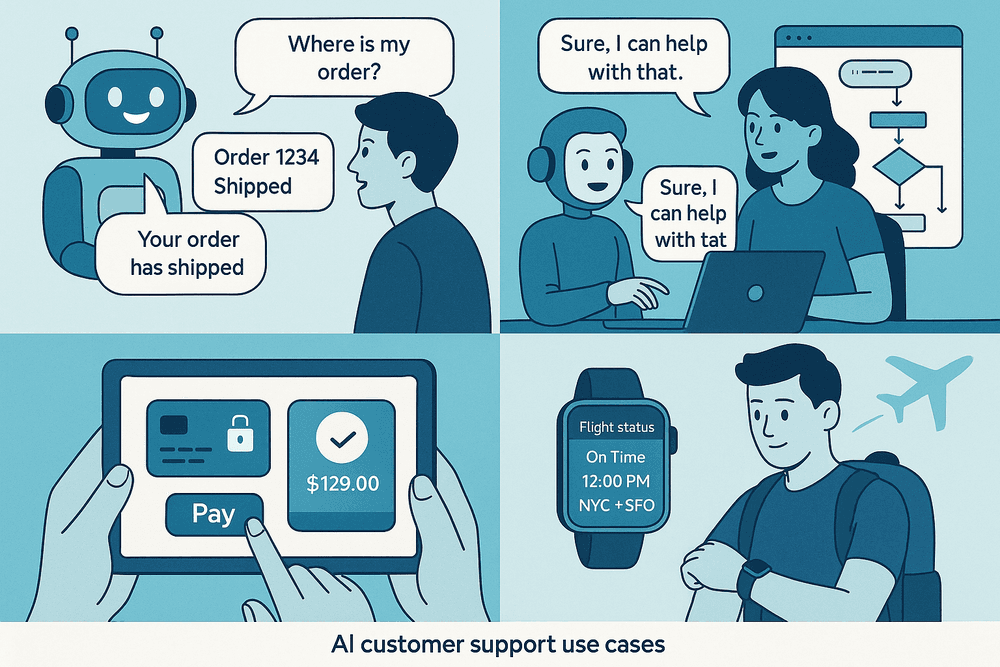
The theoretical benefits of artificial intelligence are compelling, but where does the rubber meet the road? The true power of AI customer support is revealed in its practical application across diverse industries. From online stores to financial institutions, businesses are leveraging AI to solve specific challenges, enhance user experience, and drive operational efficiency. Let's explore how different sectors are putting AI to work.
E-commerce: Automating Order Inquiries and Returns
For e-commerce brands, AI customer support is a game-changer for managing the high volume of repetitive queries that define the industry. Instead of human agents spending their day answering "Where is my order?" (WISMO), AI-powered chatbots can instantly access order data to provide real-time tracking updates 24/7.
Beyond tracking, AI excels at streamlining the returns process. An AI assistant can guide a customer through initiating a return or exchange, ask for the reason, confirm policy compliance, and even generate a shipping label—all without human intervention. This self-service model empowers customers and frees up agents to handle more complex issues like damaged goods or major shipping problems, significantly improving resolution times.
SaaS: Streamlining Technical Support and User Onboarding
In the competitive SaaS landscape, a responsive and intelligent support system can significantly reduce churn. AI customer support acts as the first line of defense for technical queries. It can instantly answer common questions about feature usage, account settings, or billing, drawing from a comprehensive knowledge base.
Furthermore, AI is instrumental in proactive user onboarding. Chatbots or in-app assistants can guide new users through initial setup, highlight key features, and offer contextual tips based on their actions. This not only reduces the number of support tickets from confused new customers but also accelerates their time-to-value, making them more likely to integrate the software into their daily workflow and remain a long-term subscriber.
Fintech: Enhancing Security and Answering FAQs
Trust and speed are paramount in finance. AI customer support in fintech is designed to deliver both. AI-driven systems can handle sensitive initial interactions, helping with secure identity verification before routing a customer to a human agent. They are also programmed to detect and flag potential fraudulent activity based on conversation patterns or user requests.
On the front end, AI-powered chatbots provide instant, accurate answers to a vast array of frequently asked questions—from transaction fees and interest rates to how to report a lost card. By offloading these high-volume, low-complexity queries, AI ensures that customers get immediate help while allowing specialized human agents to focus on complex financial advice and high-stakes security concerns.
Travel: Managing Bookings and Disruptions Effortlessly
The travel industry is defined by logistics and, often, unpredictability. This is where AI customer support truly shines. AI assistants can handle a wide range of routine booking management tasks, such as changing dates, upgrading seats, or adding baggage, freeing customers from long hold times.
Most critically, AI provides a crucial lifeline during disruptions. When a flight is canceled or delayed, an AI system can proactively notify all affected passengers simultaneously via their preferred channel (email, SMS, app notification). It can then present alternative flight options, process rebookings, and even assist with hotel or transportation arrangements. This level of proactive, scalable communication turns a potentially disastrous experience into a managed inconvenience, preserving customer loyalty.
How to Successfully Implement AI Customer Support
Integrating artificial intelligence into your support workflow is more than just flipping a switch. A strategic, phased approach ensures a smooth transition and maximizes your return on investment. A successful AI customer support implementation focuses on solving real problems for both your customers and your team. Follow these four essential steps to build a powerful, efficient, and collaborative support ecosystem.
Step 1: Identify Your Biggest Support Bottlenecks
Before you can choose a solution, you must deeply understand the problem. The first step is to conduct a thorough audit of your current customer support operations to pinpoint the most significant points of friction. Where are things slowing down or breaking?
Common bottlenecks include:
- High volume of repetitive queries: Are your agents spending hours answering the same questions about order status, password resets, or return policies?
- Long wait times: Are customers waiting too long for a first response, especially during peak hours or on weekends?
- Inconsistent information: Do different agents provide slightly different answers to the same question, leading to customer confusion?
- Lack of 24/7 availability: Are you missing opportunities to help customers who reach out after business hours?
Analyze your support ticket data, survey your agents about their daily frustrations, and review customer feedback. This data-driven diagnosis will provide a clear roadmap for where AI can have the most immediate and substantial impact.
Step 2: Choose the Right AI Tools for Your Tech Stack
With your bottlenecks identified, you can now select the right technology. Not all AI customer support tools are created equal. Your goal is to find a solution that not only addresses your specific needs but also integrates seamlessly into your existing technology stack.
Consider these factors:
- Functionality: If your bottleneck is repetitive queries, a customer-facing chatbot might be perfect. If your agents struggle with finding information for complex issues, an internal agent-assist tool that suggests answers and automates summaries would be more effective.
- Integration: The AI platform must work flawlessly with your current CRM (like Salesforce or HubSpot) and helpdesk software (like Zendesk or Freshdesk). Look for native integrations or robust APIs to ensure a smooth flow of data and avoid creating new information silos.
- Scalability: Choose a solution that can grow with your business. Can it handle an increase in ticket volume? Can it be trained to support new products or services in the future?
Step 3: Train Your AI and Your Human Agents for Collaboration
Implementation is a two-way street that involves training both the technology and the people. An AI is only as smart as the data it’s trained on. Feed your new system with historical support tickets, knowledge base articles, and FAQs to build its understanding of your business and customers. The cleaner and more comprehensive your data, the more accurate and helpful your AI will be from day one.
Simultaneously, train your human agents to work alongside their new AI partner. Frame the AI as a tool that will handle the tedious, repetitive tasks, freeing them up to focus on high-value, complex problem-solving. Show them how to supervise the AI, take over conversations seamlessly when human empathy is needed, and leverage AI-powered suggestions to respond faster and more consistently.
Step 4: Measure Success with Key Performance Indicators (KPIs)
To understand the true impact of your AI customer support initiative, you must track the right metrics. Your KPIs should directly correlate with the bottlenecks you identified in the first step.
Essential KPIs to monitor include:
- First Response Time (FRT): Has AI significantly reduced the time it takes to first engage a customer?
- Ticket Deflection Rate: How many queries are fully resolved by the AI without ever reaching a human agent?
- Customer Satisfaction (CSAT): Are customers happier with their support experience? Monitor CSAT scores on AI-led and human-assisted interactions.
- Agent Productivity: Are your agents able to resolve more complex tickets per hour now that AI is handling the simpler ones?
Continuously analyze this data to refine your AI's performance, update its knowledge base, and optimize the collaboration between your human and AI teams.

Conclusion: The Future is Here, Get Started with AI Customer Support
The landscape of customer service has fundamentally shifted. We’ve moved beyond asking if artificial intelligence has a place in support to understanding that it’s the very foundation of modern, scalable, and customer-centric operations. The journey through this guide has shown that AI customer support isn't a futuristic concept—it's a practical, powerful tool available right now. It’s not about replacing your talented human agents; it’s about augmenting their skills, automating the mundane, and empowering them to solve complex problems with unprecedented efficiency and insight.
Why AI is Non-Negotiable for Modern Support Teams
In today’s hyper-competitive market, customer experience is the ultimate differentiator. Your customers expect instant answers, personalized interactions, and 24/7 availability. Meeting these expectations at scale without driving up costs is a monumental challenge with human agents alone. This is where implementing AI customer support becomes a strategic imperative, not just an option.
Integrating AI allows you to:
- Stay Competitive: Your competitors are already leveraging AI to provide faster, more consistent service. Falling behind means risking customer churn.
- Meet Evolving Expectations: Provide the immediate, always-on support that modern consumers demand, across every channel they use.
- Boost Team Morale and Retention: By automating repetitive queries and providing agents with AI-powered assistance, you reduce burnout and transform their role from reactive problem-solver to proactive relationship-builder.
- Unlock Data-Driven Insights: AI platforms don't just handle tickets; they analyze conversations, identify trends, and provide actionable insights to improve your products, services, and overall customer journey.
How to Choose the Best AI Customer Support Partner
Selecting the right technology is as crucial as the decision to adopt it. The market is filled with options, but a true partner offers more than just software. As you evaluate potential solutions, focus on these key areas:
- Scalability and Integration: Your chosen platform must grow with you. Ensure it offers seamless, deep integrations with your existing CRM, helpdesk, and other business-critical tools. A disconnected system creates more problems than it solves.
- Advanced AI Capabilities: Look under the hood. Does the platform use sophisticated Natural Language Processing (NLP) to understand intent and sentiment, or is it just a rigid, keyword-based chatbot? The best AI customer support tools learn and improve over time.
- Ease of Use and Implementation: A powerful tool is useless if your team can't use it. Prioritize platforms with an intuitive interface, a straightforward implementation process, and comprehensive training and onboarding support.
- A True Partnership: The best providers act as an extension of your team. They should offer strategic guidance, dedicated customer success managers, and responsive technical support to ensure you achieve a maximum return on your investment.
Request a Demo to See the Future of Support Today
Reading about the benefits of AI-powered support is one thing. Witnessing it transform your own workflows in real-time is another. Stop imagining a more efficient, intelligent, and responsive support system and start building it. A personalized demo is your first step toward resolving tickets faster, reducing operational costs, and delivering a customer experience that builds loyalty and drives growth.
Don’t just adapt to the future of service—define it.
[Schedule Your Personalized Demo Today]