
August 16, 2025
What is AI Cost Optimization?
Beyond the Hype: What is AI Cost Optimization?
Forget the sci-fi fantasies of robots running boardrooms. In the real world of business, AI cost optimization is a powerful, practical strategy for making your company smarter, leaner, and more profitable. In plain English, it’s about using artificial intelligence to analyze your business operations and find hidden opportunities to reduce waste, automate tasks, and spend money more effectively. It’s not just about cutting budgets; it's about reallocating resources with surgical precision to the areas that drive the most growth.
This intelligent approach goes far beyond simply looking for areas to trim fat. It’s about building a more efficient, resilient, and forward-thinking financial foundation for your entire organization.
Why Traditional Cost-Cutting Is No Longer Enough
For decades, when a company needed to tighten its belt, the playbook was predictable: hiring freezes, across-the-board budget cuts, and delayed projects. While sometimes necessary, these methods are blunt instruments. They often cut "good" costs along with the "bad," damaging employee morale, stifling innovation, and hurting the customer experience. This old-school approach is reactive, often addressing symptoms rather than the root cause of inefficiency.
AI cost optimization, on the other hand, is proactive and data-driven. Instead of making broad, uninformed cuts, AI systems can:
- Analyze thousands of variables simultaneously, from supply chain logistics and energy consumption to marketing spend and employee workflows.
- Identify specific points of friction and waste that are invisible to the human eye.
- Model the financial impact of different decisions before you make them, minimizing risk.
It's the difference between swinging an axe and using a scalpel. One is messy and imprecise, while the other is targeted, strategic, and designed to strengthen the overall health of the business.
Immediate vs. Long-Term Financial Benefits
The impact of implementing AI for cost reduction is felt in two distinct waves: the immediate wins that boost your bottom line today, and the long-term strategic advantages that secure your future profitability.
The Quick Wins: Immediate Impact
Right out of the gate, AI can deliver tangible savings. This often comes from automating repetitive, high-volume tasks that consume valuable employee time.
- Automated invoice processing reduces manual data entry errors and hours.
- AI-powered chatbots handle routine customer queries, freeing up support agents for complex issues.
- Optimized ad campaigns automatically shift budgets to the best-performing channels in real-time, eliminating wasted spend.
The Strategic Gains: Long-Term Value
This is where AI cost optimization truly transforms a business. By continuously learning from your data, AI builds a foundation for sustained financial health.
- Predictive Maintenance: AI can predict when factory machinery will fail, allowing you to schedule repairs before a costly breakdown brings production to a halt.
- Smarter Forecasting: AI models analyze market trends, historical sales, and economic indicators to create far more accurate demand and revenue forecasts, improving inventory management and strategic planning.
- Dynamic Pricing: E-commerce and travel companies use AI to adjust prices based on demand, competition, and customer behavior, maximizing revenue from every transaction.
Ultimately, AI cost optimization isn’t a one-time project; it’s a continuous cycle of improvement that turns your company’s data into a powerful engine for financial efficiency and competitive advantage.
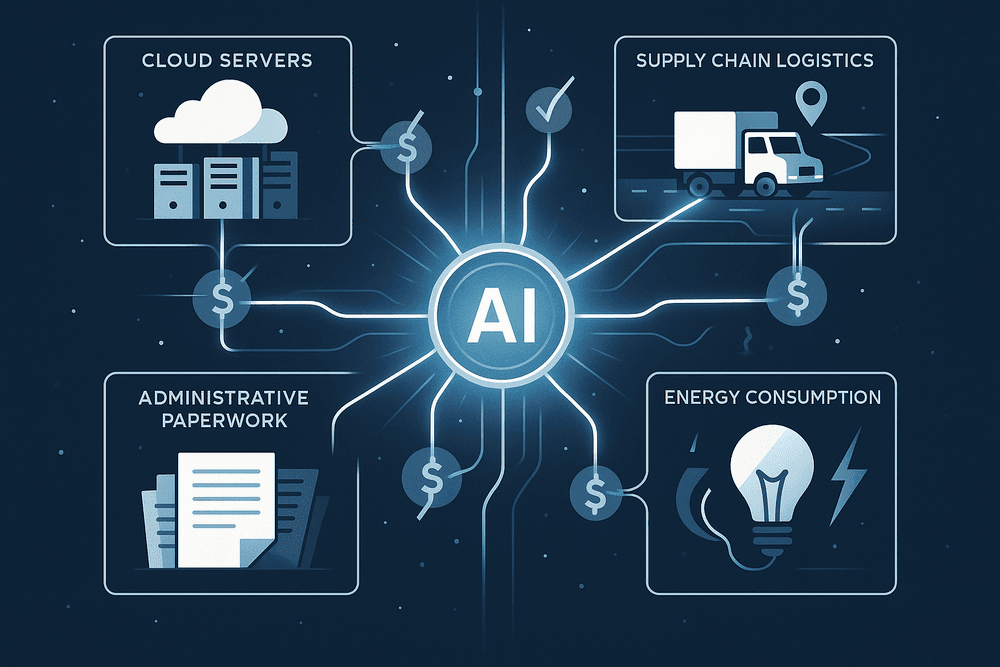
Your Financial Leaks: Where to Apply AI for Maximum Impact
Every business has financial leaks—hidden drains on resources that quietly erode profitability. The challenge has always been identifying and plugging them effectively. Today, Artificial Intelligence acts as a sophisticated diagnostic tool, pinpointing these inefficiencies with precision and offering automated solutions. Implementing a strategy for AI cost optimization isn't just about trimming budgets; it's about reallocating capital to fuel growth. Here are the four key areas where AI can deliver the most significant impact.
Optimizing Cloud Spend with Predictive Analysis
For modern businesses, the cloud is essential, but its "pay-as-you-go" model can lead to spiraling costs. Unused instances, over-provisioned resources, and complex billing statements often result in significant waste.
AI-powered cloud management platforms tackle this head-on. They continuously analyze your usage patterns, predict future demand, and provide actionable recommendations. These tools can automatically right-size virtual machines, schedule shutdowns for development environments during off-hours, and identify orphaned storage volumes. This proactive approach to AI cost optimization transforms your cloud infrastructure from a fluctuating expense into a highly efficient, predictable asset, potentially cutting monthly cloud expenditure by 20-30%.
Streamlining Supply Chains and Reducing Inventory Waste
The balancing act between overstocking (which ties up capital and increases carrying costs) and understocking (which leads to lost sales) is a timeless supply chain challenge. Traditional forecasting methods often fall short, failing to account for market volatility.
AI introduces a new level of accuracy. Machine learning algorithms can analyze vast datasets—including historical sales, seasonality, market trends, weather patterns, and even social media sentiment—to generate incredibly precise demand forecasts. Furthermore, AI can optimize logistics by determining the most efficient shipping routes in real-time, reducing fuel costs and delivery times. This leads to a leaner, more responsive supply chain, slashing inventory waste and ensuring you have the right products in the right place at the right time.
Automating HR and Administrative Overhead
Repetitive, manual tasks are a major drain on productivity and a significant source of overhead. Activities like processing invoices, managing expense reports, screening initial job applications, and answering routine employee queries consume countless hours that could be spent on strategic initiatives.
AI and Robotic Process Automation (RPA) are designed to eliminate this administrative burden. AI-powered tools can scan, categorize, and process invoices automatically, while chatbots can handle common HR and IT support questions 24/7. In recruitment, AI can screen thousands of resumes in minutes to identify the most qualified candidates. By automating these high-volume, low-complexity tasks, you free your skilled employees to focus on high-value work that drives the business forward.
Cutting Energy Consumption with Smart AI Monitoring
For businesses with physical locations—from offices to manufacturing plants—energy is a major operational expense. Inefficiencies in HVAC systems, lighting, and machinery often go unnoticed, leading to inflated utility bills.
AI-driven smart building solutions use IoT sensors to monitor energy consumption in real-time. The AI learns the unique rhythm of your facility, understanding occupancy patterns and operational schedules. It then makes intelligent, autonomous adjustments—dimming lights in empty rooms, optimizing HVAC cycles, and identifying machinery that is consuming anomalous amounts of power. This smart monitoring not only delivers substantial cost savings but also helps your business reduce its carbon footprint, enhancing its corporate social responsibility profile.
The Strategist's Toolkit for AI Cost Optimization
Moving from theory to practice requires the right set of tools. A successful AI cost optimization strategy isn't about adopting a single piece of software; it's about building a capable toolkit that addresses specific business needs, from high-level financial analysis to granular process automation. The key is to select and combine platforms that deliver a clear return on investment.
Top AI Platforms for Financial Analysis
Before you can cut costs, you must identify where the inefficiencies lie. AI-powered financial analysis platforms are your digital bloodhounds, designed to sniff out hidden waste and forecast future expenses with remarkable accuracy. These tools go beyond traditional spreadsheets and business intelligence (BI) dashboards by using machine learning to uncover patterns invisible to the human eye.
Key capabilities include:
- Predictive Forecasting: Analyze historical data to create highly accurate models of future revenue, cash flow, and departmental spending, allowing you to proactively adjust budgets.
- Anomaly Detection: Automatically flag unusual transactions, duplicate invoices, or sudden spikes in supply chain costs that could indicate fraud or inefficiency.
- Scenario Modeling: Simulate the financial impact of different business decisions—like changing suppliers or adjusting production volume—to find the most cost-effective path forward.
Platforms like Anaplan, DataRobot, and AI features within Power BI and Tableau are leading the charge, transforming the finance department from a historical scorekeeper into a strategic predictive engine for AI cost optimization.
Comparing AI-Powered Automation Software
Once you've identified inefficiencies, the next step is to eliminate them through automation. AI-powered automation software tackles repetitive, manual tasks, freeing up your employees to focus on higher-value work while reducing error rates and operational costs.
The two main categories to consider are:
- Robotic Process Automation (RPA): These tools deploy "bots" to mimic human actions for structured tasks like data entry, report generation, and processing invoices. Platforms like UiPath and Automation Anywhere are ideal for high-volume, rules-based processes.
- Intelligent Process Automation (IPA): IPA is the next evolution, combining RPA with AI technologies like natural language processing (NLP) and machine learning. This allows bots to handle more complex, semi-structured tasks, such as reading and understanding emails, interpreting documents, and making simple decisions.
When comparing solutions, evaluate them based on scalability, ease of integration with your existing systems (ERPs, CRMs), and total cost of ownership to ensure the automation investment supports your AI cost optimization goals.
Choosing Between Off-the-Shelf vs. Custom AI Models
The final strategic decision is whether to buy a pre-built solution or build a custom one. This choice has significant implications for cost, implementation time, and competitive advantage.
Off-the-Shelf AI (SaaS Solutions)
These are ready-to-use AI tools, often integrated into larger software platforms.
- Pros: Lower upfront cost, rapid deployment, and no need for an in-house data science team.
- Cons: Limited customization, potential data privacy concerns, and your competitors can use the exact same tool.
- Best for: Standard business functions like AI-driven CRMs, automated accounting software, or HR analytics tools.
Custom AI Models
These models are built from the ground up by your team or a partner to solve a unique business problem.
- Pros: Perfectly tailored to your specific processes, provides a unique competitive edge, and you retain full control over your data.
- Cons: Significant upfront investment in time and talent, requires high-quality proprietary data, and longer time-to-value.
- Best for: Core operational challenges, proprietary risk modeling, or creating a unique customer experience that sets you apart.
Ultimately, the right path depends on your unique strategic objectives. A hybrid approach is often most effective, using off-the-shelf tools for common problems and reserving custom development for areas that create true, defensible value.
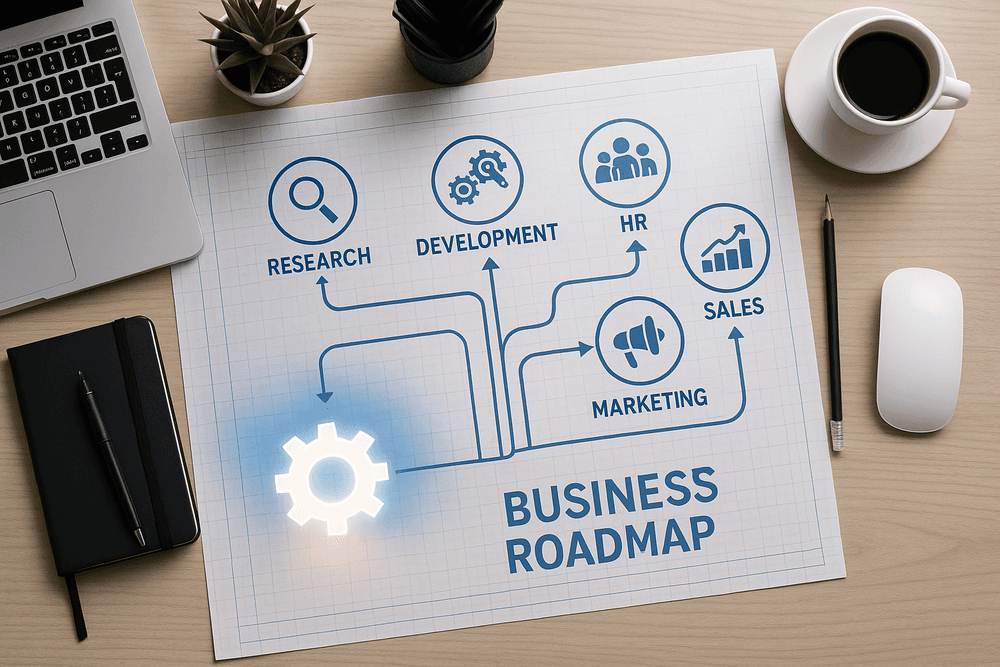
A Practical Blueprint for Implementing AI Cost Savings
Transitioning from theory to practice requires a structured approach. Embracing an AI cost optimization strategy isn’t about a single, massive overhaul; it’s about a series of deliberate, well-executed steps. This blueprint breaks down the journey, ensuring your efforts deliver tangible, measurable results and build momentum for company-wide transformation.
Step 1: Identifying a High-Impact Pilot Project
Start small to win big. The success of your entire AI initiative often hinges on the first project. The key is to select a pilot that is both achievable and offers a significant, demonstrable return. Look for "low-hanging fruit"—processes that are highly repetitive, rule-based, and consume considerable employee hours.
Prime candidates often exist in:
- Customer Service: Automating responses to common Tier 1 queries with AI chatbots.
- Finance: Streamlining invoice processing and expense report verification.
- HR: Using AI to screen initial applications against job requirements.
The ideal pilot project has clearly defined boundaries and measurable outcomes. Before you begin, secure buy-in from the department involved. Their collaboration and subject-matter expertise are essential for a successful test case that proves the value of AI and builds enthusiasm for future projects.
Step 2: Measuring ROI and Tracking Key Performance Indicators (KPIs)
What gets measured gets managed. Before you deploy a single algorithm, you must establish baseline metrics. How many hours do employees currently spend on this task? What is the cost per transaction? What is the current error rate? These are your starting-point KPIs.
After implementation, track these same metrics relentlessly to quantify the impact. Key indicators for a successful AI cost optimization project include:
- Reduced Operational Costs: A direct decrease in labor hours or material waste.
- Increased Productivity: A higher volume of tasks completed per employee per hour.
- Lower Error Rates: A measurable drop in human error and the associated costs of rework.
- Faster Cycle Times: A significant reduction in the time it takes to complete a process from start to finish.
Calculating a clear Return on Investment (ROI) for your pilot is non-negotiable. This hard data—(Financial Gain - AI Investment Cost) / AI Investment Cost—will be your most powerful tool for justifying further investment.
Step 3: Scaling Your AI Strategy Across the Business
A successful pilot is your launchpad, not the destination. Armed with positive ROI data and valuable lessons learned, you can create a strategic roadmap for scaling. Analyze what made the pilot work and identify similar processes in other departments that could benefit from automation and intelligence.
To avoid fragmented, siloed efforts, consider establishing a centralized AI team or a Center of Excellence (CoE). This group can govern implementation, share best practices, vet new tools, and ensure every project aligns with broader business goals. A critical component of scaling is proactive change management. Communicate the benefits to your workforce, provide thorough training, and reframe AI not as a replacement, but as a collaborative tool that augments human capabilities.
Avoiding Common Pitfalls in AI Implementation
The path to AI-driven savings is paved with potential traps. Steer clear of these common mistakes:
- Vague Objectives: Never adopt AI for its own sake. Every project must be tied to a specific, measurable business problem and a clear cost-saving goal.
- Poor Data Quality: AI models are only as intelligent as the data they are fed. "Garbage in, garbage out" is the unbreakable rule. Ensure your data is clean, relevant, and accessible before you begin.
- Ignoring the Human Element: Technology doesn't work in a vacuum. Failing to manage the cultural shift can doom your project. Involve employees early, address their concerns, and invest in reskilling to ensure smooth adoption.
- Solution Mismatch: Don't be swayed by the most complex platform. Choose a solution that fits your specific needs and can scale with you, rather than an overpowered tool that creates unnecessary complexity and cost.
Real-World Wins: Case Studies in AI Cost Optimization
Theory is one thing, but tangible results are what drive business decisions. The power of AI cost optimization becomes crystal clear when you see how real companies are using it to transform their operations and financials. These case studies highlight how organizations across different sectors are achieving significant savings and building a stronger competitive edge.
Case Study 1: How a Retail Giant Slashed Operational Costs by 20%
The Challenge: A leading multinational retailer was struggling with the classic inventory dilemma. Its warehouses were burdened with overstocked items, leading to high carrying costs and eventual markdowns. Simultaneously, popular products would frequently run out of stock in key locations, resulting in lost sales and customer dissatisfaction. Their traditional forecasting methods could no longer keep up with dynamic market demands.
The AI Solution: The company deployed a sophisticated AI-powered platform for demand forecasting and supply chain optimization. The system analyzed massive datasets in real-time, including historical sales figures, competitor pricing, local weather patterns, upcoming holidays, and even social media trends. By identifying complex patterns, the AI could predict consumer demand for thousands of products with remarkable accuracy, right down to the individual store level.
The Outcome: This strategic implementation of AI cost optimization revolutionized their logistics. The company reduced overstocking, cutting warehousing costs and minimizing losses from unsold goods. Stockouts on high-demand items decreased by over 60%. The result was a leaner, more responsive supply chain and a remarkable 20% reduction in overall operational costs within the first 18 months.
Case Study 2: The Manufacturing Plant That Conquered Costly Downtime
The Challenge: An automotive parts manufacturing plant was plagued by unpredictable equipment failures. When a critical machine on the assembly line went down, it caused a domino effect, halting production, leading to expensive emergency repairs, and jeopardizing delivery deadlines with major car manufacturers. Each hour of downtime cost the company tens of thousands of dollars.
The AI Solution: The plant invested in a predictive maintenance system driven by AI and the Internet of Things (IoT). Sensors were installed on key machinery to continuously monitor performance metrics like temperature, vibration, and energy consumption. This data was fed into a machine learning algorithm that learned the unique operational signature of each machine. The AI could then detect subtle anomalies that were invisible to human operators, predicting potential failures weeks before they occurred.
The Outcome: Instead of reacting to breakdowns, the maintenance team could proactively schedule repairs during planned shutdowns. Unplanned downtime was virtually eliminated, extending machinery lifespan and optimizing their spare parts inventory. This powerful application of AI cost optimization saved the plant an estimated $2 million in its first year by preventing production losses and emergency repair costs.
Case Study 3: Startup Spotlight: Scaling Smart with AI-Driven Resource Allocation
The Challenge: A fast-growing tech startup providing a SaaS product was experiencing runaway operational expenses, particularly with its cloud infrastructure. As their user base grew, their cloud bills skyrocketed, and their manual approach to scaling server resources was both inefficient and costly, often leaving them paying for idle capacity.
The AI Solution: The startup integrated an AI-driven cloud cost management tool. The platform continuously monitored application traffic and resource utilization, automatically scaling computing resources up or down in real-time. It provisioned more power during peak usage hours and scaled back dramatically during lulls, ensuring they only paid for what they actually needed.
The Outcome: The results were immediate and impactful. The startup cut its monthly cloud spending by over 35% without any negative impact on user experience. This intelligent approach to AI cost optimization freed up crucial capital, which was reinvested into product development and marketing, fueling further growth in a sustainable, cost-effective manner.
The Future is Fiscally Fit: Your Next Steps in AI-Powered Savings
You've seen the potential. You understand how artificial intelligence can transform operational inefficiencies into strategic, profit-driving advantages. But moving from concept to reality can feel daunting. This is where the journey to a leaner, more profitable future truly begins. It’s not about a complete overhaul overnight; it’s about taking deliberate, intelligent steps toward sustainable savings. Let's build your custom roadmap to success.
Building Your Custom AI Cost Optimization Roadmap
An effective ai cost optimization strategy isn't a one-size-fits-all solution. It's a tailored plan that aligns with your specific business goals, challenges, and resources. Here’s how to construct yours:
1. Assess and Identify
Start by pinpointing your most significant cost centers. Is it your cloud computing spend, marketing budget, supply chain logistics, or customer service overhead? Use analytics tools—some AI-powered themselves—to identify the areas with the most substantial potential for savings. Look for repetitive tasks, inefficient workflows, and processes prone to human error that are ripe for an intelligent upgrade.
2. Start with a Pilot Project
Don't try to boil the ocean. Select one high-impact, low-risk area for an initial AI implementation. This could be deploying a chatbot to handle tier-one customer queries or using an AI platform to optimize bidding on a single ad campaign. A successful pilot provides a clear proof-of-concept, generates early wins, and builds internal support for broader adoption across the organization.
3. Select the Right Technology
The market is flooded with AI tools. Your focus should be on solutions that solve your specific, identified problem. Do you need an off-the-shelf SaaS platform for marketing automation, or a more custom solution for predictive maintenance on your machinery? Prioritize tools that integrate seamlessly with your existing tech stack to avoid creating new data silos and ensure a smooth workflow.
4. Measure and Iterate
Define your success metrics from day one. Are you tracking man-hours saved, reduction in material waste, or a lower cost-per-acquisition? Continuously monitor these KPIs. The beauty of AI is its ability to learn and improve. Use the data from your pilot project to refine your approach and inform the next steps in your strategic AI journey.
Key Takeaways: A Summary of Savings Potential
As you embark on this path, remember the core pillars of AI-driven savings. These are the foundational benefits you can expect to achieve:
- Intelligent Automation: Drastically reduce costs associated with manual, repetitive tasks in HR, finance, and administration, freeing up your team for high-value strategic work.
- Resource Optimization: From energy consumption in your facilities to cloud server allocation, AI ensures you’re only paying for what you truly need, when you need it.
- Predictive Insight: Leverage AI forecasting to prevent costly errors like inventory overstocking, identify potential supply chain disruptions, and anticipate customer churn before it happens.
- Enhanced Decision-Making: Uncover deep, data-driven insights that expose hidden inefficiencies and highlight new opportunities for operational streamlining.
Your Journey Starts Now: Get a Free Consultation
Theory is powerful, but action creates results. Understanding how these principles apply directly to your business is the critical next step. Stop wondering about the potential savings and start quantifying them.
Our experts are ready to help you navigate the complexities of implementing AI. In a complimentary, no-obligation consultation, we will help you:
- Identify the top opportunities for AI-driven savings within your operations.
- Outline a preliminary, high-level ai cost optimization roadmap.
- Provide a realistic estimate of your potential return on investment.
Don't let your competition get the efficiency edge. Schedule your free AI savings assessment today and take the first concrete step toward a more profitable and fiscally fit future.