
November 7, 2025
An Introduction to Research AI Tools
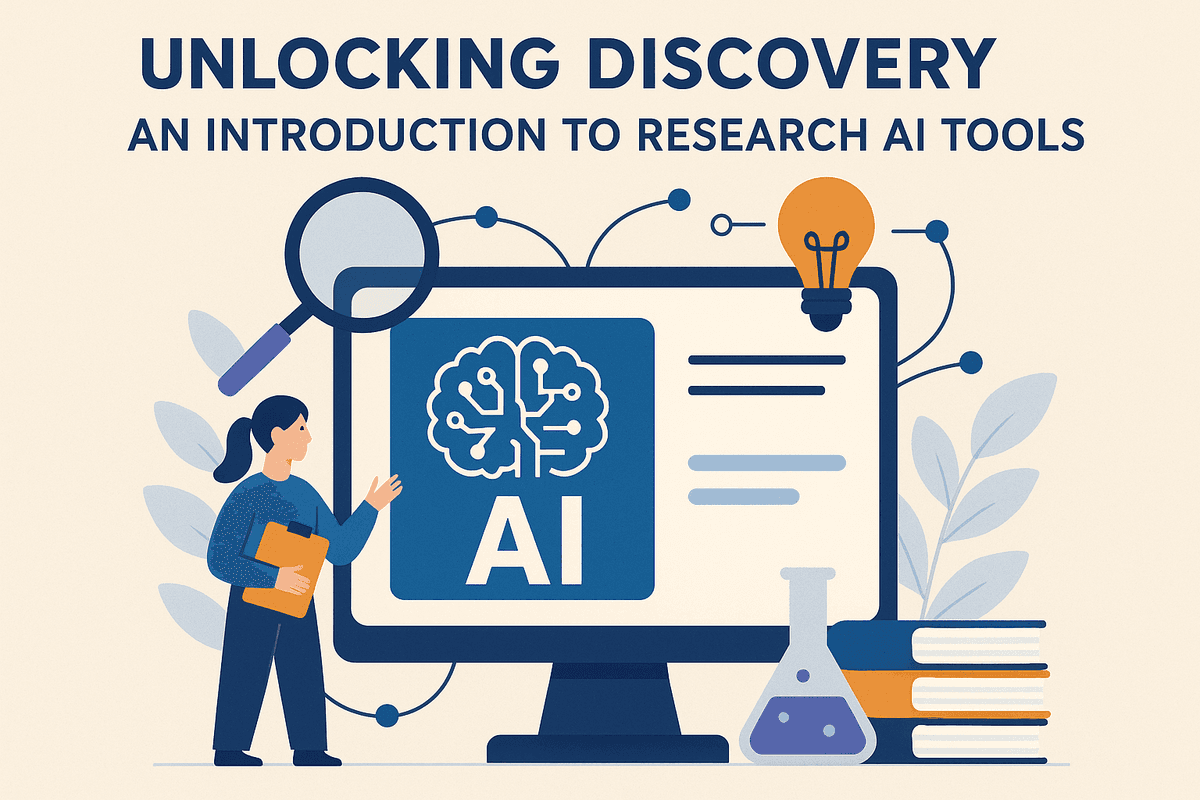
Unlocking Discovery: An Introduction to Research AI Tools
The modern research landscape is inundated with data. From genomic sequences to vast archives of historical texts, the sheer volume of information often exceeds human capacity for analysis. This is where research AI tools enter the picture, not as mere assistants, but as transformative partners in the quest for knowledge. At their core, these tools are sophisticated software applications that leverage machine learning, natural language processing (NLP), and advanced algorithms to streamline and amplify every stage of the research lifecycle. They can automate tedious literature reviews by synthesizing thousands of papers, identify subtle patterns in complex datasets that humans would miss, and even help formulate novel hypotheses. This acceleration is the game-changer: by handling the computational heavy lifting, research AI tools free up researchers to focus on critical thinking, interpretation, and creative problem-solving, fundamentally changing the pace and potential scope of scientific discovery.
The 'Why' Behind the 'What': Explainable AI (XAI) in Research
As AI models become more powerful, they also become more complex, often operating as "black boxes." We can see the input and the output, but the internal decision-making process remains opaque. For consumer applications, this might be acceptable, but in research, it’s a critical flaw. Scientific inquiry is built on a foundation of transparency, reproducibility, and validation. This is why Explainable AI (XAI) is not just a feature—it's a necessity. XAI encompasses a set of techniques and methods designed to make AI models interpretable. It answers the crucial question: Why did the model make a specific prediction or decision? For a researcher, this means being able to trust the output, validate the model’s logic against established domain knowledge, identify potential biases in the data, and confidently report findings that are both accurate and defensible. Without explainability, an AI's conclusion is just a claim; with XAI, it becomes a verifiable piece of evidence.
Navigating the Noise: Choosing the Right AI Tools
The explosion of AI has created a dizzying array of tools, all claiming to revolutionize your work. To separate the truly useful "signal" from the marketing "noise," researchers must adopt a critical evaluation framework. The key is to move beyond general-purpose chatbots and identify tools designed for specific research tasks. When evaluating your options, consider these three pillars:
- Task Specificity: Does the tool address a concrete part of your workflow? Look for specialized platforms for literature mapping, data analysis, statistical modeling, or model interpretation rather than a one-size-fits-all solution.
- Integration and Usability: How seamlessly does the tool fit with your existing software and methods? The best research AI tools complement your workflow, whether through API access, compatibility with languages like Python or R, or an intuitive user interface that doesn't require a steep learning curve.
- Transparency and Validity: This is where XAI is paramount. Does the tool provide insight into its operations? For tools that make predictions or classify data, look for features that explain the reasoning behind their outputs. Prioritize platforms that are well-documented, cited in academic literature, and trusted by the scientific community.
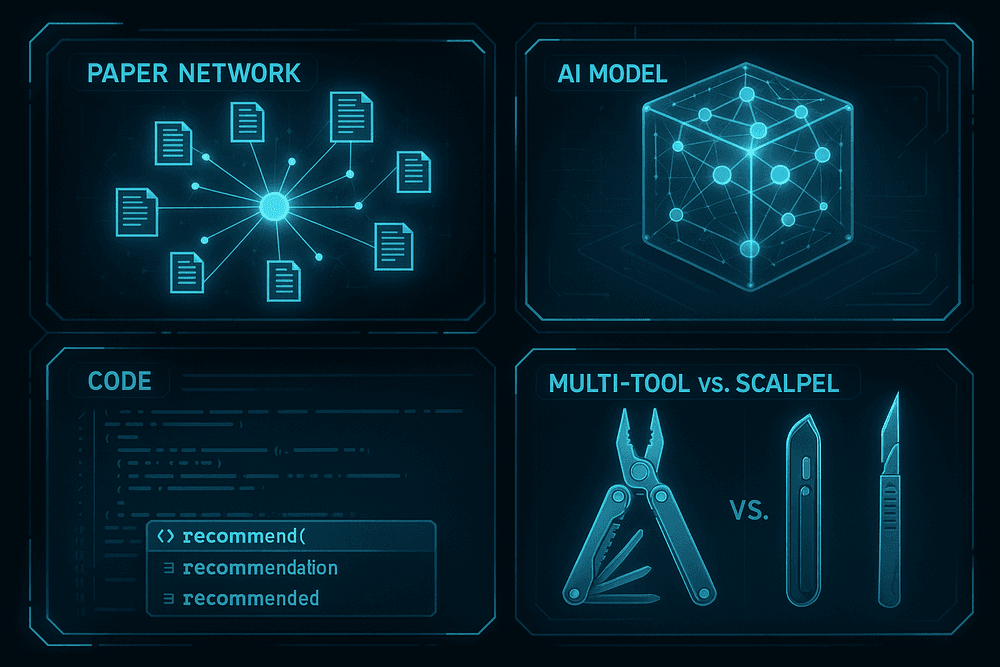
Comparing the Top Categories of Research AI Tools
The ecosystem of research AI tools is not a monolith; it's a diverse collection of specialized solutions designed to accelerate and enhance different stages of the research lifecycle. Understanding these distinct categories is the first step toward building a powerful, efficient, and transparent research workflow. From synthesizing knowledge to interpreting complex models, each category serves a unique and critical purpose.
AI Tools for Literature Review and Knowledge Synthesis
This category of tools acts as your AI-powered research assistant, revolutionizing the often-tedious process of literature review. Instead of manually sifting through thousands of papers, these platforms use Natural Language Processing (NLP) to extract key findings, summarize dense academic text, and identify thematic connections across a body of work.
Key functionalities include:
- Automated Summarization: Quickly grasping the core arguments of a paper.
- Concept Extraction: Identifying key themes, methods, and results.
- Citation Network Analysis: Visualizing how research is connected to uncover seminal papers and new trends.
Tools like Elicit.org can find relevant papers and answer research questions directly from their content, while platforms like Scispace help you read, organize, and comprehend them more effectively. This category of research AI tools dramatically accelerates the foundational stage of any project, helping you identify genuine gaps in existing knowledge.
Platforms for Data Analysis and Model Interpretation (XAI)
This is where the "black box" of AI becomes transparent. Platforms for data analysis and model interpretation—the core of Explainable AI (XAI)—are central to modern, rigorous research. They go beyond just building predictive models; they help you understand why a model makes a specific prediction.
By integrating established techniques like SHAP (SHapley Additive exPlanations) and LIME (Local Interpretable Model-agnostic Explanations), these tools provide:
- Feature Importance Visualization: Highlighting which data points most influence a model's output.
- Counterfactual Explanations: Running "what-if" scenarios to test model logic.
- Human-Readable Justifications: Translating complex mathematical decisions into understandable narratives.
For any researcher, this is non-negotiable. XAI tools are essential for validating model behavior, ensuring fairness and ethical compliance, and publishing results that are both reproducible and trustworthy.
AI-Assisted Coding and Experimentation Tools
Modern research is heavily reliant on code. AI-assisted coding tools act as a pair programmer, streamlining the entire experimentation process from development to debugging. Services like GitHub Copilot or Tabnine integrate directly into your coding environment, suggesting entire functions, catching syntax errors, and even generating unit tests. This not only boosts productivity but also lowers the barrier to entry for complex programming tasks. By automating boilerplate code and offering intelligent suggestions, these research AI tools allow you to focus your mental energy on the core logic of your experiment, not on debugging a misplaced comma.
Choosing Between Specialized vs. General-Purpose AI Models
A critical decision researchers face is whether to use a broad, general-purpose model or a tool designed for a specific task.
- General-Purpose Models (e.g., GPT-4, Claude 3): These are the Swiss Army knives of AI. They excel at brainstorming hypotheses, drafting manuscript sections, summarizing notes, and general coding assistance. Their immense flexibility is their greatest strength.
- Specialized Research AI Tools: These are the scalpels. A tool like Connected Papers is built specifically for visualizing citation networks, while a library like SHAP is exclusively for model explainability. They provide deeper, more reliable, and structured outputs for their narrow domain.
The optimal strategy is often a hybrid one. Use general-purpose models for ideation and drafting, but rely on specialized research AI tools for critical, domain-specific tasks like literature synthesis and model validation to ensure accuracy and rigor.
Essential Features of High-Impact Research AI Tools
Not all AI platforms are created equal, especially when rigor and explainability are paramount. When selecting the right software for your project, a discerning eye for specific, high-impact features is crucial. The best research AI tools go beyond simple model building to provide a comprehensive ecosystem for discovery, validation, and collaboration. Look for these four essential pillars to ensure your chosen tool can handle the demands of serious inquiry.
Assessing Model Transparency and Interpretability Metrics
At the heart of any effective research tool lies the ability to look inside the "black box." Modern AI research demands more than just predictive accuracy; it requires a deep understanding of how and why a model makes its decisions. Top-tier research AI tools integrate a robust suite of Explainable AI (XAI) features directly into the workflow.
This includes model-agnostic techniques like SHAP (SHapley Additive exPlanations) for quantifying the contribution of each feature to a prediction, and LIME (Local Interpretable Model-agnostic Explanations) for explaining individual predictions. Look for built-in visualizations like feature importance charts, partial dependence plots (PDPs), and Individual Conditional Expectation (ICE) plots. These features are non-negotiable for debugging models, uncovering hidden biases, validating scientific hypotheses, and building justifiable trust in your findings.
Evaluating Data Integration and Preprocessing Capabilities
A model is only as good as the data it’s trained on. The most time-consuming phase of any research project is often data wrangling. Therefore, a powerful tool must excel at data integration and preprocessing. It should offer seamless connectors to a wide array of data sources, including SQL and NoSQL databases, cloud storage like Amazon S3, and common file formats (CSV, JSON, Parquet).
Beyond simple ingestion, leading tools provide intelligent capabilities for data preparation. This includes automated routines for handling missing values, identifying outliers, and performing data type conversions. Advanced features might even suggest or automate feature engineering, helping you create more predictive variables from your raw data. A tool with strong data preprocessing capabilities drastically accelerates your workflow and minimizes the risk of introducing errors before the modeling even begins.
Collaboration, Version Control, and Reproducibility Features
Scientific discovery is rarely a solo endeavor, and its results must be reproducible to be valid. Modern research AI tools are built with this in mind, incorporating features that facilitate teamwork and guarantee scientific rigor. Look for integrated version control systems, similar to Git, that track changes not just in code but also in datasets, models, and experimental configurations.
Essential features include a centralized experiment tracker that logs every run, including hyperparameters, performance metrics, and resulting model artifacts. A model registry is also crucial for versioning and managing trained models in a production or publication-ready state. These capabilities ensure that every result can be traced back to its exact inputs and settings, making your work transparent, auditable, and easily shareable with colleagues or reviewers.
Scalability: From Small Datasets to Big Data Analytics
A researcher’s needs can evolve rapidly. A project that starts with a small CSV file on a laptop may quickly grow to require analysis of a massive dataset hosted in the cloud. An ideal research tool must be scalable, performing efficiently in both scenarios.
It should be optimized to run smoothly on a local machine for initial prototyping and exploration. Crucially, it must also provide a clear and simple path to scale up to distributed computing environments. This often means native integration with cloud platforms (AWS, Google Cloud, Azure) and support for big data frameworks like Apache Spark. This scalability ensures that your tool can grow with your project's ambitions, providing a consistent and powerful environment without forcing you to migrate to a new platform when your data outgrows your initial setup.

A Practical Guide to Selecting the Best Research AI Tools
The market for AI research and explainability tools is expanding rapidly, offering everything from open-source libraries to comprehensive enterprise platforms. Choosing the right one can feel overwhelming. To make an informed decision, you need a structured approach that moves beyond feature lists and focuses on your specific research context. This guide provides a four-step framework to help you select the best research AI tools for your needs.
Define Your Research Question and Desired Outcomes First
Before you even look at a single tool, clarify what you want to achieve. The most powerful tool is useless if it doesn’t answer your core questions. Start by defining your objectives with precision. Are you trying to:
- Audit a model for fairness and bias? You'll need a tool with strong capabilities in subgroup analysis and fairness metrics.
- Understand the root causes of specific predictions? Look for tools that excel at local explanations, like generating SHAP or LIME values.
- Explain a model’s global behavior to stakeholders? Prioritize tools with robust global feature importance and clear visualization features.
- Validate the inner workings of a deep learning model? You’ll require specialized tools that can visualize attention layers or generate concept-based explanations.
Your research question is your north star. It dictates the specific explainability techniques and functionalities you need, immediately narrowing the field of potential research AI tools.
Match the Tool's Complexity to Your Team's Skillset
Research AI tools exist on a wide spectrum of complexity. On one end, you have code-first Python libraries like SHAP or ELI5, which offer maximum flexibility but require strong programming and data science skills. On the other end are no-code/low-code GUI-based platforms designed for business analysts and researchers who aren't expert coders.
Be realistic about your team’s capabilities and bandwidth. Ask critical questions:
- Is your team composed of seasoned ML engineers who are comfortable in a Jupyter Notebook environment?
- Or do you need a tool that empowers domain experts without coding knowledge to interpret models?
- How much time can you dedicate to training and onboarding?
Choosing a tool that aligns with your team's existing skills will dramatically increase its adoption and impact, ensuring it becomes an asset rather than a technical roadblock.
Create a Scorecard for Comparing Key Features and Pricing
Once you have a shortlist of tools that match your research goals and team skills, it's time for a direct comparison. Avoid getting swayed by slick marketing; instead, create a simple evaluation scorecard to compare options objectively.
Include columns for criteria that matter most to you, such as:
| Feature/Criteria | Tool A | Tool B | Tool C |
| :--- | :--- | :--- | :--- |
| XAI Methods | SHAP, LIME | Counterfactuals | Integrated Gradients |
| Model Support | PyTorch, TF | Scikit-learn | All |
| Interface | Code-only | GUI & API | GUI-first |
| Visualization | Basic plots | Interactive dashboards | Limited |
| Pricing | Open-source | Per user/month | Enterprise license |
| Support | Community | Dedicated support | Email only |
This systematic process forces you to look at the practical details, helping you identify the tool that offers the best combination of functionality, usability, and value for your budget.
How to Pilot a Tool Before Full-Scale Adoption
Never commit to a tool based on a demo alone. The best way to ensure a good fit is to run a pilot project. Most commercial vendors offer free trials, and open-source tools can be tested at no cost.
- Select a Small, Defined Project: Choose a familiar model and a clear research question. This allows you to evaluate the tool's output against your existing knowledge.
- Assign a Core Team: Involve 2-3 end-users in the pilot. Their hands-on experience and feedback are invaluable.
- Define Success Metrics: What does a successful pilot look like? Is it uncovering a new insight? Explaining a difficult prediction? Generating a report for a stakeholder in half the time?
- Test the Full Workflow: Go beyond the core features. Test data integration, collaboration capabilities, and—if applicable—the responsiveness of the customer support team.
A well-executed pilot minimizes risk, validates the tool's value, and builds the confidence needed for a successful full-scale adoption.
Real-World Use Cases: Research AI Tools in Action
The theoretical power of explainable AI is impressive, but its true value emerges when applied to solve complex, real-world problems. Across diverse industries, research AI tools are moving from the lab to the front lines, providing the transparency and trust needed to turn black-box predictions into actionable intelligence. Here’s how leading professionals are putting these tools into practice.
Case Study: Accelerating Medical Discoveries with XAI
In medical research, a correct prediction is only half the battle; understanding the "why" is critical for clinical adoption and new discoveries. Researchers developing AI models to diagnose diseases from medical scans (like MRIs or X-rays) face a major hurdle: a lack of trust from clinicians who need to understand the model's reasoning.
This is where XAI tools like SHAP and LIME come in. By applying these interpretability frameworks, researchers can generate heatmaps that highlight the exact pixels or regions in an image that the model found most indicative of a disease. This not only validates that the model is looking at clinically relevant features but has also led to the discovery of novel biomarkers that were previously overlooked by human experts. The result is faster regulatory approval, increased clinical trust, and a powerful new ally in a physician's diagnostic toolkit.
How Social Scientists Leverage AI for Qualitative Analysis
Social scientists often work with vast amounts of unstructured text from interviews, open-ended surveys, and social media. While AI can quickly perform topic modeling or sentiment analysis, researchers need to ensure the machine’s interpretation aligns with nuanced human context.
Explainable AI provides that crucial layer of validation. Instead of just accepting an AI-generated topic like "Community Concerns," a researcher can use an XAI tool to see the specific words and phrases the model weighed most heavily to create that category (e.g., "zoning laws," "park safety," "school funding"). This allows them to rigorously audit the model's logic, prevent misinterpretations, and uncover subtle themes within qualitative data at a scale previously unimaginable. These research AI tools bridge the gap between computational efficiency and methodological depth.
Validating Financial Risk Models with Interpretability Frameworks
In the high-stakes world of finance, models for credit scoring and fraud detection must be both accurate and fair. Regulators increasingly demand that financial institutions explain their automated decisions, especially when a loan is denied. An unexplainable "computer says no" is no longer acceptable.
To meet these demands, financial research teams deploy XAI frameworks to audit their models for performance and bias. They can run counterfactual explanations to determine the minimum changes required for a different outcome (e.g., "What would this applicant need to change to get approved?"). Furthermore, they use these tools to ensure the model isn't unfairly weighting protected attributes like age, race, or gender. This creates more robust, compliant, and equitable financial systems.
Streamlining Engineering Research and Development Cycles
Engineers in fields like materials science and manufacturing use AI to predict outcomes, such as the tensile strength of a new alloy or the efficiency of a production line. However, their goal isn't just prediction—it's understanding the underlying principles to innovate faster.
By integrating research AI tools into their workflow, R&D teams can peek inside the model to see which input variables have the greatest impact on performance. For example, an XAI dashboard might reveal that a minor change in a specific chemical's concentration has a disproportionately large effect on a material’s durability. This insight allows engineers to prioritize their real-world experiments, saving significant time and resources by focusing only on the most promising variables. This accelerates the R&D cycle and shortens the path from discovery to market.

Conclusion: The Future is Now for AI-Powered Research
We've journeyed through the intricate landscape of AI-powered research, moving beyond the hype to uncover the tangible value of transparency and interpretability. The era of treating machine learning models as inscrutable "black boxes" is rapidly closing. Today, the most impactful breakthroughs are driven not just by predictive accuracy, but by a deep, verifiable understanding of how and why a model arrives at its conclusions. This is the core promise of Explainable AI (XAI) and the advanced research AI tools we've explored. Integrating these powerful platforms is no longer a futuristic aspiration; it's a strategic necessity for any individual or organization committed to conducting rigorous, trustworthy, and innovative research. The future isn't on the horizon—it's in your toolkit, waiting to be deployed.
Your Next Steps to Integrate Research AI Tools Effectively
Adopting a new technology stack can feel daunting, but a methodical approach ensures a smooth and successful integration. To begin harnessing the power of research AI tools, focus on these practical steps:
- Start with a Defined Problem: Don't adopt AI for its own sake. Identify a specific, high-value research challenge that can be directly addressed by an XAI tool. This could be interpreting a complex classification model, validating feature importance in a regression analysis, or ensuring fairness in a predictive algorithm. A clear objective provides the perfect pilot project.
- Educate and Empower Your Team: The most effective tools are useless in untrained hands. Invest in training sessions and workshops to familiarize your researchers and data scientists with the capabilities and nuances of your chosen platform. Empower them to ask critical questions about model behavior.
- Establish Clear Governance and Best Practices: Create a framework for how these tools will be used. This should include guidelines on when XAI is required, how model explanations should be documented, and ethical checklists to prevent bias. A solid governance structure turns a powerful tool into a reliable institutional asset.
- Iterate and Scale: Begin with your pilot project, gather feedback, and measure the impact. Use the insights gained to refine your process before scaling the use of research AI tools across other projects and departments.
Embracing a Culture of Continuous Learning and Adaptation
The field of AI is characterized by relentless evolution. The cutting-edge tool of today may be standard practice tomorrow. Thriving in this environment requires more than just adopting new software; it demands a cultural shift toward continuous learning and intellectual curiosity. Encourage your teams to experiment, to question assumptions, and to stay informed about the latest developments in XAI and machine learning interpretability. Foster a collaborative environment where data scientists, domain experts, and ethicists work together, ensuring that your research remains not only technologically advanced but also robust, responsible, and relevant.
Get Started with Our Recommended Toolkits
The journey to transparent, AI-driven discovery begins with a single step. You have the map; now it's time to choose your vehicle. We encourage you to move from theory to practice by exploring our curated selection of top-tier research AI tools. Whether you're a seasoned data scientist or a domain expert new to AI, these toolkits provide the foundation you need to build, interpret, and validate your models with unprecedented clarity.
Ready to unlock the next frontier of insight? Explore our Comprehensive Guide to the Best Research AI Toolkits and find the perfect solution to accelerate your work today.