March 15, 2026
Understanding the Zero-Click Search Phenomenon
Understanding the Zero-Click Search Phenomenon
The digital landscape is shifting, and search engine behavior is evolving faster than ever. For digital marketers, designers, and content creators looking to maximize their online presence, understanding the zero-click phenomenon is critical to adapting modern content strategies and maintaining a competitive edge.
What Exactly is a Zero-Click Search?
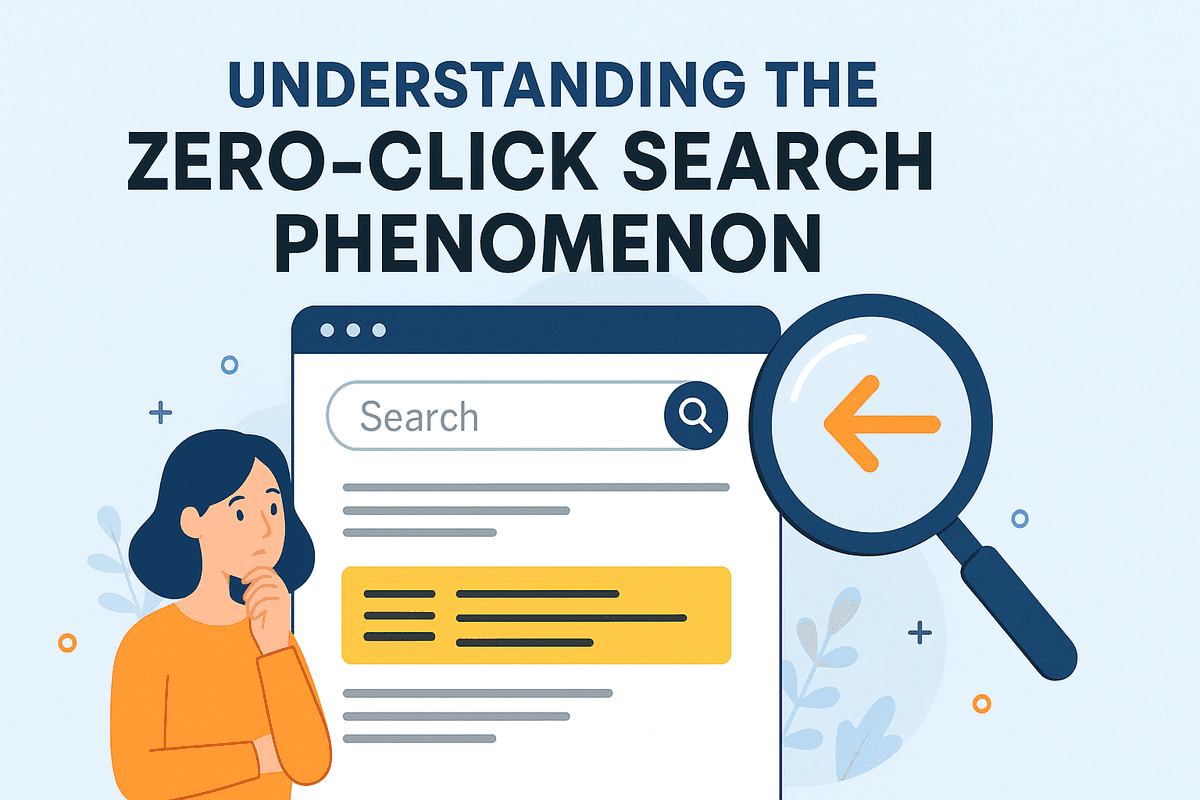
A zero-click search occurs when a user enters a query into a search engine and finds their exact answer directly on the results page, eliminating the need to click through to any external website. Instead of browsing a list of blue links, the user’s intent is satisfied instantly through built-in Search Engine Results Page (SERP) features. These include featured snippets, knowledge panels, local packs, and visual carousels.
For instance, if a user searches for quick design inspiration or a brief definition, Google provides the answer immediately. As search engines increasingly prioritize delivering direct, immediate value, these zero-click scenarios have become the new normal. For creators, this signifies a major shift: you are no longer just competing for a standard link click; you are competing for instant informational and visual dominance at the very top of the page.
The Impact of AI Overviews and Rich Results on Traffic
The recent widespread rollout of AI Overviews—formerly developed under the Search Generative Experience (SGE)—has rapidly accelerated the zero-click trend. These AI-driven summaries synthesize information from multiple sources to provide a highly conversational, comprehensive answer before the traditional search results even begin. Alongside these summaries, rich results like image packs and interactive widgets are pushing standard organic links further down the screen.
While this shift can lead to an undeniable drop in traditional website traffic, it opens a massive new opportunity for visual optimization. AI Overviews and rich results are incredibly visual environments. To capture attention in these highly coveted spots, your content needs striking, hyper-relevant graphics. This is exactly where mastering a sophisticated text to image generator becomes a strategic game-changer. By translating your written prompts into high-quality, custom visual content, you can rapidly produce the exact infographics, custom illustrations, or conceptual photos that search engines love to feature in rich results. When text links are buried, captivating AI-generated imagery can serve as the ultimate hook to drive user engagement.
Why High Impressions with Low Clicks Isn’t Always a Failure
It is easy to open your analytics dashboard, see climbing impressions alongside a stagnant click-through rate, and assume your SEO and content strategies are failing. However, in the era of the zero-click search, high impressions with low clicks often tell a completely different story: the story of powerful brand visibility.
When your content—especially your visually unique assets—appears in AI Overviews or featured snippets, you are establishing immediate industry authority. Users are seeing your brand name, reading your summarized expertise, and consuming your custom imagery without ever leaving Google. Even if they bypass clicking your link today, this repeated, high-value exposure builds critical brand recognition and trust. Over time, when that user inevitably requires a deeper dive into a topic or a specific service, they are far more likely to directly seek out the brand that consistently provided them with instant answers and stunning visual experiences.

How to Optimize Content for Zero-Click SERP Features
As the artificial intelligence landscape explodes, search behavior is shifting rapidly. When users search for a reliable text to image generator, they are increasingly met with zero-click SERP features. These are search results where Google provides the exact answer directly at the top of the page, satisfying the user's query without requiring a click to a website. While this might seem counterintuitive to driving traffic, capturing these top-of-page placements builds massive brand trust and secures high-intent visibility in the highly competitive AI design space. Here is how to position your content to dominate these coveted spots.
Structuring Content for List and Table Featured Snippets
When creatives, designers, and marketers search for the best AI visualization tools or prompt formulas, Google frequently displays list or table featured snippets. To capture these snippets, your content architecture must be highly organized.
If you are writing a roundup of AI platforms, use clear, sequential heading tags (H3s or H4s) for each individual tool. Follow each heading with a concise, factual description. For technical comparisons—such as evaluating the subscription costs, rendering speeds, and maximum image resolutions of various AI models—use clean HTML tables. Search engine crawlers effortlessly pull well-structured table data directly into the SERP. Always introduce your lists and tables with a clear, keyword-rich trigger sentence, such as, "Here are the core features to look for in a professional text to image generator:" to signal ultimate relevance.
Leveraging Schema Markup for Quick Answers and FAQs
The world of AI image synthesis is full of complex, evolving questions. Users constantly search for queries like, "Are AI generated images copyright free?" or "What is the best prompt structure for photorealism?"
To win quick-answer boxes and populate the "People Also Ask" sections, you need to implement structured data, specifically FAQ Schema markup. This code works behind the scenes, feeding your questions and answers directly to search engines in a native language they instantly understand. On the page itself, adopt an inverted pyramid writing style for your FAQ sections. Ask the targeted question in an H3 tag, and immediately provide a definitive, 40-to-50-word answer in the very first paragraph. You can then elaborate on the deeper nuances of generating AI art in the subsequent text.
Building Entity Authority for Knowledge Graph Inclusion
Google’s Knowledge Graph goes beyond simply reading keywords; it understands entities—distinct concepts, brands, and specific AI technologies. To be featured in prominent Knowledge Panels, your brand must be recognized as a topical authority in the AI text-to-image niche.
Start by utilizing Organization and Author Schema to clearly define the experts publishing your content. Consistently associate your brand with industry-standard semantic terms like "machine learning," "neural networks," "diffusion models," and "prompt engineering." Securing brand mentions and backlinks from highly authoritative technology and design publishers further strengthens your entity connections. When search engines intrinsically trust that you are a definitive expert on how a text to image generator operates, they are far more likely to extract your insights for the Knowledge Graph, solidifying your absolute authority at the top of the search results.
Adapting Keyword Research for a Zero-Click SEO Strategy
As search engines increasingly answer user queries directly on the results page, the traditional marketing playbook requires an urgent overhaul. To maintain traffic and engagement, content creators must adapt their keyword research specifically for a zero-click environment. This means shifting focus toward queries that demand deep exploration, rich multimedia, and unique human perspectives that algorithms cannot summarize in a single sentence.
Identifying 'Click-Heavy' Versus 'No-Click' Search Intents
The first step in a modernized SEO strategy is categorizing your target keywords into "click-heavy" and "no-click" intents. Broad, informational queries—such as basic definitions or simple facts—are classic no-click searches. Search engines resolve these instantly with brief text snippets or AI overviews.
Conversely, click-heavy intents involve complex tutorials, nuanced product comparisons, and searches for visual inspiration. A simple text box cannot satisfy a user looking for detailed design workflows or creative examples. By targeting visual-heavy search intents, you can capture traffic through image packs and rich media results. This is where integrating a versatile text to image generator into your content pipeline becomes an incredible advantage. By identifying queries that inherently require visual proof, you can use AI to instantly produce the exact custom graphics users are eager to click on, capturing visual search real estate even when standard web links see declining traffic.
Pivoting to Long-Tail, Experience-Driven Keywords (E-E-A-T)
Once you filter out no-click queries, the strategy must pivot toward long-tail, experience-driven keywords. Modern search algorithms heavily reward Experience, Expertise, Authoritativeness, and Trustworthiness (E-E-A-T). Users and search engines alike no longer want generic overviews; they crave highly specific, hands-on demonstrations.
Instead of targeting a broad term like "marketing graphics," pivot to a long-tail query like "how to design futuristic branding for SaaS." To truly satisfy the "Experience" aspect of E-E-A-T, your visual content must be as unique as your written insights. Relying on recycled stock photography dilutes your authority. However, using a text to image generator empowers you to transform specific written prompts into high-quality, original visual content that perfectly matches your niche topic. Generating bespoke images proves your active, creative engagement with the subject matter, signaling high quality to search engines and building immediate trust with your readers.
Using CTR Forecasting Tools to Prioritize Content Efforts
To finalize your zero-click strategy, you must protect your resources by using Click-Through Rate (CTR) forecasting tools. These specialized platforms analyze current SERP features—evaluating the presence of direct answers, shopping carousels, or video blocks—to accurately predict the percentage of users who will actually click through to a webpage.
By filtering your keyword list through CTR forecasting, you can prioritize your content creation efforts on the battles you can actually win. When the data identifies a long-tail query with high click potential, you can confidently invest time in crafting an in-depth article. By pairing data-driven keyword selection with the rapid, high-quality output of a text to image generator, you ensure your most valuable pages are enriched with captivating visuals that dominate the remaining click-heavy search results.

Building Brand Authority When Organic Clicks Decline
The digital marketing landscape is experiencing a massive paradigm shift. With the rapid rise of zero-click searches and AI-driven search overviews, relying solely on traditional organic traffic is no longer a guaranteed growth strategy. As generic organic clicks steadily decline, marketers must pivot their focus toward building an undeniable, recognizable brand presence. In this fast-paced, highly visual era, leveraging a powerful text to image generator is a vital tactic to produce the captivating visual content required to cut through the noise and capture audience attention.
Why Branded Search Volume is the New True North Metric
When generic search queries yield fewer actual clicks to external websites, a brand's safest haven is branded search volume. When a user specifically types your company’s name into a search engine, they completely bypass the unpredictable algorithms and AI summaries of traditional SERPs. Branded search is the new true north metric because it indicates genuine audience intent, brand recall, and customer loyalty.
To drive people to search for your specific brand, you need a memorable visual identity. By utilizing a text to image generator, your creative team can rapidly develop a unique, consistent visual style that sets you apart from a sea of competitors. Consistently publishing high-quality, AI-generated custom graphics helps burn your brand into the consumer's memory, ensuring that when they need a solution, your company is the first one they actively search for.
Off-Page Strategies to Capture Audience Mindshare
To drive that vital branded search, you must proactively capture audience mindshare outside of your own website. Off-page strategies—spanning across social media campaigns, digital PR, guest publishing, and community engagement—are absolutely essential for staying top-of-mind. However, standing out in crowded social newsfeeds requires an immense volume of scroll-stopping visuals.
This is where a text to image generator dramatically transforms your marketing workflow. Instead of relying on overused stock photography or waiting weeks for expensive graphic design turnarounds, you can instantly transform simple written prompts into highly tailored visual content. Whether you are generating striking conceptual graphics for a PR pitch, bespoke illustrations for a viral LinkedIn post, or vibrant art for an Instagram campaign, AI-driven visual creation empowers you to scale your off-page presence. Capturing mindshare is ultimately about being everywhere your audience is, armed with bespoke visuals that demand their attention.
Optimizing Your Brand for AI and LLM Training Data
As traditional search engines evolve into conversational AI assistants, we are entering the era of Generative Engine Optimization. Large Language Models (LLMs) formulate their answers based on massive datasets scraped from across the web. To ensure your brand is consistently cited and recommended by these next-generation AI tools, you must optimize your digital footprint for LLM training data.
This involves publishing authoritative, descriptive content paired with highly relevant media. When you use a text to image generator to create custom visual assets, surround those images with rich, context-heavy text, precise alt-tags, and clear semantic metadata. By consistently linking your brand name with specific, high-quality visual content and expert insights, you effectively train scraping bots and LLMs to associate your business with industry-leading concepts. This proactive optimization secures your brand's authority not just in today's search results, but in the AI-generated answers of tomorrow.
Measuring SEO ROI and Success Without the Clicks
In an era where search engines increasingly surface visual content directly on the results page, relying solely on traditional click-through rates is no longer sufficient. When you leverage a powerful text to image generator to produce eye-catching infographics, diagrams, or conceptual art for your brand, users often consume your message without ever leaving the search engine. This shift requires a modern approach to tracking search engine optimization (SEO) return on investment.
Rethinking Standard Google Search Console Metrics
Typically, SEO success is measured by the sheer volume of organic clicks reported in Google Search Console (GSC). However, as Google evolves into a visual-first and AI-driven discovery engine, impression data becomes just as critical. High-quality visuals can secure placements in Google Discover, rich snippets, and interactive image carousels.
Even if a user doesn't click the link, they are still absorbing your brand's visual content. Instead of dismissing low-click, high-impression queries as underperforming, treat them as valuable top-of-funnel touchpoints. By tracking impression growth and visual search appearances specifically tied to the creative assets you produce, you can quantify brand visibility in a way that traditional, click-centric metrics simply cannot capture.
Tracking Correlations Between Branded Search Lift and Direct Traffic
When a user encounters a striking, highly relevant image in search results or across linked platforms, it creates immediate brand recall. They might not click the image right then, but the visual impression sticks. Later, when they need your product, service, or content, they bypass standard discovery searches and navigate straight to your website.
To measure this "hidden" ROI of your visual strategy, look for correlations between the publication of your AI-generated visual campaigns and subsequent spikes in direct traffic. Additionally, monitor your branded search volume over time. An uptick in users searching specifically for your company name shortly after a visually rich content rollout is a strong indicator that your off-site visuals are successfully driving memorable, long-term brand awareness.
Measuring Holistic Off-Site Engagement and Zero-Click Conversions
Zero-click searches are not a lost opportunity; they are simply a different type of conversion. A zero-click conversion happens when a user gets all the information they need from your visual asset directly on the search engine results page (SERP) or within a social media feed.
To evaluate holistic off-site engagement, you must expand your analytics toolkit. Look at image shares, Pinterest saves, and native platform interactions. If a complex concept was beautifully distilled into a clear diagram using a text to image generator, and that diagram goes viral on industry forums without driving immediate website traffic, it still holds massive ROI. By assigning concrete value to off-site brand interactions and tracking how your visuals spread across the web organically, marketers can fully appreciate the true impact of their AI-enhanced design efforts.