
June 3, 2025
Beyond Keywords to True Intent
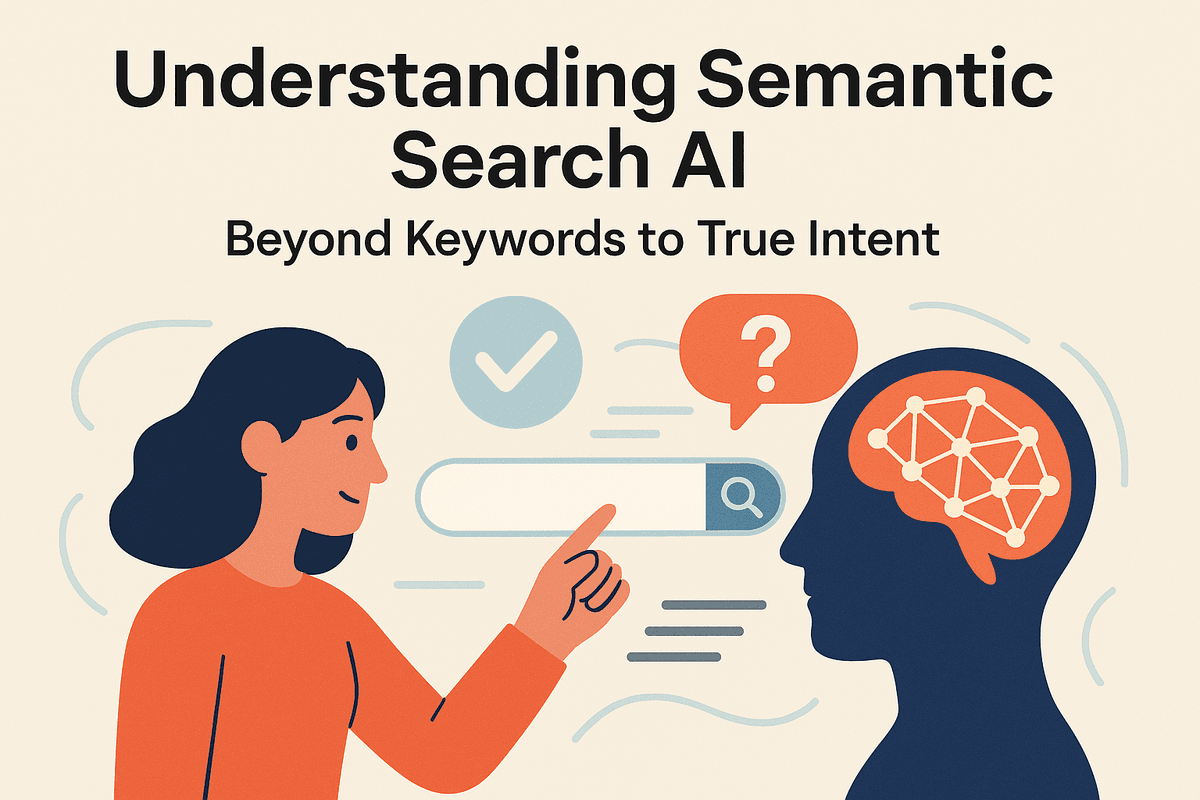
Understanding Semantic Search AI: Beyond Keywords to True Intent
Ever typed a question into a search bar, only to be met with a wall of irrelevant links because you didn't use the exact magic words? That's the common frustration semantic search AI is designed to eliminate. It marks a pivotal shift from simply matching words to genuinely understanding what you're looking for.
What Exactly is Semantic Search AI?
At its core, Semantic Search AI is a sophisticated approach to information retrieval where artificial intelligence empowers search engines to look beyond literal keyword matching. Instead of just scanning for specific terms, semantic search AI delves into the intent behind your query and the contextual meaning of the words you use. Think of it as a search assistant that doesn't just hear your words, but actively comprehends your underlying need.
This revolutionary technology leverages complex AI disciplines, primarily Natural Language Processing (NLP) and machine learning. NLP allows the system to understand the nuances of human language—things like synonyms, related concepts, and even sarcasm or implied meaning. Machine learning algorithms, trained on vast datasets, enable the search engine to learn and improve its understanding over time. The result? Semantic search AI revolutionizes information retrieval by delivering results that are connected not just by shared keywords, but by genuine conceptual relevance and meaning, providing a more intuitive and effective search experience.
Why AI-Powered Semantic Search is No Longer a "Nice-to-Have"
In today's hyper-connected, data-drenched digital landscape, why should you, or your business, pay close attention to AI-powered semantic search? The answer lies in two crucial factors: skyrocketing user expectations and the relentless need for efficiency. We are constantly navigating an ocean of information, and the ability to find what we need quickly and accurately is paramount.
Users now expect search functionalities, whether on a global search engine or within a specialized SaaS platform, to understand them intuitively. They're looking for precise answers and relevant solutions, not just a list of documents that happen to contain their search terms. For businesses, particularly those providing SaaS solutions or information-rich platforms, implementing semantic search AI translates directly into a significant competitive advantage. It dramatically enhances user experience, boosts productivity by slashing the time users spend searching for information, and ultimately fosters greater customer satisfaction and loyalty. In an era where intelligent, responsive digital experiences are the norm, embracing semantic search AI is crucial for staying relevant and effective.
The Paradigm Shift: Keyword Limitations vs. Semantic Prowess
The difference between traditional search methods and semantic search AI is akin to comparing a basic word-finding tool to an experienced research librarian. One rigidly matches terms; the other comprehends the inquiry.
The Frustration of Old-School Keyword Search
Traditional keyword-based search engines have been the workhorses of information access for years, but their inherent limitations are becoming increasingly obstructive in our information-rich world. These systems primarily operate on a simple principle: matching the exact keywords in your query to identical keywords present in documents or web pages. This often leads to:
- Irrelevant Results: If you search for "Jaguar speed" (meaning the animal), you might be inundated with results about the car brand if the system can't discern context.
- Missed Information: Valuable content that uses synonyms (e.g., "quick" instead of "fast") or related concepts but not your precise keywords is frequently overlooked.
- Poor Handling of Ambiguity: Human language is rife with words possessing multiple meanings (polysemy). Keyword search struggles to identify the correct interpretation without deeper contextual understanding.
- Difficulty with Natural Language: Complex questions or conversational queries often baffle these systems, compelling users to "think like the search engine" and awkwardly rephrase their needs into fragmented keywords.
The Intelligent Advantage of Semantic Search AI
In stark contrast, semantic search AI represents a monumental leap forward in how we interact with information. It doesn't just scan for words; it comprehends meaning, intent, and context. Here’s how semantic search AI comprehensively outshines its predecessor:
- Understanding Intent and Context: The cornerstone of semantic search AI is its ability to decipher what you mean, not just what you type. It considers the broader context of your query, and sometimes even factors like your previous search behavior, location, or the overall topic of the platform you're on, to deliver truly pertinent results.
- Recognizing Relationships: It intrinsically understands synonyms (e.g., "affordable" and "inexpensive"), hyponyms (e.g., "laptop" is a type of "computer"), hypernyms, and other complex linguistic relationships. This ensures a far more comprehensive and accurate retrieval of information.
- Handling Ambiguity and Nuance: Through sophisticated NLP models, semantic search AI can effectively differentiate between ambiguous terms based on the surrounding context within the query or the source material, leading to far more accurate disambiguation.
- Natural Language Proficiency: You can ask questions in a natural, conversational manner, such as "What are the best AI tools for content summarization for small businesses?" Semantic search AI is adept at processing such queries, understanding the various entities and relationships involved, and returning highly relevant answers or resources. This inherent power transforms information discovery from a chore into an intuitive and highly efficient process, significantly enhancing productivity, especially within feature-rich SaaS platforms.

Decoding Meaning: How Semantic Search AI Understands Queries
Ever wondered how a search engine seems to read your mind, delivering exactly what you need even when your query is a bit vague? The magic lies in semantic search AI, a sophisticated technology moving beyond simple keyword matching. Instead of just looking for literal words, it delves into the meaning and intent behind your search, striving to understand what you're truly asking. This ability to decode meaning transforms search from a hit-or-miss affair into an intelligent conversation.
The Power of Natural Language Processing (NLP) in Semantic Search AI
At the core of semantic search AI's understanding lies Natural Language Processing (NLP), an AI field enabling computers to interpret human language. When you submit a query, NLP techniques such as tokenization (breaking queries into words), lemmatization (reducing words to root forms), part-of-speech tagging (identifying grammar), and named entity recognition (spotting key entities like people or places) are employed. By dissecting the query, semantic search AI establishes a foundational understanding of its components and their interrelations, preparing for deeper interpretation.
Machine Learning and Knowledge Graphs: The Brains Behind Context
While NLP breaks down the query, machine learning (ML) and knowledge graphs provide the contextual intelligence crucial for semantic search AI's true understanding.
The Engine of Understanding: Machine Learning
Machine learning algorithms are the engine enabling semantic search AI to learn from vast data. Sophisticated models, like word embeddings and large language models (LLMs), discern complex patterns and relationships between words and concepts. They grasp synonyms, related terms, and linguistic nuances, allowing semantic search AI to infer meaning beyond literal matches. ML also facilitates continuous learning, refining the system's understanding over time.
Structuring Reality: Knowledge Graphs
Knowledge graphs add another layer by representing information as a network of entities (real-world objects, events, or abstract concepts) and their relationships—an interconnected web of facts. For example, linking "Leonardo da Vinci" to "Mona Lisa" (as its creator) and "Renaissance" (as the period he lived in). When semantic search AI processes a query, it leverages this structured knowledge to disambiguate terms (e.g., "Jaguar" the car vs. "Jaguar" the animal) and enhance contextual understanding. This helps connect disparate information for richer answers.
From Query to Concept: Interpreting User Intent with Semantic Search AI
The primary aim of semantic search AI is to transcend literal queries and grasp user intent—the why behind the search. By integrating NLP's linguistic analysis, ML's pattern recognition, and knowledge graphs' structured world data, this advanced AI deciphers what you truly seek.
For instance, when you search "best vegan restaurants near me open now," semantic search AI doesn't just match keywords. It understands "best" implies recommendations, "vegan restaurants" a specific establishment type, "near me" a location constraint, and "open now" a time filter. This intelligent system is about matching concepts to fulfill an informational need.
This capability allows semantic search AI to effectively handle:
- Ambiguous queries: Where words have multiple meanings.
- Long-tail keywords: Precise, multi-word phrases.
- Conversational questions: Queries phrased naturally (e.g., "What was the weather like in London last Tuesday?").
By interpreting intent, semantic search AI bridges human language with machine comprehension, delivering results that are not merely relevant but deeply insightful. This conceptual grasp elevates modern search experiences, making them more intuitive and powerful.
Key Benefits of Implementing Semantic Search AI
Tired of sifting through irrelevant search results? Semantic search AI is revolutionizing how we find information, moving beyond simple keyword matching to truly understand user intent. By implementing this intelligent technology, businesses and users alike can unlock a wealth of advantages. Let's explore the key benefits that make semantic search AI an indispensable tool in today's digital landscape.
Delivering Hyper-Relevant Results for Users
At its core, the most significant advantage of semantic search AI is its ability to deliver hyper-relevant results. Unlike traditional search engines that rely heavily on exact keyword matches, semantic search AI delves deeper. It analyzes the contextual meaning behind a user's query, understanding synonyms, related concepts, and the overall intent. For instance, if a user searches for "best way to capture screen activity," a semantic system understands this means "screen recording software" or "how to record my screen," even if those exact words aren't used. This nuanced understanding means users spend less time scrolling and more time engaging with precisely what they were looking for, dramatically improving the efficiency and effectiveness of their search journey. This capability is crucial for platforms with vast amounts of content, ensuring users quickly find the needle in the haystack, thanks to the sophisticated processing of semantic search AI.
Boosting User Engagement and Satisfaction with Intelligent Search
When users consistently find what they need quickly and effortlessly, their engagement and satisfaction levels soar. Semantic search AI plays a pivotal role here. By providing intelligent search experiences that feel intuitive and responsive, it minimizes user frustration often associated with less advanced search tools. No more rephrasing queries multiple times or wading through pages of off-target results. This positive experience fosters greater user engagement – they are more likely to stay on your platform longer, explore more content, and return in the future. For businesses, higher user satisfaction achieved through effective semantic search AI translates directly into increased loyalty, better retention rates, and, ultimately, improved conversion rates. An intelligent search powered by semantic search AI becomes a silent ambassador for your brand, demonstrating a commitment to understanding and serving user needs effectively.
Improving Content Discoverability and SEO Performance
Implementing semantic search AI doesn't just benefit users; it significantly enhances content discoverability and bolsters your SEO performance. By understanding the semantic relationships between queries and content, this AI can surface relevant information that might have been missed by keyword-based systems. This means your valuable content, even if it doesn't contain the exact search terms, has a better chance of being found if it aligns with the user's intent. This broader reach improves the visibility of your entire content library. Furthermore, search engines like Google increasingly favor content that satisfies user intent, a core strength of semantic search AI. By optimizing your internal search with this technology, you're aligning with best practices that can lead to lower bounce rates, increased dwell time, and a stronger overall SEO profile as users engage more deeply with relevant material surfaced by a smarter search mechanism. Effective semantic search AI helps unlock the full value of your existing content.
For SaaS: Enhancing Productivity and Knowledge Management
In the context of Software-as-a-Service (SaaS) platforms and internal business operations, semantic search AI is a game-changer for productivity and knowledge management. SaaS products often come with extensive documentation, help guides, and community forums. Semantic search AI enables users – both customers and internal support teams – to quickly find answers to complex questions or locate specific features within these vast repositories, reducing support tickets and improving the self-service experience. Internally, companies can leverage semantic search AI to power their knowledge bases, intranets, and document management systems. This allows employees to rapidly access crucial information, share expertise more effectively, and streamline workflows. The ability to instantly find relevant internal documents, past project details, or expert contacts using semantic search AI significantly cuts down on wasted time, boosting overall operational efficiency and fostering a more knowledgeable, productive workforce.

Semantic Search AI in Practice: Enhancing Productivity in SaaS Platforms
The theoretical power of semantic search ai is compelling, but its true value shines when applied to real-world challenges. From the global search engines we use daily to specialized SaaS platforms, semantic search ai is actively reshaping how we access and interact with information, leading to significant productivity gains.
Lessons from the Giants: How Leading Search Engines Master Semantic Search AI
Think about your experience with major search engines like Google or Bing. When you type a query, you're increasingly interacting with sophisticated semantic search ai. These platforms moved beyond simple keyword matching years ago. Google's advancements, for instance, with algorithms like BERT and MUM, focus on understanding the intent and context behind your search terms.
If you search "best strategies for remote team collaboration tools," a leading search engine using semantic search ai doesn't just look for pages containing those exact words. It understands you're looking for actionable advice, comparisons, and potentially specific software recommendations related to distributed teamwork. It comprehends synonyms, related concepts, and the nuances of natural language. The result? More relevant, comprehensive answers that directly address your underlying need, saving you time and frustration. This ability to deliver precise information quickly is a core tenet of productivity, a lesson SaaS platforms are keenly adopting.
Revolutionizing SaaS: Semantic Search AI for Internal Knowledge and Customer Bliss
Within the SaaS ecosystem, semantic search ai is a game-changer for both internal operations and customer-facing services, directly fueling productivity.
- Transforming Internal Knowledge Bases: Many companies struggle with sprawling internal wikis, document repositories, and shared drives. Finding specific information can feel like searching for a needle in a haystack. Semantic search ai empowers employees by allowing them to query these vast knowledge bases using natural language. Instead of guessing keywords, an employee can ask, "What was our Q3 revenue growth in the EMEA region last year?" and receive a precise answer or the exact document, dramatically reducing search time and improving decision-making speed.
- Elevating Customer Support: For SaaS platforms, efficient customer support is paramount. Semantic search ai enhances this in two key ways:
- Supercharged Self-Service: Customers can find answers to their questions more effectively through intelligent FAQ sections or help portals. A query like "my dashboard isn't loading correctly after the update" will be understood contextually, leading to the most relevant troubleshooting guide, not just a list of articles containing "dashboard" or "update." This reduces support ticket volume.
- Empowered Support Agents: When customers do reach out, agents equipped with semantic search ai can quickly find accurate solutions from internal knowledge bases during live interactions. This means faster resolution times, higher first-contact resolution rates, and ultimately, more satisfied customers.
The Proof is in the Productivity: SaaS Success Stories with Semantic Search AI
The impact of semantic search ai isn't just theoretical; SaaS companies are already reaping tangible productivity benefits:
- Case Study Example 1: "TaskFlowPro" - A Project Management SaaS
- Challenge: Users often struggled to locate specific tasks, project files, or past discussions across numerous projects and teams. Keyword search was often too broad or too narrow.
- Solution: TaskFlowPro integrated semantic search ai into its platform. Users could now search with queries like, "show me all uncompleted design tasks assigned to Maria for the Alpha project due next week."
- Outcome: The company reported a significant decrease in the average time users spent searching for information, translating to quicker task completion and more efficient project management. Teams could focus more on execution and less on digital archaeology.
- Case Study Example 2: "SupportWise" - A Customer Service Platform SaaS
- Challenge: Support agents needed to rapidly access a vast and growing library of help articles, troubleshooting steps, and historical ticket data to resolve customer issues.
- Solution: SupportWise embedded semantic search ai into its agent interface. This allowed agents to type complex customer queries or symptoms directly into their search, receiving highly relevant knowledge base articles and similar past ticket resolutions.
- Outcome: Agent productivity soared, average handling time per ticket decreased, and customer satisfaction scores improved due to faster, more accurate support.
These examples illustrate how semantic search ai directly addresses information retrieval bottlenecks, unlocking valuable time and resources.
Embedding Intelligence: Your First Steps to Semantic Search AI in SaaS
Ready to explore how semantic search ai can boost productivity in your own SaaS platform? Here’s a practical approach to getting started:
- Audit Your Data & Define Your Quest:
- Assess Your Information Landscape: What kind of data will your semantic search ai need to understand? This could include product documentation, FAQs, community forum posts, internal SOPs, or even codebase comments.
- Pinpoint High-Impact Use Cases: Where will semantic search ai deliver the most significant productivity gains? Is it enhancing your customer-facing help center, streamlining internal document discovery for your team, or improving in-app search functionality for your users? Clearly define the problem you aim to solve.
- Chart Your Technical Course:
- Build vs. Buy: Developing a robust semantic search ai engine from the ground up requires specialized expertise and significant investment. For most SaaS companies, leveraging third-party semantic search ai APIs or managed services (from providers like OpenAI, Cohere, Google Cloud AI, AWS Kendra, or vector database specialists) is a more efficient path. These services provide pre-trained models and scalable infrastructure.
- Data Preparation is Key: Regardless of your chosen approach, your data will need to be prepared. This involves cleaning, structuring, and often converting text into numerical representations (vector embeddings) that semantic search ai models can process effectively.
- Key Considerations on Your Journey:
- Scalability: Select a solution that can handle your current data volume and user load, and scale gracefully as they grow.
- Relevance & Accuracy: Plan how you will measure search result quality. Implement feedback mechanisms and consider options for fine-tuning models on your specific domain data to continuously improve relevance.
- Data Privacy and Security: If dealing with sensitive customer or internal information, ensure your chosen semantic search ai solution adheres to strict data privacy and security protocols.
- Integration Effort: Evaluate how easily the semantic search ai can be integrated into your existing SaaS architecture and workflows.
- Cost-Benefit Analysis: Factor in all associated costs, including API usage, data storage, potential development resources, and ongoing maintenance, against the anticipated productivity improvements and ROI.
By thoughtfully navigating these steps, SaaS companies can successfully integrate semantic search ai, transforming how users and employees interact with information and unlocking new levels of productivity.
Selecting the Best Semantic Search AI for Your SaaS Needs
Choosing the right semantic search AI solution is a pivotal decision for any SaaS platform aiming to supercharge user productivity and deliver truly intelligent experiences. It’s not just about picking a tool; it’s about finding a partner that understands your unique data, integrates seamlessly, and scales with your ambition. So, how do you navigate the burgeoning market and select the semantic search AI that will genuinely elevate your SaaS offering?
Essential Features: What to Look for in a Semantic Search AI Tool for SaaS
When evaluating a semantic search AI for your SaaS, certain features are non-negotiable for achieving optimal performance and user satisfaction.
First and foremost is accuracy and relevance. The core promise of semantic search AI lies in its ability to understand user intent and the contextual meaning behind queries, not just keywords. Demand a solution that consistently delivers highly relevant results, minimizing user frustration and search time. Look for capabilities like understanding synonyms, related concepts, and even nuanced questions.
Next, consider customization and domain adaptation. Your SaaS platform likely operates within a specific industry or utilizes unique jargon and data structures. A powerful semantic search AI should allow for fine-tuning or training on your specific datasets. This ensures the search understands the specialized language of your users and content, dramatically improving result quality.
Scalability and speed are critical for any growing SaaS. As your user base and data volume expand, your semantic search AI must scale effortlessly without performance degradation. Users expect near-instantaneous results; high latency can cripple the user experience. Therefore, assess the architecture for its ability to handle increasing loads and query complexity efficiently.
Don't overlook language support, especially if your SaaS targets a global audience or plans to expand internationally. Ensure the chosen semantic search AI supports the languages your users speak. Finally, robust analytics and insights into search behavior can be invaluable. Understanding what users are searching for, where they succeed, and where they struggle provides crucial feedback for improving both your content and the search experience itself. Security and compliance features are also paramount, ensuring data protection aligns with your SaaS platform's standards.
Navigating the Landscape: Comparing Top Semantic Search AI Platforms and APIs
The semantic search AI market offers a diverse range of solutions, from comprehensive platforms to flexible APIs. Understanding these categories can help you narrow down your options:
- Managed Platforms: Solutions like Algolia (with its semantic capabilities), Elasticsearch (enhanced with vector search), Pinecone, or Weaviate often provide an end-to-end service. They typically offer easier setup, managed infrastructure, and user-friendly dashboards. These are excellent if you want to implement powerful semantic search AI quickly without deep infrastructure expertise. However, evaluate their flexibility for deep customization and their pricing models carefully.
- APIs from Major Cloud Providers: Giants like Google (Vertex AI Search), AWS (Kendra), and Microsoft (Azure Cognitive Search) offer robust semantic search AI capabilities. These often integrate well if you're already within their ecosystem, leveraging their scalability and existing infrastructure. The trade-off can sometimes be a degree of vendor lock-in or complexity in navigating their broader service offerings.
- Open-Source Frameworks: Libraries and frameworks such as Sentence Transformers, Haystack, or those built on Faiss give you maximum control and flexibility. If your team possesses strong AI/ML and engineering skills, open-source semantic search AI can be a cost-effective and highly customizable route. However, this path demands significant development, deployment, and ongoing maintenance effort.
When comparing, look beyond marketing claims. Seek out independent benchmarks, detailed case studies relevant to SaaS applications, and active community support or enterprise-level assistance. The best semantic search AI for your SaaS will depend on your team's expertise, existing infrastructure, and specific feature requirements.
Seamless Integration: Evaluating Compatibility with Your SaaS Infrastructure
Even the most advanced semantic search AI will fall short if it doesn’t integrate smoothly with your existing SaaS infrastructure. This is where the rubber meets the road.
Start by evaluating data ingestion capabilities. How easily can your SaaS data – be it from databases, document stores, user-generated content, or knowledge bases – be indexed and kept up-to-date by the semantic search AI? Look for robust connectors, flexible APIs for data synchronization, and support for various data formats.
The quality of APIs and documentation is crucial for your development team. Are the APIs for querying, indexing, and managing the search well-documented, intuitive, and comprehensive enough for your needs? The availability of Software Development Kits (SDKs) in your SaaS platform’s primary backend languages (e.g., Python, Java, Node.js) can significantly accelerate development.
Consider security integration. How will the semantic search AI interface with your existing authentication and authorization mechanisms? It's vital that search respects user permissions and data privacy rules inherent in your SaaS. Furthermore, assess the deployment models offered (cloud-native, on-premise, hybrid) and choose one that aligns with your SaaS architecture, security posture, and compliance requirements. A proof-of-concept (PoC) project is often the best way to test these integration points thoroughly before committing.
The Trifecta: Balancing Performance, Scalability, and Cost in Your Semantic Search AI Investment
Ultimately, selecting a semantic search AI involves a careful balancing act between three critical factors: performance, scalability, and cost. Getting this right is key to a sustainable and impactful investment.
Performance in semantic search AI isn't just about speed; it's about consistently delivering relevant results quickly. Define what "good performance" means for your SaaS: target query latency (e.g., under 500ms), indexing speed for new content, and the system's ability to handle concurrent users without a hitch. Test how the semantic search AI performs under realistic load conditions, not just in isolated benchmarks.
Scalability refers to the semantic search AI's ability to grow with your SaaS. Consider your projected growth in terms of data volume (terabytes or petabytes?), query volume (thousands or millions per day?), and the number of users. Does the solution scale horizontally (adding more machines) and vertically (increasing resources on existing machines)? How complex and costly is the scaling process? A semantic search AI that cannot scale efficiently will become a bottleneck.
Cost is more than just the license fee or subscription price. Calculate the Total Cost of Ownership (TCO). This includes infrastructure costs (compute, storage, network), development and integration effort, ongoing maintenance, and potential costs for training your team or customizing the semantic search AI. Favor solutions with transparent, predictable pricing models. Some semantic search AI tools might seem cheaper upfront but incur hidden operational costs.
Start by clearly defining your performance and scalability requirements and establishing a realistic budget. The "best" semantic search AI isn't necessarily the most feature-rich or the most expensive; it’s the one that optimally meets your specific SaaS needs within these critical constraints, delivering tangible value to your users and your business.

The Evolving Landscape of Semantic Search AI and Your Next Steps
The world of semantic search AI is not static; it's a dynamic field brimming with innovation. Understanding its trajectory and how to prepare is crucial for any SaaS platform aiming to deliver superior user experiences and unlock new levels of productivity. Let's explore what's on the horizon and how you can embark on your semantic search AI journey.
Emerging Trends: What's Next for Semantic Search AI?
The capabilities of semantic search AI are expanding rapidly, promising even more intuitive and powerful search experiences that will redefine how users interact with SaaS platforms:
- Multimodal Understanding: Future semantic search AI will increasingly process and connect information from various formats – text, images, audio, and video – to provide richer, more contextual answers. Imagine searching your SaaS platform's knowledge base simply by uploading a screenshot of an error message or describing a visual element.
- Hyper-Personalization: Beyond understanding query intent, semantic search AI is moving towards deeply personalized results. This means search outcomes will be tailored by factoring in individual user history, preferences, roles, and the specific context within your SaaS application, making discovery uniquely relevant.
- Advanced Conversational AI Integration: Expect more sophisticated, natural interactions. Semantic search AI will power chatbots and virtual assistants that can handle complex, multi-turn conversations, understand nuanced follow-up questions, and provide truly helpful, step-by-step guidance directly within your platform.
- Explainable AI (XAI) in Search: As semantic search AI algorithms become more complex, the demand for transparency will grow. XAI developments will offer insights into why specific results are surfaced, building user trust and allowing for more effective system refinement and troubleshooting.
- Proactive Information Discovery: The most advanced semantic search AI systems will increasingly anticipate user needs. They will proactively suggest relevant documents, features, tutorials, or support articles within your SaaS platform, sometimes even before a user explicitly formulates a query, guiding them towards solutions more efficiently.
Preparing Your Content and Data for a Semantic Search AI Future
To harness the full potential of upcoming semantic search AI advancements, proactive preparation of your content and data is essential. This ensures your SaaS platform is ready to deliver optimal results:
- Prioritize User Intent and Context: Shift your content strategy from mere keyword targeting to creating comprehensive resources that genuinely answer user questions and address their underlying needs within specific scenarios. Well-structured, context-rich content is the bedrock for effective semantic search AI.
- Embrace Structured Data: Implement schema markup (e.g., for FAQs, how-to guides, troubleshooting steps) and other structured data formats. This provides explicit, machine-readable clues to semantic search AI systems, helping them understand the meaning, attributes, and relationships within your content more accurately.
- Cultivate High-Quality, Authoritative Information: The richer and more reliable your information, the better semantic search AI can perform. Develop in-depth articles, detailed product documentation, and comprehensive guides. Critically, ensure your data is consistently accurate, up-to-date, and well-organized.
- Consider Internal Knowledge Graphs: For complex SaaS platforms with vast amounts of interconnected information (features, modules, user roles, support issues), building or leveraging internal knowledge graphs can significantly enhance your semantic search AI. These graphs explicitly map entities and their relationships, providing a powerful contextual layer.
Start Your Semantic Search AI Journey: Resources and Pilot Projects
Embarking on your semantic search AI implementation doesn't have to be an overwhelming endeavor. Here’s a practical approach to getting started:
- Educate and Explore: Familiarize yourself and your team with the core concepts and benefits of semantic search AI. Explore compelling case studies, industry reports, and the array of available tools, which include vector databases, pre-trained embedding models, and specialized semantic search AI SaaS solutions.
- Identify Key Use Cases: Pinpoint specific areas within your SaaS platform where semantic search AI can deliver the most immediate and measurable value. Common high-impact areas include customer support portals, internal documentation for employees, in-app help systems, or feature discovery functionalities.
- Launch a Focused Pilot Project:
- Define Clear Objectives: What specific improvements are you aiming for? Examples include reducing support ticket volume, decreasing time-to-information, or increasing feature adoption rates.
- Start Small and Manageably: Select a limited dataset or a specific, well-contained section of your platform for the initial implementation.
- Leverage Existing Solutions: To accelerate your pilot and validate capabilities without extensive in-house development, consider using third-party semantic search AI APIs or platforms.
- Measure, Iterate, and Learn: Track your pre-defined key metrics, actively gather user feedback, and be prepared to refine your approach. A successful pilot will build internal momentum and provide invaluable learnings for a broader rollout of semantic search AI.
Call to Action: Enhance Your SaaS Platform's Search with Semantic Search AI Today!
The future of user interaction within SaaS platforms is intelligent, intuitive, and deeply understanding – all powered by the nuanced capabilities of semantic search AI. By enabling users to find precisely what they need, exactly when they need it, with unprecedented accuracy and contextual relevance, you can significantly boost user productivity, dramatically improve customer satisfaction, and secure a distinct competitive advantage in the market.
Don't let your platform's search capabilities become a point of friction. The tools, technologies, and expertise to implement powerful semantic search AI are more accessible than ever before. Take the crucial first step towards transforming your SaaS user experience: investigate how semantic search AI can revolutionize information discovery within your platform and begin planning your impactful pilot project today.