
January 1, 2026
Understanding AI Integration in the Modern Enterprise
Understanding AI Integration in the Modern Enterprise
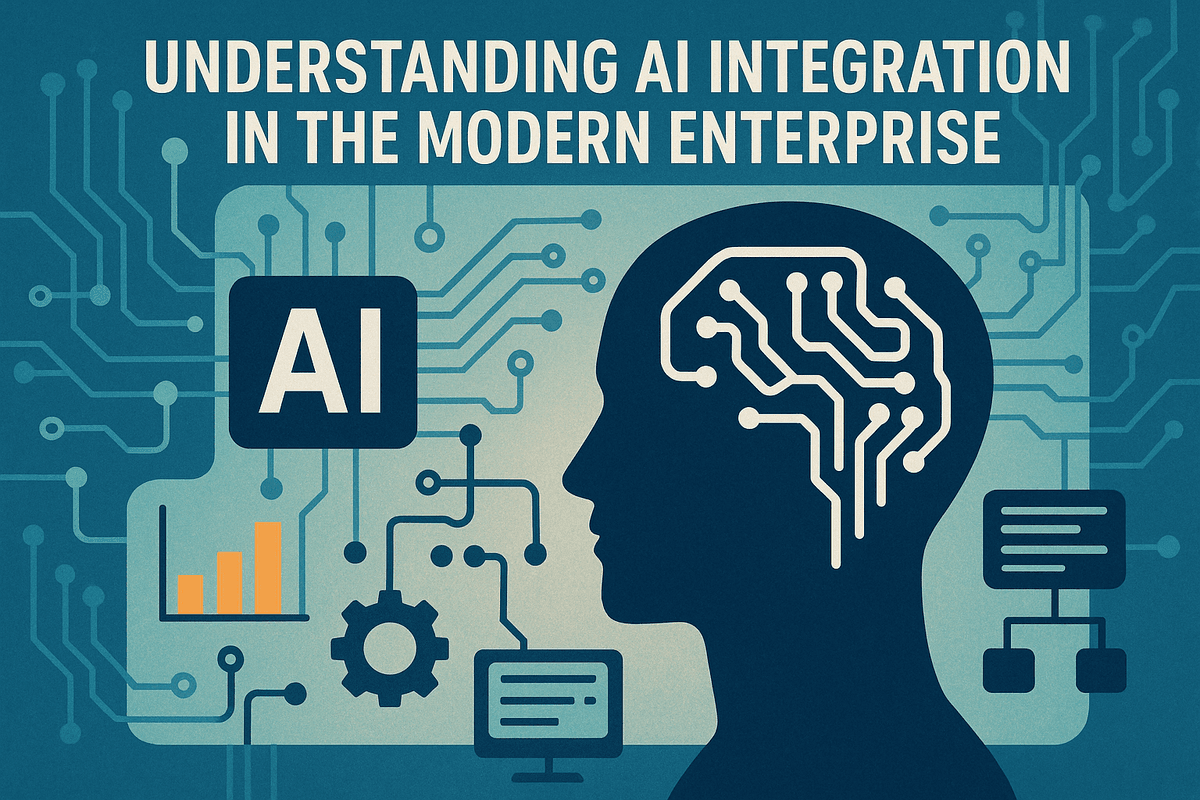
For many organizations, Artificial Intelligence began as a novelty—a browser tab open on a second monitor where employees experimented with generative text or code. However, the true value of this technology does not lie in standalone chat interfaces. The real transformative power is unlocked through AI integration: the strategic process of embedding advanced machine learning models directly into the software infrastructure that powers your daily operations.
Defining the Bridge: Connecting Models to Legacy Systems
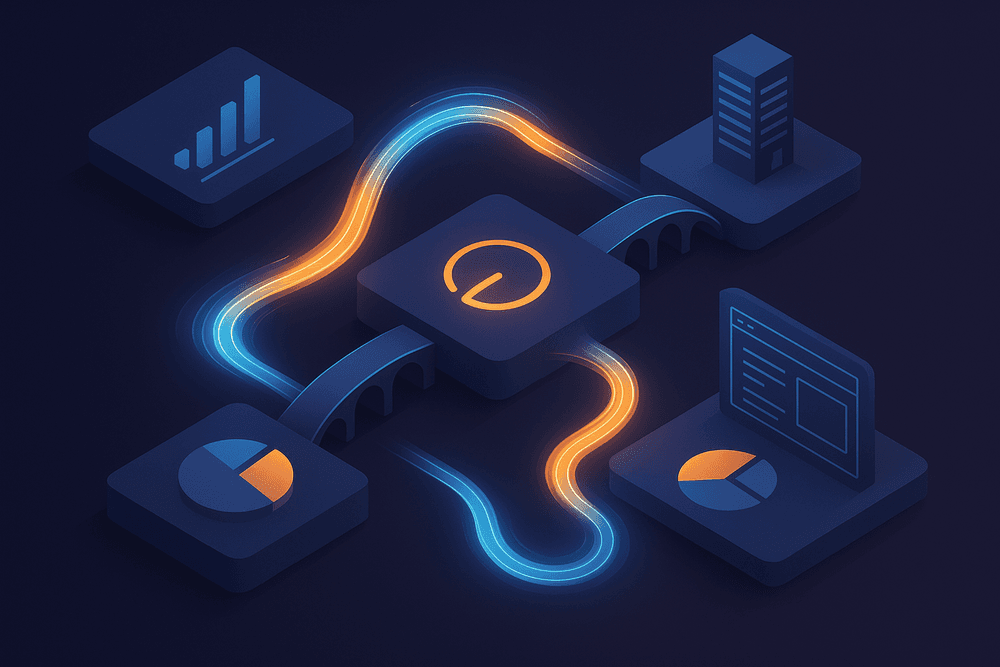
At its core, AI integration is the architectural bridge between modern intelligence and established structure. Most enterprises run on "legacy" systems—robust, reliable, yet often rigid platforms like ERPs (Enterprise Resource Planning), CRMs (Customer Relationship Management), and proprietary SQL databases. These systems are the muscles of the organization, executing tasks and storing data, but they historically lacked the ability to interpret that data contextually.
Integration involves connecting the "brain" (Large Language Models or predictive AI) to these "muscles" via Application Programming Interfaces (APIs). Instead of a human manually copying data from a dashboard, analyzing it, and pasting a conclusion into an email, an integrated system automates the entire loop. It allows the AI to query the legacy database, process the information, and trigger an action within the software environment without human intervention. This turns static records into dynamic, actionable intelligence.
The Shift from Standalone Tools to Ecosystems
We are currently witnessing a massive paradigm shift in how businesses consume technology. The initial phase of AI adoption was characterized by fragmentation—employees using disparate, standalone AI tools that resulted in data silos and security risks.
The modern approach moves away from this fragmentation toward a unified, integrated ecosystem. In this model, AI is not a separate utility to be visited; it is an invisible layer woven into the fabric of the digital workspace. When AI integration is successful, users may not even realize they are interacting with an AI model. They simply notice that their CRM automatically updates lead scores based on email sentiment, or that their supply chain software predicts shortages and drafts vendor orders autonomously. This ecosystem approach ensures that data flows seamlessly between applications, reducing the friction that typically slows down business processes.
Why Now: The Urgency of API-First Automation
The urgency to adopt these strategies stems from the rapid acceleration of the "API economy." We have moved past the point where manual data entry is an acceptable cost of doing business. In a hyper-competitive market, speed and scalability are the primary differentiators.
Adopting an API-first approach to business automation allows organizations to be modular and agile. Rather than rebuilding legacy systems from scratch—a costly and risky endeavor—companies can use APIs to inject intelligence into existing workflows immediately. This urgency is driven by the widening gap between AI-native companies and traditional firms. Those who master AI integration today are building self-correcting, self-optimizing workflows that compound in value over time. Those who wait are merely accumulating technical debt in the form of manual labor that can no longer compete with automated speed.
Core Methods for Seamless AI Integration
Developing a strategy for automation is only the first step; the true challenge lies in the execution. To bridge the gap between theoretical potential and tangible operational efficiency, businesses must select the right technical architecture. Successful ai integration is rarely a one-size-fits-all endeavor. Instead, it requires a nuanced approach that matches the complexity of the AI model with the capabilities of your existing software ecosystem.
Whether you are connecting a chatbot to a CRM or deploying a predictive analytics engine, the method of deployment dictates the speed, security, and scalability of your automation. Below are the three primary pathways for establishing robust connections between artificial intelligence and business infrastructure.
Leveraging Direct Connectivity via APIs
The backbone of most modern ai integration strategies is the Application Programming Interface (API). APIs act as the fundamental bridge, allowing two disparate software systems to "speak" to one another in real-time. For enterprise-grade automation, relying on standard protocols ensures stability and longevity.
- REST APIs (Representational State Transfer): As the industry standard, REST APIs offer a reliable method for connecting web services. They are stateless and flexible, making them ideal for standard operations like sending customer data to a large language model (LLM) and retrieving a summarized response.
- GraphQL: For more complex applications where bandwidth and precision are critical, GraphQL is gaining traction. Unlike REST, which might return a massive packet of unnecessary data, GraphQL allows the client to request exactly the specific data points needed. This reduces latency and optimizes the performance of AI models that require high-speed data ingestion.
By utilizing these API architectures, developers can build hard-coded, resilient connections that serve as the foundation for mission-critical workflows.
Accelerating Deployment with iPaaS Solutions
Not every ai integration requires a team of backend engineers. The rise of Integration Platform as a Service (iPaaS) tools has democratized access to advanced automation. Platforms like Zapier and Make (formerly Integromat) provide low-code or no-code environments that visualize workflows, allowing non-technical stakeholders to connect AI models to everyday apps like Slack, Google Sheets, or HubSpot.
iPaaS solutions function as "middleware," sitting between your AI provider (such as OpenAI or Anthropic) and your internal tools.
- Rapid Prototyping: Businesses can test an automation hypothesis in minutes rather than weeks.
- Complex Logic: Platforms like Make allow for branching logic, iterators, and data transformation, enabling sophisticated workflows where AI makes decisions based on the input it receives.
While APIs offer raw power, iPaaS offers agility, allowing marketing and operational teams to adapt their automation strategies on the fly without burdening the IT department.
Embedding Custom Machine Learning Models
For organizations with strict data privacy requirements or those seeking a proprietary competitive advantage, calling an external API may not be sufficient. In these scenarios, the most effective ai integration method involves embedding custom machine learning models directly into the proprietary software environment.
This often involves "containerizing" models using technologies like Docker or Kubernetes. By hosting the model within your own infrastructure (on-premise or private cloud), you eliminate external dependencies and latency issues associated with web traffic. This method is essential for high-frequency trading platforms, real-time fraud detection systems, or healthcare diagnostics where data cannot legally leave the secure server. While this approach requires significant technical overhead to maintain, it offers the highest ceiling for performance and security in business automation.
Strategic Benefits of AI Integration for Workflows
In today’s hyper-competitive digital landscape, relying solely on manual processes or disconnected software stacks is a recipe for stagnation. The modern enterprise requires more than just digitalization; it demands connectivity. This is where AI integration becomes a pivotal driver of growth. By embedding artificial intelligence directly into your existing software infrastructure, you transform static tools into dynamic, learning systems that actively contribute to operational goals.
The transition from standard automation to AI-driven workflows offers a profound shift in how value is created, moving beyond simple time-savings to unlock strategic agility.
Moving Beyond "If-This-Then-That": Intelligent Triggers
Traditional automation follows rigid, linear rules. While useful, these workflows break easily when faced with unstructured data or unexpected variables. AI integration introduces "intelligent triggers"—autonomous decision points that can interpret context before taking action.
For example, consider an accounts payable workflow. A standard automation tool might flag an invoice solely because the amount exceeds a specific limit. However, an AI-integrated system can analyze the invoice against historical data, vendor reliability scores, and current cash flow status. If the AI detects an anomaly—such as a price hike consistent with inflation or a discrepancy in line items—it triggers a specific approval workflow. If the invoice is standard, the AI processes it automatically. This reduces the burden on human staff, allowing them to focus on complex exceptions rather than routine approvals.
Enhancing Decision-Making with Real-Time Data Analysis
Data is often referred to as the new oil, but without refinement, it is merely potential energy. Businesses often suffer from data silos, where critical insights are trapped in disparate systems. AI integration acts as the refinery, pulling data from various API endpoints to provide a cohesive, real-time view of business health.
By connecting AI models to your ERP or project management software, you can leverage predictive analytics to foresee bottlenecks before they occur. Instead of reacting to a supply chain delay after a shipment is missed, an integrated AI model can analyze weather patterns, supplier news, and inventory levels to predict the delay weeks in advance. This allows leadership to make proactive, data-backed decisions, switching suppliers or adjusting production schedules instantly. The result is a more resilient operation that pivots based on live intelligence rather than historical reporting.
Revolutionizing Customer Experience via CRM Connectivity
Perhaps the most visible benefit of AI integration lies in customer experience (CX). Modern consumers expect immediate, personalized interactions, yet scaling support teams to meet this demand is costly. Integrating Generative AI with Customer Relationship Management (CRM) platforms bridges this gap.
When you integrate an intelligent chatbot with a CRM like Salesforce or HubSpot, the AI acts as a knowledgeable concierge rather than a script-reader. It doesn't just answer generic FAQs; it accesses the customer's purchase history, support tickets, and preferences in real-time. If a high-value client asks about a product upgrade, the AI can instantly draft a personalized offer based on their previous usage patterns and current subscription tier. This level of seamless interaction increases customer satisfaction scores (CSAT) and drives revenue, proving that automation can be deeply personal when powered by the right strategy.
Best Practices for Secure AI Integration
Implementing artificial intelligence into your business workflow offers transformative potential, but moving from a proof-of-concept to a production-grade system requires rigorous attention to detail. Successful ai integration is not merely about establishing a connection with a Large Language Model (LLM); it is about creating an ecosystem that is secure, fast, and adaptable to the rapid pace of technological change. To build a resilient automated infrastructure, organizations must prioritize data governance, latency management, and architectural flexibility.
Ensuring Data Privacy and GDPR Compliance
The most critical aspect of enterprise ai integration is protecting sensitive information. When transmitting data to external AI providers (such as OpenAI or Anthropic) via API, you leave the safety of your internal network. Without strict protocols, you risk violating regulations like GDPR, CCPA, or HIPAA.
To mitigate these risks, implementing a "Data Sanitization Middleware" is essential. This acts as a checkpoint between your internal database and the external AI service.
- PII Redaction: Before any prompt leaves your server, automated scripts should identify and redact Personally Identifiable Information (PII) such as names, social security numbers, and email addresses.
- Zero-Retention Policies: When negotiating with AI vendors, opt for enterprise tiers that guarantee your data is not used to train their public models. Ensure that data retention policies are set to zero days whenever possible.
- End-to-End Encryption: Data in transit must always be encrypted using TLS 1.3 standards. This prevents interception during the handshake between your infrastructure and the AI provider.
Optimizing API Latency for High-Performance Workflows
AI models are computationally expensive and often slower than traditional database queries. A standard database lookup might take milliseconds, whereas an LLM inference can take several seconds. To prevent ai integration from becoming a bottleneck in your user experience, you must optimize for latency.
Implement Semantic Caching
Don't pay for the same answer twice. By implementing semantic caching (often using vector databases), you can store the results of common queries. If a user asks a question similar to one previously answered, the system retrieves the cached response instantly rather than querying the AI model again. This drastically reduces latency and API costs.
Asynchronous Processing and Streaming
For workflows that do not require immediate user interaction—such as generating weekly reports or summarizing large documents—utilize asynchronous background processing. For real-time applications like customer support chatbots, enable response streaming. This allows the user to see the text generating character-by-character, reducing the "perceived latency" even if the total generation time remains the same.
Designing Scalable Architectures for Future Updates
The AI landscape shifts rapidly; the state-of-the-art model you use today may be obsolete in six months. A brittle ai integration strategy hardcodes dependencies on a specific model version, leading to significant technical debt when upgrades are required.
To future-proof your automation, adopt a Model-Agnostic Abstraction Layer. Instead of your application calling a specific API endpoint (e.g., gpt-4-turbo) directly, it should call an internal gateway. This gateway then routes the request to the best available model. This architecture allows you to:
- Swap Providers: Switch from one AI provider to another without rewriting your core application code.
- A/B Test Models: Route 10% of traffic to a newer, cheaper model to test performance against your current baseline.
- Fallback Logic: Automatically reroute requests to a backup model if the primary API experiences downtime.
By focusing on these three pillars—security, speed, and scalability—you ensure that your ai integration drives long-term operational efficiency rather than becoming a maintenance burden.
Real-World AI Integration Use Cases
Moving beyond theoretical frameworks and API documentation, the true value of artificial intelligence becomes evident when observing it in action. Across industries, forward-thinking enterprises are deploying ai integration to dismantle data silos, enhance decision-making, and automate complex workflows. By connecting advanced models to their existing software infrastructure, these companies are not just incrementally improving processes; they are fundamentally reshaping their operational capabilities.
Below are three compelling examples of how ai integration is driving business automation and delivering tangible ROI today.
Revolutionizing Customer Support: Zendesk and OpenAI
The collaboration between help-desk giant Zendesk and OpenAI represents a gold standard in customer service automation. By integrating Large Language Models (LLMs) into their ticketing architecture via API, Zendesk has transformed the agent experience from reactive to proactive.
This ai integration goes far beyond basic chatbots that rely on pre-written scripts. Instead, the system analyzes the context of incoming customer queries to perform sophisticated tasks:
- Intelligent Triage: The AI automatically categorizes tickets based on sentiment and urgency, routing complex issues to specialized human agents while resolving routine queries autonomously.
- Ticket Summarization: For long-running support threads, the AI generates concise summaries, allowing agents to understand the history of a generic issue in seconds rather than minutes.
- Response Expansion: Agents can type a few bullet points, and the integrated AI expands them into a fully formatted, empathetic, and brand-consistent email response.
Streamlining Supply Chains with Predictive Analytics
In the logistics sector, the margin for error is non-existent. Traditional ERP systems often look at historical data, but modern ai integration allows supply chain managers to look into the future. By connecting predictive analytics models with inventory management software, businesses are creating self-correcting supply chains.
This integration typically involves feeding real-time data from IoT sensors, market trends, and weather patterns into an AI model. The system then communicates directly with procurement software to:
- Forecast Demand: AI algorithms predict spikes in demand for specific SKUs with high accuracy, automatically triggering purchase orders to prevent stockouts.
- Optimize Routes: Machine learning models analyze traffic and fuel costs in real-time, pushing optimized delivery routes directly to driver applications.
- Predictive Maintenance: AI analyzes equipment performance data to predict machinery failure before it happens, scheduling maintenance during non-peak hours to avoid costly downtime.
Automating Marketing Stacks: HubSpot and Generative AI
Marketing teams are often bogged down by the sheer volume of content required to maintain a digital presence. HubSpot’s integration of generative AI tools (such as ChatSpot and Content Assistant) demonstrates how ai integration can serve as a force multiplier for creative teams.
Rather than switching between a ChatGPT window and a CMS, the AI is embedded directly within the marketing workflow. This allows for:
- Instant Content Generation: Marketers can draft blog posts, landing page copy, and social media captions directly inside the editor, utilizing customer data stored in the CRM to tailor the tone and messaging.
- Data-Driven Personalization: The AI analyzes prospect behavior and automatically generates hyper-personalized email subject lines and body copy intended to maximize open rates.
- SEO Optimization: As content is drafted, integrated AI tools scan the text against current search engine algorithms, suggesting real-time improvements to keyword density and readability.
These use cases illustrate that successful ai integration is less about the novelty of the technology and more about the seamless connectivity between intelligence and execution.

Conclusion: Starting Your AI Integration Journey
Transitioning from understanding the potential of artificial intelligence to actually deploying it within your organization marks a pivotal shift in your business strategy. As we have explored throughout this guide, successful ai integration is not merely about plugging a chatbot into your website; it is about fundamentally restructuring how your data moves and how your teams operate. The bridge between your existing software and powerful AI models is built on APIs, but the stability of that bridge depends on your preparation and execution.
Assessing Your Current Infrastructure Readiness
Before you generate your first API key or design a complex automated workflow, you must conduct a brutally honest audit of your current technological landscape. AI integration is an amplifier; if you integrate it into a messy, siloed, or outdated infrastructure, you will likely amplify inefficiencies rather than eliminate them.
To ensure your environment is ready for automation, focus on these core areas:
- Data Hygiene: AI models thrive on structured, clean data. If your CRM or ERP systems are riddled with duplicates or incomplete records, the AI’s output will be unreliable. Cleanse your datasets before connecting the pipes.
- API Compatibility: Evaluate your legacy systems. Do they have modern, RESTful APIs available? If your core software relies on on-premise servers with limited connectivity, you may need to implement middleware or cloud wrappers to facilitate a smooth handshake with modern AI tools.
- Scalability: Automation dramatically increases the speed of operations. Can your servers handle a sudden influx of automated requests? Ensure your bandwidth and processing power can scale alongside your new AI capabilities.
Choosing the Right Partners for Implementation
While the democratization of AI means that "no-code" tools are readily available, enterprise-grade implementation often requires specialized expertise. Deciding whether to build in-house or collaborate with external partners is a critical strategic decision.
If you lack an internal team of data scientists or backend engineers familiar with Large Language Model (LLM) behavior, seek out technology partners or agencies that specialize in automation. The right partner should offer more than just technical coding skills; they should understand your specific industry logic. Look for vendors who prioritize security compliance and offer ongoing maintenance, as API endpoints and AI model versions change frequently. A strong partner will help you navigate the nuances of token usage costs and latency issues, ensuring your ai integration remains cost-effective and responsive.
Next Steps to Automate Your Business Processes Today
The journey toward a fully automated enterprise begins with a single, well-defined workflow. Don't attempt to overhaul your entire operation overnight. Instead, adopt an iterative approach:
- Identify Low-Hanging Fruit: Select a repetitive, high-volume task that requires minimal human creativity but consumes significant time—such as data entry, invoice processing, or tier-one customer support ticket routing.
- Run a Pilot Program: Connect your chosen AI model to this specific workflow using a secure API gateway. Monitor the results closely for accuracy and latency.
- Measure and Optimize: Compare the automated output against your previous manual benchmarks. Look for gains in speed and reductions in error rates.
- Scale and Expand: Once the pilot is stable, expand the integration to more complex, multi-step workflows.
By taking these calculated steps, you move beyond the hype and start leveraging ai integration as a tangible asset. The future of business belongs to those who can seamlessly blend human ingenuity with machine efficiency. The tools are ready; the infrastructure is waiting. It is time to turn the key and start your engine.