
December 1, 2025
The Why and How of Strategic AI Integration
The Why and How of Strategic AI Integration
In today's fast-paced digital landscape, using AI is no longer a question of if, but how. While many businesses are experimenting with standalone AI applications, the real competitive advantage lies in something far more profound: AI integration. So, what is it, and why is it the most critical technological shift for your business today?
At its core, AI integration is the strategic process of embedding artificial intelligence capabilities directly into your existing software, platforms, and daily business workflows. It’s not about having your team toggle between their CRM and a separate AI chatbot. Instead, it’s about making your CRM smarter. It’s about empowering your project management tools with predictive analytics and your customer support software with intelligent, automated responses. This move from auxiliary tool to core component is what unlocks unprecedented efficiency, data-driven insights, and hyper-personalized customer experiences.
Beyond the Hype: Moving from Standalone AI Tools to Seamless Workflows
The initial wave of AI adoption saw a flood of standalone tools. A marketing team might use one tool for generating ad copy, another for analyzing social media sentiment, and a third for creating images. While useful, this approach creates digital friction—a clunky, inefficient process of copying and pasting, switching tabs, and manually connecting disparate pieces of information. It’s AI as a siloed accessory.
Strategic AI integration dismantles these silos. Imagine a sales workflow:
- Without Integration: A sales representative manually pulls customer data from the CRM, pastes it into an external AI tool to draft a follow-up email, then copies the final text back into their email client.
- With Integration: The sales representative opens a customer profile in the CRM, and a button, powered by an integrated AI, instantly generates three personalized email drafts based on the customer’s history, recent interactions, and company data.
This seamless experience is the hallmark of effective AI integration. By weaving intelligence directly into the tools your team already uses, you eliminate context-switching, reduce manual effort, and empower employees to focus on high-value strategic work. The AI becomes an invisible, ever-present co-pilot, enhancing productivity right at the point of action.
A Glimpse into the Future of AI-Powered Business Operations
The journey of AI integration is just beginning, and its future promises a fundamental transformation of business operations. We are moving toward a state of "ambient intelligence," where systems don't just respond to commands but proactively anticipate needs and automate complex decision-making processes.
The next frontier includes AI-powered "agents" that can independently manage supply chain logistics, dynamically adjust marketing spend based on real-time performance data, and even predict customer churn with enough accuracy to trigger automated retention campaigns. Operations will become predictive, not just reactive. Your business won't just analyze what happened; it will have systems in place that constantly model what will happen and adjust accordingly. Building a robust AI integration strategy today is the essential foundation for creating this smarter, more autonomous, and resilient business of tomorrow.
Choosing Your AI Integration Path: APIs vs. Platforms
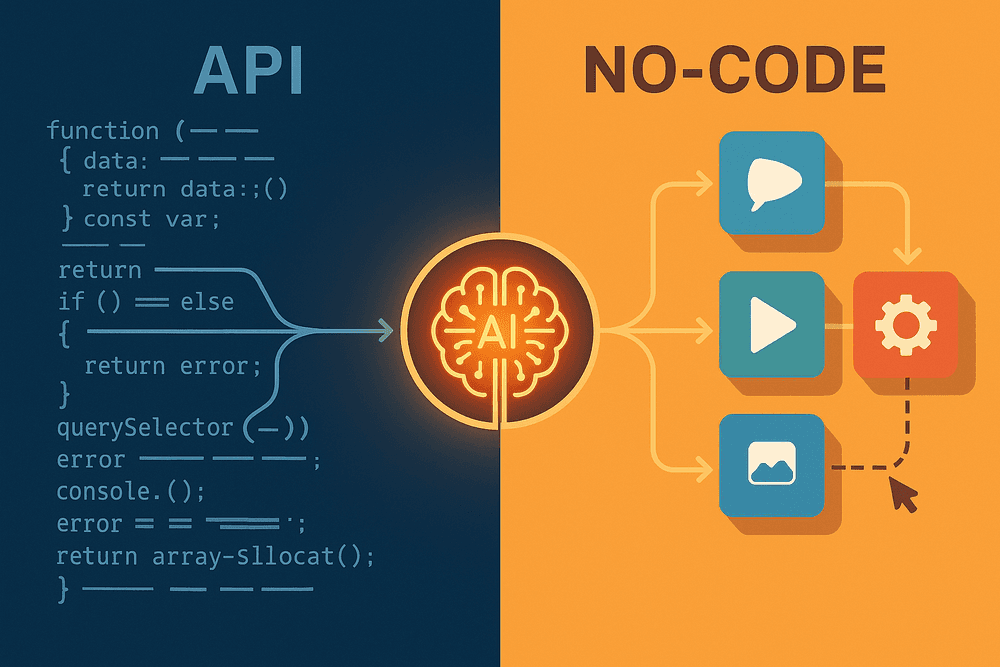
Once you’ve decided to harness the power of AI, the next critical question is how. Your approach to ai integration will fundamentally shape your project's timeline, budget, and capabilities. Broadly, you have two primary paths: working directly with AI models via APIs or using intermediary low-code/no-code platforms. Each path offers distinct advantages and is suited for different goals.
The Direct Route: API-Based AI Integration
Think of an API (Application Programming Interface) as a direct line to the AI model's brain. Companies like OpenAI, Google AI, and Anthropic provide APIs that allow your developers to send requests and receive AI-generated responses directly within your own software. This method is the foundation for creating deeply embedded and custom AI features.
Advantages:
- Maximum Customization: With direct API access, you have granular control. You can fine-tune model behavior, engineer complex prompts, and build a user experience that is perfectly tailored to your application’s unique needs.
- Seamless User Experience: AI features can be woven directly into your existing software, feeling like a natural, native part of the product rather than a bolted-on component.
- Ultimate Scalability: While requiring careful engineering, an API-based ai integration is built for scale. You can design infrastructure to handle millions of requests, optimizing for performance and cost as you grow.
Considerations: This path requires significant technical expertise. You'll need developers comfortable with reading API documentation, handling authentication, managing data securely, and building a resilient application architecture.
The Fast Track: Low-Code/No-Code AI Integration Platforms
If APIs are the raw ingredients, platforms like Zapier, Make, and n8n are the meal-kit delivery services. These platforms act as powerful intermediaries, connecting the apps you already use (like Slack, Google Sheets, or your CRM) with powerful AI models through a user-friendly, visual interface. You can build sophisticated workflows by simply dragging and dropping modules and connecting them.
Advantages:
- Speed and Accessibility: This is the fastest way to get started. You can build and deploy a functional ai integration in a matter of hours, often without writing a single line of code. This empowers non-technical team members to automate their own workflows.
- Vast Ecosystem: These platforms come with thousands of pre-built connectors, making it incredibly easy to link various services together in a chain of automated actions.
- Lower Initial Cost: For straightforward tasks and lower volumes, a subscription to one of these platforms can be more predictable and cost-effective than hiring a development team.
Considerations: The trade-off for speed is a loss of control. You are limited by the actions and triggers the platform provides, and deep customization can be difficult or impossible.
Making the Right Choice: Key Factors to Consider
So, which path is right for you? The decision hinges on three key factors:
- Technical Expertise: Do you have an in-house development team or the budget to hire one? If yes, the power of a direct API integration is at your fingertips. If not, a no-code platform is your most effective starting point.
- Cost: API costs are typically usage-based (pay-per-token), which can be extremely efficient at scale but requires an upfront development investment. Platforms use a predictable subscription model, which is great for starting but can become expensive as your usage and complexity grow.
- Scalability and Complexity: Are you automating a simple, linear task, like summarizing meeting notes and sending them to Slack? A platform is perfect for that. Are you building a core product feature that needs to handle thousands of concurrent users with complex logic? An API-based approach is the only way to ensure long-term performance and flexibility.
A Practical Guide to API-Based AI Integration
Transitioning from theory to practice is where the real power of AI integration is unlocked. API-based integration provides a streamlined, accessible path to embedding advanced AI capabilities directly into your existing systems without building models from scratch. This guide breaks down the process into actionable steps, from identifying opportunities to ensuring a robust and secure implementation.
Step 1: Identifying Key Processes for AI Enhancement
Before writing a single line of code, the first step in any successful AI integration project is to identify the right business processes to augment. Look for areas characterized by:
- Repetitive, high-volume tasks: Think summarizing meeting notes, categorizing customer support tickets, or generating routine social media updates.
- Data-intensive analysis: AI can rapidly analyze large datasets to identify trends, forecast sales, or detect anomalies in user behavior that would take a human analyst hours.
- Enhanced customer interaction: Automating initial customer queries with intelligent chatbots or personalizing marketing content at scale are prime candidates.
Start with a process that offers high impact but has relatively low complexity. A quick win will build momentum and demonstrate the value of AI to your organization.
Step 2: Selecting the Right AI Model and API
With your use case defined, the next task is choosing the appropriate AI model and its corresponding API. The market is filled with powerful options, each with unique strengths:
- Large Foundational Models: Providers like OpenAI (GPT series), Google (Gemini), and Anthropic (Claude) offer versatile, powerful APIs suitable for complex reasoning, content creation, and sophisticated analysis. They are excellent for general-purpose tasks.
- Specialized and Open-Source Models: Platforms like Hugging Face or Replicate provide access to thousands of models, including open-source alternatives (e.g., Llama, Mistral) and those fine-tuned for specific tasks like code generation or multilingual translation.
When selecting, consider factors like cost per API call, performance (speed and accuracy), the quality of the API documentation, and the provider's scalability to ensure it can grow with your needs.
Step 3: Making Your First API Call and Handling Data Securely
An API (Application Programming Interface) call is simply a structured request sent to the AI provider's server, which then returns a response. The core components include:
- API Key: A unique secret token that authenticates your requests. Never expose this in your client-side code; store it securely as an environment variable.
- Endpoint: The specific URL for the AI service you want to use (e.g., a text completion endpoint).
- Payload: The data you send, typically in JSON format. This includes the model you're using, your prompt, and other parameters like
temperature(creativity) ormax_tokens(response length).
Data security is paramount. When handling data in your AI integration, always anonymize or remove Personally Identifiable Information (PII) before sending it to a third-party API. Carefully review the provider's data privacy and usage policies to ensure they align with your compliance requirements.
Best Practices for Error Handling and Monitoring
A production-ready AI integration must be resilient. API calls can fail for various reasons, such as network issues, invalid requests, or exceeding rate limits. Implement robust error handling by:
- Using try-catch blocks to gracefully manage failed requests.
- Implementing retry logic with exponential backoff for transient errors (e.g., temporary server unavailability).
- Logging errors to understand what went wrong and why.
Furthermore, continuously monitor your integration. Track key metrics like API call frequency, costs, latency (response time), and the quality of the AI's output. This data is invaluable for optimizing performance, managing budgets, and ensuring your AI-powered feature delivers consistent value.

Real-World Examples of Successful AI Integration
The theoretical benefits of AI are compelling, but its true power is revealed through practical application. Across industries, companies are moving beyond standalone AI tools and leveraging strategic AI integration to transform core business functions. By embedding intelligent capabilities directly into existing workflows and platforms, businesses are unlocking new levels of efficiency and insight. Let's explore three powerful, real-world examples where this technology is already making a significant impact.
Automating and Elevating Customer Support
Customer support is a prime area for successful AI integration. Modern support teams are under constant pressure to deliver fast, accurate, and 24/7 assistance. By integrating AI-powered chatbots and virtual assistants directly into platforms like Zendesk, Salesforce Service Cloud, or a company website, businesses can automate a significant portion of their support load.
Through API-based connections, these AI agents can access knowledge bases and customer data to provide instant, context-aware answers to common inquiries such as "Where is my order?" or "How do I reset my password?" This immediate response capability dramatically improves customer satisfaction and reduces wait times. More importantly, this AI integration frees up human agents to focus their expertise on complex, high-value, or emotionally charged customer issues that require a human touch. The AI handles the routine, while humans manage the relationships.
Streamlining Marketing Content Creation with Integrated AI Assistants
The demand for high-quality marketing content is relentless. To keep up, marketing teams are integrating generative AI assistants into their content management systems (CMS) and digital marketing platforms. Instead of using a separate AI tool and copying the output, marketers can now leverage embedded AI directly within their familiar environments like WordPress, HubSpot, or a custom-built content editor.
This deep AI integration acts as a creative co-pilot. An AI assistant can help brainstorm blog post ideas, generate initial drafts, write compelling ad copy variations for A/B testing, or craft engaging social media posts tailored to different platforms. For example, a content marketer could highlight a paragraph of a whitepaper and ask the integrated AI to instantly turn it into a tweet thread or a concise email summary. This not only accelerates the content creation pipeline but also ensures brand consistency and allows marketers to dedicate more time to strategy and campaign analysis.
Enhancing Data Analysis and Business Intelligence
Businesses today are data-rich but often insight-poor. Traditional Business Intelligence (BI) dashboards are excellent at showing what happened in the past, but AI integration is transforming them into forward-looking decision-making engines. Companies are embedding machine learning models and natural language processing (NLP) capabilities directly into BI platforms like Tableau, Power BI, and Looker.
With this integration, users can move beyond static charts. They can ask questions in plain English, such as "What were the key drivers of sales growth in the last quarter?" and receive an AI-generated analysis complete with visualizations. Furthermore, predictive models can be integrated to forecast future trends based on historical data. A retail company, for instance, can use this AI integration to analyze real-time sales data and automatically predict inventory needs for each store, preventing stockouts and optimizing cash flow. This turns data analysis from a reactive reporting function into a proactive, strategic advantage.
Best Practices for a Seamless AI Integration Strategy
A successful AI integration is more than a technical achievement; it's a strategic business transformation. Simply plugging in an API is not enough. To truly unlock value and ensure long-term success, you need a thoughtful approach that balances innovation with practicality. Adopting these best practices will help you navigate the complexities of implementation, mitigate risks, and maximize your return on investment.
Start Small: The Power of a Pilot Project
The most effective way to begin your AI integration journey is with a focused pilot project. Instead of attempting a company-wide overhaul, identify a specific, high-impact business problem that AI can solve. This "start small, think big" approach serves several critical functions:
- Proves Value: A successful pilot provides a tangible proof-of-concept, demonstrating the real-world benefits of AI to stakeholders and securing buy-in for larger-scale projects.
- Minimizes Risk: It allows you to experiment in a controlled environment, identifying potential challenges with data, workflows, and technology before committing significant resources.
- Builds Momentum: An early win, even a small one, generates enthusiasm and builds confidence within your team, creating a positive foundation for future AI integration initiatives.
Choose a project with clear, measurable goals—such as automating a repetitive manual task or improving the accuracy of a specific forecast.
Ensure Data Privacy and Ethical AI Use
As you integrate AI into your workflows, you are also assuming responsibility for how it uses data and makes decisions. Trust is paramount. A robust AI integration strategy must have a strong ethical framework and prioritize data privacy from day one.
- Data Governance: Establish clear policies for data collection, storage, and access. Ensure you are compliant with regulations like GDPR and CCPA. Anonymize sensitive data wherever possible.
- Transparency and Explainability: Strive to understand how your AI models arrive at their conclusions. For critical applications, avoid "black box" models where the decision-making process is opaque.
- Bias Mitigation: Actively audit your data and models for inherent biases that could lead to unfair or discriminatory outcomes. A diverse team can help identify and correct these potential pitfalls.
Train Your Team to Work Alongside AI
The goal of AI integration is not to replace your team but to augment their capabilities. However, this human-AI collaboration requires deliberate training and cultural adaptation.
- Demystify AI: Host workshops and provide resources that explain what the new AI tools do and, just as importantly, what they don't do. Alleviate fears by focusing on how AI will handle tedious tasks, freeing up employees for more strategic, creative work.
- Develop New Skills: Invest in upskilling your workforce. Employees will need to learn how to effectively prompt AI, interpret its outputs, and manage the new AI-powered workflows.
- Foster a Culture of Experimentation: Encourage your team to explore the new capabilities and provide feedback. Create a safe environment where they can learn and adapt without fear of failure.
Measure ROI: How to Track Success
To justify continued investment, you must be able to measure the impact of your AI integration. Define your Key Performance Indicators (KPIs) before you launch your pilot and track them consistently. The ROI of AI isn't always purely financial. Consider a mix of metrics, including:
- Efficiency Gains: Measure reductions in the time or resources required to complete tasks.
- Cost Savings: Track direct savings from automation and optimized processes.
- Quality and Accuracy: Monitor reductions in error rates or improvements in output quality.
- Customer Satisfaction (CSAT): Measure the impact on customer experience, such as faster response times or more personalized service.
- Employee Engagement: Survey your team to gauge how the new tools are affecting their job satisfaction and daily work.
Conclusion: Your Next Steps in AI Integration
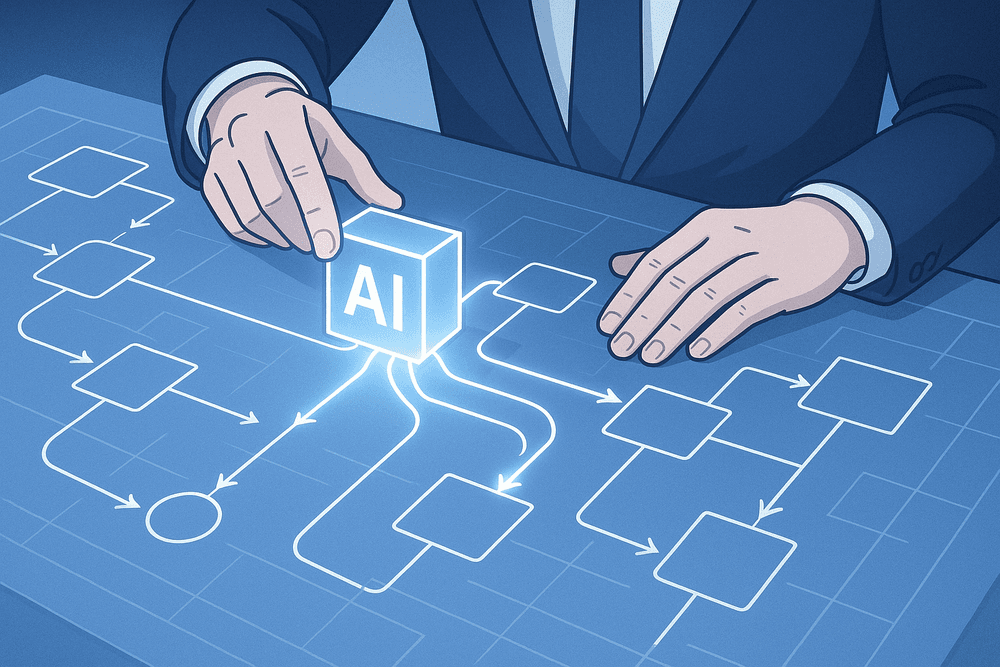
You've explored the what, why, and how of integrating artificial intelligence into your business. The journey from concept to execution is no longer a monumental leap but a series of strategic, achievable steps. A successful AI integration isn't about overhauling your entire operation overnight; it's about smartly embedding intelligent capabilities into your existing workflows to unlock new levels of productivity and innovation. The key is to begin now, armed with a clear strategy and the right tools.
Recapping Your AI Integration Blueprint
As we've covered, a powerful AI integration strategy is built on a solid foundation. Before you move forward, let's revisit the core principles for success:
- Start with the Problem, Not the Tech: The most effective AI solutions solve real business challenges. Identify a specific pain point or opportunity—like enhancing customer service or automating data analysis—before you even consider a specific tool.
- Leverage API-Based Integration: For most businesses, API-based methods offer the fastest and most flexible path to integrating sophisticated AI capabilities. This approach allows you to connect to powerful, pre-trained models without needing a dedicated team of machine learning PhDs.
- Choose the Right Platform: Your choice of AI platform or service provider is critical. Evaluate options based on their specific capabilities, documentation, scalability, pricing, and commitment to data security and ethics.
- Prioritize Data and Security: Your data is the fuel for any AI system. Ensure you have robust data governance, privacy policies, and security protocols in place from day one to build a trustworthy and effective AI-powered ecosystem.
- Think Big, Start Small, Scale Fast: Begin with a manageable pilot project to demonstrate value and build momentum. Learn from this initial implementation, iterate, and then scale the successful AI integration across other parts of your organization.
Launch Your First AI Integration Project Today
Theory is powerful, but action creates results. Here’s a simple, four-step plan to kickstart your first AI integration project this week:
- Identify a Quick Win: Find a high-impact, low-risk process. Could you integrate an NLP API to automatically categorize incoming support tickets? Or use a vision API to tag product images? Choose a project where success is easy to measure.
- Assemble a Lean Team: You don't need a massive task force. A project lead, a developer familiar with APIs, and a business stakeholder who "owns" the problem area is a perfect starting trio.
- Explore an AI Sandbox: Most major AI providers (like OpenAI, Google Cloud AI, or Microsoft Azure AI) offer free tiers or trial credits. Use their developer sandboxes to experiment with API calls and see how the technology works with your sample data.
- Define Your Success Metric: How will you know it worked? Decide on one key performance indicator (KPI) to track, such as "reduce ticket resolution time by 15%" or "increase marketing email click-through rate by 5%."
Staying Ahead of AI Integration Trends
The world of AI is evolving at an unprecedented pace. Staying current is essential for maintaining your competitive edge.
- Follow Key Resources: Subscribe to newsletters from major AI labs and tech publications. Regularly visit the official blogs of platforms like Google AI, AWS, and OpenAI for product updates and case studies.
- Join the Community: Participate in professional networks on LinkedIn, forums, or developer communities like Stack Overflow and GitHub. These are invaluable for practical advice and real-world insights into AI integration challenges and solutions.
- Embrace Continuous Learning: Encourage a culture of experimentation within your team. Allocate time for developers and strategists to explore new AI APIs and models as they are released. The landscape of AI integration is dynamic, and the most successful organizations are those that learn and adapt continuously.