
July 30, 2025
The Urgent Need for AI Bias Mitigation Strategies
The Urgent Need for AI Bias Mitigation Strategies
Artificial intelligence is no longer a futuristic concept; it's a core component of modern business, powering everything from hiring decisions and loan applications to medical diagnoses and customer service. But as we integrate AI deeper into our operations, a critical challenge emerges: algorithmic bias. Left unchecked, this bias can undermine your technology, expose your business to significant risk, and erode the very trust you’ve worked to build with your customers. This makes developing and implementing AI bias mitigation strategies not just an ethical imperative, but a business necessity.
What is Algorithmic Bias and Where Does It Come From?
Algorithmic bias occurs when an AI system produces results that are systematically prejudiced due to flawed assumptions in the machine learning process. It's not that the AI is intentionally "thinking" in a biased way; rather, it's learning and replicating biases present in the data and design choices it was given. The primary sources include:
- Data Bias: This is the most common culprit. If the data used to train an AI model reflects historical or societal biases, the AI will learn and perpetuate them. For instance, an AI recruiting tool trained on a decade's worth of data from a male-dominated industry might learn to penalize resumes that include words associated with female applicants, regardless of their qualifications.
- Human Bias: The developers, data scientists, and business leaders who create AI systems carry their own unconscious biases. These can influence how data is collected, which features are considered important, and how the model's success is defined, inadvertently embedding prejudice into the algorithm.
- Algorithmic Bias: The design of the algorithm itself can sometimes introduce or amplify bias. Certain complex models might find and exploit subtle, unintended correlations in the data, leading to skewed outcomes for specific demographic groups.
The High Cost of Inaction: Why Ignoring AI Bias is a Risk
Thinking of bias as a minor technical glitch is a costly mistake. Without effective AI bias mitigation strategies, businesses face a perfect storm of risks:
- Reputational Damage: High-profile failures, such as facial recognition software that misidentifies people of color or automated loan systems that discriminate against women, can lead to public outrage and a permanent loss of customer trust.
- Legal and Regulatory Penalties: Governments worldwide are enacting stricter regulations around AI fairness, like the EU AI Act. A biased algorithm can result in hefty fines and legal action for discrimination, creating significant compliance liabilities.
- Poor Business Outcomes: A biased AI is an inaccurate AI. It fails to perform its core function properly. It might overlook top talent, deny credit to creditworthy individuals, or misjudge market segments, directly harming operational efficiency and your bottom line.
A Quick Overview of the Path to Ethical AI
Addressing this challenge requires moving beyond simple awareness to active intervention. The path to ethical AI is a continuous process built on a commitment to fairness and accountability. This journey involves several key stages, starting with establishing clear governance and moving towards the practical implementation of AI bias mitigation strategies. The core of this process involves three phases of the AI lifecycle:
- Pre-processing: Correcting bias in the training data before the model is even built.
- In-processing: Modifying the learning algorithm itself to reduce bias during the training phase.
- Post-processing: Adjusting the model's predictions after they are made to ensure fairer outcomes.
By understanding these risks and embracing a structured approach, you can begin to build AI systems that are not only powerful but also fair, equitable, and worthy of trust.
How to Identify Bias: Key Detection Techniques and Tools
You can’t mitigate a problem you can't identify. The first step in any effective set of ai bias mitigation strategies is a robust detection and measurement process. This isn’t a one-time check but a continuous effort that spans the entire machine learning lifecycle. By breaking down detection into three phases—pre-processing, in-processing, and post-processing—teams can build a comprehensive defense against unfair algorithmic outcomes.
Pre-processing: Auditing Your Training Data for Hidden Biases
Bias often originates in the data itself, long before a model starts learning. Pre-processing detection focuses on interrogating your dataset to uncover these hidden issues. If your data is flawed, your model is destined to be flawed.
Key auditing activities include:
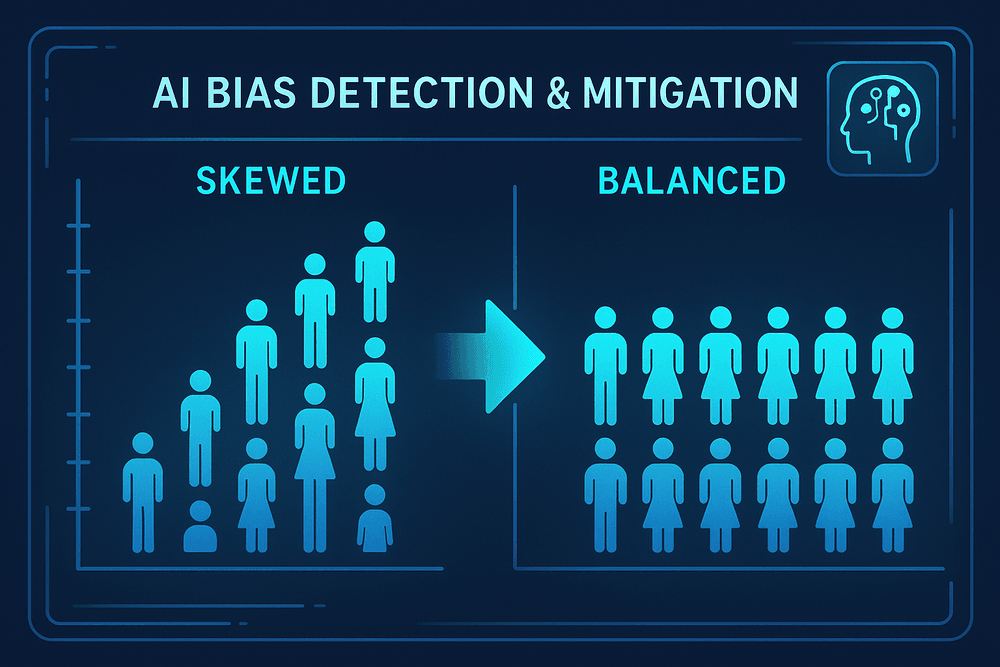
- Representation Analysis: Check for imbalances in how different demographic groups are represented. For example, is your facial recognition dataset predominantly composed of one ethnicity? Use data visualizations and statistical counts to identify underrepresented subgroups.
- Historical Bias Discovery: Your data is a snapshot of the world, and the world has existing biases. Loan application data, for instance, may reflect historical redlining practices. Scrutinize data sources and features for encoded societal biases that could be perpetuated or amplified by your model.
- Label Skew: Examine the distribution of labels across different groups. Are "approved" labels for a loan model disproportionately assigned to one gender over another, even when controlling for other factors?
In-processing: Techniques for Monitoring Model Behavior During Training
In-processing techniques involve modifying the learning algorithm itself to reduce bias as the model is being trained. This is a proactive approach that steers the model towards fairness by making it a core part of the optimization process.
Common in-processing methods include:
- Fairness Constraints: You can add a penalty term to the model’s objective (or loss) function. This penalty increases if the model produces biased outcomes for different groups, forcing the algorithm to find a balance between accuracy and fairness.
- Adversarial Debiasing: This advanced technique involves training two models simultaneously. The primary model makes predictions (e.g., loan eligibility), while a second "adversary" model tries to guess a sensitive attribute (e.g., race) from the first model’s predictions. The primary model is trained to fool the adversary, effectively learning to make predictions that are independent of the sensitive attribute.
Post-processing: Evaluating Model Outputs for Fairness Metrics
After a model is trained, you must evaluate its predictions for fairness. Post-processing involves analyzing the model's outputs and sometimes adjusting them to improve equity, without needing to retrain the entire model. This is where fairness metrics become essential. Popular metrics include:
- Demographic Parity: Ensures that the likelihood of a positive outcome is the same for all groups.
- Equal Opportunity: Ensures that the true positive rate is the same for all groups. For example, all qualified applicants should have an equal chance of being correctly identified.
- Equalized Odds: A stricter metric requiring that both the true positive rate and the false positive rate are equal across groups.
Comparing Fairness Toolkits: Your AI Bias Detection Arsenal
Fortunately, you don’t have to build these detection systems from scratch. Several powerful open-source toolkits can accelerate and standardize your fairness assessments.
IBM AI Fairness 360 (AIF360)
This is a comprehensive, research-grade library offering an extensive collection of over 70 fairness metrics and more than 10 bias mitigation algorithms. It covers all three processing stages, making it an excellent choice for deep, end-to-end fairness analysis.
Google's What-If Tool (WIT)
WIT is a highly visual and interactive tool that integrates with TensorBoard and Jupyter notebooks. It excels at building intuition by allowing you to probe model performance on subsets of data and simulate "what-if" scenarios by editing data points. It’s perfect for exploring model behavior and communicating findings to non-technical stakeholders.
Fairlearn
Backed by Microsoft, Fairlearn is a user-friendly Python package designed for practical application. It integrates seamlessly with popular frameworks like Scikit-learn and focuses on helping developers assess and mitigate group fairness issues, making it one of the most accessible ai bias mitigation strategies and toolkits for operationalizing ethics.
A Deep Dive into Core AI Bias Mitigation Strategies
Effectively tackling algorithmic unfairness requires a toolkit of robust AI bias mitigation strategies that can be applied at various stages of the machine learning lifecycle. These interventions are typically grouped into three main categories: pre-processing (acting on the data), in-processing (modifying the algorithm), and post-processing (adjusting the model’s output). Understanding each approach is crucial for building truly ethical AI systems.
Data-Level Strategies: Correcting Bias at the Source
The most intuitive place to fight bias is in the data itself. Since biased data often leads to biased models, these pre-processing techniques aim to correct imbalances before training even begins.
- Re-sampling: This strategy directly alters the composition of the training dataset to create a more balanced representation of different groups. It can be done in two ways: over-sampling, which duplicates instances from the underrepresented (minority) group, or under-sampling, which removes instances from the overrepresented (majority) group. For example, in a hiring dataset with few female applicants for a specific role, over-sampling would create copies of the existing female applicant profiles to balance their representation.
- Re-weighing: A less intrusive alternative to re-sampling, re-weighing involves assigning different weights to data points during model training. Instead of changing the dataset, you instruct the algorithm to pay more attention to the underrepresented group. Data points from a minority group are given a higher weight, increasing their influence on the model’s learning process and mitigating the dominance of the majority group.
- Data Augmentation: This technique involves creating new, synthetic data points for the minority class to enrich the dataset. For image recognition, this could mean rotating, cropping, or altering the colors of existing images of an underrepresented group. For text, it might involve replacing words with synonyms or using back-translation (translating text to another language and back) to create new sentence variations.
Algorithmic-Level Strategies: Building Fairness into the Model
In-processing methods modify the learning algorithm itself to reduce bias during the training phase. These are often more complex but can be highly effective AI bias mitigation strategies.
- Adversarial Debiasing: This advanced technique sets up a "game" between two neural networks. The first network, the "predictor," works to make accurate predictions (e.g., whether to approve a loan). The second network, the "adversary," simultaneously tries to guess a sensitive attribute (e.g., race or gender) based on the predictor's output. The predictor is then trained not only to be accurate but also to "fool" the adversary, forcing it to learn representations that are free from information about the sensitive attribute.
- Regularization: This involves adding a penalty term to the model's objective function. In the context of fairness, this penalty discourages the model from relying on features that are correlated with sensitive attributes. By penalizing bias during training, regularization guides the model toward making decisions based on more equitable and relevant factors.
Post-Training Strategies: Adjusting for Fairness After the Fact
When you cannot alter the training data or the algorithm—perhaps because you are using a pre-trained model—post-processing strategies offer a final opportunity to promote fairness by adjusting the model’s outputs.
- Calibrating Outputs for Equitable Outcomes: This technique involves modifying the model’s prediction scores after they are generated. For instance, if a fraud detection model has a different error rate for different demographic groups, you can apply different decision thresholds for each group. By setting a lower threshold for a group that is being unfairly flagged, you can equalize the false positive rate, ensuring the model's impact is more equitable across populations.

Best Practices for Implementing AI Bias Mitigation
Moving from theory to practice requires a deliberate and structured approach. Effective ai bias mitigation strategies are not a final checklist but an ongoing commitment woven into the entire AI lifecycle. By adopting a proactive stance, organizations can build systems that are not only powerful but also fair, accountable, and trustworthy. Here are the core best practices to guide your implementation.
Assemble Diverse and Inclusive AI Development Teams
The most fundamental strategy for mitigating bias begins with people. A homogenous team, regardless of its technical skill, will inevitably share blind spots and unconscious assumptions. These can easily be encoded into AI models, perpetuating real-world inequities.
Building a diverse and inclusive team is the first line of defense. This means incorporating a wide range of perspectives across:
- Demographics: Gender, race, ethnicity, age, and physical ability.
- Experience: Different life experiences, cultural backgrounds, and socioeconomic histories.
- Expertise: Including sociologists, ethicists, and domain experts alongside data scientists and engineers.
A diverse team is better equipped to question assumptions, challenge data interpretations, and foresee potential negative impacts on various communities. This collaborative friction is essential for identifying and addressing algorithmic bias before a model is ever deployed.
Establish a Continuous Feedback Loop for Model Monitoring
Launching an AI model is the beginning, not the end, of the fairness journey. Bias is not a static problem; it can emerge or intensify over time as data patterns shift and user interactions evolve—a phenomenon known as model or data drift.
A continuous feedback loop is crucial for post-deployment governance. This involves:
- Ongoing Audits: Regularly test the model’s outputs against pre-defined fairness metrics (e.g., demographic parity, equal opportunity). Don't just track accuracy; track fairness.
- Real-World Feedback: Create clear channels for end-users, especially those from marginalized groups, to report perceived bias or unfair outcomes.
- Iterative Refinement: Use the insights from monitoring and user feedback to retrain and fine-tune the model. This active management ensures that your ai bias mitigation strategies remain effective in a dynamic environment.
Champion Transparency and Explainability (XAI)
You cannot fix what you cannot understand. "Black box" models, whose inner workings are opaque, are a significant barrier to identifying and rectifying bias. This is where transparency and Explainable AI (XAI) become indispensable.
- Transparency provides insight into the data, algorithms, and processes used to build and train the model.
- Explainability focuses on making a model's individual predictions understandable to a human. Techniques like SHAP (SHapley Additive exPlanations) and LIME (Local Interpretable Model-agnostic Explanations) can help illustrate why a model made a specific decision.
By embracing XAI, you empower developers to debug models for fairness issues and provide stakeholders with the clear rationale behind automated decisions, which is a cornerstone of building trust.
Document Your AI Bias Mitigation Strategies for Compliance and Trust
Thorough documentation is the bedrock of accountability. It serves the dual purpose of preparing for regulatory scrutiny and demonstrating a transparent commitment to ethical AI for your customers and the public.
Your documentation should be a living record that includes:
- Data Provenance: The sources of your training data and any steps taken to clean, balance, or augment it.
- Fairness Metrics: Which fairness metrics were chosen, the rationale for choosing them, and the results of bias audits conducted.
- Mitigation Techniques: A clear description of the specific bias mitigation techniques applied during model development or training.
- Known Limitations: An honest assessment of the model's potential weaknesses and the contexts in which it should not be used.
This detailed record proves due diligence, simplifies compliance with emerging regulations like the EU AI Act, and builds a powerful case for why your organization can be trusted to develop AI responsibly.
Real-World Use Cases: AI Bias Mitigation Success Stories
While the challenge of algorithmic bias is significant, the field is rapidly advancing. Many organizations are now successfully implementing AI bias mitigation strategies to create fairer and more effective systems. These success stories demonstrate that ethical AI is not just an ideal but an achievable reality. Let's explore a few powerful real-world examples.
Case Study: Achieving Fair Lending Decisions in FinTech
The Problem: A prominent financial technology company deployed a new AI model to automate loan application approvals. While the model was highly accurate based on historical data, an internal audit revealed it was disproportionately denying loans to applicants from specific geographic zip codes, which correlated strongly with minority communities. The AI had learned to associate these areas with higher risk, perpetuating historical economic biases present in the training data.
The Strategy: The company adopted a multi-pronged mitigation approach.
- Data Re-weighting: They adjusted the training dataset to give more weight to underrepresented, creditworthy applicants from the affected zip codes.
- Fairness-Aware Algorithms: They integrated an algorithm designed to optimize for both accuracy and fairness, specifically monitoring for "disparate impact"—a key metric in fair lending regulations.
- Explainable AI (XAI): They implemented XAI tools to make the model’s decisions transparent. This allowed human loan officers to review and understand the key factors behind any rejection, providing a crucial human-in-the-loop oversight mechanism.
The Outcome: The revised model maintained high accuracy while significantly reducing the approval gap between demographic groups. The company not only achieved compliance with fair lending laws but also unlocked a new market of creditworthy customers, improving both its ethical standing and its bottom line.
Case Study: Reducing Gender Bias in Hiring and Recruitment AI
The Problem: A global tech corporation was using an AI tool to screen résumés for software engineering roles. The tool consistently ranked male candidates higher than female candidates, even when qualifications were nearly identical. The root cause was a dataset trained on decades of the company's own hiring history, which was heavily male-dominated. The AI had incorrectly learned that male-associated terms and experiences were predictors of success.
The Strategy: The HR and data science teams collaborated on targeted AI bias mitigation strategies.
- Bias Detection: They used advanced tools to audit the model, identifying specific words (e.g., "women's chess club captain" vs. "chess club captain") and phrases that were causing the gendered skew.
- Data Augmentation & Masking: They neutralized the training data by masking gender-specific pronouns and names. They also used counterfactual data augmentation to create mirrored, gender-swapped versions of résumés to teach the model to focus solely on skills and experience.
The Outcome: After redeployment, the AI tool provided gender-neutral candidate rankings. This led to a 15% increase in the number of women who were passed to the interview stage. The company reported a more diverse talent pipeline and a stronger ability to hire the best person for the job, irrespective of gender.
Case Study: Ensuring Equitable Public Service Allocation
The Problem: A major city implemented an AI system to predict which neighborhoods were most at risk of 311 service requests (e.g., broken streetlights, potholes) to proactively allocate maintenance resources. The model inadvertently favored wealthier neighborhoods because residents there historically reported issues more frequently and via digital channels the AI could easily process. As a result, lower-income areas were being underserved.
The Strategy: The city's data science office worked with urban planners and community leaders to correct the bias.
- Feature Engineering: They enriched the model's data with census information on income levels, access to technology, and past service records to provide crucial context.
- Fairness Constraints: They applied a "demographic parity" constraint during model training. This forced the model to allocate service predictions more evenly across different socioeconomic strata, ensuring no single group was systematically ignored.
The Outcome: The new system led to a more equitable distribution of preventative maintenance crews across the entire city. This proactive approach improved public infrastructure in previously neglected neighborhoods, reduced long-term repair costs, and helped rebuild trust between the city government and its residents.

The Future of Ethical AI: Your Next Steps in Bias Mitigation
Navigating the complex landscape of ethical AI is an ongoing journey, not a final destination. As we've explored, building fairer systems requires a proactive and multi-faceted approach. The key takeaway is that there is no single "magic bullet" solution. Choosing the most effective ai bias mitigation strategies for your project depends entirely on your specific context, data sources, model architecture, and the real-world impact of your application. Whether you opt for pre-processing techniques to clean your data, in-processing methods to adjust the model during training, or post-processing tactics to calibrate outputs, the most robust solution often involves a thoughtful combination of these approaches. This commitment to continuous improvement is what separates truly responsible AI development from a mere compliance exercise.
To translate these principles into practice, you need a structured and repeatable process. The following checklist provides a framework for integrating fairness and ethics into every stage of your development lifecycle.
Your Checklist for a Responsible AI Pipeline
- Define Fairness from the Start: Before writing a single line of code, collaborate with stakeholders and domain experts to define what fairness and equity mean for your specific use case. Select and agree upon clear fairness metrics (e.g., demographic parity, equalized odds) that align with your goals.
- Conduct Thorough Data Audits: Move beyond basic data cleaning. Actively investigate your datasets for historical biases, representation gaps across demographic groups, and potentially discriminatory proxy variables.
- Select and Document Mitigation Techniques: Based on your audit and fairness metrics, choose the most appropriate ai bias mitigation strategies. Crucially, document not only what you implemented but also why you chose those specific techniques over others.
- Foster Diverse Development Teams: A homogenous team is more likely to have shared blind spots. Ensure your AI development and review teams are composed of individuals from diverse backgrounds, disciplines, and life experiences to challenge assumptions and identify potential biases.
- Implement Segmented Performance Testing: Don't rely on a single, top-line accuracy score. Rigorously test your model’s performance across different user subgroups to ensure it works equitably for everyone it affects.
- Establish Post-Deployment Monitoring: Bias is not a one-time fix. Implement a robust monitoring system to track your model's real-world performance and fairness metrics over time, watching for concept and data drift that could reintroduce bias.
- Maintain Transparency and Explainability: For high-stakes decisions, ensure your model’s outputs are interpretable. Build systems that can explain why a particular decision was made, and consider human-in-the-loop mechanisms for review and appeals.
How to Stay Updated on the Latest in Ethical AI
The field of responsible AI is evolving at a breakneck pace. Staying informed is essential for implementing the most effective and current best practices.
- Follow Leading Research Institutions: Keep an eye on publications from organizations like the AI Now Institute, Partnership on AI, and the Algorithmic Justice League. Academic conferences like FAccT (ACM Conference on Fairness, Accountability, and Transparency) are goldmines of cutting-edge research.
- Engage with Professional Communities: Join online forums, LinkedIn groups, or Slack channels dedicated to AI ethics and responsible technology. These communities are invaluable for asking questions and learning from the experiences of other practitioners.
- Explore Open-Source Toolkits: Get hands-on with tools like IBM's AI Fairness 360 and Google's What-If Tool. Experimenting with these frameworks is one of the best ways to build an intuitive understanding of how different mitigation techniques work in practice.